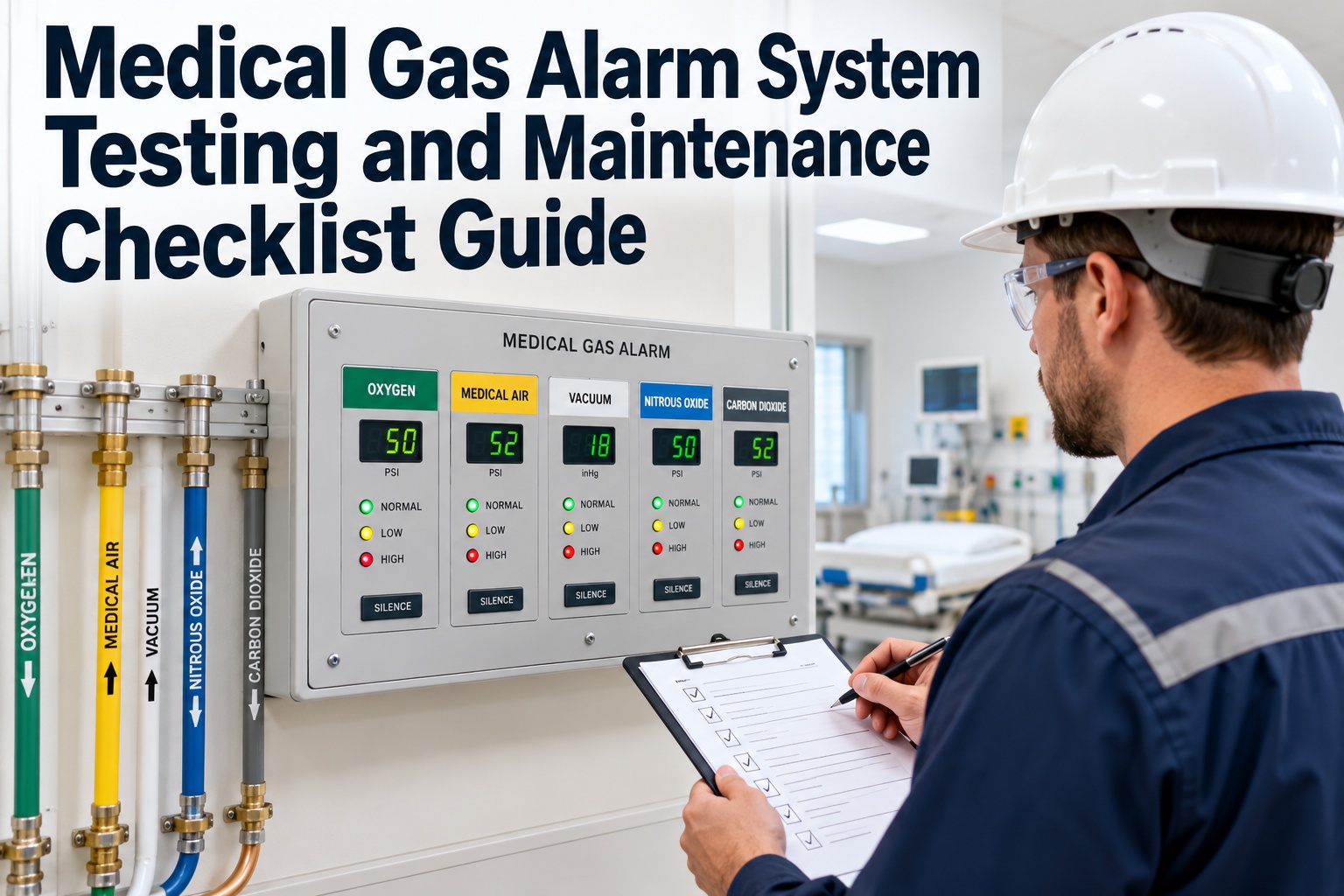
Medical gas alarms are the early-warning system for everything that keeps oxygen, medical air and vacuum flowing to patients. When a manifold is about to run dry or a line loses pressure, the alarm is what turns a developing failure into a few minutes of warning instead of a crisis at the bedside. Which means a silent or faulty alarm isn't a minor defect — it's the one failure that lets every other failure arrive unannounced. This checklist covers testing and maintaining the master, area and local alarms that watch your medical gas system. OXMAINT AI — the AI-powered maintenance management software — schedules every test, captures the results and turns a failed alarm into corrective work.
Healthcare · Medical Gas Alarms · Testing & Maintenance Checklist · 2026
Medical Gas Alarm Testing & Maintenance Checklist Guide
Master, area and local alarms are the medical gas system's warning layer — test them on schedule, document every result, and fix what fails. The OXMAINT AI maintenance management software keeps the schedule, the record and the corrective work in one place.
Master
Area
Local
Documented
Warning layer
a working alarm turns a supply failure into advance notice
Three types
master, area and local alarms each watch a different point
Tested & logged
every alarm condition proven and the result on record
Compliance
a documented trail for NFPA 99, the Joint Commission and your AHJ
The Three Types of Medical Gas Alarm
A medical gas system is watched at three levels, and each alarm type covers a different failure. Testing has to prove all three, because a gap at any level leaves part of the system unwatched; book a demo to see alarm testing scheduled in OXMAINT AI.
Level 1
Master alarms
Located at two continuously monitored points, they watch the source equipment — manifolds, compressors, vacuum pumps — and main-line pressure for every gas. They warn when the supply itself is in trouble, before it reaches any ward.
Level 2
Area alarms
Sited in patient-care zones — outside operating rooms, ICUs, recovery — they monitor line pressure for that area's gases and warn local staff the moment pressure drifts high or low where care is given.
Level 3
Local alarms
Tied to specific source equipment, they signal the operating condition of a manifold or pump — a changeover, a reserve in use — so a source problem is caught at the equipment before it becomes a system one.
The Alarm Testing & Maintenance Checklist
Routine visual checks keep the panels honest day to day; the full functional test proves every alarm condition on its interval. The chip on each line shows how often it's due; start free and put every check on a schedule in OXMAINT AI.
Frequency
DDaily / routine
QQuarterly
AAnnual functional test
Who tests what. Routine visual checks can be done by trained facilities staff; the full annual functional test of medical gas alarms is performed and documented by qualified, certified personnel to NFPA 99 and your authority having jurisdiction. Always follow NFPA 99, Joint Commission requirements and your facility's policy — this checklist is a planning aid, not a substitute for the code.
An Alarm Nobody Tested Is a Warning You May Never Get.
A medical gas alarm fails silently — you only learn it's dead when the supply fails and no one is warned. The OXMAINT AI maintenance management software schedules every test, captures the result against the panel, and raises corrective work the moment one fails — so the warning layer is proven, not assumed.
Why Alarm Maintenance Can't Slip
Medical gas alarms sit in the background until the day they matter — and that's exactly why they get overlooked. These are the stakes that make testing non-negotiable; book a demo to keep alarm testing on track in OXMAINT AI.
Patient safety
The alarm is the margin between a pressure loss caught in time and one that reaches a patient on oxygen or ventilation.
Compliance
NFPA 99, the Joint Commission and your AHJ expect documented alarm testing — and a surveyor will ask to see it.
Early warning
A working alarm buys the minutes to switch to reserve or manifold before a supply dips below what care needs.
Defensible record
A logged test per panel shows exactly what was proven, by whom and when — defensible if anything is ever questioned.
How OXMAINT AI Runs Medical Gas Alarm Maintenance
Alarm testing only protects patients when it actually happens on schedule and the results are somewhere a surveyor can see. Here's what the OXMAINT AI maintenance management software brings; start free and keep every alarm on a plan in OXMAINT AI.
Scheduled testing
Daily visual checks and annual functional tests on their own cadence per panel, so no alarm test quietly lapses.
Digital test records
Each alarm condition ticked and timestamped on a device, with who tested it — legible and complete every time.
Auto corrective work
A failed alarm becomes a work order at once, with the panel, zone and finding attached, so nothing stalls.
Compliance trail
A dated test history per panel and zone, ready to show NFPA 99 and Joint Commission surveyors on request.
Verifier records on file
Certification and third-party verification documents stored against the asset, not lost in a filing cabinet.
Full asset history
Every test, fault and repair on record per panel, so recurring alarm problems and weak points stand out.
“
Our medical gas alarms were tested once a year by a contractor, and in between nobody really watched them — we assumed a dead panel would be obvious, which it isn't. Putting daily panel checks and the annual test on a schedule, with the results logged per panel, closed that gap. When a surveyor asked for our alarm testing records, we pulled them up by zone in seconds instead of digging through a binder. And a failed low-pressure alarm now turns into a work order the same day, not whenever someone remembers.
Director of Facilities · Acute Care Hospital
Frequently Asked Questions
What are the three types of medical gas alarm?
Master alarms, at two continuously monitored locations, watch the source equipment and main-line pressure for every gas. Area alarms, in patient-care zones, monitor line pressure where care is given. Local alarms signal the operating condition of specific source equipment like a manifold or pump. Testing has to prove all three.
Start free and schedule all three.
How often should medical gas alarms be tested?
Trained staff do routine visual checks that panels show normal, typically daily, while a full functional test of every alarm condition is performed and documented at least annually by qualified, certified personnel. Your exact intervals follow NFPA 99, Joint Commission requirements and your authority having jurisdiction.
Who is qualified to test medical gas alarms?
Routine visual checks can be done by trained facilities staff, but the full functional verification is carried out by qualified, certified medical gas personnel and documented to code. The daily watching keeps panels honest between those formal tests; the annual verification is the one that proves every alarm condition works.
Book a demo to see testing scheduled.
What should a medical gas alarm test verify?
That every alarm condition triggers both the audible and visual signal, that sensors read true against a reference, that the silence-and-re-alarm function works, that backup power keeps the alarm live through a mains loss, and that labels correctly identify the zone and gases. Each result is recorded against the panel for the compliance trail.
How does a CMMS help with medical gas alarm compliance?
It schedules daily checks and the annual functional test per panel, captures each result digitally with who tested it, raises a corrective work order automatically on any failure, stores verifier certifications against the asset, and keeps a dated test history per panel and zone — so the record is ready for NFPA 99 and Joint Commission surveyors instead of scattered across binders.
Prove the Warning Layer — Before the Day It Has to Work.
Keep medical gas alarms tested and documented with the OXMAINT AI maintenance management software — scheduled checks and annual tests, digital records per panel, automatic corrective work, verifier certifications on file, and a compliance trail ready for any survey. Stop assuming the alarms work and start proving it.