A hospital fire sprinkler system has to work on the one night of the decade it is asked to. The only way to know it will is a documented inspection, testing and maintenance program under NFPA 25 — weekly gauges, monthly valves, quarterly flow switches, annual main drains, five-year obstruction investigations. Miss the cadence and the system is still there; miss the record and the Joint Commission writes it up. OXMAINT AI is the AI-powered CMMS and maintenance management software that holds every ITM task per riser, every reading timestamped, every deficiency routed and every five-year test logged — so compliance is a search, not a scramble.
HOSPITAL FIRE SPRINKLER · MAINTENANCE CHECKLIST · NFPA 25 · 2026
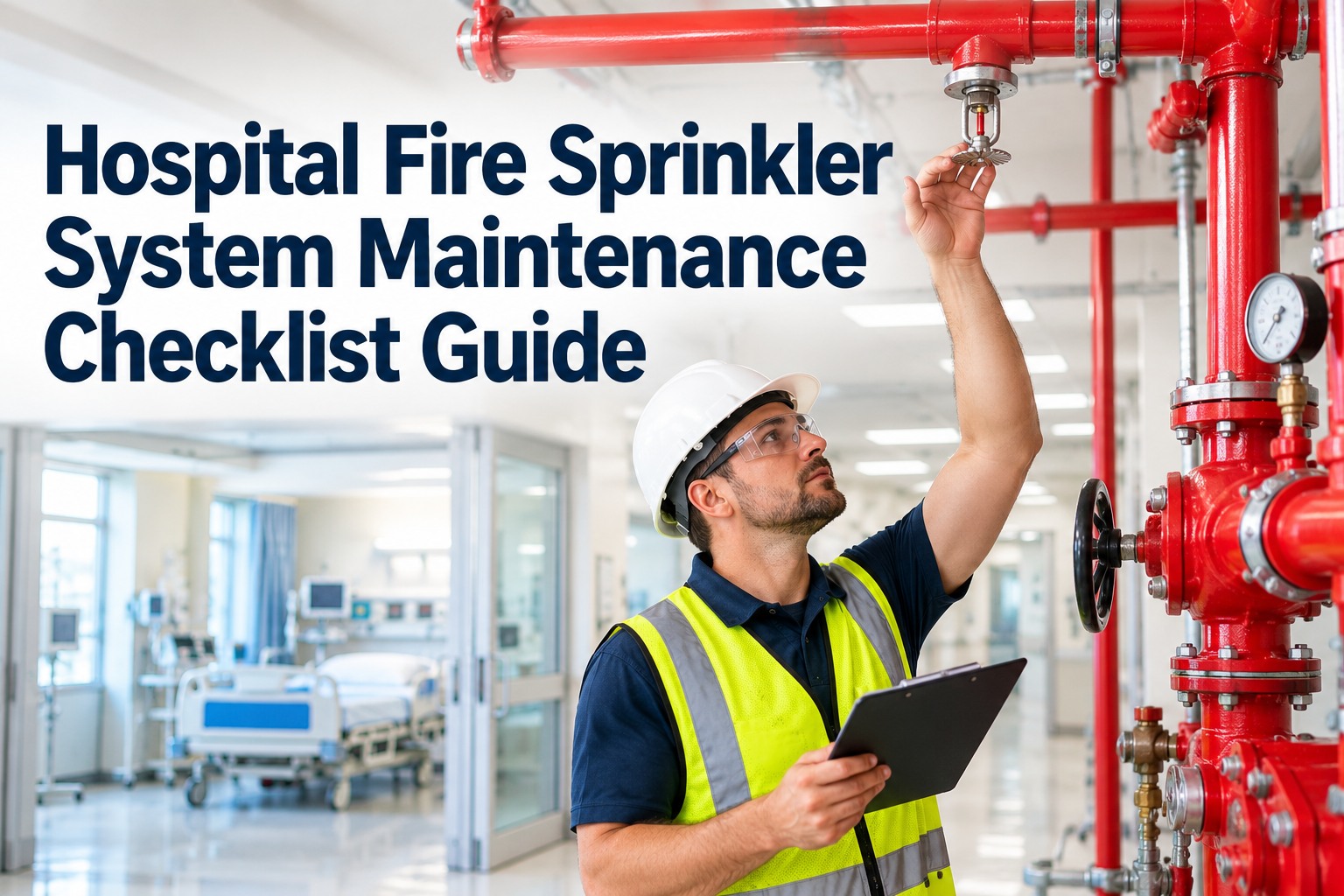
Hospital Fire Sprinkler System Maintenance Checklist Guide
Six frequency bands under NFPA 25 carry the whole hospital fire-sprinkler ITM program — weekly through five-year. Each one has specific tasks on specific components. The OXMAINT AI software auto-schedules every one against the riser or system, holds the checklist mobile for the facilities tech, and keeps the full ITM record ready for the next CMS or Joint Commission survey.
WWeekly
MMonthly
QQuarterly
SSemi-annual
AAnnual
55-year
NFPA 25
standard for the inspection, testing and maintenance of water-based fire protection systems
6
frequency bands cover the full ITM program (W / M / Q / S / A / 5-yr)
LS.02.01.35
Joint Commission standard requiring compliant fire-sprinkler ITM records in a hospital
1
missing annual main-drain record is enough to trigger a survey finding
The Six ITM Frequency Bands — What Each Covers
NFPA 25 organizes the whole ITM program around frequency. Each band has specific tasks that must be documented, timestamped and signed by the facilities technician. OXMAINT AI auto-raises each one as a recurring work order per riser or system — schedule a walkthrough of the NFPA 25 cadence in OXMAINT AI.
WEEKLY
Gauges & dry-pipe panels
Control-valve gauges, dry-pipe system air pressure, pre-action panel status. Visual walk by facilities.
MONTHLY
Control valves & FDC
All control valves in correct position (open and locked / sealed / tamper-switched), fire department connection caps and swivels.
QUARTERLY
Flow switches & alarms
Water-flow switch test, supervisory signals, hydraulic nameplate, inspector's test valve on each system.
SEMI-ANNUAL
Valve supervisory signals
Valve supervisory switches tested; tamper-switch continuity confirmed on every monitored control valve.
ANNUAL
Main drain, trip test, heads
Main drain flow test on each riser; dry-pipe trip test; visual sprinkler head inspection from floor level.
5-YEAR
Obstruction & internal
Internal inspection of piping; obstruction investigation if indicators present; gauge replacement or recalibration.
The Full ITM Checklist — Grouped by Frequency
Walk this on the agreed cadence per riser. Every box is a real native checkbox — filed in OXMAINT AI from a phone at the valve, timestamped to the system. Unchecked boxes block the system from "ITM current" status.
The System Doesn't Fail an Audit. The Record Does.
A compliant hospital fails fire-sprinkler findings almost entirely because the ITM record for a specific riser on a specific date doesn't exist in a form the surveyor can see. The OXMAINT AI software times every task to the risers, holds the signed record and makes the next survey a query, not a hunt.
Deficiency Categories — What Happens After an Unchecked Box
An unchecked ITM finding is not all equal. NFPA 25 defines three deficiency categories, each with a different response. OXMAINT AI routes each one automatically — critical deficiencies escalate; impairments trigger the impairment procedure under NFPA 25 Chapter 15.
NON-CRITICAL
Deficiency that does not reduce system functionality (e.g. missing nameplate, minor corrosion). Log, raise planned work order, repair at next cycle.
CRITICAL
Deficiency that materially reduces functionality but system still operates (e.g. painted sprinkler head, blocked FDC). Priority WO, repair within days.
IMPAIRMENT
System or part of system is out of service (closed valve, trip failure). NFPA 25 Chapter 15 impairment procedure — fire watch, AHJ and insurer notified.
The ITM Compliance Scorecard — One View Per Riser
Facilities leadership needs one view that answers: are our risers current, which bands are overdue, and which deficiencies are open? OXMAINT AI generates this from the ITM log directly — the monthly review is a glance, not a spreadsheet rebuild.
ITM SCORECARD · EAST TOWER · MONTH-END
R-04 Wet riser · 4th floorControl valve closed for maintenanceIMPAIRMENT · fire watch
R-07 Dry system · parkingAnnual trip test overdue 11 daysAnnual overdue
R-02 Wet riser · 2nd floorQuarterly flow test due this weekScheduled Thu
R-09 Pre-action · MRI suiteAll ITM currentOK
How OXMAINT AI Runs Hospital Fire-Sprinkler ITM
The frequency scheduler, mobile checklist, deficiency router, impairment procedure and compliance scorecard all live natively in the OXMAINT AI maintenance management software — spin up a free account and set up your riser register in OXMAINT AI.
Riser & System Register
Every riser, pre-action and dry system held with its NFPA 25 cadence and hydraulic nameplate reference.
Auto-Scheduled ITM
W / M / Q / S / A / 5-year tasks raised as recurring work orders — nothing drifts past the required frequency.
Mobile Checklist Capture
Native checkboxes filed at the valve or FDC; readings and photos timestamped to the riser.
Deficiency & Impairment Router
Non-critical / critical / impairment routed to the right queue; impairment triggers Chapter 15 fire-watch workflow.
Compliance Scorecard
Per-riser status rolled up to building, campus and system-wide view — the surveyor's question answered in one query.
Audit-Ready Record
Every ITM task, deficiency, impairment, trip test and gauge replacement retained for Joint Commission and CMS review.
Frequently Asked Questions
What is the single most-cited hospital fire-sprinkler finding?
When does an impairment procedure have to be followed?
Any time a sprinkler system or part of a system is out of service, including planned work — NFPA 25 Chapter 15 requires an impairment coordinator, fire watch (if required), notification of the AHJ, insurer and occupants.
Does this software replace our contracted inspection vendor?
No. Many hospitals use a licensed contractor for annual and 5-year tests. OXMAINT AI holds the contractor report against the riser so the record lives in one system alongside the in-house weekly and monthly checks.
How fast can we have ITM running?
Most hospitals load the riser list and the NFPA 25 cadence in two to three weeks per campus. Historical records can be imported so year-over-year main-drain trends are visible from day one.
Pass the Survey Because the Record Was Already Clean.
Put every hospital riser on the OXMAINT AI maintenance management software — NFPA 25 frequency enforced, mobile checklist filed at the valve, deficiency routed by category, impairment procedure triggered automatically, and the audit record ready for Joint Commission the day they arrive.