A smoke damper nobody has opened in years. A stair fan that only runs on normal power. A door wedged open on the ward. A fire turns these small gaps into a corridor full of smoke. OXMAINT AI is the AI-powered maintenance management software that schedules every smoke control test, captures the proof, and turns every failure into a tracked work order.
Hospital Life Safety · Smoke Control · Checklist
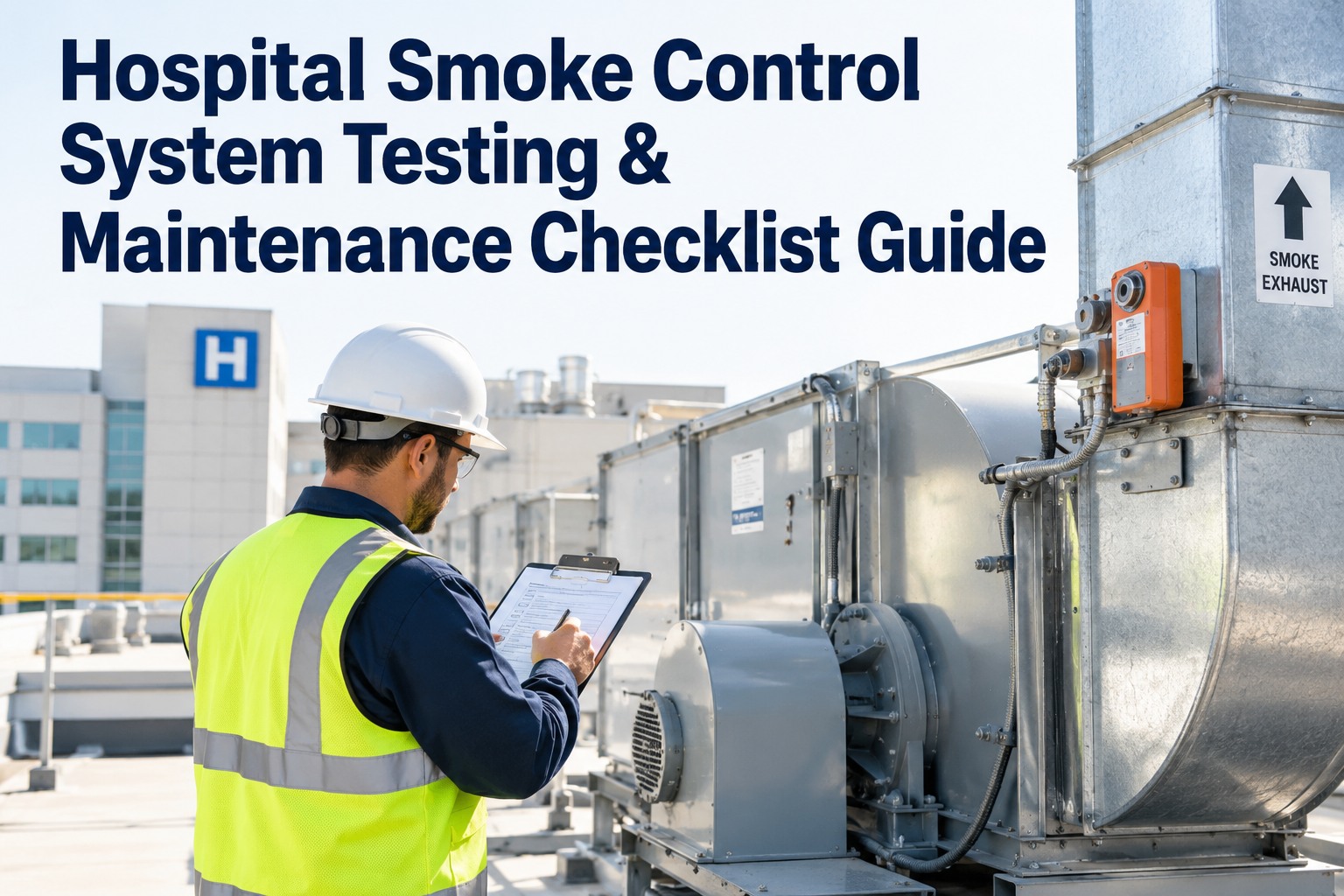
Hospital Smoke Control System Testing & Maintenance Checklist Guide
In a hospital, patients can't simply walk out — they are defended in place, and smoke control is what keeps that place breathable. OXMAINT AI turns every damper, fan and door check into a guided inspection, every failed check into a ranked work order, and every test cycle into an automated schedule you can prove on survey day.
The Smoke Control Clock
WeeklyAutomatic self-test on dedicated systems
6 MonthsFull test of dedicated smoke control
AnnualNon-dedicated systems + HVAC smoke shutdown
6 YearsEvery fire and smoke damper in a hospital
6 yrs
hospital damper test cycle, after a first test one year from install
0.10 in.
water gauge minimum stair pressurization under IBC 909.20.5
$3.8B
global fire and smoke damper market in 2025
7.5%
annual growth to a projected $6.29B by 2032
Two Systems Protect Every Smoke Compartment
Hospital smoke protection is really two systems working together. Passive barriers hold smoke where it starts; active equipment moves it or pushes it back. A checklist that covers only one half leaves the other half untested — which is why OXMAINT AI keeps both on the same asset register and the same schedule. Start free and put both halves on one schedule in OXMAINT AI.
PASSIVE CONTAINMENT
Hold the Smoke Where It Starts
Smoke barriers and compartmentsFire, smoke and combination dampersSelf-closing smoke doorsSealed penetrations above ceilings
NFPA 101 · NFPA 80 · NFPA 105
+
ACTIVE SMOKE CONTROL
Move It Out or Push It Back
Smoke exhaust and makeup air fansStair and zone pressurizationFirefighter's smoke control panelDetection and control sequences
NFPA 92 · IBC/IFC 909
The Hospital Smoke Control Checklist
Six systems, 25 checks, one line each. The chip on each line shows how often it typically comes due — dedicated systems are tested every six months, non-dedicated systems shared with HVAC every year. Tick each line as you confirm it; in OXMAINT AI, any line you can't tick becomes a work order with the asset and location attached. Book a demo to run this checklist on a phone in OXMAINT AI.
WeeklyAutomatic self-test
Each Test6-month or annual system test
AnnualEvery 12 months
6-YearHospital damper cycle
Intervals shown are typical code-based cycles. Your adopted code editions, the authority having jurisdiction and the manufacturer set your final schedule.
A Damper You Can't Prove Is a Damper That Didn't Close.
OXMAINT AI tracks every damper, fan and door as its own asset — with its location, last test, result and the person who signed it — so your six-year cycle never loses a single damper between surveys.
How a Smoke Control Test Day Runs
A full system test proves the whole chain — from a detector seeing smoke to a fan, damper and door doing their jobs at the same moment. OXMAINT AI walks your team through each stage in order and keeps every reading attached to the test. Start free and build your test-day procedure in OXMAINT AI.
1
Notify
Alert clinical staff, the fire alarm monitor and any affected units.
2
Trigger
Activate a zone from a detector, pull station or the panel.
3
Watch
Confirm fans start, dampers move and doors close as designed.
4
Measure
Record pressure differences and door forces at each barrier.
5
Restore
Reset to normal and repeat on standby power.
6
Record
Save readings, deficiencies and sign-offs together.
Why Smoke Control Fails Its Test
Most failures aren't dramatic. They are small things that drift between tests — and each one has a fix OXMAINT AI can schedule before the next survey. Book a demo to see failed checks turn into work orders.
No Access to the Damper
Ceilings and ductwork added over the years hide access panels.
Seized or Dead Actuator
A damper left still for years may not move when it matters.
Fan Fails on Standby Power
The fan runs fine until the test switches to emergency power.
Doors Held or Damaged
Wedged doors, missing gaskets and broken closers leak smoke.
Controls Changed, Not Retested
A building automation change quietly breaks the smoke sequence.
Open Penetrations
New cable and pipe runs leave holes through smoke barriers.
The Records Your Surveyor Will Ask For
For every damper, the code expects its location, inspection date, inspector name and any deficiency — with a note of when and how it was corrected — kept for the life of the damper. OXMAINT AI stores all of it against the asset, so the record is complete the moment the test closes. Start free and keep every smoke control record in OXMAINT AI.
01
Damper Log
Location, date, inspector and result for each damper.
02
System Test Reports
Fan, pressure and sequence readings vs acceptance data.
03
Weekly Self-Test Logs
Proof the automatic checks ran and faults were cleared.
04
Closed Deficiencies
Every failed item traced to a finished, retested repair.
How OXMAINT AI Maintenance Management Software Runs Your Smoke Control Program
Everything on this checklist — the assets, the cycles, the test day and the records — lives in one place in OXMAINT AI. The software connects the inspection, the repair and the proof, so nothing found in the ceiling is forgotten on the ladder. Book a demo to walk your smoke control program end to end.
1
Every Damper an Asset
Each damper, fan and door has its own record, location and history.
2
Cycles on Autopilot
Weekly, six-month, annual and six-year tasks scheduled automatically.
3
Guided Mobile Checks
This checklist on a phone, with required readings and photos.
4
Failures Become Work Orders
A failed damper or fan is raised as a ranked work order on the spot.
5
Retest Before Close
Repairs can't close until the damper or sequence passes again.
6
Survey-Ready History
Filter records by system, floor or date for your next survey.
Frequently Asked Questions
How often must hospital smoke dampers be tested?
Fire and smoke dampers are tested one year after installation, then every four years — and NFPA 80 and NFPA 105 allow hospitals to extend that to every six years. Dampers that are part of a smoke control system are also tested with that system.
Start free and schedule your damper cycle in OXMAINT AI.
What is the difference between dedicated and non-dedicated systems?
A dedicated system exists only for smoke control and is tested every six months. A non-dedicated system shares equipment with normal HVAC and is tested every year.
What pressure should a pressurized stair hold?
Under IBC 909.20.5, at least 0.10 in. of water gauge above adjacent spaces and no more than 0.35 in. — the upper limit keeps the door within the 30-pound opening force.
What happens when a damper fails its test?
It must be repaired promptly and retested, and both the failure and the correction belong in the damper's record.
How does OXMAINT AI help with smoke control compliance?
The maintenance management software tracks every damper, fan and door as an asset, schedules each test cycle, turns failed checks into work orders and keeps every result ready for survey.
Keep Every Compartment Clear of Smoke.
Put your dampers, fans, pressurization and smoke doors on one schedule with OXMAINT AI — guided checks, ranked work orders, retest before close and a complete record ready for your next life safety survey.