
Running maintenance operations across a single hospital campus is hard. Running them across five, ten, or twenty is a different problem entirely — one that most health systems are solving with a patchwork of spreadsheets, site-specific CMMS platforms, and a monthly PDF report that arrives too late to change anything. The result is not just operational inconsistency; it is a compounding financial and compliance liability that grows with every campus added to the network. This guide is for the operations and facilities leaders responsible for the whole portfolio — not just one building. To see how Oxmaint unifies multi-campus operations on a single platform, start a free trial or book a demo and walk through a live multi-site health system deployment with our team.
Multi-Campus Hospital Operations: Standardize Maintenance Across Health Systems
A strategic framework for VP Operations, Directors of Facilities, and Asset Managers overseeing maintenance performance, compliance, and capital planning across distributed hospital networks.
What Does Multi-Campus Standardization Actually Mean?
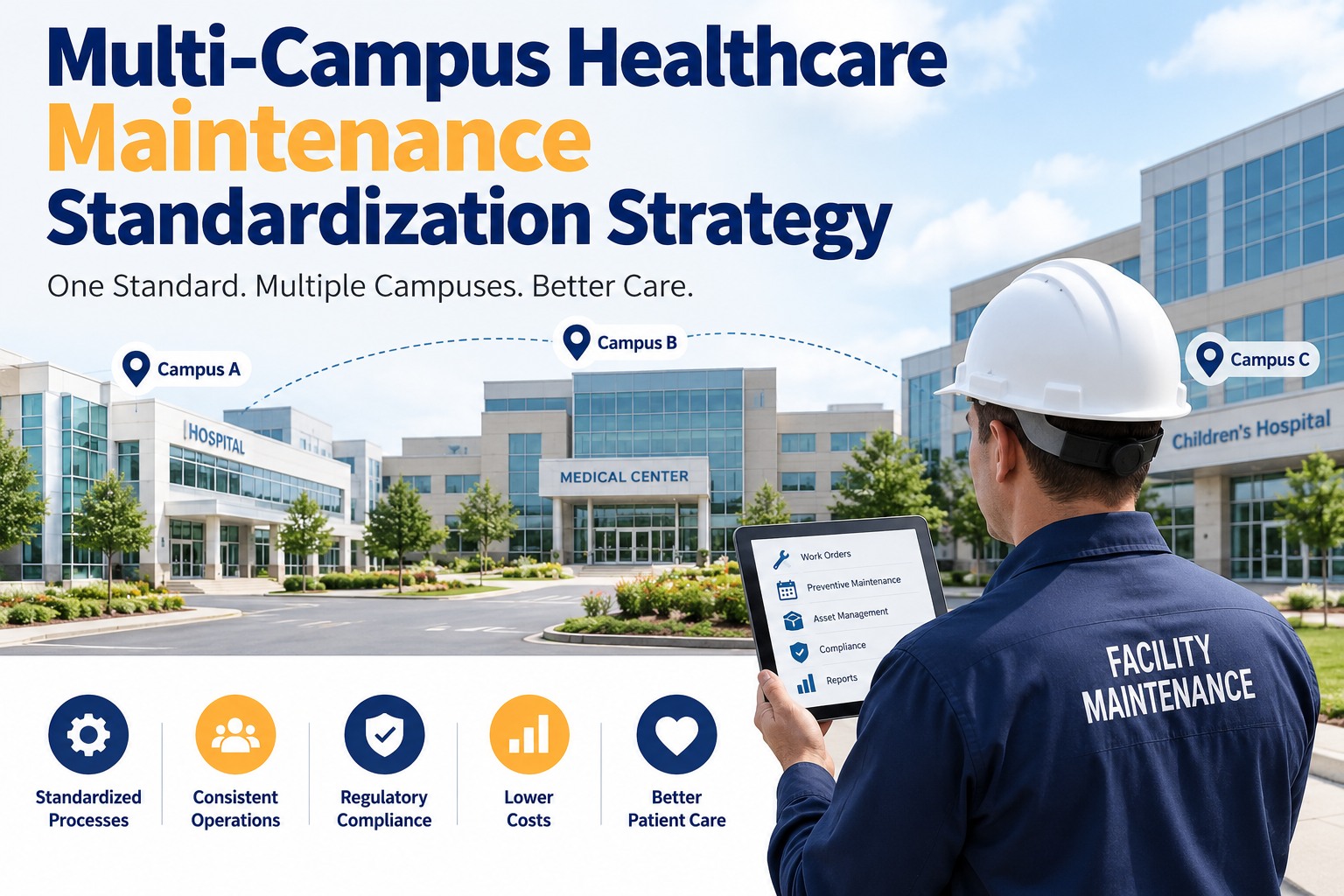
Multi-campus hospital maintenance standardization is the operational discipline of ensuring that every facility in a health system network — regardless of size, age, or geography — operates maintenance programs to the same documented standards, tracks asset performance with the same metrics, and reports to portfolio leadership in the same format.
It is not about making every campus identical. A 600-bed academic medical center and a 90-bed community hospital in the same network will always have different asset mixes, staffing models, and compliance profiles. Standardization means the data they generate, the processes they follow, and the accountability structures they operate within are consistent enough to be compared, benchmarked, and managed at the portfolio level.
Without it, a VP of Operations reviewing ten campuses is not really reviewing ten campuses — they are reviewing ten different versions of reality, each filtered through a different tool, a different reporting template, and a different definition of "on track." The result is decisions made on incomplete information, with consequences that compound across every site in the network. Ready to see what centralized control looks like in practice? Start a free trial or book a demo with our enterprise healthcare team.
Why Health Systems Can't Afford Siloed Operations
These are not abstract inefficiencies. Each one has a direct financial and operational cost — and they compound across every campus in your network.
5-Layer Standardization Framework for Multi-Campus Health Systems
Effective multi-campus standardization is not a single system deployment. It is a layered framework built from asset data upward. Each layer depends on the one below it — which is why most fragmented health systems are trying to build the top layers without the foundation.
Fragmented vs. Standardized: The Operational Reality
Here is what the same 8-campus health system looks like before and after portfolio-level standardization — using real operational metrics from Oxmaint's enterprise healthcare client base.
| Operational Dimension | Fragmented (8 Campuses, 3 CMMS Platforms) | Standardized (Oxmaint Single Platform) |
|---|---|---|
| Monthly portfolio reporting | 8–12 hrs manual aggregation per FM Director | Automated — real-time portfolio dashboard |
| PM compliance rate variance across sites | 51%–88% — 37 percentage point spread | 87%–94% — 7 percentage point spread |
| Cost-per-bed visibility | Not comparable — different cost categories per site | Normalized — identical cost buckets, real-time |
| CapEx request preparation | 6–8 weeks per annual cycle, each campus separately | Portfolio model generated in under 2 hours |
| TJC documentation completeness | 62%–91% — significant exposure at low-performing sites | 100% at all sites — mandatory field enforcement |
| Reactive work order share | 28%–52% reactive across sites | 12%–18% reactive across all sites |
| Cross-site procurement leverage | 12 separate vendor relationships — no volume aggregation | Unified MRO spend visibility — 18% avg cost reduction |
| After-hours SLA breach visibility | Discovered next morning in manual review | Automatic escalation at breach — zero latency |
Based on Oxmaint enterprise health system transitions. Results vary by network size, starting data quality, and legacy platform complexity. Want to model your network's gap? Start a free trial or book a demo and we will walk through your portfolio specifically.
How Oxmaint Powers Multi-Campus Standardization
Oxmaint is architected from the ground up for multi-site operations. Its asset hierarchy, reporting engine, and escalation framework are designed to give portfolio leaders true operational control — not a roll-up of disconnected site reports. Every capability below is active across all sites simultaneously from a single platform deployment.
What Multi-Campus Standardization Delivers: Measured Outcomes
Across Oxmaint's enterprise healthcare clients — health systems operating between 4 and 22 campuses — these are the outcomes measured after moving to a standardized, unified operations platform.
How to Standardize a Multi-Campus Health System in 90 Days
Most health system standardization initiatives fail because they try to change everything at once. This phased approach prioritizes the foundational data layer first — because every metric, every comparison, and every compliance record is only as good as the asset data underneath it.
Frequently Asked Questions: Multi-Campus Operations
How does Oxmaint handle campuses that are already using a different CMMS platform?
Oxmaint is designed to replace fragmented platform environments — not to co-exist with them indefinitely. For health systems transitioning from multiple existing CMMS platforms, Oxmaint's implementation team supports structured data migration: asset records, PM history, and work order archives are imported into the unified Oxmaint environment from legacy systems. Migration is typically completed in a phased rollout by campus, starting with the highest-priority sites. Most health systems complete full network transition within 60–90 days. During the transition period, Oxmaint can operate in parallel at active sites while legacy systems are wound down at others — ensuring no operational gap during the changeover.
Can portfolio-level standards be customized for individual campuses with specific regulatory requirements?
Yes — and this is a core architectural distinction of Oxmaint's multi-site design. Standards are set at the portfolio level and cascade down to sites, but site-level overrides are supported for legitimate regulatory or operational reasons. For example, a campus with an NCI-designated cancer center may require stricter PM frequencies on specific equipment classes than the portfolio standard. These overrides are documented, tracked, and visible at the portfolio level — so they are a transparent exception, not an invisible deviation. Compliance reporting distinguishes between portfolio-standard performance and variance-with-justification, which is critical for network-wide accreditation management.
What is the minimum network size where multi-campus standardization delivers meaningful ROI?
The cross-site benchmarking and procurement consolidation benefits become significant starting at 3–4 campuses. The CapEx planning and compliance oversight benefits are meaningful even at 2 sites if those sites have different legacy systems or reporting formats. The reporting time reduction — from 8–12 hours of monthly manual aggregation to a real-time dashboard — is relevant from 2 campuses onward. In practice, the clearest ROI signal appears when a health system can compare PM compliance rates, reactive spend ratios, and cost-per-bed across at least 3 sites simultaneously — because that is when the first actionable performance gaps become visible to portfolio leadership.
How does Oxmaint's investor-grade reporting work for health systems with bond financing or private equity involvement?
Oxmaint's portfolio reporting module generates standardized financial and operational outputs used directly in bond covenant compliance reporting, private equity operational reviews, and lender facility assessments. Outputs include: network-wide Facility Condition Index, deferred maintenance liability by campus and system type, 5–10 year capital replacement forecast with cost escalation modeling, PM compliance trends, and reactive-to-planned spend ratios. These reports are generated from live operational data — not assembled manually for each reporting cycle. For health systems refinancing debt or operating under PE ownership, having continuous access to these metrics outside of an annual facilities assessment is increasingly a lender and investor requirement, not just a best practice.
One Platform. Every Campus. Complete Control.
Oxmaint gives multi-campus health systems the unified asset registry, cross-site benchmarking, portfolio CapEx forecasting, and compliance documentation to manage every campus with the same operational rigor — from a single platform that goes live without a 6-month implementation. Health systems that standardized on Oxmaint reduced portfolio reporting time by 89%, cut per-bed maintenance costs by 31%, and closed cross-campus PM compliance gaps from 37 points to 7 in under a year.

.jpg)
