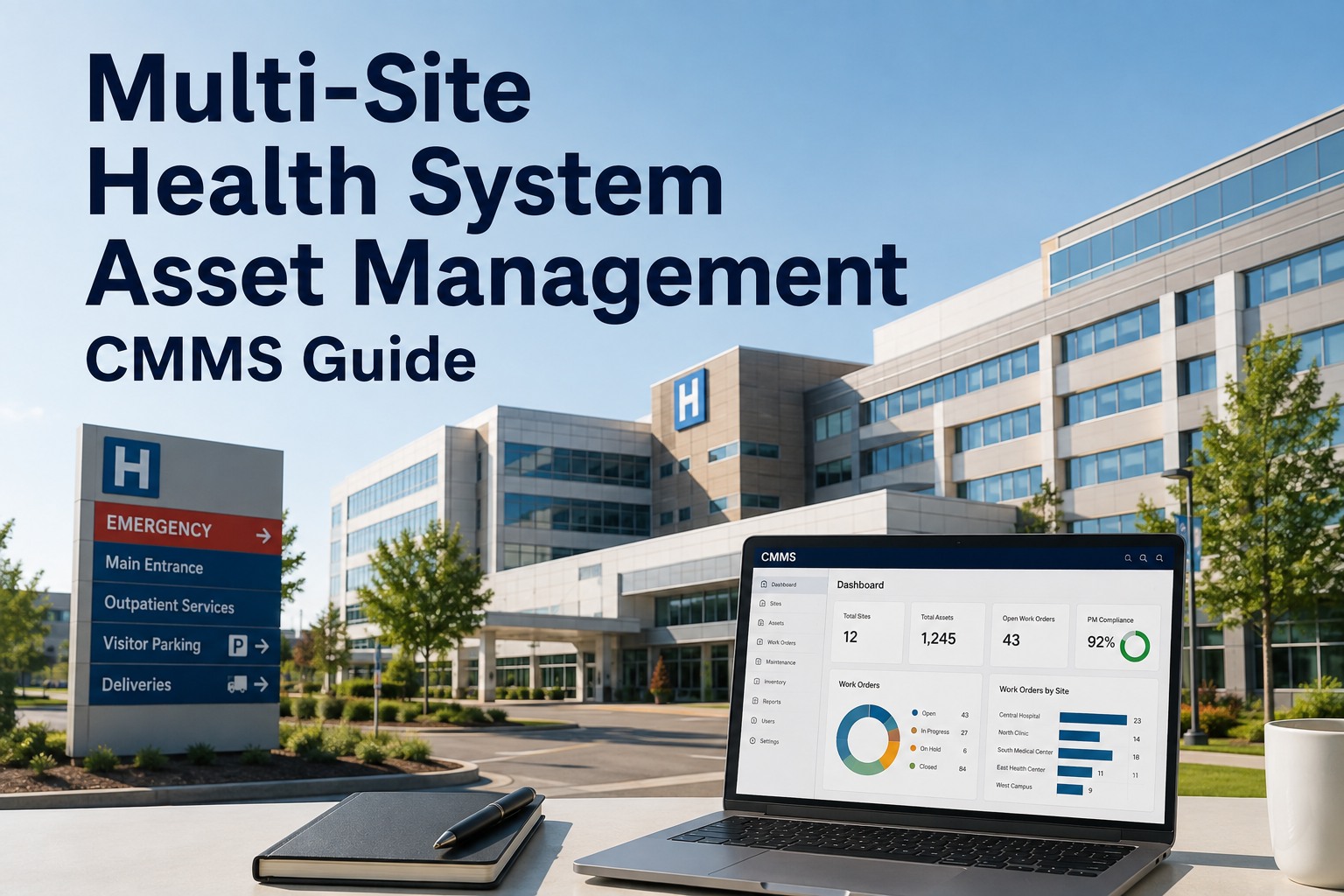
Multi-site health system asset management demands a CMMS architecture that follows patients, equipment, and clinical engineering teams across every hospital, outpatient clinic, and ambulatory site in the network. A 2026 health system asset guide has to go beyond single-facility work-order tracking — it needs enterprise asset hierarchy, cross-site PM standardization, shared compliance libraries, and a multi-hospital CMMS dashboard that gives each facility operational autonomy while delivering real portfolio visibility to system-level leaders. OxMaint was built for exactly this: a health system portfolio CMMS that centralizes asset data, compares compliance across sites, and uses AI to predict failures before they disrupt care. Explore the platform with a Start Free Trial or book a personalized walkthrough below.
Health System CMMS Guide 2026
Can your CMMS see every asset across every hospital — in real time?
Most clinical engineering teams juggle 3–8 disconnected CMMS instances or spreadsheets across hospitals and clinics. The result: blind spots in compliance, duplicated PM effort, and no system-level visibility into 10,000+ medical assets. OxMaint unifies multi-site healthcare asset management into one AI-powered platform — one hierarchy, one shared PM library, one portfolio dashboard.
Enterprise Architecture
Why multi-site health systems outgrow single-hospital CMMS
A single-hospital CMMS treats each facility as an island. But in a multi-site health system, infusion pumps travel between campuses, biomedical engineering teams cover multiple hospitals, and Joint Commission surveys inspect the entire network — not just one building.
Enterprise asset hierarchy
Map 10,000+ assets across hospitals, clinics, and ambulatory sites into one parent-child hierarchy — System → Region → Hospital → Department → Asset — so leaders can drill from portfolio view to a single IV pump in 2 clicks.
Shared PM library
Build one preventive-maintenance template for each asset class — anesthesia machines, defibrillators, sterilizers — and deploy it network-wide. Update the protocol once and every site inherits the change instantly.
Cross-site compliance comparison
Compare Joint Commission, DNV, and FDA compliance metrics across every hospital on one dashboard. Spot the laggard site before the surveyor does — and close gaps with a single work-order dispatch.
Site autonomy + portfolio visibility
Each hospital's biomed team controls its own work-order queue, spare-parts inventory, and vendor schedules — while system leaders see rolled-up KPIs, downtime trends, and capital-readiness reports across the network.
Cost of Disconnected Systems
What fragmented multi-hospital asset management actually costs
A 5-hospital system managing assets in 5 separate CMMS instances — or worse, 5 spreadsheet silos — loses visibility, duplicates effort, and pays a measurable penalty in downtime, compliance risk, and staff time.
A 4-hospital, 220-clinic regional health system managed 14,000 medical assets across 6 legacy CMMS instances and 11 spreadsheets. Biomed teams spent 340 hours/month reconciling asset registers. After consolidating on OxMaint's multi-site CMMS architecture, the network cut reconciliation time by 85%, eliminated 3 CMMS licenses ($54K/yr), and reduced audit-prep from 6 weeks to 4 days — all while giving each hospital full control of its own work-order queue.
CMMS Multi-Site Healthcare Architecture
How to structure a multi-site health system CMMS in 6 phases
Rolling out a health system portfolio CMMS is not an IT project — it is a reliability transformation. Here is the phased path OxMaint's implementation team follows with multi-hospital networks.
Asset hierarchy standardization
Define a unified naming convention and parent-child hierarchy: Health System → Region → Facility → Department → Asset Class → Individual Asset. OxMaint imports existing data from all CMMS instances and spreadsheets, deduplicates, and maps to the new hierarchy in 2–4 weeks.
Shared PM library deployment
Build preventive-maintenance templates for every asset class (AAMI, Joint Commission standards). Deploy one library network-wide so every biomed team executes the same PM protocol — updated centrally, inherited everywhere.
Cross-site work-order mobility
Enable shared technician pools — a biomed engineer at Hospital A can pick up a work order at Clinic B. OxMaint routes by proximity, skill, and certification, cutting travel time and improving first-time-fix rates by 25–40%.
Compliance dashboard activation
Turn on the multi-hospital CMMS dashboard. Leaders see Joint Commission, DNV, CMS, and FDA compliance metrics by site, by asset class, and by technician — with automated gap alerts and one-click corrective work orders.
Predictive maintenance layer
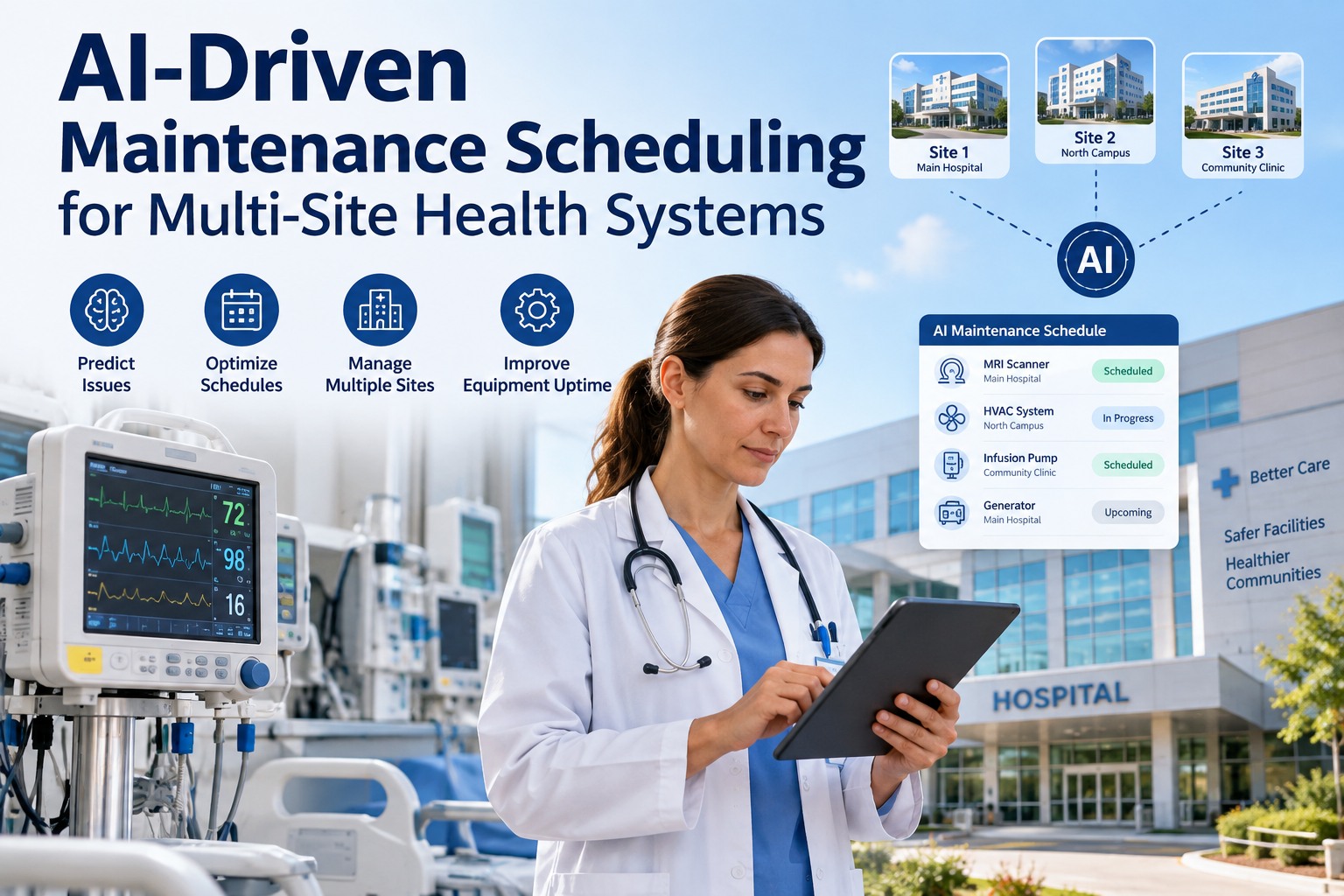
OxMaint's AI engine begins analyzing work-order history, sensor data, and failure patterns across the network to predict asset failures 2–6 weeks before they happen — shifting maintenance from reactive to predictive across the highest-criticality equipment.
Capital planning integration
Use OxMaint's lifecycle analytics to build a network-wide capital replacement plan. Compare asset condition scores, maintenance cost trends, and downtime impact across hospitals to prioritize $5M–$50M capital budgets with data — not politics.
Before vs. After OxMaint
Multi-site hospital CMMS: disconnected vs. unified
The difference between a fragmented asset-management stack and a unified health system CMMS is not incremental — it is transformational. Here is what changes when OxMaint goes live across your network.
| Capability | Disconnected CMMS / Spreadsheets | OxMaint Unified Health System CMMS |
|---|---|---|
| Asset visibility | Each hospital is a silo — no network-wide view | One dashboard, 10K+ assets, drill-down in 2 clicks |
| PM standardization | 3–6 different PM protocols for the same infusion pump | One shared library, updated centrally, inherited everywhere |
| Cross-site work orders | Technicians cannot see or pick up work outside their hospital | Shared queues routed by skill, proximity, and certification |
| Compliance reporting | 6 weeks of manual prep before every Joint Commission survey | Real-time compliance dashboard, 4-day audit prep |
| Failure prediction | Reactive — fix after the ventilator goes down mid-procedure | AI predicts failures 2–6 weeks out, 30–50% fewer unplanned outages |
| Spare-parts inventory | Each hospital overstocks the same parts to feel safe | Network-wide parts pool visibility, 20–35% inventory reduction |
| Capital planning | Excel spreadsheets, anecdotal priority arguments | Data-driven lifecycle scoring across every asset and site |
How OxMaint Helps
How OxMaint solves multi-site health system asset management
OxMaint was architected from day one as a multi-site CMMS for healthcare networks. These are the four capabilities that deliver the fastest, most measurable impact when a health system switches from fragmented tools.
Unified portfolio dashboard
One real-time view of every asset, work order, PM status, and compliance metric across all hospitals and clinics — with drill-down to any individual device in under 2 clicks.
AI-powered predictive maintenance
Machine-learning models trained on your network's work-order history and sensor data predict failures on critical equipment — ventilators, imaging systems, sterilizers — 2–6 weeks before breakdown.
Cross-site compliance engine
Automated tracking of Joint Commission, DNV, CMS, and FDA requirements across every site, with real-time gap detection and one-click corrective work-order generation.
Network-wide spare-parts pooling
See every part in every hospital's storeroom on one screen. OxMaint recommends transfers between sites before ordering new, and auto-reorders based on usage trends and lead times.
See OxMaint on your assets — book a 30-minute demo
We will load your asset hierarchy, map your sites, and show you the cross-site compliance dashboard live. No slideware — just your network on OxMaint.
FAQ — Multi-Site Health System CMMS
Common questions about CMMS for multi-site healthcare networks
What is a multi-site health system CMMS?
A multi-site health system CMMS is a computerized maintenance management platform architected to manage medical assets, preventive maintenance, work orders, and compliance across multiple hospitals and clinics from a single unified database. Unlike single-facility CMMS, it provides enterprise asset hierarchy, shared PM libraries, cross-site work-order mobility, and portfolio-level dashboards while preserving each facility's operational autonomy. OxMaint is purpose-built for this multi-hospital architecture.
How does a multi-hospital CMMS improve Joint Commission compliance?
A multi-hospital CMMS centralizes compliance tracking across every site, so biomed and facilities leaders see real-time readiness for Joint Commission, DNV, CMS, and FDA requirements on one dashboard. Instead of 6 weeks of manual chart-pulling before a survey, the system flags overdue PMs, missing inspections, and documentation gaps instantly — and generates corrective work orders with one click. Health systems using OxMaint typically cut audit-prep time by 80–90%.
Can each hospital keep autonomy in a shared CMMS?
Yes. OxMaint uses a role-based, multi-tenant architecture where each hospital controls its own work-order queues, spare-parts inventory, vendor schedules, and technician assignments. System-level leaders see rolled-up KPIs and compliance metrics, but local biomed managers run their facility day-to-day without interference. You can Start Free Trial to test site-level permissions, or book a demo to see the autonomy-vs-visibility balance live.
How long does it take to migrate from multiple legacy CMMS instances to OxMaint?
For a 3–5 hospital network, OxMaint's implementation team typically completes data migration, hierarchy standardization, and go-live in 4–8 weeks. The platform imports asset registers, work-order history, PM schedules, and parts data from all existing CMMS instances and spreadsheets, deduplicates records, and maps them to a unified hierarchy. A single pilot hospital can be live in as little as 2 weeks.
What is the ROI of switching to a health system portfolio CMMS?
Most multi-site health systems see ROI within 6–12 months of switching to OxMaint. Savings come from eliminating duplicate CMMS licenses ($30K–$60K/yr), reducing unplanned downtime by 30–50% ($500K–$2M/yr for a 5-hospital network), cutting spare-parts inventory 20–35% through cross-site pooling, and slashing audit-prep labor by 80%. The payback period is typically under 9 months for networks with 3+ hospitals.
Unify your health system's asset management in 30 days
Join multi-hospital networks using OxMaint to cut downtime, pass audits with confidence, and see every asset — every site — in real time.
Free 14-day trial · No credit card



.png)