
Managing medical equipment across multiple hospital locations presents one of the most complex operational challenges in healthcare today. With 41.2% of facility management challenges attributed to communication deficiencies and 85.8% of healthcare organizations still relying on manual data updates, the need for centralized visibility has never been more critical. As hospital networks expand through acquisitions and new construction, maintaining consistent asset management standards across geographically dispersed facilities becomes nearly impossible without the right technology infrastructure.
Transform Your Network Operations Today
Join leading hospital networks using Oxmaint to achieve 187 hours of clinical time savings per clinician annually and reduce maintenance costs by 15% within the first year.
The global healthcare CMMS market, valued at $706.4 million in 2024 and projected to reach $2 billion by 2034, reflects the urgency of this transformation. Hospital networks that implement centralized asset management platforms report maintenance cost reductions of 10-15% within the first year, alongside significant improvements in regulatory compliance and patient safety. Sign up to discover how your network can achieve similar results.
The Fragmentation Challenge
The Multi-Site Hospital Network Dilemma
Hospital networks operate in an environment where equipment availability directly impacts patient outcomes. When a critical piece of imaging equipment fails at one facility, the immediate question becomes: Can we source a replacement from another location within our network? Without centralized visibility, these decisions rely on phone calls, spreadsheets, and institutional knowledge that walks out the door when experienced staff retire.
The financial implications extend beyond maintenance budgets. NHS pilot programs demonstrate that comprehensive equipment tracking can release 140,000 clinical hours back to patient care while generating £5 million in recurrent inventory savings. Book a demo to see how these metrics translate to your specific network size.
Five Pillars of Centralized Asset Intelligence
Unified Asset Registry
Single source of truth for all medical equipment across every facility, accessible in real-time through cloud-based architecture.
Predictive Maintenance
AI-powered algorithms analyze historical data to predict failures 30-40% more accurately than calendar-based schedules.
Inter-Facility Mobility
Track equipment transfers between locations with automated chain-of-custody documentation and compliance logging.
Regulatory Compliance
Automated audit trails and FDA-compliant documentation ensure Joint Commission readiness across all sites.
Resource Optimization
Right-size inventory across the network by identifying underutilized assets at one facility that could serve another.
ROI That Scales With Your Network
Implementation data from major health systems reveals compelling returns. University Hospitals of Derby and Burton realized £3.2 million in cumulative benefits within 18 months of deployment. Leeds Teaching Hospitals reduced product recall times from 8.33 days to 35 minutes, generating £84,411 in annual savings on recalls alone.
The payback timeline follows a predictable pattern: initial deployment and inventory optimization in months 0-6, workflow improvements emerging in months 6-12, and full deployment benefits realized by months 12-18. Sign up today to start your network's transformation journey.
Implementation Value Curve
See Network-Wide Visibility in Action
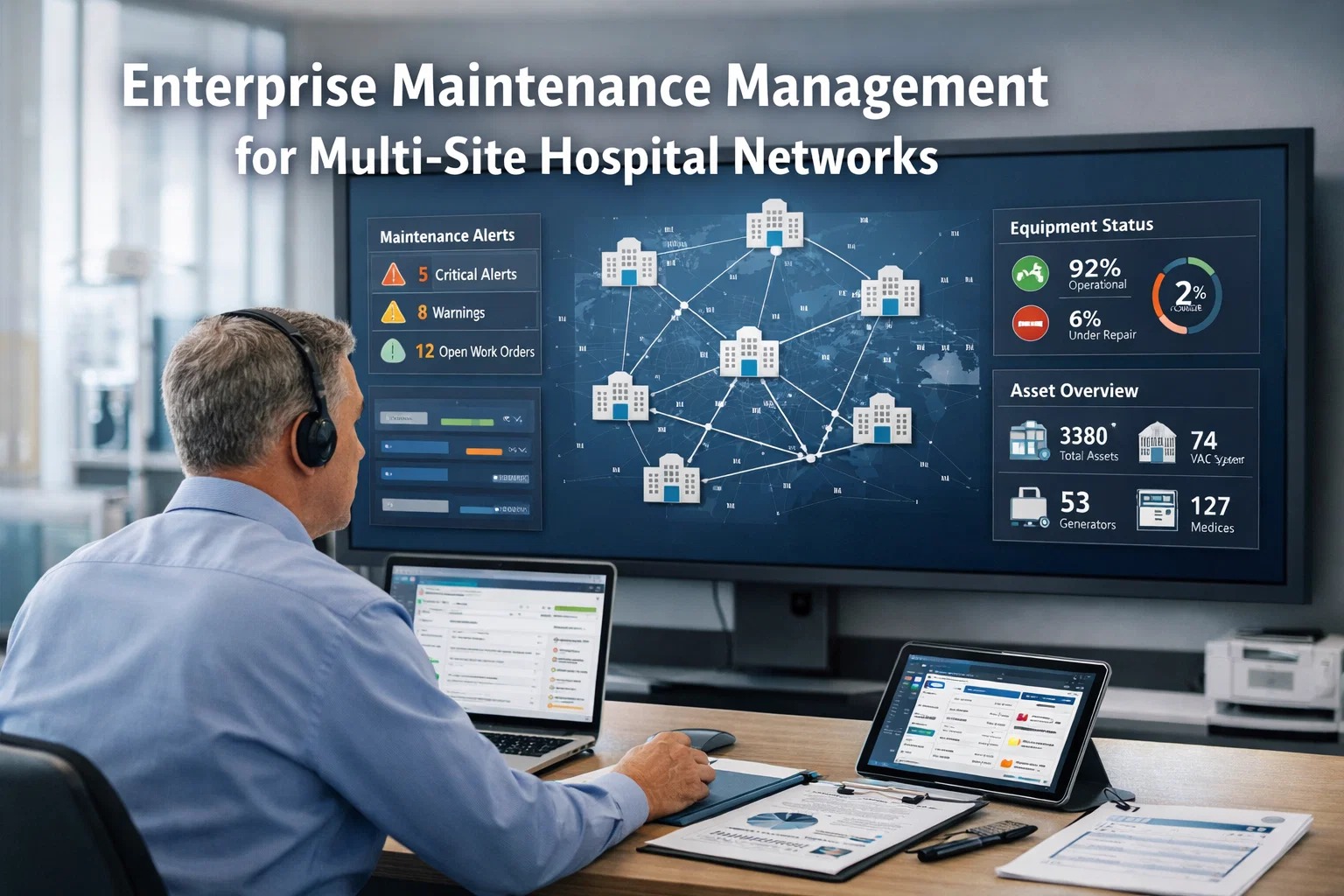
Discover how Oxmaint connects your facilities into a unified asset ecosystem. Our platform integrates with Epic, Cerner, SAP, and existing IoT infrastructure to deliver real-time insights across every location.
Technology Integration Without Disruption
Modern centralized platforms integrate seamlessly with existing hospital information systems, ERP platforms, and IoT sensor networks. Cloud-based architecture eliminates the need for substantial IT infrastructure investments while providing the scalability to add new facilities as your network grows. Book a demo to see integration capabilities specific to your current tech stack.
Mobile-first design ensures that biomedical technicians, facilities teams, and clinical staff can access critical asset information from any location. Voice-activated work order creation improves response times by 25%, while augmented reality maintenance procedures boost first-time fix rates by 45%.

.png)
.jpg)
