Preventive maintenance protocols at US hospitals cost an average of $240,000 annually per facility in scheduled inspections and routine service calls — yet 58% of hospital maintenance managers report critical equipment failures between scheduled maintenance windows. The gap isn't between what gets maintained and what fails — it's between what maintenance data shows you at inspection time and what your clinical operations actually need before the next failure occurs. Oxmaint bridges that gap with predictive maintenance analytics that flag degradation weeks before failure, letting hospital engineering teams prioritize investment on high-risk equipment while protecting patient care capacity and reducing emergency repair costs. Book a demo to see how Oxmaint identifies equipment failure risk before clinical impact.
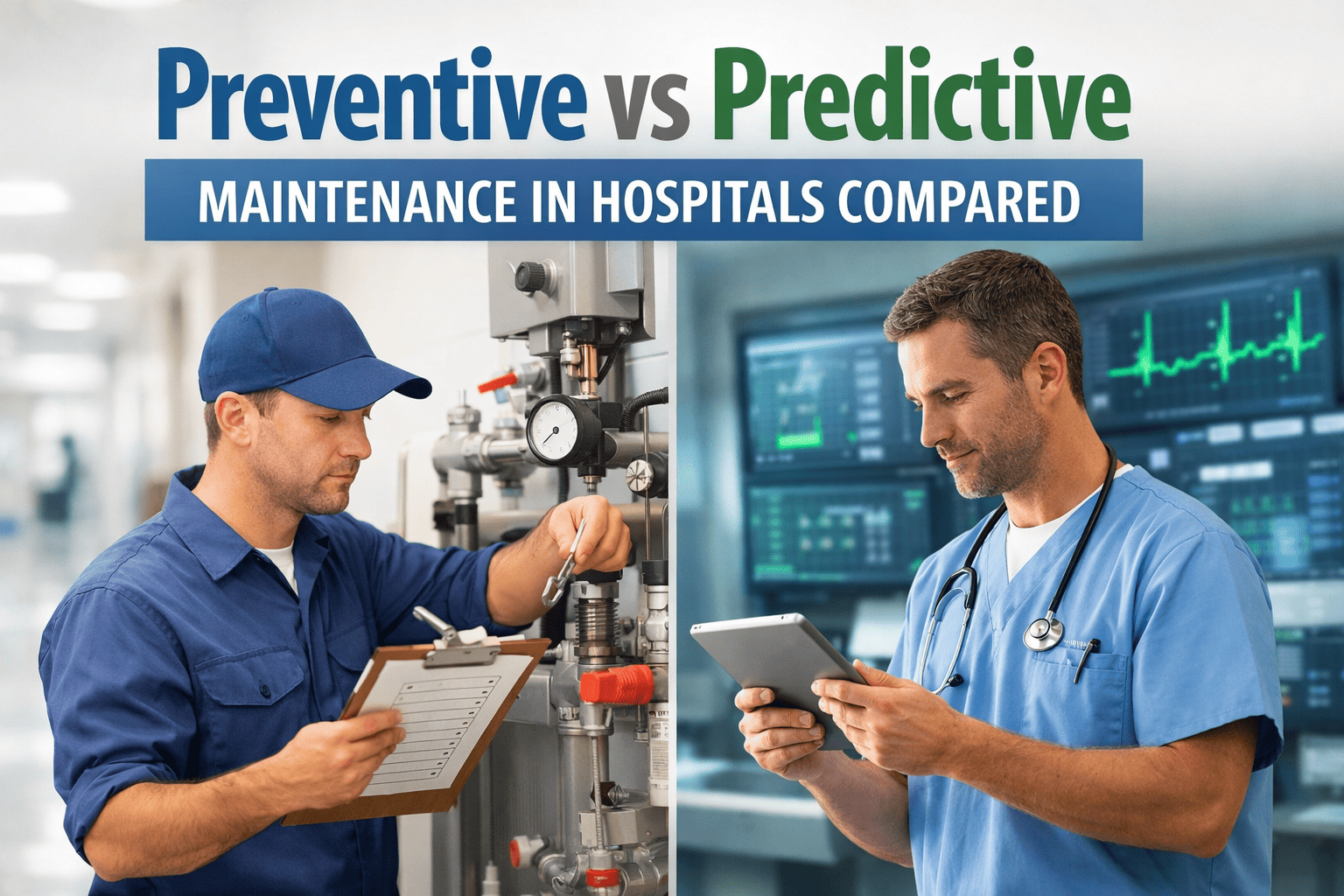
Hospital equipment maintenance requires two parallel strategies: preventive maintenance (PM) for regulatory compliance and baseline reliability, and predictive maintenance (PdM) for early detection of degradation before clinical impact. Oxmaint layers condition-based monitoring onto your existing PM schedule — analyzing vibration, temperature, electrical performance, and operational hours to flag equipment requiring immediate intervention. The result is higher equipment availability, lower emergency repair frequency, and measurable reduction in unplanned clinical downtime. Book a demo to see predictive monitoring configured for your critical equipment.
Why Preventive Maintenance Alone Falls Short in Hospital Operations
Hospital equipment operates in environments where failure impact is measured in patient outcomes, not production delays. Calendar-based preventive maintenance assumes uniform degradation across identical equipment — an assumption that breaks down in clinical practice.
A surgical suite's HVAC system and a pediatric clinic's HVAC system face identical PM schedules — despite operating at different utilization rates, humidity exposure, and contamination load. Hospital equipment doesn't degrade on the calendar; it degrades on operational hours and environmental stress. Preventive maintenance that ignores actual condition creates two failure modes: over-maintenance of lightly-used equipment and under-maintenance of heavily-stressed assets.
Preventive maintenance averages $1,500 to $3,000 per equipment intervention across labor, parts, and scheduling coordination. Emergency repair — called out during high-demand periods with expedited parts procurement — averages $6,000 to $12,000. Predictive monitoring flags degradation weeks in advance, converting emergency events to planned maintenance windows where labor and parts procurement are optimized.
Joint Commission, CMS, and state health department regulations mandate preventive maintenance schedules, inspection records, and corrective action closure for all patient-critical equipment. Predictive monitoring doesn't replace these requirements — it enhances them by providing condition data that justifies maintenance intervals and documents equipment reliability trends for surveyors and accreditation reviews.
Over-maintenance wastes engineering resources and clinical availability. Predictive condition monitoring identifies which equipment actually requires intervention and which equipment is performing within acceptable parameters — reducing unnecessary maintenance callouts by 30% to 40% while improving detection of genuine degradation. Oxmaint's monitoring layer sits on top of your PM schedule, signaling when PM intervals should be advanced or deferred based on equipment condition.
Every Critical Asset Monitored — Not Just on Schedule, But on Condition
Oxmaint layers real-time condition monitoring onto your preventive maintenance program — capturing vibration, temperature, and electrical performance data from equipment and analyzing it against failure thresholds specific to your facility and clinical demand patterns. When degradation is detected, your maintenance team receives actionable alerts weeks ahead of failure, converting emergencies to planned interventions. Book a demo to see condition monitoring configured for your critical equipment categories.
Hospital Equipment Categories Requiring Hybrid Preventive + Predictive Strategy
Different equipment categories carry different failure risk profiles. Oxmaint's monitoring templates are configured per equipment class to balance regulatory compliance and early failure detection.
Ventilators, cardiac monitors, anesthesia delivery, surgical lighting, sterilization equipment. Failure impact: immediate patient risk. PM Schedule: Monthly. PdM monitoring: Continuous real-time. Strategy: Aggressive predictive monitoring with zero tolerance for condition degradation — any detected change triggers maintenance scheduling within 48 hours.
HVAC systems, water treatment, medical gas delivery, power distribution, data center cooling. Failure impact: clinical operations degradation over hours. PM Schedule: Quarterly. PdM monitoring: Weekly or continuous for critical nodes. Strategy: Predictive monitoring with 7-day advance planning window — condition changes trigger work order creation with planned scheduling.
Imaging equipment (MRI, CT, ultrasound), laboratory analyzers, pharmacy automation, dietary equipment, laundry systems. Failure impact: service delays and operational inefficiency. PM Schedule: Semi-annual or annual. PdM monitoring: Monthly or trend-based. Strategy: Preventive maintenance as primary control with predictive analytics as secondary layer — condition data informs when PM intervals should be adjusted.
Oxmaint Equipment Monitoring and Maintenance Optimization
Equipment-specific PM intervals configured per manufacturer specifications and regulatory requirements — automated alerts trigger 14 days, 7 days, and 1 day before scheduled maintenance is due.
Vibration, temperature, electrical current, and performance metrics captured from equipment sensors — analyzed against failure thresholds to predict degradation weeks in advance.
Every PM task, condition reading, and maintenance closure automatically archived — ready for Joint Commission surveys, CMS audits, and accreditation reviews in under 2 hours.
Maintenance requests automatically prioritized by equipment criticality category, condition alert urgency, and clinical schedule impact — ensuring critical repairs are scheduled first.
Historical data on each asset's maintenance frequency, repair costs, and failure patterns — enabling capital planning decisions and equipment replacement analysis.
For health systems with multiple hospitals, unified view of equipment status across all facilities — identifying equipment reliability trends and fleet-wide maintenance optimization opportunities.
From Reactive Repair to Planned Maintenance — Across Your Entire Equipment Portfolio
Hospitals deploying Oxmaint's hybrid PM + PdM approach report 35% reduction in emergency repair frequency and $180,000 to $320,000 annual savings in maintenance labor and parts cost per facility. Book a demo to see ROI modeling for your facility's equipment portfolio.
Hospital Equipment Maintenance KPI Benchmarks
Client Results — Hospital Systems Using Oxmaint Maintenance Management
These outcomes reflect hospital deployments where Oxmaint's hybrid preventive and predictive maintenance approach replaced calendar-based PM systems within the first 6 months of operation.
Frequently Asked Questions
From Reactive Repair to Predictive Equipment Management — Across Your Hospital
Oxmaint's hybrid preventive and predictive maintenance system deploys in weeks — connecting your existing PM schedules with real-time condition monitoring to prevent failures, reduce emergency repair costs, and ensure regulatory compliance. Book a demo with your Engineering Director and see equipment monitoring configured for your critical assets.


.png)