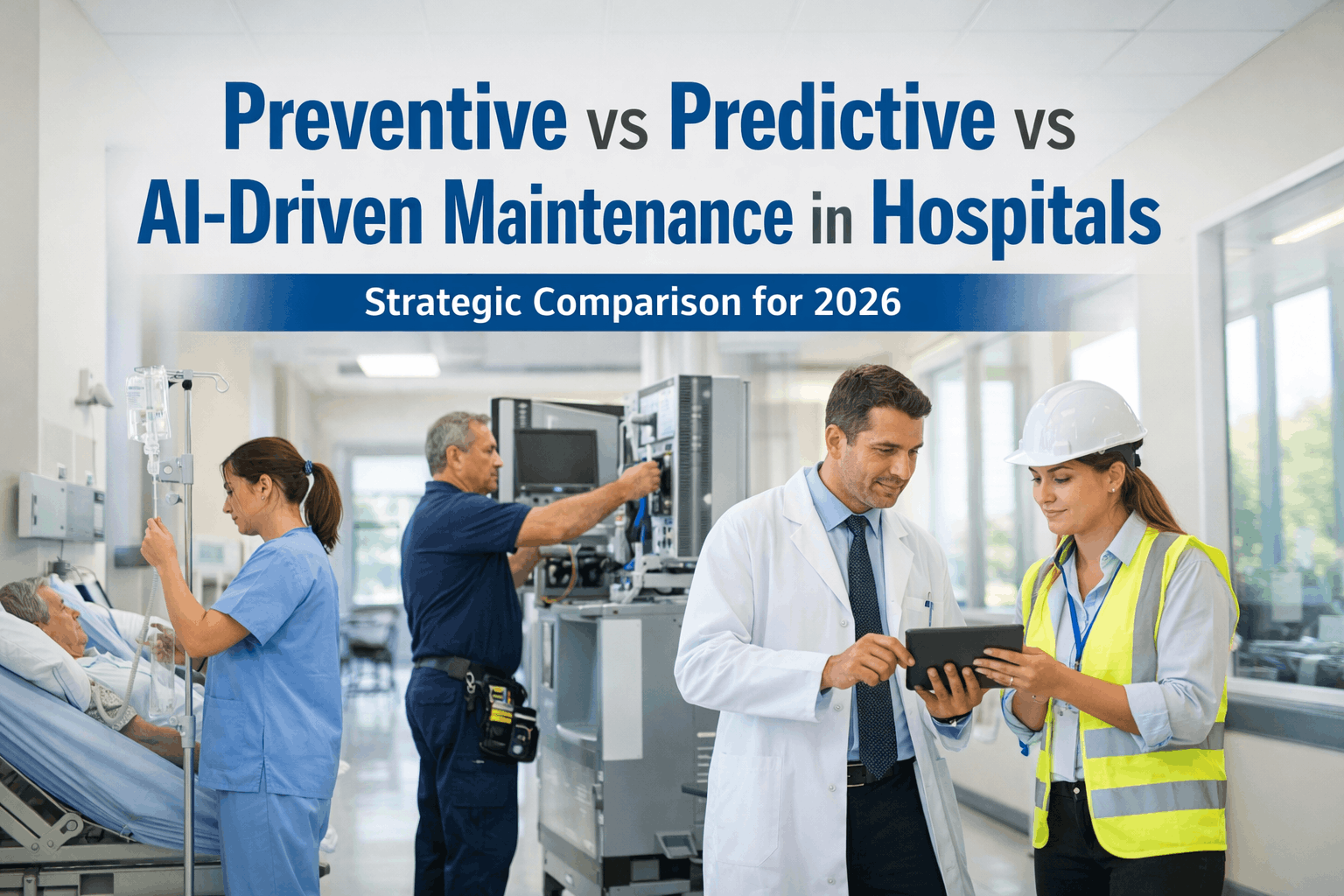
In 2026, hospitals face a defining crossroads in how they maintain the equipment that keeps patients alive. The era of simply fixing machines after they break is rapidly fading. Today, forward-thinking healthcare facilities are choosing between three distinct maintenance philosophies: preventive, predictive, and AI-driven. Each carries its own strengths, trade-offs, and long-term impact on patient safety and operational budgets. With equipment downtime costing hospitals thousands per minute and regulatory pressures intensifying, choosing the right maintenance strategy is no longer optional. This guide breaks down each approach with real-world context, helping hospital administrators and facility managers make a confident, data-backed decision. If you are ready to transform your hospital maintenance operations, sign up for OxMaint and experience the difference from day one.
Understanding the Three Pillars of Hospital Maintenance
Before diving into comparisons, it is essential to understand what each maintenance model actually means in a healthcare context. Hospitals are not factories. Equipment failure here does not just halt production; it can endanger lives, trigger regulatory penalties, and erode patient trust in ways that take years to rebuild.
Preventive Maintenance
Time-based or usage-based servicing performed on a fixed schedule, regardless of equipment condition. Think of it as your car's oil change every 5,000 miles. In hospitals, this means servicing ventilators, imaging machines, and HVAC systems at regular intervals whether or not they show signs of wear.
Predictive Maintenance
Condition-based monitoring using sensors and data analytics to predict when a piece of equipment is likely to fail. Instead of a calendar-driven approach, technicians intervene only when real indicators like vibration patterns, temperature spikes, or pressure anomalies suggest trouble is near.
AI-Driven Maintenance
The next evolution. AI-driven maintenance combines IoT sensor data, machine learning algorithms, and historical performance records to not only predict failures but also prescribe the optimal course of action. It learns continuously, gets smarter over time, and can coordinate maintenance across an entire hospital ecosystem in real time.
Why Hospital Maintenance Strategy Matters More Than Ever in 2026
The healthcare maintenance landscape has shifted dramatically. Industry data reveals that 71% of maintenance professionals still rely on preventive maintenance as their primary strategy, while only 27% have adopted predictive approaches. Meanwhile, roughly 65% of maintenance teams plan to adopt AI by the end of 2026, signaling a massive transition is underway.
Hospitals face unique pressures that make this decision especially consequential. Equipment downtime does not just cost money; it disrupts diagnoses, delays surgeries, and can force emergency patient diversions. With hospital infrastructure aging by more than 10% over the last two years, the strain on maintenance budgets and teams is only growing. Want to stay ahead of these challenges? Book a demo with OxMaint to see how smart hospitals are solving this.
Strategic Comparison: Side by Side
Preventive Maintenance: The Reliable Foundation
Preventive maintenance has been the backbone of hospital operations for decades, and for good reason. It provides structure, compliance alignment, and a baseline level of equipment reliability. Scheduled servicing of MRI machines, sterilizers, elevators, HVAC units, and backup generators keeps hospitals running within regulatory standards.
However, the model has inherent limitations. Because maintenance is scheduled regardless of actual equipment condition, hospitals frequently over-maintain assets that are perfectly healthy while under-maintaining others that are quietly deteriorating between service intervals. A WHO study found that 80% of healthcare instrument failures stem from preventable factors, suggesting that scheduled servicing alone cannot catch every issue. Preventive maintenance also demands significant labor resources and can disrupt clinical operations when equipment must be taken offline for routine checks.
Best suited for: Smaller hospitals or clinics with limited budgets that need a reliable, compliance-friendly baseline. It works well for non-critical assets where the risk of unexpected failure is manageable.
Predictive Maintenance: The Data-Informed Upgrade
Predictive maintenance takes hospital operations a meaningful step forward by introducing condition monitoring. Instead of servicing equipment on a fixed calendar, sensors track real-time parameters like vibration, temperature, humidity, and pressure. When these readings cross predefined thresholds, maintenance teams receive alerts.
Research shows that predictive maintenance can reduce maintenance costs by up to 25% and increase equipment uptime by 10 to 20%. For hospitals, this translates directly into fewer cancelled procedures, less patient diversion, and more efficient use of biomedical engineering staff. That said, predictive maintenance still relies on human analysis to interpret sensor data and make scheduling decisions. It detects problems early but does not autonomously prescribe solutions. To explore how predictive tools integrate into your hospital workflow, sign up for OxMaint today.
Best suited for: Mid-size hospitals and health systems that have invested in IoT infrastructure and want to optimize maintenance spending without fully committing to AI platforms yet.
AI-Driven Maintenance: The Smart Hospital Standard
AI-driven maintenance represents the convergence of everything that works in preventive and predictive approaches, amplified by machine learning, real-time orchestration, and continuous improvement. AI systems ingest data from IoT sensors, historical maintenance records, equipment usage patterns, and even environmental factors to forecast failures with far greater accuracy than traditional condition monitoring.
What makes AI-driven maintenance genuinely transformative is its prescriptive capability. It does not just tell you something might fail; it tells you when, why, and what action to take. It can automatically generate work orders, prioritize tasks based on clinical urgency, optimize spare parts inventory, and coordinate schedules across departments. Hospitals implementing comprehensive AI-driven strategies have reported downtime reductions of 40 to 50% within the first year, along with maintenance cost savings of 25 to 35%.
Industry experts predict 2026 is the year AI moves from pilot programs to full-scale operational deployment in healthcare. The era of experimentation is officially ending, with hospitals now demanding AI tools that can be governed, audited, and trusted at scale.
Best suited for: Large hospitals, multi-facility health systems, and any organization pursuing smart hospital certification or seeking measurable operational transformation.
Ready to Upgrade Your Hospital Maintenance Strategy?
Join 1,000+ facilities worldwide that trust OxMaint to reduce downtime, cut costs, and protect patient safety with AI-powered CMMS.
Sign Up Free Book a DemoThe Real Cost of Getting It Wrong
The financial stakes of hospital maintenance failures are staggering. Downtime costs hospitals an average of $7,500 per minute, and poor equipment maintenance costs U.S. hospitals an average of $7.5 million annually in unexpected expenses. A single day of downtime can cost healthcare organizations approximately $1.9 million when accounting for lost revenue, delayed billing, regulatory penalties, and recovery efforts.
Beyond dollars, the clinical consequences are severe. Lab results can be delayed by over 60% during system outages. Emergency patients get diverted to other facilities. Medication errors increase. Staff revert to manual paper-based processes that are slower and more error-prone. Each percentage point of improvement in critical equipment uptime delivers $150,000 to $300,000 in annual value for a typical hospital. These are not hypothetical numbers; they represent the daily reality of facilities that have not yet modernized their maintenance approach.
The Evolution Path: From Preventive to AI-Driven
Most hospitals will not leap directly from reactive or purely preventive maintenance to full AI-driven operations. The journey typically follows a natural progression that builds data maturity and team capability at each stage.
Build the Preventive Foundation
Implement standardized work orders, asset registers, and scheduled PM tasks using a CMMS platform. This creates the data backbone that everything else builds upon.
Layer in Predictive Monitoring
Add IoT sensors to high-value and high-risk assets. Begin collecting condition data and training your team to interpret alerts and adjust maintenance schedules accordingly.
Activate AI-Driven Intelligence
With sufficient historical and real-time data, enable machine learning models that predict failures, auto-generate work orders, optimize resource allocation, and continuously improve.
The good news is that modern CMMS platforms like OxMaint support this entire journey. You can start with preventive maintenance workflows today and progressively activate predictive and AI capabilities as your data and team mature. Book a demo to see this evolution path in action.
Which Strategy Is Right for Your Hospital
The answer depends on your facility's size, budget, existing infrastructure, and long-term vision. Here is a practical decision framework:
If you are a community hospital or clinic with limited IT infrastructure and tight budgets, start with a strong preventive maintenance program on a modern CMMS. This alone will dramatically outperform spreadsheet-based or paper-based tracking.
If you are a mid-size hospital with some IoT capability and a growing biomedical engineering team, combining preventive and predictive maintenance gives you the best balance of cost control and risk reduction.
If you are a large health system, an academic medical center, or pursuing smart hospital goals, AI-driven maintenance is not just recommended; it is becoming the expected standard. The hospitals that invest now will see compounding returns as their AI models learn and improve.
Regardless of where you start, the critical first step is digitizing your maintenance operations with a platform that can grow with you. That is exactly what OxMaint is built for. Sign up now and take the first step toward smarter hospital maintenance.
Key Takeaways for Healthcare Leaders
Preventive maintenance remains essential as a compliance baseline, but relying on it exclusively leaves hospitals exposed to costly, unplanned failures. Predictive maintenance significantly improves efficiency and safety by shifting from calendar-based to condition-based servicing. AI-driven maintenance represents the future standard, delivering the highest ROI through automated decision-making, prescriptive actions, and continuous learning. The best approach for most hospitals is a layered strategy that starts with strong preventive practices and progressively adds predictive and AI layers as organizational maturity grows.
The hospitals that move now will establish a data advantage that compounds over time. Those that wait risk falling behind in both operational efficiency and patient safety standards. With 65% of maintenance teams targeting AI adoption by end of 2026, the window for gaining a competitive edge is narrowing. Book a demo with OxMaint to see how leading hospitals are making this transition.
Start Your Smart Maintenance Journey Today
OxMaint gives you preventive, predictive, and AI-powered maintenance in one platform. Trusted by 1,000+ clients across healthcare and beyond.
Sign Up Free Book a DemoFrequently Asked Questions
What is the difference between preventive and predictive maintenance in hospitals
Preventive maintenance follows a fixed schedule, servicing equipment at regular intervals regardless of its actual condition. Predictive maintenance uses real-time sensor data and analytics to identify when equipment is actually showing signs of wear or impending failure, allowing maintenance teams to intervene only when needed. Predictive approaches typically reduce costs by 20 to 25% compared to purely preventive programs.
How does AI-driven maintenance improve patient safety
AI-driven maintenance continuously monitors critical medical equipment like ventilators, imaging machines, and surgical instruments using IoT sensors and machine learning. It detects failure patterns far earlier than human observation can, automatically prioritizes maintenance based on clinical urgency, and ensures life-critical equipment stays operational when patients need it most.
How much does hospital equipment downtime actually cost
Hospital downtime costs an average of $7,500 per minute. When factoring in lost revenue, delayed procedures, regulatory penalties, and recovery efforts, a single day of downtime can cost approximately $1.9 million. Poor equipment maintenance costs U.S. hospitals an average of $7.5 million annually in hidden expenses including emergency repairs, overtime labor, and patient diversions.
What percentage of hospitals are adopting AI for maintenance in 2026
About 65% of maintenance teams plan to use AI by the end of 2026, up from less than one-third that have fully or partially implemented it as of 2025. In the broader healthcare AI space, 71% of nonfederal acute care hospitals reported using some form of predictive AI in 2024, with adoption rates continuing to climb.
Can a small hospital benefit from predictive or AI-driven maintenance
Yes. Modern CMMS platforms like OxMaint are designed to scale with your facility. Smaller hospitals can start with preventive maintenance workflows and progressively add predictive capabilities as their data foundation grows. Cloud-based AI tools have significantly lowered the barriers to entry, making smart maintenance accessible even for community hospitals and clinics.
What is the fastest way to transition from reactive to AI-driven maintenance
The fastest path starts with digitizing your maintenance operations on a CMMS platform that supports all three strategies. Build a complete asset register, standardize work orders, and begin collecting data. Then layer in IoT sensors for high-value assets, followed by AI analytics that learn from your historical data. Hospitals following this phased approach typically see measurable results within 3 to 12 months.



.jpg)