Real-Time Monitoring in Healthcare: How IoT Sensors Are Transforming Smart Hospital Facility Management

By Jack Edwards on March 23, 2026

real-time-monitoring-healthcare-iot-sensors-smart-facility-management

Every hospital runs on invisible systems — HVAC keeping surgical suites sterile, refrigeration preserving temperature-sensitive medications, ventilators sustaining lives in the ICU. For decades, facility managers learned about failures only after they happened. That era is ending. IoT sensors now stream live data from thousands of asset points simultaneously, turning reactive guesswork into proactive certainty. This is not a technology trend — it is a fundamental operational shift that separates hospitals that prevent failures from those that respond to them. If you want to see what this looks like inside your own facility, start a free 30-day trial or book a demo with Oxmaint to see how live IoT data integrates with your asset management workflow.

IoT-Connected CMMS for Healthcare
See Your Facility's Asset Health — Live

Oxmaint connects IoT sensor data directly to your asset registry, maintenance schedules, and CapEx forecasts — giving healthcare facility teams a single operational picture across every site.

4.8x
Higher Cost of Emergency Repairs
vs. planned preventive maintenance in healthcare facilities
$28B
Annual Cost of Medical Equipment Downtime
across US hospitals due to unplanned failures and reactive maintenance
41%
Reduction in Unplanned Downtime
reported by facilities deploying IoT-integrated predictive maintenance programs
$9.1B
Global Healthcare IoT Market by 2027
growing at 19.3% CAGR as hospitals accelerate smart infrastructure investment
Foundation

What Is Real-Time Monitoring in Healthcare Facilities?

Real-time monitoring in healthcare is the continuous, automated collection of operational data from physical assets — clinical equipment, HVAC systems, refrigeration units, power infrastructure, and environmental controls — via networked IoT sensors. Unlike traditional inspection cycles that capture a snapshot in time, real-time systems stream live readings every few seconds, flagging deviations the moment they occur.

For facility engineers and maintenance managers, this means moving from a calendar-based maintenance model to a condition-based one. The sensor tells you when an asset needs attention — not a date on a spreadsheet. For hospital administrators, it means compliance data is generated automatically, continuously, and without manual effort.

01
Condition-Based Triggers
Maintenance is initiated when sensor readings — temperature deviation, vibration spike, pressure drop — exceed defined thresholds. Not when a calendar date arrives.
02
Continuous Compliance Logging
Every reading is timestamped and stored automatically. Audit trails are built in real time — not assembled manually before an inspection. FDA, TJC, and CQC requirements met by default.
03
Predictive Failure Intelligence
Pattern recognition across sensor data identifies assets trending toward failure weeks before breakdown. Maintenance is scheduled on your terms — not forced by an emergency.
04
Multi-Site Portfolio Visibility
Live dashboards aggregate data across every facility in a network. One view. Every asset. Every alert. Whether you manage one hospital or a national health group.
Core Technology

Six IoT Sensor Applications Transforming Hospital Facilities

Not all IoT sensor deployments deliver equal value. These six applications account for the highest measurable ROI in hospital facility management — from patient safety compliance to capital asset protection.

01
Temperature and Humidity Monitoring
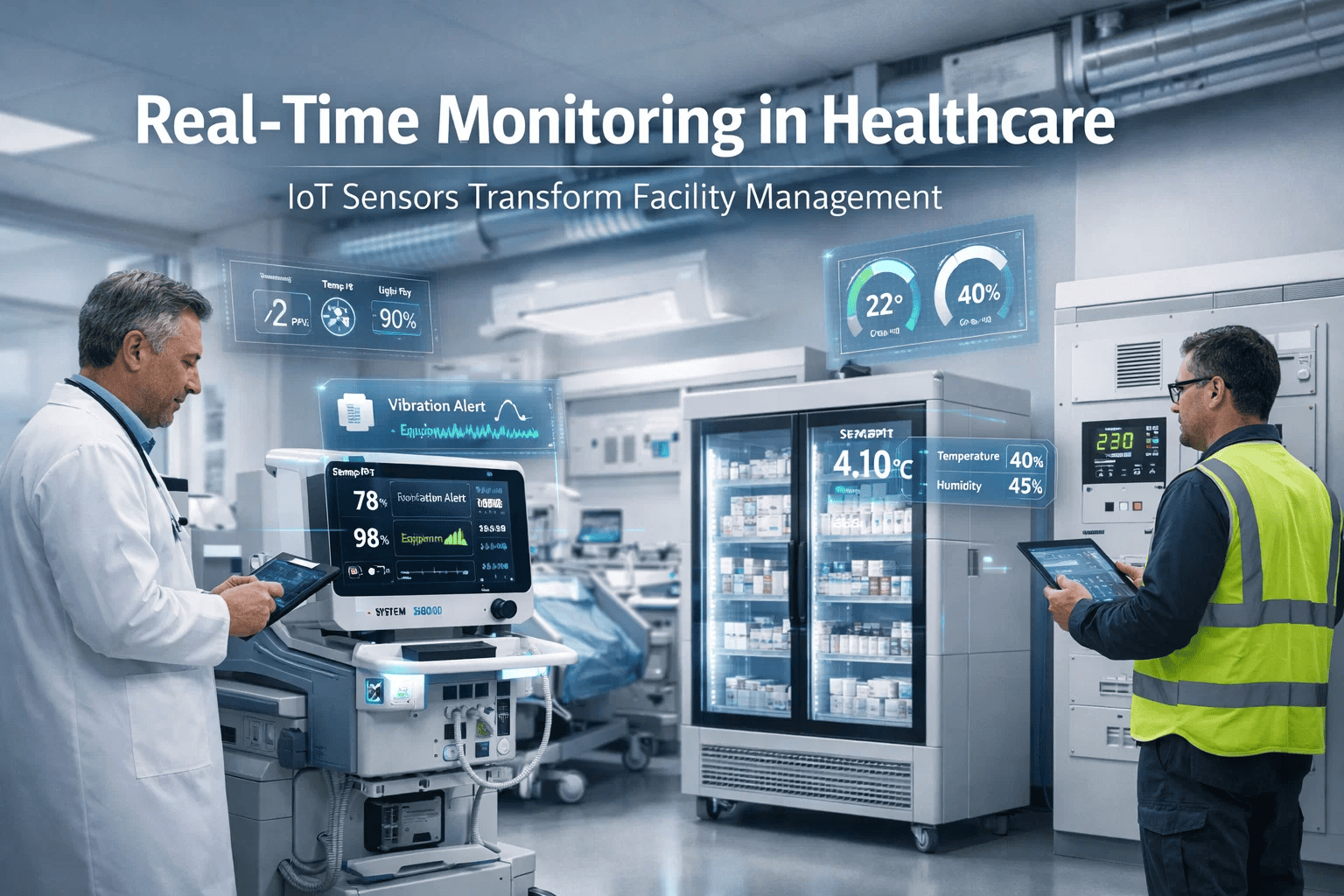
Pharmaceutical cold chains, blood banks, surgical suites, and sterile stores require precise environmental control. IoT sensors stream readings every 30 seconds — alerting staff to any deviation before products or patients are compromised. Hospitals using automated temperature monitoring report 94% reduction in spoilage-related losses.
02
Medical Equipment Health Monitoring
Ventilators, infusion pumps, imaging systems, and surgical robots generate continuous telemetry. Vibration, electrical load, cycle counts, and runtime data feed directly into asset records — triggering preventive maintenance before failure. MRI equipment monitored via IoT shows 38% longer service intervals between unplanned breakdowns.
03
HVAC and Air Quality Control
Infection control in hospitals depends on precise HVAC performance — pressure differentials between isolation rooms, HEPA filtration status, and air change rates. Real-time HVAC monitoring detects filter degradation and pressure imbalances instantly, maintaining the clinical environment standards required for Joint Commission and CQC compliance.
04
Water System and Legionella Risk Monitoring
Water temperature fluctuations in hospital plumbing create Legionella risk. IoT sensors continuously monitor water temperature across every riser, outlet, and storage tank — automatically flagging readings in the 20–45°C danger zone. Compliance documentation is generated without manual testing rounds, reducing risk and labour costs simultaneously.
05
Power and Utilities Monitoring
Generator readiness, UPS battery health, and critical power circuit loads are monitored in real time. For ICUs and operating theatres where a power interruption is life-critical, knowing your backup power system is healthy is not optional. Facilities with live power monitoring detect backup system failures on average 18 days before they would have been discovered manually.
06
Asset Location and Utilisation Tracking
RTLS (Real-Time Location Systems) combined with IoT tags track high-value mobile assets — infusion pumps, portable monitors, wheelchairs — across a facility in real time. Hospitals deploying asset tracking reduce equipment search time by 73% and cut procurement of duplicate assets by up to 20% annually.
Pain Points

Where Hospitals Without Real-Time Monitoring Pay the Price

Before IoT-connected monitoring becomes standard, these are the failure modes that cost healthcare facilities the most — in money, compliance exposure, and patient outcomes. If any of these feel familiar, start a free trial to see how Oxmaint changes the picture, or book a demo for a walkthrough specific to your facility type.


Cold Chain Failures Discovered Too Late
Without continuous temperature monitoring, medication refrigeration failures are found during manual checks — hours after the breach. Average loss per incident: $14,000 in drug spoilage plus regulatory reporting obligations.

Imaging Equipment Downtime During Procedures
CT and MRI systems failing mid-day cost hospitals an average of $22,000 per hour in cancelled procedures, rescheduling costs, and emergency engineer call-outs. Reactive maintenance catches nothing in advance.

Compliance Gaps Found During Audits
Manual inspection rounds produce inconsistent records. CQC, TJC, and OSHA audits surface gaps that existed for months undetected. Corrective action plans, fines, and reputational damage follow — all preventable with automated logging.

Infection Control Breaches from HVAC Drift
Pressure differentials in isolation rooms and operating theatres drift undetected without continuous monitoring. HAI (hospital-acquired infection) outbreaks traced to HVAC failure cost NHS trusts an average of £1.2M per incident in extended stays and litigation.

Capital Decisions Based on Asset Age, Not Condition
Without real-time condition data, CapEx committees replace equipment by age rather than health. Facilities routinely retire assets with 3–5 years of remaining useful life while underinvesting in assets approaching critical failure.

Staff Time Lost to Manual Monitoring Rounds
Facilities engineers performing manual temperature checks, pressure readings, and equipment inspections spend an estimated 18% of their working hours on data collection alone — time that could be redirected to higher-value maintenance work.

Generator Failures During Critical Events
Backup generator systems failing during planned maintenance windows or actual power cuts are catastrophic. Without continuous load testing and battery health monitoring, readiness is assumed — not verified.

Siloed Data Across Multiple Sites
Hospital networks managing 5, 10, or 50 sites have no unified view of asset health. Portfolio-level reporting requires manual data consolidation — taking days to assemble what a real-time dashboard would show in seconds.
How Oxmaint Solves It

How Oxmaint Integrates IoT Monitoring with Asset Management

Oxmaint closes the gap between raw sensor data and operational action. Rather than IoT data sitting in a separate platform disconnected from your maintenance workflows, Oxmaint routes live sensor readings directly into asset records, maintenance triggers, and CapEx models. The result is a single operational picture — not three disconnected tools. Ready to close that gap in your facility? Start a free trial and connect your first assets in under 30 minutes, or book a demo and let us walk through your specific asset environment.

Asset Registry
Full Equipment Inventory with Live Condition Scores
Every asset — from MRI units to HVAC chillers — is logged with condition scores updated continuously from IoT sensor feeds. You see real health, not assumed health based on last service date.
Predictive Maintenance
Sensor-Triggered Work Orders — Automatically
When a sensor reading crosses a defined threshold, Oxmaint automatically generates a work order, assigns it to the correct technician, and logs the trigger event against the asset record. Zero manual intervention required.
Compliance Engine
Audit-Ready Documentation Generated Continuously
Every sensor reading, maintenance event, and technician action is timestamped and stored in an immutable log. TJC, CQC, OSHA, TGA, and DIN audit preparation becomes a report pull — not a two-week manual assembly exercise.
IoT and SCADA Integration
Connect Any Sensor, Any Protocol
Oxmaint integrates with BACnet, Modbus, MQTT, and proprietary SCADA systems. Whether your facility uses legacy BMS infrastructure or modern wireless sensors, data flows into Oxmaint without custom engineering work.
CapEx Forecasting
Condition-Based 5–10 Year Capital Plans
Sensor-derived condition scores feed directly into Oxmaint's rolling CapEx models. Replacement decisions are based on actual remaining useful life — not asset age. Boards and investment committees get investor-grade forecasts, not guesswork.
Portfolio Visibility
Multi-Site Dashboard — One Login
Every facility in your network — aggregated into a single portfolio view. Asset health scores, open work orders, compliance status, and CapEx commitments visible across every property simultaneously.
Mobile-First Operations
Technicians Receive Live Alerts on Mobile
When IoT triggers a work order, the assigned technician receives an instant mobile alert with full asset history, sensor reading context, and required parts — before they reach the equipment.
Spare Parts Intelligence
MRO Inventory Linked to Predictive Triggers
As IoT data identifies assets trending toward maintenance, Oxmaint cross-references spare parts inventory automatically — alerting procurement teams to reorder before the technician arrives empty-handed.
Comparison

Reactive Facility Management vs. IoT-Connected Operations

The operational and financial difference between reactive and IoT-connected facility management is not marginal. It is structural. The table below shows the delta across every dimension that matters to healthcare facility and operations leaders.

Operational Dimension Reactive — No IoT Monitoring IoT-Connected with Oxmaint
Equipment Failure Detection After failure occurs. Average response lag: 4–8 hours. Detected within seconds of threshold breach. Work order auto-generated.
Temperature Compliance Manual checks 2–3x daily. Gaps between rounds unmonitored. Continuous sensor logging every 30 seconds. Alerts instant. Records automatic.
Maintenance Scheduling Calendar-based. Over-maintains healthy assets, under-maintains degrading ones. Condition-triggered. Maintenance timed to actual asset health, not arbitrary dates.
Audit Preparation 1–3 weeks of manual record assembly before inspections. One-click compliance report export. Always audit-ready.
CapEx Planning Based on asset age and committee experience. High write-off risk. Condition-score-driven 5–10 year models. Risk-weighted, data-backed.
Multi-Site Visibility Site-by-site reports. Days to consolidate portfolio view. Live portfolio dashboard. Every facility, every asset, every alert. Real time.
Results

Measured Outcomes from IoT-Connected Healthcare Facility Programs

These are not projected figures. They are outcomes documented across healthcare facilities that have deployed IoT-connected asset management programs integrated with CMMS platforms. Use them to benchmark your own facility's current performance and build a business case for transformation. When you are ready to put numbers behind your own scenario, start a free trial with Oxmaint to begin generating your own data, or book a demo and we will model the ROI for your specific asset base.

41%
Reduction in Unplanned Downtime
Facilities using IoT-triggered predictive maintenance programs vs. calendar-based PM only
94%
Decrease in Cold Chain Spoilage Events
Hospital pharmacies using continuous automated temperature monitoring vs. manual check rounds
73%
Faster Asset Location and Recovery
Nursing and clinical teams using RTLS asset tracking vs. manual search procedures
18 days
Earlier Backup Power Failure Detection
Average lead time advantage from continuous generator and UPS health monitoring vs. periodic manual testing
Regional Context

IoT Monitoring Requirements Across Key Healthcare Markets

Regulatory frameworks, investment incentives, and compliance requirements for IoT-connected facility management vary significantly across markets. Understanding your region's specific drivers sharpens the business case and speeds procurement decisions.

USA
OSHA, TJC and NFPA Compliance Drivers
The Joint Commission's Environment of Care standards require continuous documentation of temperature, humidity, and equipment maintenance across accredited facilities. OSHA 29 CFR 1910 mandates real-time hazard monitoring in clinical environments. Automated IoT logging satisfies both simultaneously. US hospitals managing multi-site CRE portfolios are also using IoT-driven CapEx models to optimise capital allocation across aging infrastructure.
UK
NHS PLACE Standards and CQC Inspection Requirements
CQC inspections evaluate whether healthcare providers can demonstrate continuous environmental control and equipment maintenance documentation. NHS PLACE assessments score cleanliness, safety, and maintenance — all of which improve when IoT monitoring automates the data trail. The Building Safety Act 2022 adds further obligations for critical system monitoring in healthcare settings above 18m height.
UAE
Vision 2030 Smart Hospital Mandate
Dubai Health Authority has mandated IoT-based building management and predictive maintenance integration for all new hospital developments above 200 beds. Abu Dhabi SEHA hospitals have deployed smart monitoring across 12 facilities as part of their digital transformation programme, reporting 36% improvement in facility management efficiency. UAE's high construction standards and smart city ambitions make IoT adoption both regulatory and competitive.
Australia
High Labour Costs and Accreditation Council Requirements
Australia's high labour costs make manual monitoring rounds disproportionately expensive. NSQHS Standard 3 (Preventing and Controlling Healthcare-Associated Infection) requires documented environmental monitoring in accredited facilities. IoT automation replaces high-cost manual rounds with continuous automated compliance — a particularly compelling ROI in Australian healthcare economics where engineer hourly rates exceed $95/hr.
Built for Healthcare Facility Teams
Connect Your Assets. Eliminate Reactive Surprises.

Oxmaint is the CMMS built for healthcare facility complexity — multi-site portfolios, IoT integration, condition-based maintenance, and investor-grade CapEx reporting. No heavy implementation. No long onboarding. Real-time asset intelligence from day one.

FAQ

Frequently Asked Questions

What types of IoT sensors are most critical for hospital facility management?

The highest-priority sensor categories for hospital facilities are temperature and humidity sensors (pharmaceutical storage, blood banks, sterile processing), pressure differential sensors (isolation rooms, operating theatres), vibration and current sensors (mechanical plant, imaging equipment), water temperature sensors (Legionella prevention), electrical load sensors (critical power infrastructure), and RTLS asset tracking tags for mobile medical equipment. The specific priority depends on your facility type — acute hospitals weight clinical equipment and critical environment monitoring most heavily, while long-term care facilities prioritise environmental comfort and medication storage compliance.

How does IoT monitoring connect to a CMMS like Oxmaint?

Oxmaint integrates with IoT sensor platforms and SCADA systems via standard protocols including BACnet, Modbus, MQTT, and REST API. Sensor data streams into Oxmaint and is mapped to specific asset records within the asset hierarchy. When a reading crosses a defined threshold, the platform automatically generates a work order, assigns it to the appropriate technician, and logs the trigger event against the asset's maintenance history. All readings are stored in a timestamped compliance log, and aggregated sensor data feeds directly into CapEx condition scoring models. Integration setup typically takes days, not months, with no custom engineering fees required for standard protocol environments.

What compliance standards does IoT-automated monitoring satisfy in healthcare?

Automated IoT monitoring supports compliance with a broad range of healthcare facility standards globally. In the USA: The Joint Commission Environment of Care standards, OSHA 29 CFR 1910, and FDA 21 CFR Part 211 for pharmaceutical storage. In the UK: CQC Key Lines of Enquiry for safety and effectiveness, NHS PLACE assessment criteria, HTM 04-01 (water hygiene), and HTM 03-01 (HVAC in healthcare). In Australia: NSQHS Standards 3 and 18 for infection prevention and medication management. In Germany: DIN EN ISO 14644 for clean room monitoring and BetrSichV equipment safety requirements. Continuous automated logging satisfies the documentation burden across all of these frameworks simultaneously.

How long does it take to implement IoT-connected asset management with Oxmaint?

Most healthcare facilities reach operational status with Oxmaint within 2–4 weeks from initial deployment. The process involves three phases: asset registry population (building the hierarchical equipment database), IoT integration configuration (mapping sensor feeds to asset records), and threshold calibration (setting alert limits for each asset type and regulatory requirement). Facilities with existing asset lists or CMMS data can import records directly, reducing setup time significantly. There are no heavy implementation fees, no multi-month professional services engagements, and no requirement to replace existing BMS infrastructure — Oxmaint layers on top of what you already have. Pilot programmes typically begin with the highest-priority asset categories and expand across the portfolio over 60–90 days.

Share This Story, Choose Your Platform!