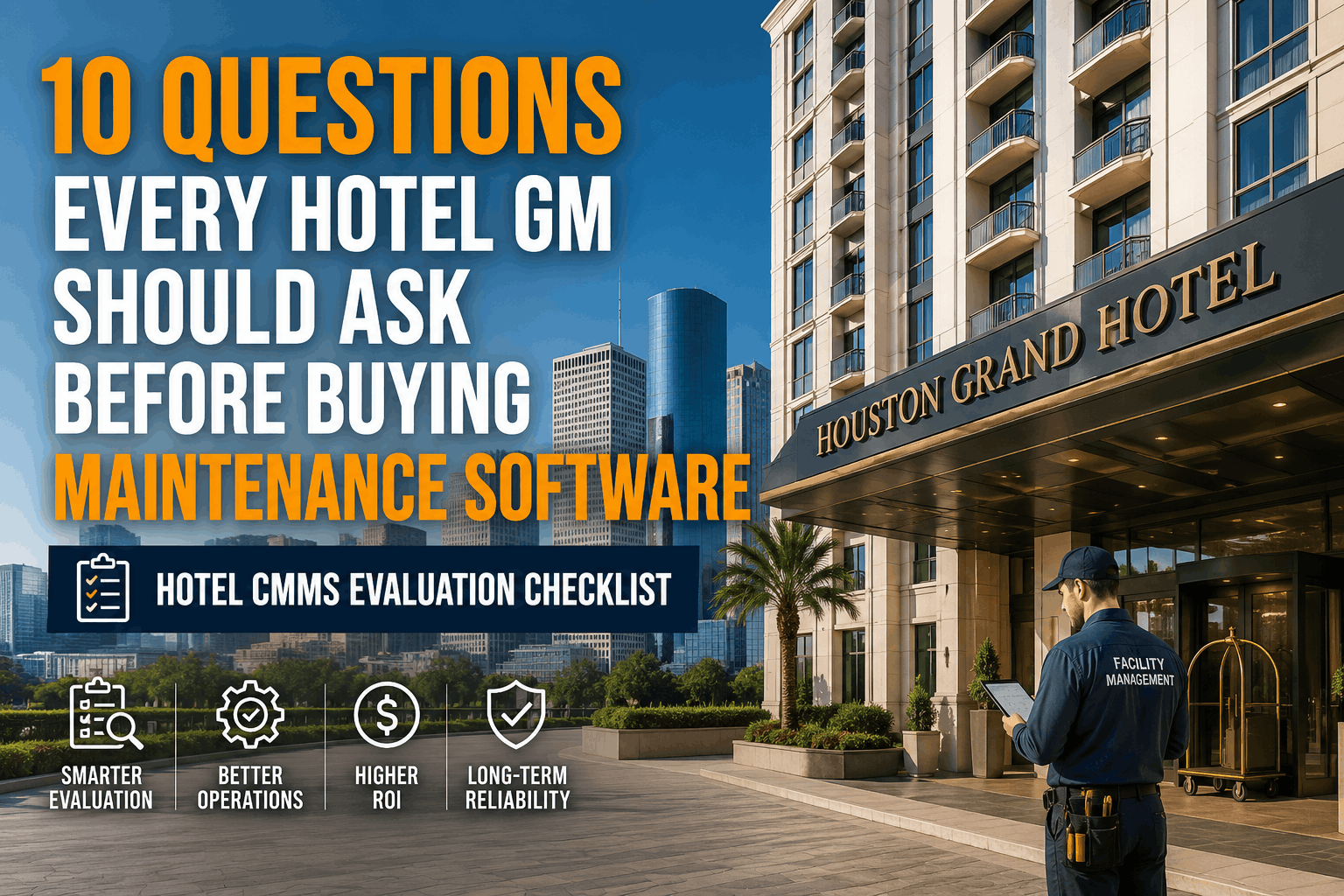
Hotel general managers and chief engineers typically approach CMMS software selection reactively — your current system breaks down, you're frustrated with manual work order processes, or a regional director mandates modernization. Most GMs evaluate platforms in 2–4 weeks, comparing features, pricing, and vendor claims without systematically asking the hard questions that determine whether a CMMS implementation succeeds or fails. That compressed timeline is exactly why hotel CMMS implementations often disappoint — you're led by vendor demos and pricing negotiations, not fundamental operational reality. After implementation, you discover that the platform handles your specific workflow poorly, integrations that vendors promised take weeks to debug, or adoption across your team stalls because the mobile app doesn't match how your technicians actually work. The right approach is different. Before committing to any hotel CMMS platform, ask ten critical questions that reveal whether the vendor truly understands hospitality operations, whether the platform's architecture actually supports your maintenance discipline, and whether implementation and support will enable success. These questions distinguish vendors who talk about hotel operations from those who've actually deployed hundreds of properties and learned from real-world challenges. Schedule a vendor conversation where you ask these questions and evaluate the answers honestly.
Why Hotel GMs Get CMMS Selection Wrong: The Evaluation Trap That Leads to Buyer's Remorse
Hotel general managers typically evaluate CMMS platforms using vendor-controlled criteria: feature checklists created by vendor marketing, pricing models designed to appear competitive, and implementation timelines that vendors quote (then routinely miss). This approach is backwards. Vendors excel at selling software; they don't disclose implementation challenges, platform limitations, or adoption risks until you're committed. Most hotel GMs spend more time negotiating the cost of a major capital equipment purchase than evaluating a CMMS platform that affects daily operations and maintenance ROI for five years. That's a mistake. The ten questions below flip the evaluation framework from vendor-friendly to reality-focused. Instead of asking "What features does your software have?" — which vendors always answer positively — ask "How does your platform handle preventive maintenance when reactive guest requests surge?" or "What's the realistic adoption timeline for non-technical maintenance teams?" These questions reveal how vendors actually support hospitality operations versus how they market generic functionality. Use these questions to evaluate OxMaint and any competing platforms you're considering.
The 10 Essential Questions: What to Ask Every Hotel CMMS Vendor Before Making Your Decision
These ten questions move evaluation from feature comparison to operational reality. Ask each question, listen to how vendors answer, and pay attention to how they handle questions that don't have easy yes/no answers. Vendors who genuinely understand hotel operations give thoughtful, detailed answers that acknowledge complexity. Vendors selling generic platforms give scripted answers that avoid specifics. Ask these questions during vendor demos and reference calls. OxMaint's team can address all ten questions with specific examples from real hotel deployments because we built the platform specifically for hospitality operations.
How Does Your Platform Prioritize Preventive Maintenance When Guest Requests and Reactive Work Surge?
Most CMMS platforms treat all work equally — guest requests enter the queue alongside preventive maintenance, and technicians work through the highest-priority items first. But hotels need different logic: critical preventive maintenance (HVAC servicing, fire suppression testing, water quality management) should be protected from reactive queue pressure. Ask vendors: How does your system reserve labor capacity specifically for preventive maintenance? Can you enforce PM scheduling even when guests submit urgent requests? OxMaint's answer: We model labor as constrained capacity and reserve specific technician hours for PM work. If PM is scheduled but reactive work surges, our system escalates the conflict and requires deliberate triage — you can't accidentally disrupt PM discipline through queue pressure alone.
What's Your Real Implementation Timeline and What Determines Whether You Hit or Miss That Target?
Vendors quote 8–12 weeks for implementation, but most hotels experience 16–24 weeks from kickoff to full deployment. Ask: What does implementation include? Who handles PMS integration (you or us)? How long does data migration realistically take? What percentage of hotels complete deployment on schedule? Most vendors can't answer honestly because implementation is subcontracted to regional partners with inconsistent quality. OxMaint's answer: 60–90 days typical implementation with dedicated team ownership. We quote implementation scope upfront: data migration, PMS setup, team training, post-launch stabilization. If timeline slips, it's our responsibility, not yours.
How Do You Handle Mobile-First Technician Dispatch and Offline Work Logging for Multi-Story Buildings?
Many CMMS platforms offer mobile apps, but they're often thin clients requiring constant internet connectivity. In multi-story hotels with basement mechanical rooms and underground parking, connectivity drops. If a technician loses connection mid-job, they can't log work. Ask vendors: Does your mobile app work offline? Can technicians receive task assignments, update status, and log parts without internet? OxMaint's answer: Full offline functionality. Technicians download their task list, work without connection, and data syncs when internet returns. No manual re-entry, no connectivity pressure affecting work logging.
What's Your Realistic Adoption Timeline for Non-Technical Maintenance Teams and How Do You Handle Training?
Hotel maintenance teams range from highly technical (resort properties) to operationally focused (boutique hotels). One vendor's "60-day adoption" assumes tech-savvy teams; other properties need 6+ months to reach proficiency. Ask vendors: What training model do you use? Do you provide ongoing support or one-time training? How do you handle technicians who resist mobile-first workflows? OxMaint's answer: Mobile-native design means adoption is natural — technicians prefer mobile dispatch to paper work orders. We provide role-based training (different for technicians, supervisors, admins) and 30-day post-launch support. Most teams hit productivity within 60–90 days; outliers get extended support at no cost.
How Do You Integrate with Our PMS and What Happens If Integration Fails or Requires Customization?
Every vendor claims PMS integration, but "integration" often means manual data export/import or limited read-only access. Real integration means work orders flow automatically between PMS (guest requests) and CMMS (maintenance dispatch), and completed work updates back to PMS for guest communication. Ask vendors: Do you have pre-built connectors for our PMS? What does integration cost? If our PMS version isn't supported, how do you handle customization? OxMaint's answer: Pre-built connectors for major PMS platforms (Amadeus, Opera, Cloudbeds). Full API access for custom integrations. If your PMS isn't supported, we build connector as part of implementation — no surprise fees.
What Happens When We Need to Customize Workflows or Reports That Your Standard Product Doesn't Support?
No two hotels operate identically. Your approval workflows, reporting requirements, or equipment classification schemes likely differ from vendor defaults. Ask vendors: How flexible is your platform for customization? What does custom development cost? Who owns custom code if we move vendors later? Enterprise CMMS vendors often respond "we can customize it" without discussing cost or timeline. OxMaint's answer: Hotel-native templates handle 90% of workflows without customization. When customization is needed, our configuration engine (no coding required) covers most cases. Complex custom development is possible but rare for hotels using our standard framework.
What's Your Pricing Model and What's Realistically Included in Your Quoted Price Versus What Costs Extra?
Vendor pricing is deliberately opaque. Software license price is quoted upfront, but implementation, training, integration, customization, and support all cost extra. Ask vendors: Does your quote include implementation? Training? PMS integration setup? Support in first year? Customization? Get vendors to specify exactly what's included in the quote and what costs additional. OxMaint's answer: Our per-property pricing includes everything — software, implementation support, training, integrations, and support. No hidden add-on costs. What you see quoted is what you pay for 12 months, period.
How Do You Support Hotels Post-Launch and What's Your SLA for Bug Fixes, Feature Requests, and Emergency Issues?
Post-launch support is where many vendor relationships deteriorate. You hit production issues, support is slow or unavailable, and your maintenance operations suffer. Ask vendors: What support SLA do you offer? (Response time for critical issues, bug fix turnaround, feature request roadmap). Is support included in pricing or charged separately? What's your support team size? OxMaint's answer: 24/7 support with 1-hour response for critical issues affecting operations. Bug fixes deploy within 48 hours. All support included in pricing — no tiered support tiers.
Can You Provide References From Hotel Customers Similar to Our Property Type and Give Us Direct Access to Their Experience?
Vendor references are typically pre-screened advocates. More valuable are peer customers who've experienced similar challenges to yours. Ask vendors: Can we contact 3–5 customers who've deployed your platform at similar property types (boutique, mid-size, resort)? Can we ask them about implementation challenges they experienced? How did you handle issues? OxMaint's answer: We provide references from boutique chains, independent operators, and portfolio managers in your region. Our customer success team can facilitate conversations and answer questions without scripting.
What's Your Long-Term Product Vision and How Do You Ensure Our Investment Isn't Stranded on a Declining Platform?
Hotel technology vendors consolidate frequently. Your platform vendor might be acquired, sunset legacy products, or shift focus to different verticals. Ask vendors: What's your product roadmap for the next 3–5 years? Are you actively investing in hospitality-specific features or shifting focus? What happens to my data if you're acquired? OxMaint's answer: We're hospitality-focused entirely — every product decision is driven by hotel operations. We're growing in hospitality, not diversifying away. Your data is portable through standard APIs if you ever choose to move.
How to Structure Your Vendor Evaluation Process for Maximum Clarity and Minimum Surprises
Asking the right questions is half the battle; structuring your evaluation process to compare answers systematically is the other half. Most hotel GMs evaluate vendors sequentially (meet with Vendor A, then B, then C), making comparison difficult and last-impression bias likely. Instead, use a structured evaluation rubric that keeps vendors accountable to identical criteria. Create a simple scorecard with the ten questions above, score each vendor's answers (1–5 scale), and compare total scores. This removes emotion from the decision and forces focus on operational reality. Schedule vendor demos on the same day or within a few days so answers are fresh. Most importantly, include your facility manager and chief engineer in the evaluation — they'll ask different questions and catch platform limitations that GMs miss.
Create Your Evaluation Rubric (Week 1)
Document the ten questions above and your property's specific requirements (property size, staffing, asset complexity, current pain points). Weight questions based on importance to your operations (e.g., mobile dispatch might be critical, customization less important). Create a scoring rubric (1–5 scale) so you can quantify vendor responses and compare objectively.
Identify 3–4 Candidate Vendors and Schedule Vendor Conversations (Week 1–2)
Research CMMS platforms designed for hospitality (HotSOS, Quore, OxMaint, Maintenance Connection, etc.). Narrow to 3–4 finalists based on reputation, pricing transparency, and hospitality focus. Schedule vendor demos on the same day if possible, or within 48 hours of each other to keep responses comparable.
Conduct Vendor Demos and Ask the 10 Questions (Week 2–3)
Attend each vendor demo with your facility manager and chief engineer. Use the evaluation rubric — ask each vendor the same ten questions and take notes on specific answers. Request live demos showing mobile dispatch, preventive maintenance scheduling, and PMS integration rather than pre-canned presentations. Score each answer on your rubric immediately after the demo.
Contact Customer References and Validate Vendor Claims (Week 3–4)
Request references from each vendor and contact 2–3 customers directly. Ask about implementation timeline accuracy, post-launch support quality, adoption challenges, and whether they'd recommend the vendor. Use these conversations to validate or challenge vendor claims about adoption speed, feature capability, and support SLA.
Negotiate Pricing and Implementation Commitments (Week 4–5)
Based on your evaluation scores, select a top choice and negotiate. Demand fixed implementation cost (not open-ended consulting), specify what's included in quoted pricing, establish support SLA, and get realistic implementation timeline in writing. Use your evaluation rubric to justify selection to ownership and regional management.
Frequently Asked Questions: Hotel CMMS Software Evaluation and Vendor Selection
How long should a hotel CMMS evaluation typically take from initial vendor conversation to vendor selection?
Structured evaluation typically takes 4–6 weeks: week 1 planning, weeks 2–3 vendor demos and scoring, week 4 reference calls, weeks 4–5 negotiation and contract. Rushed evaluations (2–3 weeks) often result in poor vendor fit and buyer's remorse. Allow sufficient time for team input and customer reference validation.
What's the most common reason hotel CMMS implementations disappoint, and how can I prevent it during vendor evaluation?
Most disappointment comes from adoption failure — teams don't use the platform as envisioned, and ROI never materializes. Prevent this by: (1) asking detailed questions about mobile usability and adoption support, (2) involving your facility team in vendor demos, (3) contacting customer references and asking specifically about adoption challenges.
Should I prioritize hotel-specific CMMS platforms (designed for hospitality) or enterprise CMMS platforms with hotel modules?
Hotel-specific platforms are typically better choice. They understand occupancy constraints, guest-facing priorities, and labor challenges unique to hospitality. Enterprise platforms with "hotel modules" often feel bolted-on and struggle with hospitality-specific workflows. For hotels, specialized beats generic every time.
What questions should I specifically ask vendor references to validate whether platform fits our property?
Ask references: Was implementation on-time and on-budget? What adoption challenges did your team face? Would you recommend this vendor? What surprised you negatively after deployment? How responsive is vendor support? These conversations reveal operational reality that vendor demos hide.
How should I involve my chief engineer and facility manager in CMMS vendor evaluation?
Include them in vendor demos — they'll ask technical questions that GMs miss. Their buy-in is essential for post-launch adoption. Use their feedback in your evaluation rubric; operators' perspectives often catch platform limitations that management-level questions don't reveal.
What red flags should I watch for during vendor conversations that indicate the platform might not fit hotel operations?
Red flags: (1) Vendor can't explain how they handle PM discipline under reactive pressure, (2) Implementation timeline is vague ("8–12 weeks typically"), (3) Support SLA is undefined, (4) References are limited or unavailable, (5) Pricing has hidden add-ons, (6) Vendor emphasizes features over outcomes. Trust your instincts.
Should I pilot CMMS software with one property before rolling out across a portfolio?
Absolutely recommend piloting — especially for multi-property operators. Pilot at your most challenging property (oldest assets, highest occupancy, most complex workflows) so you understand platform capability in stress conditions. Success at your hardest property often means success everywhere.
What questions should I ask about implementation costs and timeline to ensure vendor doesn't surprise me with expenses or delays?
Demand: (1) Fixed implementation cost in writing (not time-and-materials), (2) Detailed scope of what's included (data migration, PMS setup, training), (3) Realistic timeline with specific delivery dates, (4) Support plan for post-launch issues. Make implementation details contractual, not aspirational.