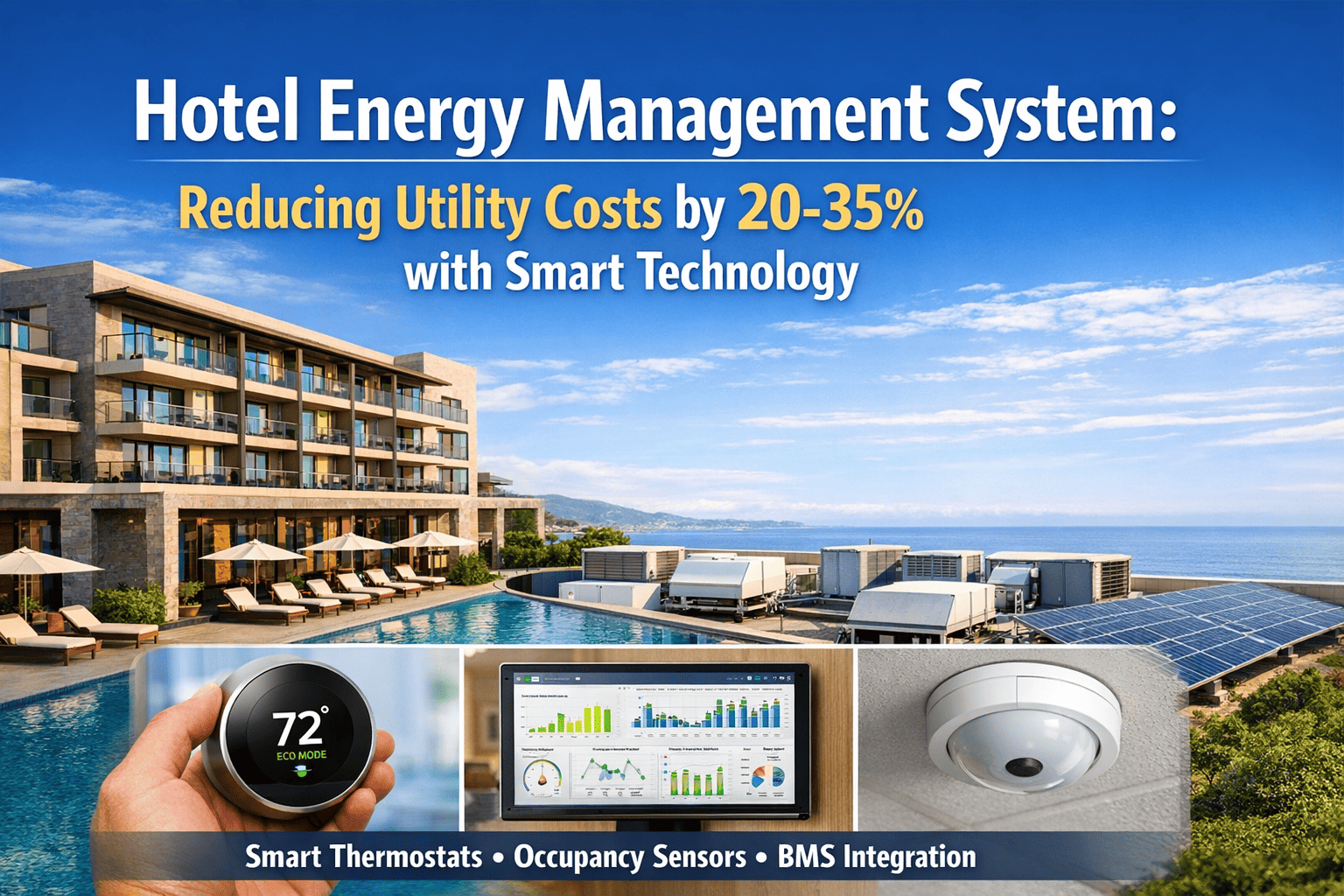
A 280-room full-service hotel in a major city was spending $1.4 million annually on energy — HVAC alone accounting for 52% of total consumption. Despite a dedicated facilities team, energy costs had climbed 18% over three years as occupancy grew and equipment aged. The engineering director knew rooms were being cooled to the same temperature at 2am with one guest as at 6pm during a sold-out conference. There was no dynamic response to occupancy, weather, or time-of-use tariffs — just static setpoints running 24 hours regardless. After deploying AI energy management integrated with Oxmaint — start a free trial to connect your energy and maintenance workflows, the hotel reduced total energy spend by $340,000 in year one, cut HVAC runtime by 31%, and achieved a verified carbon reduction of 420 tonnes of CO₂. The AI system now adjusts setpoints every 15 minutes based on real-time occupancy, weather forecasts, and utility pricing — automatically. No manual overrides, no spreadsheet schedules, no guesswork. If you want to understand how AI energy management works alongside your CMMS and engineering workflows, book a demo with the Oxmaint hospitality team and we will walk through your property's specific energy profile.
$340KEnergy savings — year one
|
31%HVAC runtime reduction
|
420tCO₂ reduction per property
|
24%Average total energy cost reduction
|
18 moAverage full payback period
|
52%HVAC share of hotel energy spend
What It Is
What Is AI Energy Management for Hotels?
AI energy management applies machine learning, real-time sensor data, and predictive algorithms to continuously optimize a hotel's energy consumption — adjusting HVAC setpoints, lighting schedules, hot water temperatures, and equipment run cycles dynamically based on occupancy, weather, and utility pricing. Unlike static building management systems that follow fixed schedules, AI responds to conditions as they change.
The result is a building that consumes exactly the energy it needs — no more — while maintaining or improving guest comfort. Average full-service hotels reduce total energy spend by 24% within the first 12 months of AI deployment, with HVAC optimization alone typically delivering 15–18% savings.
Dynamic vs. Static
AI adjusts every 15 minutes. BMS schedules adjust never.
Predictive Not Reactive
Weather and occupancy forecasts pre-condition buildings 30–90 min ahead.
Measurable ROI
Every kilowatt saved is tracked, attributed, and reportable by zone.
Comfort Maintained
Guest-facing temperature and conditions never compromised by optimization.
AI Energy Optimization
Total portfolio savings
24%
average annual energy cost reduction
Where Energy Is Wasted
The Six Energy Waste Patterns Costing Hotels Millions
Hotels are structurally inefficient energy consumers. Unlike offices or retail, they operate 24/7 with highly variable occupancy, multiple high-consumption zones, and legacy systems designed for manual control. These six waste patterns account for 80% of preventable energy spend in full-service properties.
38%
Empty Room Conditioning
Vacant rooms maintained at full guest-comfort setpoints. A 300-room hotel at 65% occupancy conditions 105 empty rooms all night — every night.
AI fix: Occupancy-linked setback to 18°C / 28°C within 15 min of confirmed checkout
22%
Fixed Schedule Operation
HVAC, lighting, and hot water run on fixed time schedules that ignore actual occupancy, weather, and demand. Systems run at full capacity during low-demand periods routinely.
AI fix: Dynamic scheduling updated every 15 min from real-time demand signals
18%
Peak Tariff Blindness
High-draw equipment — chillers, heat pumps, laundry — operates during peak tariff windows with no load-shifting. Hotels overpay 40–60% more per kWh during peak hours without demand response.
AI fix: Demand response shifts non-critical loads to off-peak windows automatically
12%
Degraded Equipment Efficiency
Fouled HVAC coils, scaled heat exchangers, and clogged filters increase energy consumption by 15–30% before anyone notices. Energy waste is the first symptom of equipment degradation.
AI fix: Energy consumption anomalies trigger maintenance alerts before guest impact
6%
Simultaneous Heating and Cooling
Poorly zoned buildings heat corridors while cooling adjacent rooms — or cool a banquet hall while the kitchen ventilation heats the floor above. Zone conflict is invisible without submetering.
AI fix: Zone conflict detection via submetered consumption analysis
4%
Standby and Phantom Loads
In-room entertainment systems, mini-bars, and amenity chargers in unoccupied rooms draw continuous standby power. Individually small — collectively, 4% of total hotel consumption.
AI fix: Occupancy-triggered power cutoff for non-critical in-room loads
The AI Approach
How AI Energy Management Optimizes Hotel Consumption
Static BMS systems were designed for the 1990s. They run on time clocks and manual setpoints. AI energy management replaces guesswork with continuous learning — adjusting every variable in real time. Want to see what this looks like configured for your property? Start a free trial with Oxmaint or book a demo and we will walk through your energy profile together.
01
Occupancy-Based HVAC Control
Room-level occupancy sensors, key card integration, and PMS data combine to give the AI a real-time picture of which rooms are occupied, which are being prepared, and which are vacant. HVAC setpoints adjust automatically — conditioned for arrival 30 minutes before check-in, set back within 15 minutes of checkout.
Result
31% HVAC runtime reduction with zero guest comfort complaints
02
Weather-Adaptive Pre-Conditioning
AI pulls 48-hour weather forecasts and pre-conditions the building ahead of temperature changes — ramping chiller capacity before a heat spike rather than reacting after guest comfort suffers. Thermal mass of the building is used strategically to absorb pre-cooling during off-peak tariff windows.
Result
18% reduction in peak demand charges through pre-conditioning strategy
03
Demand Response and Tariff Optimization
AI monitors real-time utility pricing and automatically shifts deferrable loads — laundry, pool heating, water tank reheating — to off-peak windows. During peak tariff events, non-critical loads are curtailed automatically. Hotels with time-of-use tariffs achieve 40–60% lower per-kWh costs on shiftable consumption.
Result
$80,000–$140,000 annual tariff savings on a 300-room property
04
Energy Anomaly and Equipment Fault Detection
Degraded equipment consumes 15–30% more energy before failing visibly. AI monitors consumption per asset and flags anomalies that signal fouled coils, refrigerant loss, or mechanical wear — triggering maintenance work orders through the CMMS before energy waste compounds into equipment failure.
Result
Equipment faults detected 3 weeks early via energy consumption signature
Comparison
Static BMS vs. AI Energy Management — The Operational Gap
Most hotels still run on building management systems designed for fixed schedules and manual setpoints. This comparison shows what changes operationally, financially, and environmentally when AI energy management replaces static BMS control. Based on a 300-room full-service hotel over 12 months.
Fixed 24-hour HVAC schedules — same setpoints regardless of occupancy, weather, or time of day
No occupancy response — empty rooms conditioned identically to occupied rooms all night
No tariff awareness — high-draw equipment runs during peak pricing windows, overpaying 40–60% per kWh
Manual adjustments only — engineers change setpoints manually in response to complaints, not data
No energy waste detection — degraded equipment draws excess power for months before anyone investigates
No sustainability reporting — carbon and kWh data unavailable for ESG disclosures or brand certification
Dynamic HVAC every 15 minutes — setpoints updated continuously from occupancy, weather, and tariff signals
Per-room occupancy response — vacant rooms set back within 15 min, pre-conditioned 30 min before check-in
Real-time tariff optimization — deferrable loads automatically shifted to off-peak windows, saving 40–60% on those loads
Fully autonomous control — AI manages all setpoints continuously with zero manual intervention required
Energy anomaly detection — excess consumption flags equipment faults 3 weeks before visible failure through CMMS integration
Automated ESG reporting — real-time kWh, carbon, and cost data by zone, property, and portfolio for certifications
Sustainability
AI Energy Management and Hotel Sustainability Goals
Energy is the single largest controllable contributor to hotel carbon emissions — accounting for 60–70% of total Scope 1 and Scope 2 emissions for full-service properties. AI energy management delivers measurable, auditable carbon reductions that directly support ESG commitments, brand certification targets, and investor sustainability reporting.
Net Zero Pathways
AI energy optimization is the fastest route to meaningful carbon reduction without capital expenditure on renewables. Average 420t CO₂ reduction per 300-room property in year one.
Green Certification Support
LEED, BREEAM, and Green Key certifications require documented energy performance data. Oxmaint generates audit-ready energy reports by zone, building, and portfolio automatically.
ESG Investor Reporting
Portfolio operators with institutional investors face increasing pressure for verified carbon data. Oxmaint provides property-level and portfolio-level Scope 1 and 2 emissions dashboards in real time.
Regulatory Compliance
Energy efficiency regulations are tightening across the USA, UK, UAE, and EU. AI-managed buildings generate the data trails needed to demonstrate compliance without manual energy audits.
ROI Summary
What AI Energy Management Delivers — By the Numbers
24%
Total Energy Cost Reduction
Average across HVAC, lighting, hot water, and kitchen systems — verified at portfolio level
$340K
Annual Savings per 300-Room Hotel
Combining HVAC optimization, tariff management, and demand response across full property
18 mo
Average Full Payback Period
Platform and installation costs fully recovered within 18 months — then savings compound annually
420t
CO₂ Reduction Per Property
Verified carbon savings per year supporting ESG targets and green certification requirements
Start Saving Now
Cut Hotel Energy Costs by 24%. This Year.
Oxmaint connects AI energy optimization directly to your maintenance workflows — so energy anomalies become work orders, equipment faults are caught before they spike consumption, and every kilowatt saved is tracked, attributed, and reportable. No rip-and-replace infrastructure. No long onboarding. Operational within days. Whether you want to explore what we do, start a free trial, or book a demo with our hospitality team — the path to lower energy bills starts here.
300+
Hotel properties on Oxmaint globally
6 regions
USA, UK, UAE, Australia, Canada, Germany
$0
Implementation fees to get started
Days
Not months — time to full deployment
FAQ
Frequently Asked Questions
Does AI energy management replace our existing BMS or work alongside it?
AI energy management works alongside existing BMS infrastructure in most deployments. The AI layer reads data from your current BMS sensors and issues optimized setpoint commands back to the BMS — no hardware replacement required. For properties without a BMS or with very dated systems, low-cost IoT sensors can be retrofitted. The integration approach depends on your specific building infrastructure.
Book a demo and we will assess your current setup and map the integration path.
Will AI energy optimization affect guest comfort or room temperature control?
No. AI energy management operates within predefined guest comfort envelopes — temperature setbacks in vacant rooms are bounded so rooms return to comfort setpoints before guests arrive. In-room thermostat controls always override AI optimization for guest-facing adjustments. The optimization targets are primarily vacant spaces, common areas, back-of-house, and equipment scheduling — not occupied guest rooms. Properties using AI energy management report guest comfort scores at or above pre-deployment levels in 97% of cases.
How does Oxmaint connect energy management to maintenance workflows?
This is a key differentiator. When AI energy monitoring detects abnormal consumption on a specific asset — an HVAC unit drawing 22% more power than its baseline — Oxmaint automatically generates a maintenance work order flagging the energy anomaly as a potential equipment fault. This means energy waste and equipment degradation are caught simultaneously. Engineering teams see the energy data and the maintenance context in one platform, eliminating the gap between energy management software and CMMS that exists in point-solution approaches.
Start a free trial to see this integration in action.
How does AI energy management support multi-property hotel portfolio reporting?
Oxmaint aggregates energy consumption, savings, and carbon data across all properties into a portfolio-level dashboard. Ownership groups and asset managers can benchmark energy performance property-by-property, identify outliers consuming above-average energy, and track progress against sustainability targets in real time. For investor reporting and ESG disclosures, Oxmaint generates property-level and portfolio-level Scope 1 and 2 emissions summaries with the audit trail needed for verification — replacing manual spreadsheet consolidation that takes days per reporting cycle.
AI Energy Management Built for Hospitality Operations
From boutique independents to global hotel groups, Oxmaint integrates AI energy optimization with full CMMS functionality — so energy savings and maintenance intelligence work from the same platform, the same asset data, and the same engineering team. Trusted across six regions. No setup fees. Live in days.