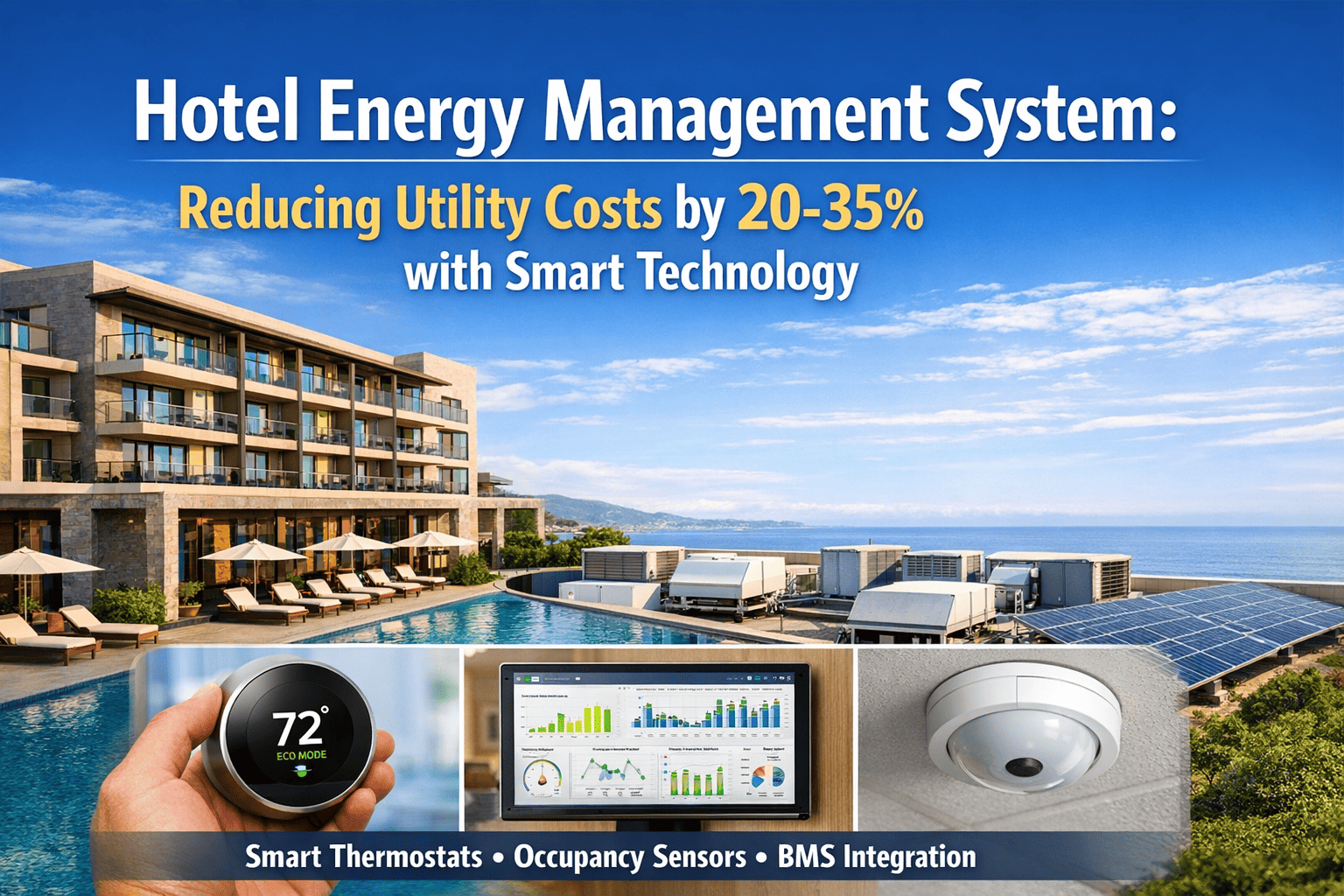
A boutique hotel in Miami reduced annual energy costs from $127,000 to $84,500—a 33% reductionnot through capital-intensive equipment replacement, but by optimizing the energy management system already installed but poorly configured. The culprit HVAC systems running full capacity in vacant rooms, lobby lighting operating 24/7 regardless of occupancy water heaters maintaining peak temperatures overnight when demand was minimal, and no integration between reservation data and climate control schedules. This scenario repeats across thousands of hotels where installed EMS technology operates at perhaps 30% of its optimization potential. According to the U.S. Department of Energy, hotels implementing comprehensive EMS optimization strategies achieve 25-35% energy cost reductions with typical payback periods under 18 months. The opportunity isn't installing new systems—it's unlocking the capabilities already present in existing infrastructure through strategic configuration, integration, and continuous optimization.
Advanced Intelligence Layer
Predictive Analytics
Machine Learning Optimization
Demand Response Integration
Automated Control Systems
Occupancy-Based HVAC
Smart Lighting Controls
Integrated Scheduling
Zone Management
Foundation Energy Controls
Programmable Thermostats
Timer Controls
Manual Monitoring
Basic Setbacks
Equipment Scheduling
Critical Energy Management Strategies for Hotel Operations
The International Facility Management Association identifies six core EMS optimization strategies that deliver measurable ROI across all hotel segments. These aren't theoretical concepts—they're proven interventions validated through thousands of implementations showing consistent 20-35% energy cost reductions. Occupancy-based climate control automatically adjusts HVAC in guest rooms based on reservation status and real-time occupancy detection. Intelligent scheduling aligns equipment operation with actual demand patterns rather than arbitrary time blocks. Zone-based management optimizes different areas independently—guest rooms, meeting spaces, back-of-house, public areas—each with appropriate control strategies. Demand limiting prevents costly peak charges by strategically load-shedding non-critical systems during high-demand periods. Real-time monitoring provides visibility into consumption patterns enabling rapid identification of waste and anomalies. Integration with property management systems enables predictive optimization based on booking forecasts and occupancy projections.
01
Occupancy-Based HVAC Control
Integration: PMS + Occupancy Sensors + HVAC Automation
Savings:
18-25% HVAC costs
Impact: Vacant rooms automatically set to energy-saving temperatures; occupied rooms pre-conditioned before arrival
Implementation: 2-4 weeks with existing infrastructure integration
02
Intelligent Equipment Scheduling
Strategy: Align operation with actual demand vs. fixed schedules
Savings:
12-18% overall energy
Impact: Water heaters, pool systems, ventilation match occupancy patterns; eliminates unnecessary runtime
Target: Equipment runs only when needed based on occupancy forecasts
03
Demand Limiting & Peak Shaving
Method: Strategic load shedding during peak demand periods
Savings:
15-30% demand charges
Impact: Automatically curtails non-critical loads (laundry, storage cooling) when approaching peak demand thresholds
Critical: Demand charges often represent 30-40% of utility bills
04
Zone-Based Temperature Control
Approach: Independent setpoints for different building zones
Savings:
8-15% HVAC energy
Impact: Guest rooms, lobby, meeting rooms, back-of-house each optimized for usage patterns vs. single building setpoint
Best Practice: 5-8 degree setback in unoccupied zones
05
Smart Lighting Automation
Technology: Occupancy sensors + daylight harvesting + scheduling
Savings:
40-60% lighting costs
Impact: Automatic shutoff in vacant areas, dimming during daylight hours, scheduled reduction during low-occupancy periods
ROI: Typically 12-18 months when combined with LED retrofit
06
Real-Time Energy Monitoring
System: Continuous tracking with automated anomaly detection
Savings:
5-12% via waste identification
Impact: Identifies equipment malfunctions, unauthorized usage, inefficient patterns; enables immediate intervention
Essential: Dashboard visibility drives accountability and continuous improvement
The American Hotel & Lodging Association benchmarking reveals that properties implementing all six strategies achieve cumulative savings of 32-38% compared to baseline consumption. Importantly, these aren't mutually exclusive interventions requiring sequential implementation—they work synergistically. Occupancy-based HVAC becomes more effective when combined with zone controls and intelligent scheduling. Demand limiting works best alongside real-time monitoring that predicts approaching peak thresholds. Properties using integrated energy management platforms—start optimizing free today implement all six strategies through unified dashboards rather than managing separate point solutions.
Equipment-Specific Optimization Strategies
Generic building-wide energy strategies must be supplemented with equipment-specific optimization addressing the unique characteristics of hotel systems. HVAC represents 40-50% of total energy consumption, making it the highest-priority optimization target. Water heating consumes 20-25% of energy budgets. Lighting accounts for 15-20%. Kitchen equipment, laundry systems, and pool heating comprise the remaining 10-25%. Each system requires tailored optimization approaches beyond simple scheduling or setbacks.
HVAC Systems
Occupancy-Based Setbacks
80°F cooling / 65°F heating (vacant)
Variable Speed Drive Integration
20-30% fan energy reduction
Economizer Optimization
Free cooling when outdoor temp permits
Optimal Start/Stop Algorithms
Pre-condition only as needed
40-50% of energy budget—every 1°F setback saves 3% annually
Water Heating Systems
Time-of-Day Temperature Adjustment
Lower setpoint during low-demand hours
Heat Recovery Integration
Capture HVAC waste heat
Tank Insulation Upgrades
Reduce standby losses 25-40%
Point-of-Use Systems
Eliminate distribution losses
20-25% of energy costs—maintenance critical for efficiency
Lighting Systems
Motion Sensor Controls
Auto-off in vacant areas
Daylight Harvesting
Dim/off when natural light sufficient
LED Conversion
60-75% energy reduction vs incandescent
Scheduled Dimming
Reduce levels during low-activity periods
15-20% of energy—highest ROI optimization target
Kitchen Equipment
Equipment Right-Sizing
Match capacity to actual demand
Cooking Equipment Scheduling
Power down between service periods
Refrigeration Optimization
Night setback, strip curtains, maintenance
Ventilation Demand Control
Vary exhaust based on cooking activity
High-intensity loads—strategic scheduling essential
Laundry Systems
Off-Peak Scheduling
Shift loads to lower-rate periods
Cold Water Washing
90% of loads don't require hot water
Heat Recovery Integration
Capture dryer exhaust heat
High-Efficiency Equipment
Energy Star rated replacements
Dual energy/water savings opportunity
Pool & Spa Systems
Variable Speed Pump Control
50-70% pump energy reduction
Pool Cover Deployment
Reduce heat loss 50-70%
Solar Heating Integration
Offset gas/electric heating costs
Temperature Optimization
Lower setpoint during low-use periods
High heating loads—automation delivers major savings
HVAC optimization particularly deserves comprehensive attention given its dominant share of energy consumption. The Department of Energy confirms that properly configured HVAC automation delivers 18-25% energy savings compared to manual or poorly optimized systems. For a boutique property spending $60,000 annually on HVAC-related energy, this represents $10,800-$15,000 in annual savings achievable through optimization without equipment replacement. Key interventions include occupancy-based setbacks (8-10°F in vacant rooms), optimal start/stop algorithms that pre-condition spaces based on thermal mass and outdoor conditions, economizer controls maximizing free cooling when outdoor temperatures permit, and variable speed drives allowing equipment to operate at partial capacity matching actual loads rather than full on/off cycling.
Optimize Your Energy Management Today
Oxmaint integrates with your existing BMS and PMS to enable occupancy-based controls, intelligent scheduling, and real-time energy monitoring—unlocking 25-35% savings from infrastructure you already own.
Industry Benchmarks: Energy Performance Comparison
Understanding your property's energy performance requires context—absolute consumption values mean little without comparison to similar properties. The Energy Star Portfolio Manager establishes normalized benchmarks accounting for property size, climate zone, occupancy rates, and amenity mix. For boutique hotels (30-100 rooms), energy intensity typically ranges from 95-165 kWh per square meter annually. Properties in the top performance quartile (most efficient) achieve 95-115 kWh/m²/year through systematic EMS optimization. Median performers consume 120-140 kWh/m²/year with basic controls. Bottom-quartile properties exceed 145 kWh/m²/year due to poor optimization or deferred maintenance.
Energy Use Intensity (kWh/m²/year)
Top Quartile (Optimized EMS)
Bottom Quartile (Poor Optimization)
33% gap between top and bottom quartiles = $45,000/year savings opportunity (50-room property)
Energy Cost per Available Room/Year
$930/room annual gap = $27,900/year for 30-room property through EMS optimization
HVAC Energy as % of Total
Lower percentage indicates efficient HVAC controls and zone optimization
Demand Charges as % of Electric Bill
Demand limiting automation reduces costly peak charges by 30-50%
Energy Waste from Vacant Rooms (%)
Occupancy-based automation virtually eliminates vacant room waste
EMS ROI Payback Period (months)
Optimizing existing infrastructure delivers fastest ROI vs. equipment replacement
The benchmarking data validates a critical insight: the performance gap between top and bottom quartiles isn't primarily about equipment quality—it's about optimization sophistication. Properties with 15-year-old HVAC systems achieve top-quartile energy intensity through intelligent controls, while properties with brand-new equipment languish in the bottom quartile due to poor configuration and lack of automation. This represents opportunity: moving from median to top-quartile performance requires optimizing systems already installed rather than capital-intensive equipment replacement. For properties seeking energy optimization roadmaps—schedule assessment, benchmarking reveals exactly where focus delivers maximum ROI.
The 5-Phase EMS Optimization Implementation Framework
Systematic energy optimization follows a proven methodology that minimizes disruption while delivering measurable results. Rushing implementation creates guest comfort issues and staff resistance. The following framework, refined through deployments at hundreds of properties, achieves 25-35% energy reductions while maintaining service quality and guest satisfaction.
Utility Analysis
Review 12-24 months billing history, identify rate structure, calculate baseline consumption normalized for occupancy and weather
Equipment Inventory
Catalog all major energy-consuming systems, document current control strategies, assess automation capabilities
Waste Identification
Walk property identifying obvious waste: lighting 24/7, HVAC in vacant rooms, equipment running unnecessarily
Setpoint Optimization
Adjust thermostats to efficient ranges: 72-74°F cooling, 68-70°F heating in occupied spaces; aggressive setbacks in vacant areas
Equipment Scheduling
Implement time-based controls for lighting, ventilation, water heaters, pool systems based on actual usage patterns
Behavioral Changes
Train staff on energy-conscious practices, establish equipment shutdown protocols, implement energy awareness program
PMS Integration
Connect reservation system to HVAC controls enabling occupancy-based automation, pre-arrival conditioning, checkout setbacks
Sensor Deployment
Install occupancy sensors in meeting rooms, back-of-house areas, public spaces; integrate with lighting and HVAC
Monitoring Platform
Deploy real-time energy tracking dashboard with automated alerts for anomalies and opportunities
Demand Limiting
Configure automated load shedding to prevent peak demand charges; prioritize critical vs. deferrable loads
Predictive Controls
Implement optimal start/stop algorithms, weather-based adjustments, occupancy forecasting for proactive conditioning
Zone Optimization
Refine independent controls for guest rooms, meeting spaces, F&B areas, back-of-house matching usage patterns
Phase 5: Continuous Improvement (Ongoing)
Monthly performance reviews, quarterly optimization adjustments, annual benchmarking analysis, ongoing training and refinement. Target: 2-3% annual efficiency improvement through continuous optimization.
The phased approach ensures quick wins (Phase 1-2) fund subsequent investment in automation (Phase 3-4) while maintaining operational stability throughout. Properties typically achieve 10-15% savings from Phases 1-2 alone—interventions requiring minimal investment completed within 4-6 weeks. These initial savings validate the program and generate enthusiasm for subsequent automation phases. The full 25-35% savings potential materializes after completing Phase 4, with continuous improvement (Phase 5) preventing performance degradation over time. Properties using integrated platforms—explore implementation support compress timelines by 30-40% through pre-built integrations and guided workflows.
Expert Analysis: The Future of Hotel Energy Management
The next evolution in hotel energy management isn't more sophisticated equipment—it's artificial intelligence that learns from property-specific patterns and optimizes continuously without human intervention. Machine learning algorithms analyze thousands of variables: historical occupancy patterns, weather forecasts, energy pricing fluctuations, equipment performance characteristics, guest comfort preferences. These systems predict optimal HVAC pre-conditioning timing, automatically adjust setpoints based on forecasted conditions, and identify degrading equipment performance before efficiency drops become apparent. The competitive advantage goes not to properties with the newest building automation systems, but to those leveraging AI to extract maximum value from existing infrastructure through intelligent, adaptive optimization.
Predictive Optimization
AI-powered EMS platforms now predict energy demand 24-72 hours ahead based on reservation data, weather forecasts, and historical patterns. This enables proactive load management, time-of-use rate optimization, and pre-emptive demand limiting—delivering 15-25% additional savings beyond traditional automation.
Autonomous Performance Tuning
Self-learning systems continuously refine control strategies based on outcomes. If HVAC pre-conditioning starts too early (wasting energy) or too late (guest discomfort), the system automatically adjusts timing. This eliminates the manual tuning and seasonal adjustments that traditional EMS requires.
Equipment Health Monitoring
IoT sensors tracking equipment energy signatures detect degrading performance before failures occur. A 12% increase in HVAC energy consumption for the same cooling output indicates refrigerant loss, dirty coils, or mechanical issues—triggering maintenance before efficiency drops further or catastrophic failure happens.
The convergence of AI optimization, IoT sensing, and cloud-based analytics creates capabilities impossible with traditional building automation alone. Properties implementing these technologies report 8-15% additional energy savings beyond conventional EMS optimization—while simultaneously improving equipment reliability and extending asset life through predictive maintenance. The key isn't abandoning proven strategies like occupancy-based controls and intelligent scheduling, but rather layering machine learning that continuously refines how these strategies execute based on actual performance outcomes rather than static programming.
Ready to Optimize Your Energy Performance
Oxmaint integrates energy management with maintenance operations, connecting equipment performance to energy efficiency. Identify waste, automate controls, and achieve 25-35% cost reductions through intelligent optimization of existing infrastructure.
Frequently Asked Questions
What's the fastest way to reduce hotel energy costs without major capital investment
Optimizing existing building automation systems delivers 10-18% savings within 4-6 weeks with minimal investment. Start with three high-impact interventions: implement aggressive temperature setbacks in vacant guest rooms (8-10°F from occupied setpoints), schedule equipment (lighting, ventilation, water heaters) to match actual occupancy patterns rather than running 24/7, and integrate property management system data with HVAC controls to enable occupancy-based automation. These changes require configuration adjustments to existing systems rather than new equipment purchases. For properties without existing automation, programmable thermostats and lighting timers represent the highest ROI first investments—typical payback under 12 months. The Department of Energy confirms these operational improvements consistently deliver larger savings percentages than equipment upgrades, though the latter may be necessary for aging, inefficient systems. Focus first on eliminating waste through better control, then consider equipment replacement for systems demonstrably inefficient despite optimal operation.
How do you balance energy savings with guest comfort and satisfaction
The key is intelligent automation that differentiates occupied versus vacant spaces rather than blanket setbacks affecting guest experience. In occupied rooms, maintain standard comfort ranges (72-74°F cooling, 68-70°F heating) with guest-controllable thermostats. Implement energy optimization in vacant rooms where guest impact is zero: set aggressive setbacks (80°F cooling, 65°F heating) and pre-condition spaces before arrival based on reservation data. This approach achieves 15-20% HVAC savings without any guest discomfort. For public spaces, use occupancy sensors that automatically adjust climate and lighting based on actual use—guest areas remain comfortable when occupied while saving energy during vacant periods. Meeting rooms exemplify this strategy: pre-condition before scheduled events, maintain comfort during use, setback immediately after. The mistake properties make is implementing energy programs that inconvenience guests to save energy—sophisticated optimization saves substantial energy in ways completely invisible to guests. Cornell hospitality research shows properties with the most aggressive energy programs also achieve the highest guest satisfaction scores when optimization focuses on vacant spaces and off-hours rather than occupied experiences.
What ROI can boutique hotels expect from energy management system upgrades
ROI varies significantly based on intervention type: optimizing existing automation (software configuration, PMS integration, sensor additions) typically delivers 12-18 month payback with 18-28% energy savings; complete EMS system replacement runs 24-36 month payback achieving 25-35% savings; and equipment replacement (HVAC, lighting, water heating) varies widely—LED lighting shows 10-18 month payback, high-efficiency HVAC 4-7 year payback. For a 50-room boutique hotel spending $90,000 annually on energy, optimizing existing systems with $15,000 investment saves $24,000/year (payback: 7.5 months). Full EMS replacement costing $75,000 saves $28,000/year (payback: 32 months). The optimal strategy typically combines quick-payback optimization projects immediately with longer-payback equipment replacement scheduled as part of normal replacement cycles. Calculate ROI including both energy savings and maintenance cost reductions—efficient equipment requires less maintenance than aging, inefficient systems. Don't forget utility incentives and tax credits which can improve payback 20-40%. Properties should target blended payback under 24 months when combining multiple energy projects, prioritizing fastest-ROI interventions first to generate cash flow funding subsequent investments.
How do you measure and verify energy savings from EMS optimization projects
Proper measurement and verification (M&V) requires establishing accurate baselines before optimization and tracking performance continuously afterward while normalizing for variables affecting consumption. Calculate baseline energy intensity (kWh per square meter or per occupied room night) using 12 months pre-optimization data. This baseline must be weather-normalized using degree days and occupancy-normalized using actual room nights sold—raw consumption comparisons are meaningless without these adjustments. Post-optimization, track the same metrics monthly and calculate variance from normalized baseline. For example, if baseline is 135 kWh/m²/year and post-optimization performance is 95 kWh/m²/year (both weather and occupancy normalized), verified savings are 30%. The International Performance Measurement and Verification Protocol (IPMVP) provides detailed methodologies. Real-time monitoring systems make M&V easier by automatically calculating normalized performance and displaying variance from baseline. Track savings monthly rather than annually—this enables rapid identification of degrading performance before significant savings erosion. Properties achieving verified 25%+ savings in year one often see gradual degradation to 15-18% by year three without continuous optimization—regular tuning and staff training maintain performance. Consider third-party M&V for projects involving performance contracts or utility incentives where verified savings determine payment.
Can small boutique hotels without dedicated engineering staff implement sophisticated energy management
Yes—modern cloud-based EMS platforms designed for small properties make sophisticated energy management accessible without dedicated engineering staff or large IT infrastructure. These systems operate through intuitive mobile apps and web dashboards that general managers or maintenance staff can configure and monitor. The key is selecting platforms offering: pre-built integration with common PMS systems (avoiding custom programming), automated optimization recommendations (eliminating the need for deep technical expertise), remote support and configuration assistance from the vendor, and mobile accessibility enabling monitoring from anywhere. Many small properties successfully implement energy optimization through combination strategies: cloud-based monitoring platform providing visibility and alerts, third-party service contracts for periodic optimization tuning and seasonal adjustments, and energy-conscious operational procedures requiring minimal ongoing technical management. The automation handles complex optimization (occupancy-based controls, demand limiting, equipment scheduling) while staff simply monitor dashboards for anomalies and respond to alerts. Budget $200-400/month for platform subscription plus $1,500-3,000 for initial setup and integration—this delivers capabilities previously requiring $50,000+ capital investment in on-premise systems plus dedicated engineering staff. Start with the highest-impact systems (HVAC, lighting) rather than attempting whole-building optimization simultaneously. Success requires commitment to actually using the data and acting on recommendations, not sophisticated technical skills.