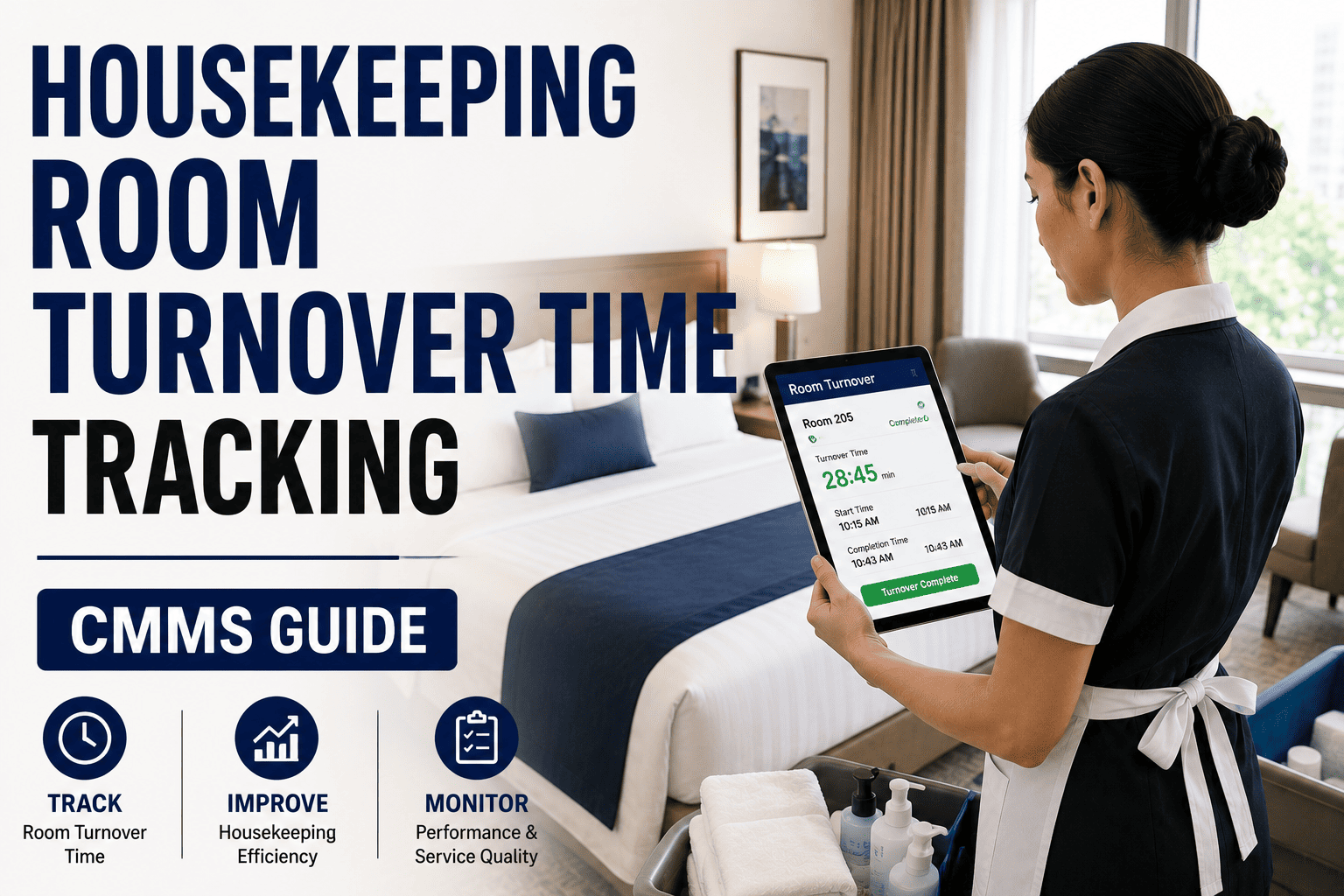
A 280-room full-service hotel discovered their average room turnover time was 38 minutes nearly double the industry benchmark—but couldn't pinpoint why. Housekeeping supervisors blamed understaffing. The operations director cited complex checkout patterns. Room attendants reported equipment delays. Without data showing where minutes were actually lost, management added two housekeepers at $52,000 annually, installed new vacuum systems for $18,000and revised checkout policies—spending $88,000 when AI-powered turnover analytics would have revealed that 64% of delays came from three specific factors: late PMS room status updates (averaging 8.2 minutes), inefficient floor routing that created unnecessary travel between rooms (5.4 minutes per turnover), and unbalanced workload distribution leaving three attendants with 40% more rooms than others. Hotels using OXmaint's AI-powered facility management platform build the operational intelligence that transforms room turnover from guesswork into precision—turning housekeeping data into actionable insights that reduce turnover time, optimize staffing, and maximize room revenue.
Turnover Time
25-40 min
AI Reduces: 25-35%
Labor Costs
$45-70K/room/yr
AI Cuts: 18-28%
Room Revenue Loss
$8K-25K/mo
AI Recovers: 30%
Staff Turnover
60-85%/yr
AI Reduces: 40%
Guest Complaints
12-18%
AI Prevents: 55%
25-35%
Average room turnover time reduction hotels achieve with AI-powered analytics
$42.8B
Global hotel housekeeping market size—AI optimization is the fastest-growing technology segment
18-28%
Housekeeping labor cost reduction reported by hotels using AI turnover optimization
AI-powered room turnover optimization uses machine learning algorithms to analyze historical cleaning data, occupancy patterns, staff performance, room types, and guest preferences—predicting optimal cleaning sequences, staffing levels, and task prioritization that reduce turnover time while maintaining quality standards. Unlike manual scheduling or basic task lists, AI turnover analytics continuously learn from thousands of data points across checkout times, cleaning durations, inspection results, and revenue impacts to recommend the exact actions that maximize both operational efficiency and guest satisfaction. Properties ready to see what AI reveals about their turnover operations can schedule a free consultation to explore how OXmaint's platform builds the housekeeping intelligence foundation that powers AI optimization capabilities.
How AI Room Turnover Optimization Works
AI turnover optimization isn't a single algorithm—it's an integrated intelligence system that connects PMS data, housekeeping task tracking, staff performance metrics, guest feedback, and revenue management systems into one continuously learning model. This model identifies the hidden patterns driving turnover delays and recommends specific interventions that compress cleaning time without sacrificing quality.
1
Cleaning Time Analysis
Task duration by room type, Attendant efficiency patterns, Equipment delay tracking, Quality inspection times
Time Baseline
Variance Analysis
Bottleneck ID
2
Predictive Staffing
Checkout forecasts, Occupancy patterns, Historical workload, Seasonal demand curves
Staff Needs
Shift Optimization
Cost Efficiency
3
Route Optimization
Floor layouts, Cart positioning, Travel time tracking, Room sequencing logic
Travel Reduction
Sequence Logic
Cart Efficiency
4
Quality Control
Inspection scores, Guest complaints, Rework frequency, Standards compliance
Quality Scores
Defect Patterns
Training Needs
5
Revenue Impact
Room availability timing, Late checkout costs, Early arrival revenue, Occupancy correlation
RevPAR Impact
Timing Value
Revenue Recovery
6
Staff Performance
Individual productivity, Task completion rates, Quality consistency, Training effectiveness
Performance Trends
Skill Gaps
Recognition Data
Build Your AI-Powered Turnover Foundation
OXmaint's platform creates the housekeeping data, task tracking, and performance intelligence that powers AI turnover optimization. Start your free trial—no complex setup required.
Top Turnover Optimization Opportunities AI Reveals
Hotels hide significant efficiency gains inside turnover workflows that manual observation and traditional scheduling can't detect. AI analytics excel because they correlate thousands of variables simultaneously—room condition, attendant skill level, equipment availability, time of day, day of week, and revenue urgency—revealing the specific interventions that deliver measurable time and cost savings.
What AI Reveals: Optimal room cleaning order based on checkout times, priority guest arrivals, floor proximity, and attendant location—eliminating backtracking and dead travel time that wastes 12-18 minutes per shift
Typical savings: 8-14 minutes per turnover
What AI Reveals: Exact staffing needs by day/shift based on predicted checkouts, historical patterns, events calendar, and seasonal trends—preventing both overstaffing waste and understaffing delays
Typical savings: $35,000-$85,000/year labor costs
What AI Reveals: Which room types and attendants achieve fastest cleaning without sacrificing inspection scores—identifying best practices to replicate and training opportunities to address
Typical impact: 15-25% quality score improvement
What AI Reveals: Which rooms to prioritize based on confirmed arrivals, suite premiums, VIP status, and booking urgency—maximizing early-check-in revenue opportunities worth $80-300 per occurrence
Typical impact: $12,000-$45,000/year revenue recovery
Traditional Housekeeping vs. AI-Optimized Turnover
The fundamental difference is precision. Traditional housekeeping management operates on fixed schedules, estimated workloads, and reactive problem-solving. AI turnover optimization provides dynamic, data-driven recommendations that adapt to daily conditions—transforming guesswork into measurable performance improvement.
Staffing:
Fixed ratios, manual estimates
Task Assignment:
Floor-based, intuition-driven
Performance:
Room count only, no timing data
Optimization:
Trial and error, complaint-driven
Revenue Link:
Disconnected from booking system
Staffing:
Predictive models, dynamic adjustment
Task Assignment:
Route-optimized, priority-ranked
Performance:
Real-time tracking, benchmarking
Optimization:
Continuous learning, pattern detection
Revenue Link:
Integrated with PMS, RevPAR-optimized
25-35%
turnover time reduction
18-28%
labor cost savings
Expert Perspective: Why AI Wins in Hotel Housekeeping
Industry Insight
"Housekeeping is the heartbeat of hotel operations—it directly impacts guest satisfaction, room revenue, and operational costs. Yet most properties manage it with methods from the 1980s: fixed room assignments, estimated workloads, and reactive problem-solving. AI changes everything. The algorithms detect patterns invisible to human observation—like the fact that turnover time increases 22% on Mondays because weekend guests create more disorder, or that three specific attendants consistently finish suites 18% faster without quality drops. Properties using AI don't just clean rooms faster—they make fundamentally smarter decisions about staffing, training, and revenue optimization."
— Director of Housekeeping Operations, 850+ Room Resort Property, 12 years experience
Pattern Recognition
AI identifies efficiency patterns across thousands of turnovers that reveal best practices, training gaps, and process improvements no manual analysis could detect.
Dynamic Optimization
Recommendations adapt daily based on actual conditions—predicted checkouts, staff availability, VIP arrivals, and revenue urgency—not fixed rules.
Staff Empowerment
Performance data helps recognize top performers, identify training needs, and create fair workload distribution—reducing turnover and improving morale.
Hotels achieving the strongest AI turnover results start with a comprehensive housekeeping management platform that captures accurate task data, timing information, and performance metrics. Without clean, structured data on what's actually happening during turnover, even sophisticated AI produces unreliable recommendations. OXmaint provides this data foundation from day one—and as your information quality improves, so does your ability to leverage increasingly powerful AI optimization. Ready to explore how this works for your property? Our team demonstrates implementations across full-service hotels, resorts, and extended-stay properties.
Transform Your Room Turnover with AI Analytics
OXmaint's housekeeping platform creates the task tracking, performance data, and operational analytics that power AI turnover optimization. Begin your free trial—your first AI insights can be live within days.
Frequently Asked Questions
What is AI-powered room turnover optimization?
AI-powered room turnover optimization uses machine learning algorithms to analyze housekeeping data—cleaning times, staff performance, room types, occupancy patterns, and guest arrival schedules—to recommend specific actions that reduce turnover time while maintaining quality standards. The AI continuously learns from thousands of completed turnovers to predict optimal cleaning sequences, identify efficiency bottlenecks, forecast staffing needs, and prioritize rooms based on revenue impact. Unlike manual scheduling, AI adapts recommendations daily based on actual conditions and performance trends.
How much can AI reduce room turnover time?
Hotels typically achieve 25-35% turnover time reduction within 90 days of implementing AI optimization. A property averaging 35-minute turnovers can expect to reach 23-26 minutes through optimized task sequencing, improved routing, predictive staffing, and quality-speed balance. The exact savings depend on current baseline efficiency, data quality, and implementation completeness. Properties starting from manual scheduling or paper-based tracking see larger improvements than those with existing digital systems.
What data does AI need to optimize turnover?
AI turnover optimization requires: (1) Historical cleaning times by room type and attendant, (2) PMS occupancy data including checkout/arrival patterns, (3) Room status updates throughout the day, (4) Quality inspection scores and guest feedback, (5) Staff scheduling and attendance records, and (6) Floor plans and room layouts for routing optimization. The AI becomes more accurate as data accumulates—initial recommendations appear within 2-3 weeks, but optimal performance develops over 60-90 days of continuous learning.
Can AI integrate with our existing PMS and housekeeping systems?
Yes. Modern AI turnover platforms integrate with major property management systems (Opera, Maestro, Protel, Mews, Cloudbeds) via API connections that pull occupancy data, checkout schedules, and room status updates. They also connect with housekeeping management systems, task tracking apps, and quality inspection tools. The AI operates as an intelligence layer that enhances existing systems rather than replacing them—providing optimization recommendations while your staff continues using familiar tools.
How does AI turnover optimization impact staff?
AI helps housekeeping staff work smarter, not harder. Attendants receive optimized room sequences that minimize travel time and backtracking. Supervisors get predictive staffing forecasts that prevent both understaffing stress and overstaffing waste. Performance analytics identify training opportunities and recognize top performers fairly. Hotels using AI report 30-40% reductions in staff turnover because workloads are distributed more equitably, expectations are clearer, and recognition is data-driven rather than subjective. The technology empowers teams rather than replacing them.
Ready to Optimize Your Turnover Operations?
Join hundreds of hotels using OXmaint to build the housekeeping intelligence that powers faster turnovers, lower costs, and higher guest satisfaction. Start your free trial today.