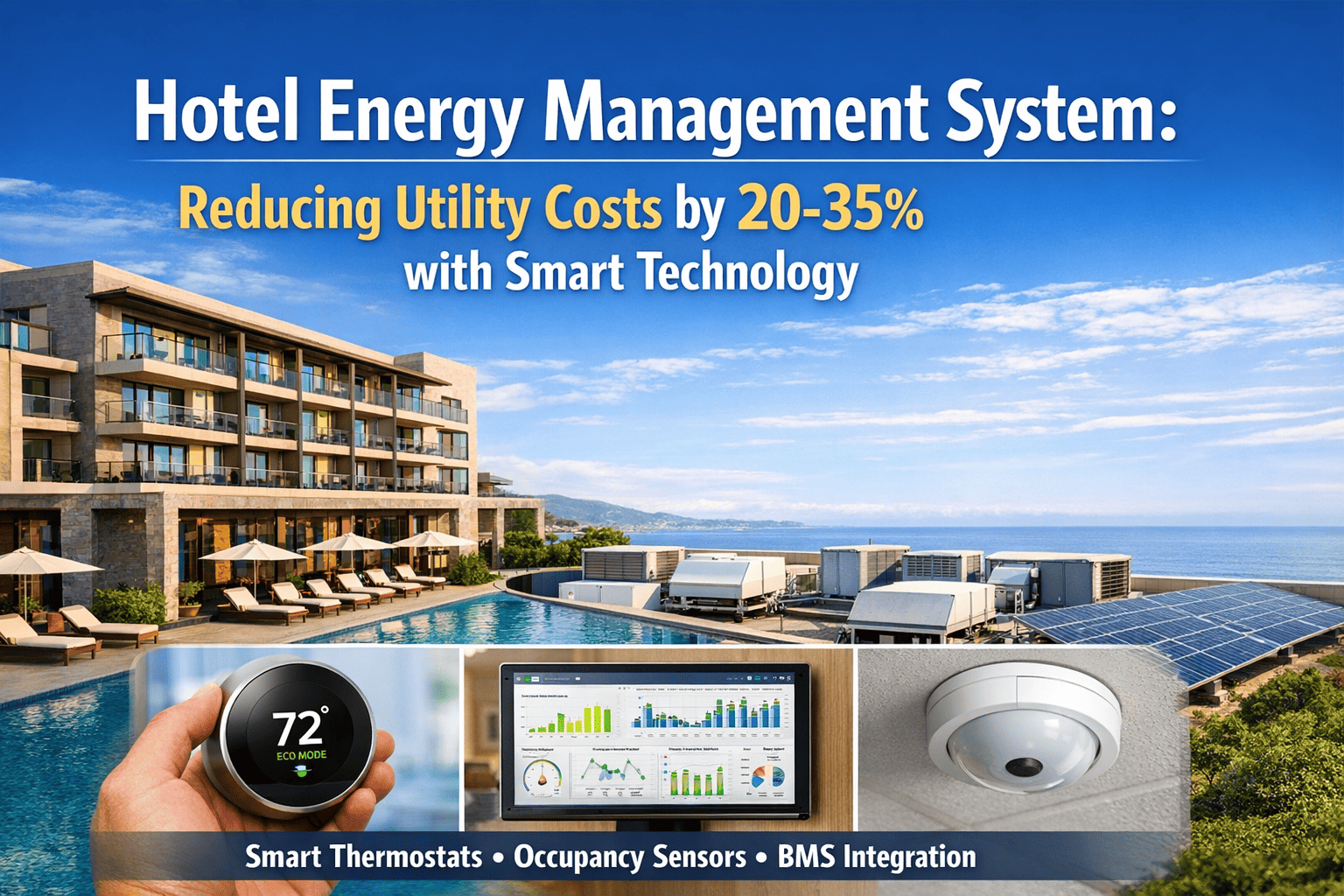
A 200-room urban hotel was spending $38,000 monthly on electricity—without knowing that 34% of that cost came from HVAC systems cooling empty conference rooms, hallway lighting running at full brightness at 3 AM, and kitchen exhaust fans operating 24/7 regardless of cooking activity. After deploying AI-powered energy analytics, the property identified $14,200 in monthly waste within 72 hours. Within 90 days, total energy spend dropped to $26,600/month—a 30% reduction achieved entirely through intelligent automation and behavioral pattern recognition, with zero capital equipment replacement.
AI Decision & Automation Layer
Predictive Load Balancing
Dynamic Pricing Response
Autonomous Optimization
Analytics & Pattern Recognition
Occupancy Correlation
Weather Forecasting
Equipment Efficiency
Peak Demand Shaving
Energy Data Collection Network
Smart Meters
Sub-Meters
BMS Integration
Utility API Feeds
IoT Sensors
AI energy analytics transforms hotel energy management from static scheduling into dynamic, self-optimizing intelligence. By analyzing real-time occupancy, weather forecasts, utility rate structures, and equipment performance simultaneously, AI platforms make thousands of micro-adjustments daily—each one invisible to guests but collectively worth 20-35% in energy cost reduction. Properties that integrate AI energy analytics with CMMS platforms gain both cost optimization and predictive maintenance intelligence, ensuring equipment operates at peak efficiency while consuming minimum energy.
Core AI Energy Optimization Strategies for Hotels
AI analytics delivers energy savings through five distinct optimization pathways, each addressing a different source of waste. Properties that consult with energy optimization specialists typically implement these strategies in priority order based on property size, climate zone, and existing infrastructure.
01
Occupancy-Based HVAC Optimization
Method: AI correlates PMS check-in/out data, keycard activity, and occupancy sensors with HVAC zones
Savings:
18-30% HVAC reduction
Impact: Unoccupied rooms auto-setback to energy mode—pre-condition 15 min before guest arrival
Payback: 2-4 months • No guest comfort impact
02
Peak Demand Shaving & Load Shifting
Method: AI predicts peak demand windows and pre-cools/heats buildings during off-peak rate periods
Savings:
12-22% on demand charges
Impact: Staggers equipment startups, shifts laundry/kitchen loads to avoid simultaneous peak draws
Payback: 3-6 months • Reduces utility demand penalties
03
Weather-Predictive Pre-Conditioning
Method: AI ingests 72-hour weather forecasts to proactively adjust building thermal strategy
Savings:
10-18% cooling/heating costs
Impact: Pre-cools buildings before heatwaves using overnight rates—avoids daytime compressor strain
Payback: 4-8 months • Extends equipment life 15-20%
04
Lighting & Common Area Automation
Method: AI adjusts lighting intensity based on daylight levels, occupancy patterns, and time schedules
Savings:
25-40% lighting energy
Impact: Corridors, lobbies, and parking dim automatically during low-traffic periods
Payback: 1-3 months • Enhances ambiance with smart dimming
05
Equipment Efficiency Degradation Detection
Method: AI baselines equipment energy signatures and flags efficiency drops indicating maintenance needs
Savings:
8-15% equipment energy
Impact: Detects dirty coils, failing compressors, and refrigerant leaks through energy consumption patterns
Payback: 3-6 months • Prevents catastrophic equipment failures
AI Analytics → CMMS: The Energy-Maintenance Integration
The real power of AI energy analytics emerges when energy anomalies automatically trigger maintenance workflows. When AI detects a chiller consuming 22% more energy than its baseline, the system shouldn't just flag the waste—it should generate a maintenance work order, schedule the inspection, and track the energy recovery after repair.
HVAC Overconsumption Detected
Chiller #1
↑ 22% above baseline
Condenser coil fouling suspected—efficiency dropping 3% weekly
Ghost Load Identified
Floor 6 West
⚠ 4.2 kW at 0% occupancy
HVAC running in 8 vacant rooms—BMS override malfunction detected
Peak Demand Warning
Tomorrow 2-5 PM
↑ 105°F forecast
Pre-cooling strategy activated—shifting thermal load to overnight rates
Coil Cleaning Work Order
WO #5102
Priority: High
HVAC tech assigned—estimated energy recovery: $420/month
BMS Override Correction
WO #5103
Priority: Medium
Controls tech dispatched—wasting $18/day in unnecessary HVAC
Pre-Cool Schedule Created
Auto-Task
Priority: Scheduled
Building pre-cooled 4 AM–8 AM at off-peak rate—saving $340 tomorrow
Turn Energy Waste Into Automated Savings
Oxmaint CMMS connects with AI energy analytics platforms to automatically generate maintenance work orders when equipment efficiency drops—closing the loop between energy intelligence and facility action.
Measuring AI Energy Optimization ROI
AI energy analytics delivers compounding returns—initial savings from eliminating waste grow as the system learns property-specific patterns and identifies deeper optimization opportunities over time.
AI Strategy
Occupancy-Based HVAC
→
Optimization
Auto setback in vacant rooms
→
Reduction
HVAC costs -18-30%
→
Annual Savings
$18K-$55K/property
AI Strategy
Peak Demand Shaving
→
Optimization
Load shifting to off-peak
→
Reduction
Demand charges -12-22%
→
Annual Savings
$8K-$25K/property
AI Strategy
Efficiency Degradation Alert
→
Optimization
Proactive maintenance triggers
→
Reduction
Equipment energy -8-15%
→
Annual Savings
$10K-$30K/property
AI Strategy
Smart Lighting Control
→
Optimization
Daylight + occupancy dimming
→
Reduction
Lighting costs -25-40%
→
Annual Savings
$5K-$15K/property
Expert Analysis: AI Energy Trends in Hospitality 2026
The hotels achieving 30%+ energy reductions in 2026 aren't installing more efficient equipment—they're making existing equipment smarter. AI analytics platforms that connect energy consumption patterns to occupancy data, weather forecasts, and utility rate structures are delivering savings that traditional building management systems never could. The game-changer is closing the loop: when AI detects an efficiency anomaly, the CMMS automatically generates a work order, schedules the repair, and verifies the energy recovery—creating a self-optimizing facility that gets more efficient every month.
Digital Twin Energy Modeling
AI-powered digital twins simulate building energy behavior under thousands of scenarios—testing optimization strategies virtually before deploying them. Hotels use digital twins to predict the energy impact of renovation decisions, event bookings, and seasonal occupancy shifts before they happen.
Grid-Interactive Buildings
AI platforms now participate in utility demand response programs automatically—reducing energy consumption during grid stress events in exchange for financial incentives. Hotels earn $5,000-$15,000 annually in demand response payments while reducing peak energy costs simultaneously.
ESG Compliance Automation
AI energy platforms auto-generate sustainability reports, carbon footprint calculations, and green certification documentation. Properties pursuing LEED, Green Key, or ENERGY STAR certifications use AI analytics to track and verify performance metrics continuously rather than through annual manual audits.
Ready to Optimize Your Hotel's Energy Performance?
Oxmaint CMMS integrates with AI energy analytics platforms to transform consumption data into automated maintenance actions. From HVAC efficiency alerts to peak demand optimization—connect energy intelligence to facility action.
Frequently Asked Questions
How much can AI energy analytics save a hotel annually?
Hotels deploying AI energy analytics typically achieve 20-35% total energy cost reductions, translating to $40,000-$125,000 in annual savings for a 100-200 room property depending on climate zone and existing efficiency levels. The largest savings come from occupancy-based HVAC optimization (18-30% reduction) and peak demand shaving (12-22% reduction in demand charges). Most properties achieve full ROI payback within 3-6 months of deployment, with savings compounding as AI models learn property-specific patterns over time.
Does AI energy optimization affect guest comfort?
Properly implemented AI energy optimization actually improves guest comfort. AI pre-conditions rooms before guest arrival based on PMS data, maintains precise temperature setpoints through continuous micro-adjustments, and eliminates the temperature swings caused by traditional on/off cycling. Guest rooms are only set to energy-saving mode when verified unoccupied. Properties consistently report that temperature-related complaints decrease 40-60% after AI implementation because the system maintains more consistent conditions than manual or timer-based controls.
What infrastructure does a hotel need for AI energy analytics?
At minimum, hotels need smart meters or sub-meters on major energy systems (HVAC, lighting, kitchen, laundry) and a building management system (BMS) with network connectivity. Most modern properties already have 60-70% of the required infrastructure. AI platforms integrate via API with existing BMS, PMS, and CMMS systems. For properties without sub-metering, wireless energy monitors can be installed on circuits in hours without electrical modifications. Cloud-based AI platforms require no on-premise servers—data flows through secure gateways to analytics engines that return optimization commands to the BMS.
How does AI energy analytics integrate with hotel CMMS?
AI energy platforms connect to CMMS through APIs to create a closed-loop optimization system. When AI detects equipment consuming more energy than its baseline (indicating dirty filters, failing components, or refrigerant loss), it automatically generates a CMMS work order with priority level, suspected cause, affected asset, and estimated energy recovery value. After maintenance is completed, the AI monitors energy consumption to verify the repair restored efficiency. This integration ensures energy anomalies are addressed through maintenance workflows rather than just dashboard alerts that get ignored.