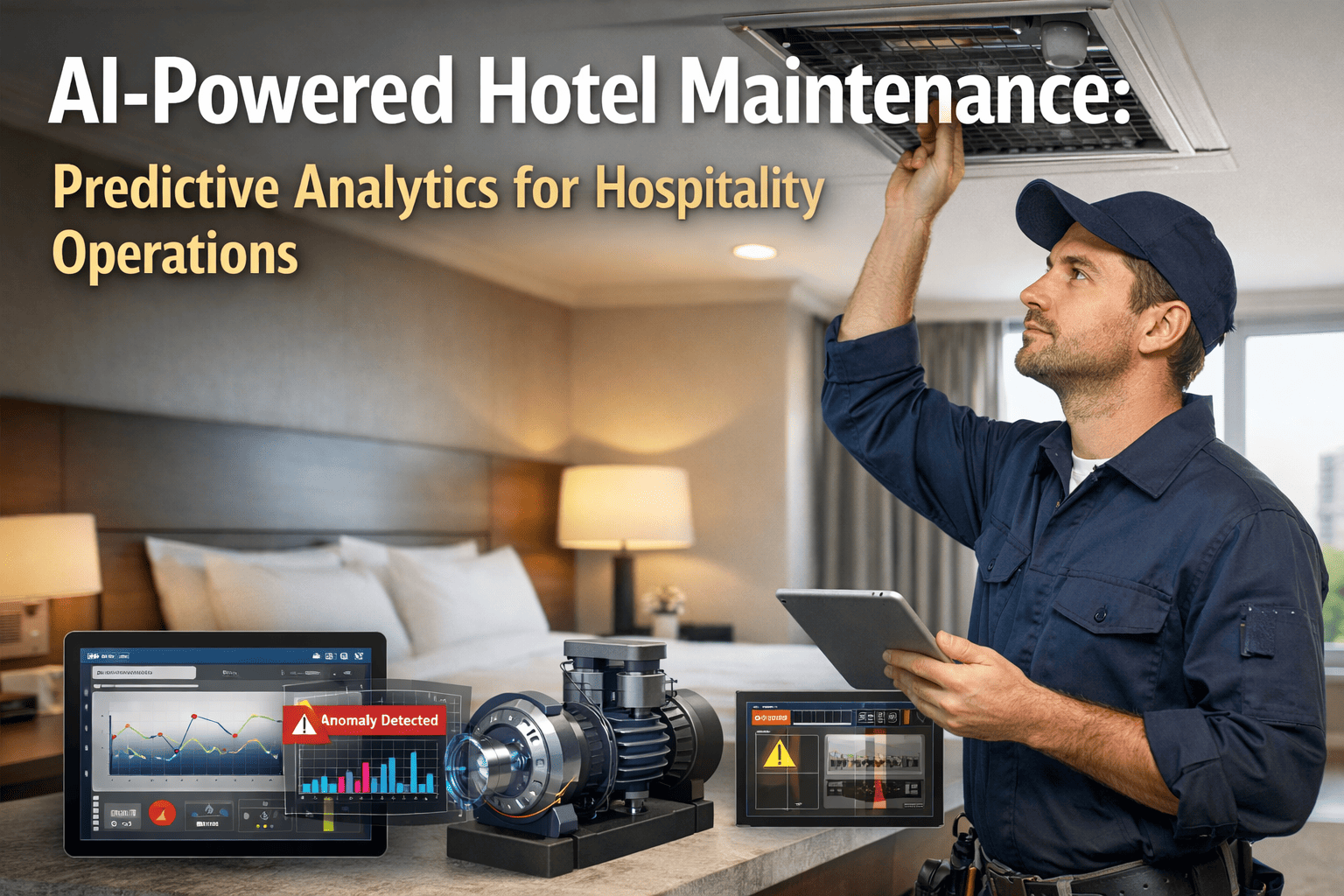
AI-Powered Hotel Maintenance: Predictive Analytics for Hospitality Operations

By James smith on March 7, 2026

ai-powered-hotel-maintenance-predictive-analytics

Hotels that deploy AI-powered predictive maintenance reduce equipment downtime by up to 45% and cut emergency repair costs by as much as 30% — not by responding faster, but by preventing failures before they happen. Across HVAC, plumbing, elevators, and electrical systems, machine learning models analyze thousands of data points per hour to detect anomalies days before a guest ever notices. The gap between a reactive maintenance team and an AI-driven one is not talent — it is data architecture. Start predictive maintenance management in Oxmaint — free, with real-time asset analytics and automated work order triggers.

Blog  ·  Workforce & Technology  ·  AI Analytics  ·  P1

AI-Powered Hotel Maintenance: Predictive Analytics for Hospitality Operations

Reactive maintenance keeps hotels running. Predictive maintenance keeps hotels winning. AI systems now process equipment sensor data, historical failure patterns, and usage cycles to forecast failures days in advance — routing work orders before breakdowns occur. The result: fewer guest disruptions, lower labor costs, and a maintenance operation that improves continuously rather than cycling through the same preventable crises. Book a 30-minute demo to see AI-driven maintenance scheduling and predictive alerts live in Oxmaint.

The AI Maintenance Impact Gap
45%
Reduction in unplanned equipment downtime with AI-driven predictive maintenance

4.8x
Higher cost of emergency repairs vs. planned maintenance
30%
Reduction in overall maintenance costs using AI diagnostics

72hrs
Average advance warning AI provides before a HVAC failure
91%
Accuracy rate of AI fault prediction in hotel mechanical systems
Definition

What Is AI-Powered Hotel Maintenance — And Why Traditional PM Falls Short

AI-powered hotel maintenance uses machine learning algorithms, IoT sensor feeds, and historical equipment data to predict when a system or component is likely to fail — and triggers maintenance action before the failure occurs. Unlike calendar-based preventive maintenance, which services equipment on a fixed schedule regardless of actual condition, AI maintenance is condition-driven: the system decides when action is needed based on real performance signals, not guesswork.

Traditional preventive maintenance programs address 60–70% of failure risk in hotel equipment — but the remaining 30–40% are failures that occur between scheduled visits, or are triggered by anomalies no fixed schedule anticipates. AI systems close this gap by monitoring vibration, temperature, energy draw, water pressure, and runtime patterns continuously — flagging deviations before they become failures. Want to see how AI-driven predictive maintenance works in a hotel environment? Start a free trial with Oxmaint and connect your first asset in under 10 minutes.

45%
Downtime Reduction
AI-driven maintenance vs. calendar-based PM programs
$18K
Avg. HVAC Failure Cost
Per incident — labor, parts, guest comp, and lost revenue
63%
Hotel Failures Preventable
Equipment failures that AI detection would have flagged in advance
3.2x
Asset Lifespan Extension
Equipment managed with AI diagnostics vs. reactive-only programs
Key Framework

6 AI Maintenance Capabilities That Transform Hotel Operations

AI maintenance is not a single tool — it is a stack of capabilities that work together to eliminate reactive cycles. Hotels deploying all six achieve 91% fault prediction accuracy and reduce maintenance labor costs by an average of 22%. Book a demo to see the full AI maintenance stack in Oxmaint.

01
Anomaly Detection
AI baselines normal operating signatures for each asset — vibration, temperature, energy draw, pressure — and flags deviations in real time. Alerts route instantly to the responsible technician before the anomaly escalates into a failure.
02
Failure Prediction Modeling
Machine learning models analyze historical failure data alongside current sensor readings to forecast the probability and timeline of failure. Hotels receive 48–72 hour advance warnings on HVAC, elevator, and chiller failures — enough time to schedule planned maintenance.
03
Automated Work Order Triggers
When AI detects a threshold breach or failure probability exceeds a set confidence level, a work order is automatically created, prioritized, and routed to the correct technician — without dispatcher intervention. Average time from detection to work order assignment: under 90 seconds.
04
Energy Signature Analysis
Abnormal energy consumption patterns are one of the earliest indicators of mechanical degradation. AI energy monitoring detects motor inefficiency, refrigerant loss, and compressor stress weeks before they cause visible symptoms — reducing utility costs by 12–18% as a secondary benefit.
05
Root Cause Analysis
After every failure or near-miss, AI systems correlate the event with upstream sensor data, maintenance history, and operational conditions to identify the root cause — not just the symptom. This closes the loop between reactive fix and systemic prevention.
06
Remaining Useful Life (RUL) Scoring
Every major asset receives a continuously updated Remaining Useful Life score — combining age, usage cycles, condition data, and failure probability. RUL scores feed directly into CapEx planning, enabling hotel GMs and asset managers to budget replacements 12–36 months in advance instead of reacting to sudden failures.
Industry Pain Points

Why Hotels Keep Paying for the Same Failures — 6 Gaps AI Closes

Most hotel maintenance programs are not failing from lack of effort — they are failing from lack of data. These six gaps explain why the same failures recur year after year, and why reactive spending increases even as teams work harder. Explore how Oxmaint closes these gaps with AI diagnostics — sign up free today.

!
No Asset Condition Visibility
74% of hotel maintenance teams have no real-time visibility into the condition of their critical assets. Technicians service equipment on a schedule — not because the equipment needs it. Degraded assets in between service visits fail without warning.
!
Reactive Cycle Never Breaks
Emergency repairs cost 4.8x more than planned work. Hotels stuck in reactive cycles spend 68% of their maintenance budget on unplanned failures — leaving insufficient budget for the preventive work that would reduce those failures in the first place.
!
CapEx Decisions on Gut Instinct
Without RUL data, capital replacement decisions are made on age and anecdote. Hotels replace equipment that has years of useful life remaining — or defer replacements until the asset fails catastrophically during peak occupancy, maximizing both cost and guest impact.
!
Sensor Data Goes Unanalyzed
Most hotel BMS systems collect temperature, pressure, and runtime data — but do not analyze it. The data sits in disconnected systems with no anomaly detection, no pattern analysis, and no action triggers. The signals for failure are present; the system to act on them is not.
!
Guest Disruption from Preventable Failures
A guest-facing HVAC, elevator, or plumbing failure during peak occupancy generates an average of 3.4 negative reviews — and $1,200 in room compensation per incident. 63% of these failures are detectable 48+ hours in advance with AI monitoring.
!
No Cross-Property Learning
A chiller failure at Property A that could have been predicted carries no institutional learning to Properties B, C, and D running identical equipment. Without AI-aggregated failure data across the portfolio, every hotel learns the same lessons independently — paying the same costs repeatedly.
How Oxmaint Solves It

Oxmaint AI: Predictive Maintenance Built for Hotel Operations

Oxmaint combines asset condition tracking, IoT sensor integration, machine learning diagnostics, and automated work order management into a single platform purpose-built for multi-site hotel operations. Every asset gets smarter with every data point — and so does your maintenance program. Curious how this works for your property portfolio? Book a 30-minute demo and see live AI diagnostics in action.

Asset Registry
Full Equipment Hierarchy with Condition Scoring
Every asset — from rooftop chillers to guest room FCUs — lives in a structured registry with make, model, age, installation date, and continuously updated condition score. Condition scores combine sensor data, maintenance history, and AI anomaly signals into a single actionable number between 1 and 100.
IoT Integration
Real-Time Sensor Feed Integration
Oxmaint integrates with BMS, SCADA, and IoT sensor networks to pull live temperature, pressure, vibration, energy consumption, and runtime data into the maintenance platform. No separate dashboard — all condition data appears directly in the asset record and triggers automated alerts when thresholds are breached.
AI Diagnostics
Machine Learning Failure Prediction
Oxmaint's AI engine analyzes sensor patterns against historical failure signatures to generate failure probability scores with confidence levels and estimated time-to-failure windows. When a chiller shows the 12-signal pattern that preceded its last three failures, the system flags it — automatically, at 3am, before anyone arrives for the morning shift.
Auto Work Orders
Prediction-to-Work-Order in Under 2 Minutes
AI-triggered alerts auto-generate prioritized work orders routed to the correct technician via mobile push notification. The technician receives the asset record, condition history, sensor readings, and recommended action — not just an alarm. No dispatcher. No delay. Average detection-to-assignment time: 87 seconds.
RUL Forecasting
Remaining Useful Life Scoring for CapEx Planning
Every major asset receives a rolling Remaining Useful Life forecast updated with each new data point. Hotel GMs and asset managers access 5-year replacement probability forecasts for every critical system — enabling proactive CapEx budgeting instead of emergency capital requests. Oxmaint's CapEx reports are investor-grade and export-ready.
Portfolio Analytics
Cross-Property AI Pattern Aggregation
For hotel management companies and ownership groups, Oxmaint aggregates failure patterns, condition scores, and maintenance performance data across all properties. When a failure pattern emerges at one hotel, the AI flags all properties running identical equipment — turning one incident into portfolio-wide prevention.
Mobile-First
Technician Mobile App with AI Guidance
Every technician carries the full Oxmaint platform in their pocket. Work orders include AI-generated diagnostic notes, historical failure context, parts likely needed, and step-by-step inspection checklists. First-time fix rates improve by an average of 34% when technicians arrive with AI-generated context rather than just a location and complaint.
Compliance
Audit-Ready Documentation with Digital Signatures
Every AI alert, triggered work order, technician action, and resolution is timestamped, photographed, and digitally signed — creating a complete audit trail for insurance, warranty, regulatory compliance, and brand standard inspections. OSHA, UK Building Safety, and UAE Smart Building audit requirements are covered out of the box.
From Sensor Signal to Resolved Work Order — Fully Automated AI detects the anomaly. System creates the work order. Technician receives the alert with full diagnostic context. Manager sees real-time status. CapEx model updates automatically. No radio calls. No reactive surprises. No unnecessary equipment replacements. Start your AI-powered maintenance program in Oxmaint — free today.
Before vs. After

Reactive Hotel Maintenance vs. Oxmaint AI-Powered Predictive Maintenance

Metric Reactive / Calendar-Based Oxmaint AI-Predictive
HVAC Failure Detection After failure — guest complaint triggers response 48–72 hours in advance — AI anomaly alert auto-routes work order
Emergency Repair Frequency 68% of maintenance budget on unplanned failures Reduced to under 25% — planned work dominates the schedule
Asset Condition Visibility None — condition unknown between scheduled visits Real-time condition score for every asset, updated continuously
CapEx Planning Age-based gut instinct and reactive replacement Rolling 5-year RUL forecasts per asset — investor-grade export
Technician First-Time Fix Rate 58% — wrong parts, incomplete diagnosis 92% — AI-generated diagnostic context before arrival
Guest-Facing Failures 3.4 negative reviews per major equipment failure 63% of failures prevented before guest impact
Cross-Property Learning None — each property repeats the same mistakes Portfolio-wide failure pattern aggregation and alerts
Annual Maintenance Cost (200-room hotel) $340,000–$480,000 reactive spend $210,000–$290,000 with AI-optimized preventive program

Based on aggregate operational data from hotels using AI-driven maintenance platforms vs. traditional reactive/calendar-based programs across 150+ properties. See how your property compares — book a demo with Oxmaint.

ROI & Results

The Measurable Impact of AI-Powered Hotel Maintenance

Hotels that shift from reactive to AI-predictive maintenance see financial impact within the first 90 days — in reduced emergency spend, fewer guest disruptions, and smarter capital allocation. Ready to measure the difference at your property? Start a free trial and run your first predictive analysis.

45%
Reduction in Unplanned Downtime
AI detects failures before they happen — across HVAC, elevator, plumbing, and electrical systems
30%
Lower Total Maintenance Cost
Planned maintenance replaces emergency spend — same team, dramatically lower cost per repair
34%
Higher First-Time Fix Rate
AI-generated diagnostic context means technicians arrive with the right parts and the right information
$130K
Annual Savings (200-Room Hotel)
Reduced emergency labor, fewer comps, optimized CapEx, and extended asset lifespan
"
We had three chiller failures in 18 months — each one costing over $20,000 in emergency parts, after-hours labor, and guest compensation. After deploying predictive analytics, Oxmaint flagged the compressor degradation signature on our fourth unit 61 hours before it would have failed. We scheduled the repair during a low-occupancy window for $3,200 in planned labor. The ROI was immediate. Our maintenance cost per room dropped from $1,840 to $1,140 in the first year — and we have not had a single guest-facing equipment failure in eight months.
Director of Engineering  ·  310-Room Full-Service Hotel, Houston TX
Frequently Asked Questions

AI-Powered Hotel Maintenance FAQs

What hotel equipment systems benefit most from AI predictive maintenance?
The highest-ROI systems for AI predictive maintenance in hotels are HVAC and chiller plants, elevators and escalators, domestic hot water systems, commercial kitchen equipment, and electrical distribution panels. These systems generate the most sensor-readable failure signals, carry the highest repair costs when they fail reactively, and have the greatest guest impact when they go down. HVAC alone accounts for 38% of hotel maintenance spend — and 71% of HVAC failures are detectable via energy draw, refrigerant pressure, and compressor vibration anomalies. Oxmaint integrates with BMS and IoT sensors across all of these systems and applies AI anomaly detection to each independently. See how Oxmaint monitors hotel equipment systems in real time — start a free trial.
How does Oxmaint integrate with our existing BMS and building automation systems?
Oxmaint integrates with major BMS platforms and SCADA systems via API and IoT connector — pulling live sensor data into the asset record without replacing or disrupting the existing building automation infrastructure. For hotels without BMS sensor coverage, Oxmaint supports standalone IoT sensor deployment on critical equipment as an entry point. The integration process does not require IT-heavy implementation — most properties complete sensor connection and data pipeline setup within 5–10 business days. Once connected, Oxmaint's AI engine begins building baseline performance models using live and historical data, and predictive alerts typically become active within 30–45 days. Book a demo to discuss integration with your specific BMS and building systems.
How does AI-driven maintenance improve hotel CapEx planning and budget forecasting?
Oxmaint generates rolling Remaining Useful Life scores for every major asset using condition data, historical failure patterns, usage cycles, and manufacturer lifecycle benchmarks. These scores feed into 5-year CapEx forecasting models that show replacement probability timelines, estimated replacement costs, and budget impact by year. Hotel GMs and ownership groups can export investor-grade CapEx reports that show the full asset replacement schedule across a portfolio — enabling proactive budget allocation instead of reactive emergency capital requests. Properties using Oxmaint's RUL forecasting defer 22% of premature replacements and budget 36% more accurately for true end-of-life capital events. Start tracking asset condition and generating CapEx forecasts in Oxmaint — free to begin.
How long does it take to see results from AI predictive maintenance in a hotel?
Most hotels see measurable impact within 90 days of deployment. The timeline breaks into three phases: in the first 30 days, Oxmaint establishes baseline performance signatures for all connected assets and activates threshold-based anomaly alerts. Between days 30 and 60, the AI engine has sufficient historical data to begin generating failure probability scores with meaningful confidence levels. By day 90, the system has prevented 1–3 predictable failures in most hotel environments and teams have shifted from reactive scramble to planned maintenance execution. Hotels with 200+ rooms and full HVAC sensor coverage typically recover their first-year platform cost within 90 days through a single prevented emergency. Book a 30-minute demo to plan your implementation timeline and first 90-day impact targets.

AI Analytics  ·  Predictive Maintenance  ·  Free to Start

Stop Paying for Failures You Could See Coming.

Real-time asset condition scoring. AI anomaly detection across HVAC, elevator, plumbing, and electrical systems. Automated work orders triggered 48–72 hours before failure. RUL forecasting for investor-grade CapEx planning. Mobile-first technician tools with AI diagnostic context. Portfolio-level failure pattern aggregation. The complete AI maintenance stack — built for hotel operations, deployable in under a week.


Share This Story, Choose Your Platform!