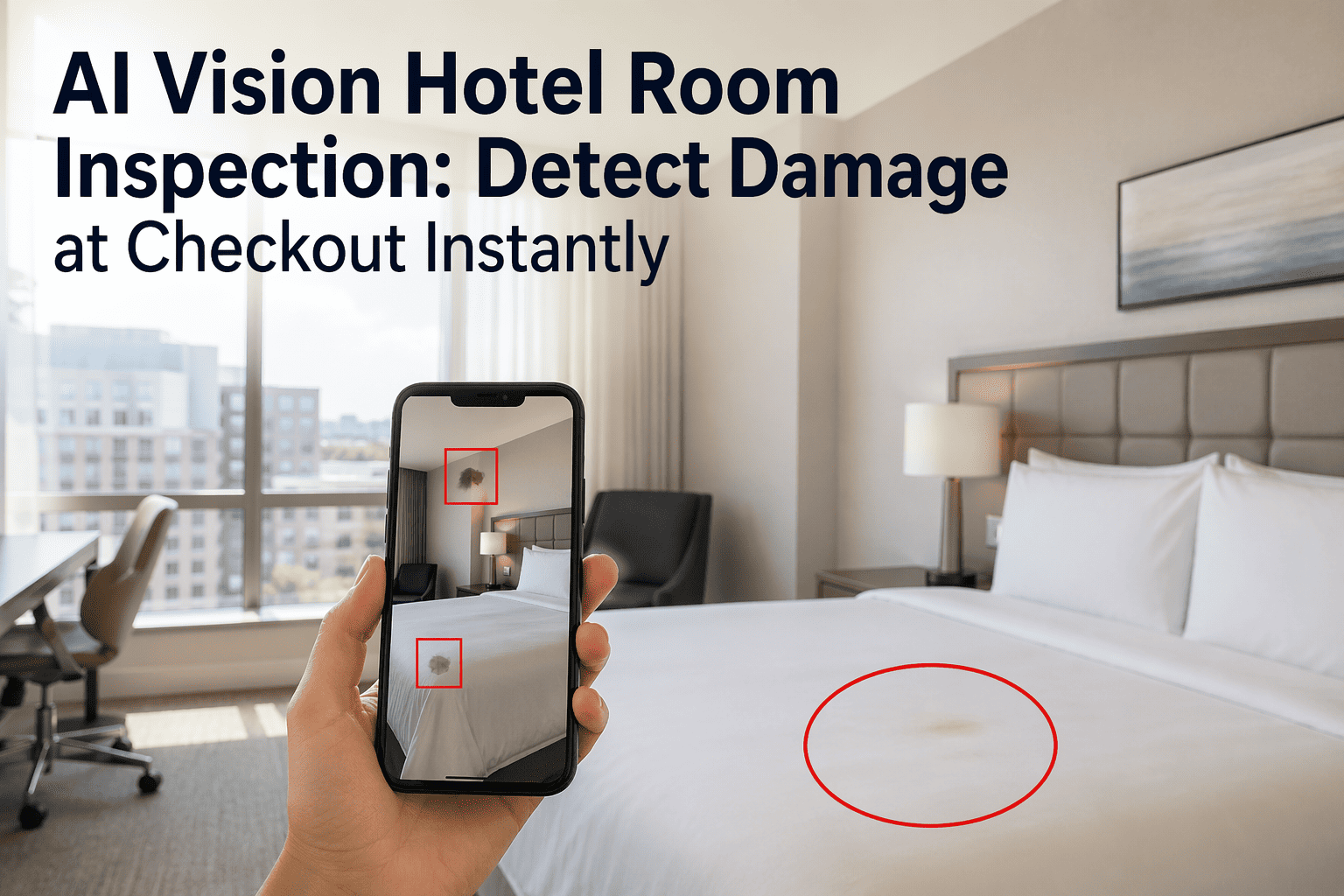
AI Vision for Hotel Floor Inspection & Slip Risk Detection
By Mark Strong on April 18, 2026
Every hotel lobby tells a story — in the micro-cracks forming along grout lines, in the tile edges worn down by a thousand footsteps a day, in the dull patch near the entrance where the finish has quietly given up. Most hotel teams never see that story until a guest does — from the floor. Slip-and-fall incidents are the most common premises liability claim in hospitality, and floor surface failure is at the center of nearly all of them. AI vision technology is changing who catches the problem first.
AI-Powered Hotel Maintenance
See Floor Damage Before Your Guests Do
Computer vision that detects wear, cracks, and slip hazards — and triggers work orders automatically
$30K–$40K
Average hospital cost per slip-and-fall incident
2M+
Fall injuries annually linked to unsafe floors
$24B
AI visual inspection market value in 2024
25.4%
CAGR of AI visual inspection systems
The Floor Problem Hotels Cannot Afford to Ignore
Hotels operate under a legal duty of care. When a guest slips on an undetected worn tile or cracked grout in your lobby corridor, courts ask one question: did the hotel know — or should it have known — about the hazard? Manual inspection rounds, conducted once a shift or less, leave hours-long windows where dangerous floor conditions go undetected. AI vision systems close that window entirely.
Legal Liability
Failure to identify a known floor defect exposes hotels to premises liability claims. Settlements range from tens of thousands to millions depending on injury severity.
Guest Experience
Cracked grout, worn tile edges, and surface staining are visible to guests before they become safety hazards — damaging brand perception and review scores.
Reactive Cost Spiral
Small surface defects caught early cost hundreds to fix. Ignored for months, the same defect can require full tile section replacement costing tens of thousands — plus downtime.
What AI Vision Actually Detects on Hotel Floors
Modern computer vision systems trained on hospitality-grade imagery can identify defect types that human walkthroughs routinely miss — particularly under variable lighting conditions in corridors and lobby transition zones.
Floor Defect Types Detected by AI Vision
Surface Wear Mapping
Tracks finish degradation across high-traffic zones — lobby entries, elevator banks, corridor junctions — before surface becomes slip-hazard territory.
Slip Risk: High
Grout Line Cracking
Sub-millimeter crack detection in grout joints that create trip edges and water infiltration paths — invisible to casual inspection, clearly visible to trained models.
Slip Risk: High
Tile Edge Lifting
Identifies tiles where adhesive bond has failed and edges have raised — a direct trip hazard that is notoriously hard to spot during routine walkthroughs.
Trip Risk: High
Staining and Contamination
Differentiates between cosmetic staining and surface coating breakdown — the latter signals structural vulnerability that requires maintenance action, not just cleaning.
Maintenance Priority
Carpet Seam and Fiber Wear
Monitors carpet transition strips, seam separations, and fiber compression patterns in ballroom and conference corridors where surface changes create uneven walking surfaces.
Preventive Alert
Drain and Threshold Conditions
Monitors pool deck drains, bathroom thresholds, and spa transition zones for pooling indicators and surface texture changes that reduce slip resistance below safe thresholds.
Preventive Alert
How It Works: From Camera to Work Order
The value of AI vision is not just detection — it is the closed loop between detection and action. Without that loop, alerts pile up in dashboards nobody checks. Oxmaint connects the computer vision layer directly to CMMS work order workflows so every flagged defect becomes a documented, assigned, and tracked maintenance task.
AI Vision to Work Order: The Complete Loop
01
Continuous Camera Capture
Existing CCTV or dedicated inspection cameras capture floor surface imagery across lobby, corridors, pool decks, and transition zones — continuously or on scheduled intervals.
02
AI Defect Classification
Deep learning models analyze frames in near real-time, classifying surface conditions by defect type, severity, and location. High-confidence detections are flagged automatically.
03
Risk Severity Scoring
Each detection receives a priority score based on defect type, zone traffic volume, and proximity to guest pathways — so maintenance teams focus on what matters first.
04
Automatic Work Order Generation
Flagged defects generate CMMS work orders in Oxmaint — with location, photo evidence, priority level, and suggested remediation — ready for team assignment without manual entry.
05
Documented Audit Trail
Every detection, assignment, and resolution is timestamped and stored — creating the inspection and maintenance record that proves due diligence if a liability claim arises.
Where Hotels Are Most Exposed
Not all floor zones carry equal risk. High-traffic areas with surface transitions, variable lighting, and moisture exposure are where both defects and incidents concentrate.
Hotel Floor Risk Zones: Priority Inspection Areas
Priority 1
Main Lobby Entrance
Outdoor-to-indoor transition, weather moisture tracking, heaviest foot traffic. Tile finish wear is fastest here and slip risk peaks during rain.
Priority 1
Pool and Spa Deck
Constant moisture, wet footfall, and chemical exposure degrade slip-resistant coatings. Anti-slip surface wear is frequently invisible until tested.
Priority 2
Elevator Banks and Landings
Concentrated foot traffic in a small zone, frequent surface transitions between tile and carpet. Grout fatigue and edge lifting are common here.
Priority 2
Restaurant Ingress / Bar Area
Spill risk combined with worn tile makes this a high-incident zone. Surface staining often masks deeper finish degradation that a camera can classify correctly.
Priority 3
Guest Floor Corridors
Carpet seam separation and transition strip failures are hard to detect during housekeeping rounds. AI vision monitors pattern changes across long corridor lengths.
Priority 3
Stairwells and Landings
Nosing wear and tread surface degradation are progressive defects. Detected early, they are inexpensive to remediate. Detected after a fall, they are evidence of negligence.
Stop Finding Floor Hazards After the Fall
Oxmaint connects AI visual inspection directly to CMMS work orders — so every detected defect becomes a documented, assigned maintenance task before it becomes a liability.
When a hotel slip-and-fall claim is filed, the first things requested are maintenance logs, inspection records, and corrective action documentation. Hotels relying on manual log sheets often discover those records are incomplete, missing, or ambiguous. AI vision systems paired with a CMMS create an automatic, tamper-evident audit trail.
Inspection Records
Every AI scan is logged with timestamp, zone, detected conditions, and confidence score — far more detailed than a staff member noting "floor checked, OK" in a paper log.
Corrective Action Proof
Work orders auto-generated from detections carry creation timestamp, priority classification, assignee, and resolution confirmation — proving the hotel acted on every identified hazard.
Photo Evidence Chain
Before-and-after image documentation for each defect is stored with metadata — establishing both the detection event and the remediation outcome in a format courts recognize.
Trend and Frequency Data
Detection history by zone shows wear progression over time — evidence that hazards were monitored proactively, not ignored until a guest reported them.
ROI: Three Ways Digital Floor Inspection Pays
Liability Avoidance
$30K – $250K+
Typical hotel slip-and-fall settlement range. One prevented claim pays for years of AI inspection platform costs — with documented proof of due diligence as a byproduct.
Maintenance Cost Reduction
40–60%
Reduction in reactive repair costs when surface defects are caught at the micro-crack stage vs. full tile or carpet section replacement after structural failure.
Inspection Labour Savings
3–5 hrs/day
Manual floor inspection hours recovered per property per day when continuous AI monitoring replaces scheduled walkthrough rounds — redeployable to guest-facing tasks.
Frequently Asked Questions
Can AI vision work with our existing hotel cameras?
In most cases, yes. Modern AI inspection platforms can integrate with existing CCTV infrastructure, reducing deployment cost significantly. Dedicated high-resolution cameras are recommended for areas requiring sub-millimeter crack detection, such as pool decks and lobby entry zones.
How does AI vision handle low-light corridor conditions?
Models trained on hospitality environments include low-light and variable-lighting scenarios. For critical zones like stairwells, supplemental lighting paired with scheduled capture intervals maintains detection accuracy regardless of ambient conditions.
Does AI floor inspection replace manual maintenance rounds?
It supplements and significantly reduces them. AI handles continuous surface condition monitoring, while staff focus on confirmation, remediation, and areas requiring physical assessment. The result is fewer undetected hazards and better-documented maintenance activity.
How does the system generate work orders in Oxmaint?
When a defect is classified above a configurable confidence and severity threshold, the system automatically creates a work order in Oxmaint with the detection image, zone location, defect type, and suggested priority — ready for team assignment with no manual data entry required.
What surface types can AI vision inspect in hotel environments?
Ceramic and porcelain tile, natural stone, polished concrete, hardwood, carpet, vinyl composite tile, and epoxy-coated surfaces. Training datasets for hospitality environments cover the full range of floor materials found in lobbies, corridors, pool decks, and restaurant zones.
Oxmaint brings AI vision floor inspection and automated work order generation together in one platform built for hotel maintenance teams. Start with a free trial — no credit card required — or speak with our team about your property's specific floor safety needs.