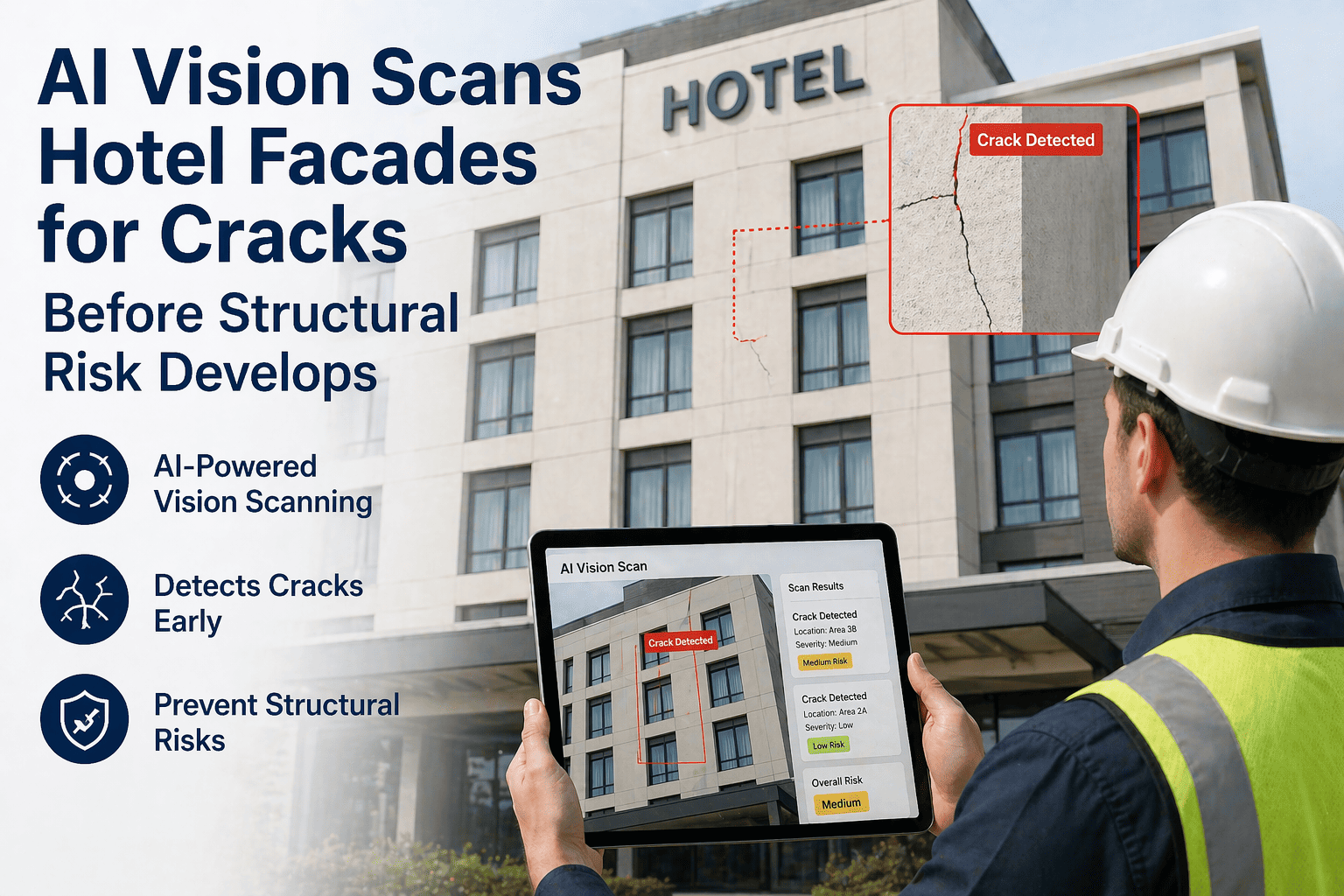
A hairline crack at the base of a spandrel panel on the 14th floor of a hotel is invisible from street level and inaccessible without scaffolding. Left unmonitored, it widens with each freeze-thaw cycle, allows water ingress behind the cladding, corrodes the embedded steel, and eventually spalls a 20-kilogram section of masonry onto the pavement below. The entire degradation sequence — from first detectable crack to structural failure — takes two to four years. AI vision systems running on drone-captured imagery detect that hairline crack in year one, not year three.
Facade AI Inspection
Detect Cracks Before They Become Structural Events
Drone-mounted and fixed AI vision systems scan hotel facades continuously — detecting hairline cracks, spalling, and joint failures before they reach regulatory or structural thresholds.
95%
Detection accuracy for cracks, spalling, corrosion, and delamination using AI vision
5 yrs
NYC FISP / Local Law 11 mandatory cycle — AI catches what manual inspections between cycles miss
80%+
Precision and recall rates for structural vs. non-structural crack classification on real buildings
70%
Reduction in safety incidents with regular AI-assisted inspection programs
What AI Vision Detects on Hotel Facades
01
Hairline and Structural Cracks
AI models classify cracks as structural or non-structural based on geometry, orientation, and location relative to load-bearing elements — not just detecting them, but diagnosing their cause and urgency.
Structural risk if undetected
02
Concrete Spalling
Surface delamination and exposed aggregate detected at sub-centimetre resolution — identifies zones where embedded reinforcement is actively corroding and expansion pressure is building behind the cladding face.
Falling debris liability
03
Expansion Joint Failure
Deteriorated sealant, open joints, and failed backer rod detected across the full elevation. Water infiltration through failed expansion joints is the primary mechanism of internal steel corrosion in hotel facades.
Water ingress driver
04
Efflorescence and Staining
Salt crystal deposits and water-borne staining patterns mapped across the elevation — both direct indicators of active water movement through masonry and early-stage chemical degradation of the bond mortar.
Early-stage water ingress
05
Corrosion and Rust Staining
Iron oxide staining on masonry or concrete surfaces marks the location of corroding embedded steel below the surface. AI detects these before the corrosion products expand enough to crack the covering material.
Structural — early warning
06
Parapet and Coping Displacement
Geometric analysis of parapet alignment detects millimetre-scale displacement from plumb — indicating foundation movement, differential settlement, or freeze-thaw ice-jacking in the parapet anchoring system.
Regulatory — immediate action
Drone vs. Fixed Camera: Deployment Options for Hotels
Drone-Mounted AI Vision
Full elevation capture from 5–10 metres — 0.5mm/pixel resolution on defects
Scheduled scans quarterly or annually — no scaffolding, no rope access
Geotagged defect mapping — every finding has a precise 3D location on the building model
Thermal imaging option detects moisture infiltration behind cladding invisible to RGB cameras
Best for: Full-elevation surveys, compliance documentation, FISP / Local Law 11 preparation
Fixed Camera Monitoring
Continuous monitoring of high-risk zones — parapets, expansion joints, stress concentration areas
Change detection between frames detects crack progression in real time — not just at inspection intervals
No operational disruption — cameras run 24/7 without flight operations or crew mobilisation
Lowest cost per monitoring point for specific high-priority locations identified by initial drone scan
Best for: Post-repair monitoring, known problem zones, continuous parapet surveillance per LL 126
Compliance: What Hotels Must Document
NYC FISP / Local Law 11 — Cycle 10
Buildings over 6 stories require full facade inspection every 5 years by a QEWI. Cycle 10 commenced February 2025. AI vision data supports QEWI reporting — providing photographic evidence, defect classification, and location documentation at scale.
NYC Local Law 126 — Annual Parapet Observation
All NYC buildings with parapets fronting a public right-of-way must have annual parapet observations regardless of height. Fixed AI vision cameras provide continuous documentation, automatically flagging any change in parapet condition between annual filing dates.
SWARMP Condition Monitoring
Conditions classified as "Safe With a Repair and Maintenance Program" must be remediated before the next cycle or they default to Unsafe. AI vision tracks SWARMP conditions between cycles — confirming repair completion and detecting any progression before the filing deadline.
Hotel Facade Inspection Intelligence
From Drone Scan to CMMS Work Order — Automatically
Every AI-detected defect generates a documented, prioritised work order in Oxmaint — with location, imagery, defect classification, and compliance status. One platform from detection to repair to audit record.
Frequently Asked Questions
Can AI vision replace the Qualified Exterior Wall Inspector required by NYC Local Law 11?
No — a QEWI (licensed PE or RA approved by NYC DOB) is still required to file the technical report under FISP. AI vision significantly enhances and accelerates the QEWI's process: drone imagery provides comprehensive photographic evidence at a resolution and scale impossible to achieve manually, and AI defect classification pre-identifies conditions for the engineer to review and classify. The QEWI applies engineering judgment to AI-identified findings — working faster, with better documentation, and with coverage of areas that would require rope access or scaffolding under traditional methods.
How does AI distinguish a structural crack from a non-structural surface crack?
Structural crack classification uses geometric analysis — crack width, length, orientation relative to load-bearing elements, pattern type (diagonal, horizontal, vertical, map cracking), and location context on the building elevation. Research demonstrates precision and recall rates above 80% for structural vs. non-structural classification on real-world high-rise facades. This is not a binary detection — the system outputs a confidence score and classification type that the engineering reviewer uses to prioritise on-site physical inspection of flagged locations.
How does detected facade damage reach the maintenance team in Oxmaint?
AI inspection outputs are mapped to asset records in Oxmaint per facade zone and elevation. Each classified defect generates a work order pre-populated with the defect type, severity, geotagged location on the building model, inspection image, and recommended action. Work orders are prioritised by defect classification — structural findings generate Priority 1 items requiring immediate engineering review; cosmetic findings generate scheduled maintenance tasks. The complete inspection record — findings, work orders, repairs, and sign-offs — becomes the FISP compliance documentation chain.
How frequently should hotel facades be AI-scanned between mandatory inspection cycles?
Best practice for hotel properties over six stories is annual drone scans for full-elevation coverage, with fixed camera monitoring on known problem zones or post-repair areas running continuously. This interval catches defects within 12 months of initiation — well within the window where repair costs are manageable and before conditions progress to Unsafe classification. Properties with SWARMP conditions from the previous FISP cycle should scan semi-annually to document repair progress and detect any further deterioration before the filing deadline.