Hotel Back of House Flooring and Slip Resistance Maintenance
By Alex Jordan on June 3, 2026
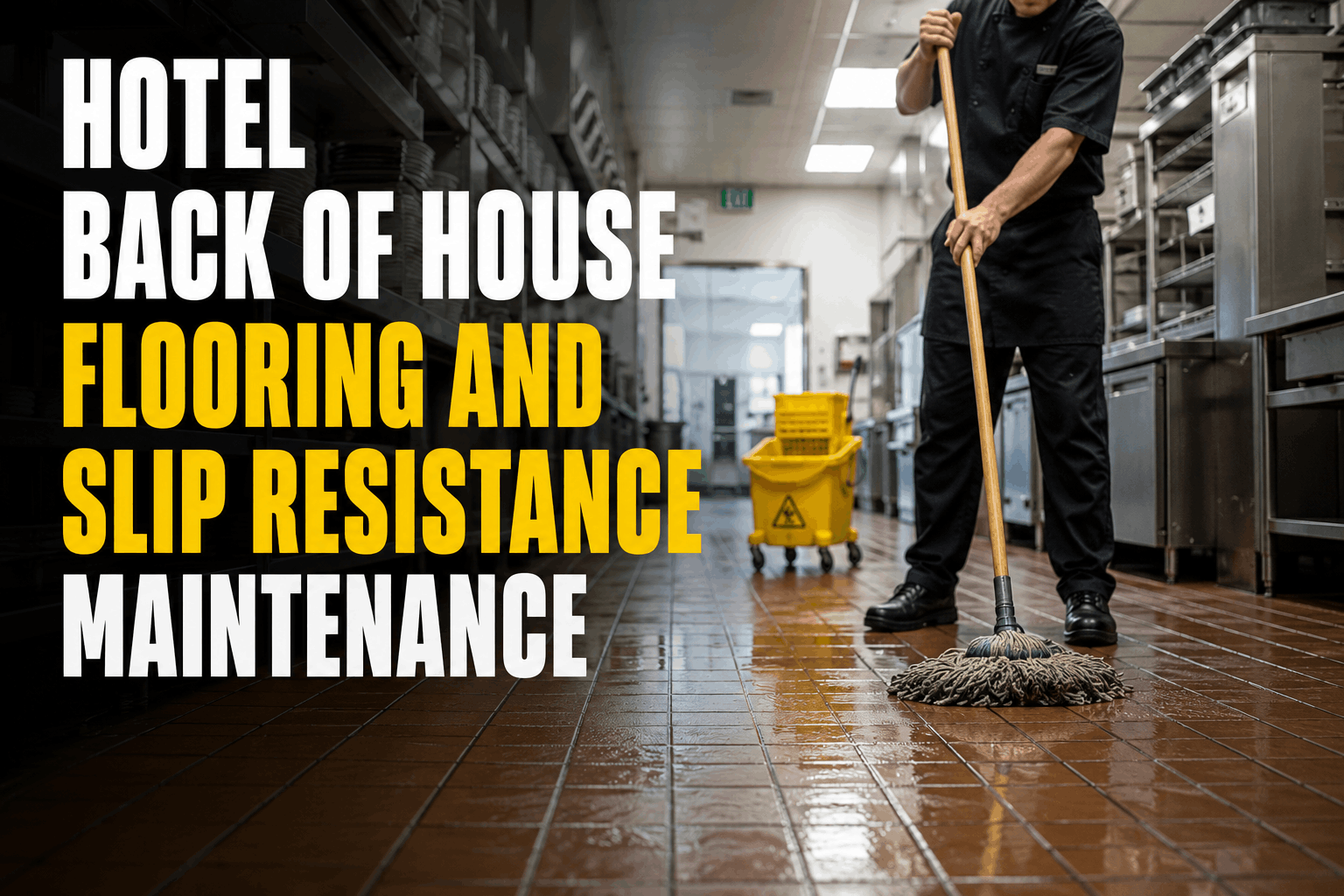
Kitchen grease, laundry moisture, and warehouse dust create slip hazards that are invisible until a staff member falls. Back-of-house flooring in hotels — kitchens, dishwashing areas, laundries, boiler rooms, and receiving docks — requires specific maintenance protocols that front-of-house floors do not. Slip resistance is measured by the Coefficient of Friction (COF), and OSHA standards consider floors with a COF below 0.5 to be hazardous in wet conditions. Yet the majority of hotel slip-and-fall incidents occur on floors that were cleaned — but cleaned incorrectly, leaving behind a residue film that is more slippery than the original soil. This guide covers monthly deep cleaning schedules, slip testing methods (pendulum tester, variable-angle tribometer), anti-slip treatment options, and the documentation required to defend against a slip-and-fall liability claim. Book a demo to see how Oxmaint schedules and documents floor safety inspections.
BACK OF HOUSE · FLOOR SAFETY · 2026
Hotel Back of House Flooring and Slip Resistance Maintenance
Kitchen slips are liability risks. Learn the monthly floor cleaning and slip testing schedule for hotel back-of-house areas — kitchens, laundries, boiler rooms, and warehouses.
Back of House Floor Safety — Inspection to Documentation Pipeline
How scheduled cleaning and slip testing becomes a defensible safety record
01
Scheduled Deep Cleaning
Kitchen degreasing, laundry floor scrubbing, warehouse dust control — scheduled weekly/monthly per zone.
02
Slip Testing (COF)
Quarterly pendulum or tribometer testing across all back-of-house zones — wet and dry conditions.
03
COF Below Threshold Alert
Results below 0.5 COF (wet) trigger automatic alerts to housekeeping manager and engineering.
04
Corrective Action Work Order
Oxmaint auto-creates work order for deep cleaning, anti-slip treatment, or floor coating repair.
05
Documentation & Compliance
All cleaning records, test results, and repairs stored — timestamped, photo-documented, audit-ready.
Back of House Flooring Zones — Where Slip Risks Are Highest
Manual floor inspection catches visible hazards like standing water. But the highest slip risks in back-of-house areas are invisible: grease residue after cleaning, detergent film buildup, and polished tile that becomes slippery when wet. Book a demo to see Oxmaint's zone-based floor safety tracking.
Kitchen — Cooking Line & Dishwashing
High Risk
Grease accumulation on quarry tile and epoxy floors. Monthly deep degreasing required. COF target: 0.6+ wet. Slip accidents here account for 38% of back-of-house claims. Daily spot cleaning insufficient — grease builds a polymer film that routine mopping cannot penetrate.
Laundry — Wash Aisle & Ironer Area
High Risk
Standing water, detergent residue, and lint create a film that reduces COF below 0.3. Weekly deep scrub required. Laundry floors are consistently wet for 12–16 hours daily. Detergent residue is as slippery as grease — but invisible to visual inspection.
Receiving Dock & Warehouse
Medium Risk
Rainwater tracked in, dust accumulation, and worn floor coating. Monthly cleaning, quarterly COF testing. Dock areas see variable conditions — wet from rain, dry from dust. Each requires different maintenance approaches. Worn epoxy coating exposes smooth concrete below.
Boiler Room & Mechanical
Medium Risk
Oil leaks, condensation, and smooth concrete finish. Weekly spot cleaning, monthly deep scrub. Boiler rooms are frequently overlooked in floor safety programs — but they are walked daily by engineering staff carrying tools and equipment.
Loading Ramp & Trash Enclosure
Medium Risk
Outdoor exposure, algae growth, and tracked-in debris. Monthly pressure wash, quarterly slip testing. Ramp slopes increase slip risk — a 5-degree slope multiplies slip force by 1.5× compared to flat floor.
Staff Corridors & Locker Rooms
Medium Risk
High-traffic polished concrete or tile. Weekly cleaning, quarterly COF testing. These are the most-walked back-of-house surfaces — and the most likely to be cited in a slip-and-fall claim because they are not obviously "industrial" flooring.
Floor Types and Anti-Slip Treatments — What Works Where
Standard in hotel kitchens. Naturally slip-resistant when clean — but grease film destroys COF. Requires alkaline degreaser weekly. Never seal with epoxy or urethane — sealing fills the natural texture that provides slip resistance.
Epoxy Coated Concrete
Common in receiving, laundry, warehouse. Smooth finish has low inherent slip resistance. Requires anti-slip aggregate additive during application. Aged epoxy becomes polished from foot traffic — COF declines over time even without visible wear.
Polished Concrete (Sealed)
Common in staff corridors, locker rooms. Most hazardous when wet. COF typically 0.3–0.4 — below OSHA wet floor guidance. Requires anti-slip treatment (acid etching or grit additive) or matting in wet areas.
Vinyl Composition Tile (VCT)
Found in some back-of-house corridors. Smooth, polished finish — extremely slippery when wet. Requires frequent stripping and refinishing. Anti-slip floor finish additives available but degrade after 3–6 months of mopping.
Anti-Slip Grit Tape / Matting
Temporary solution for high-risk zones. Apply at kitchen cooking line, dishwashing exit, laundry washer discharge. Replace every 6–12 months. Grit wears smooth under foot traffic. Document installation and replacement dates for liability defense.
Anti-Slip Chemical Treatment
Acid etching or surface modification for tile and concrete. Increases COF by 0.2–0.4. Requires application every 12–24 months. Treatment wears off over time — quarterly testing verifies whether retreatment is needed before a slip occurs.
Slip Testing Methods and Frequency — Documenting COF Compliance
Proactive Floor Safety vs Slip-and-Fall Liability Cost
Typical cost ranges — hotel back-of-house operations, USA market 2025
Proactive — Documented Floor Safety
Quarterly Slip Testing (pendulum/tribometer)
$1,200–$2,400/year
Monthly Deep Cleaning (degreasing)
$6,000–$12,000/year
Anti-Slip Treatment Application
$800–$3,000/year
Anti-Slip Matting Replacement
$400–$1,200/year
OSHA Fine (no violation with documentation)
$0
Total Proactive Annual Cost
$8,400–$18,600
Reactive — After Slip Incident
Worker's Compensation Claim
$15,000–$50,000
OSHA Citation (serious violation)
$5,000–$15,000
Guest Slip-and-Fall Settlement
$50,000–$500,000+
Legal Defense Costs
$20,000–$100,000
Insurance Premium Increase
$5,000–$25,000/year
Total Reactive Cost (Single Incident)
$95,000–$690,000+
"A dishwasher slipped on a greasy kitchen floor that housekeeping had mopped twice that day. The residue film was invisible. Our attorney asked for our floor testing records — we had none. The case settled for $187,000. After that, we implemented Oxmaint's floor safety module. Now we test COF quarterly in every back-of-house zone. When a second slip occurred eight months later, we produced 18 months of cleaning logs and slip test results showing COF consistently above 0.6. The claim was dismissed in pre-suit. Our insurer reduced our premium by 18% after reviewing our documented floor safety program."
— Director of Engineering, 420-Room Convention Hotel, Texas, USA · 2025
Oxmaint Back-of-House Floor Safety — Platform Features
Zone-Based Floor Safety Scheduling
Kitchen degreasing, laundry deep scrub, warehouse cleaning — each zone on its own recurring schedule. Oxmaint assigns tasks to the right team member with checklists specific to that floor type.
Slip Testing Schedule & Results Log
Quarterly COF testing scheduled automatically. Results logged with pendulum reading or tribometer value, test location, wet/dry condition. COF below 0.5 triggers immediate alert.
Auto Work Order for Low COF
When slip test result falls below threshold, Oxmaint creates a corrective work order — deep clean, anti-slip treatment, or floor coating repair — with priority based on zone risk level.
Floor Condition Dashboard
Every back-of-house zone visible on one screen — last cleaning date, last COF test result, days until next scheduled test. Green/Yellow/Red status per zone.
Photo Documentation of Floor Condition
Before/after photos for every deep cleaning and anti-slip treatment. Visual evidence of maintained floor condition — invaluable when defending against a "hazardous condition" claim filed months after the fact.
Liability Defense Reports
Export complete floor safety history for any date range — cleaning logs, test results, corrective actions, photo documentation. Ready for attorney review in under 5 minutes.
Back-of-House Floor Condition — Live View
Example: 8-zone hotel property snapshot
Main Kitchen
COF 0.62 — Good
Dishwashing
COF 0.55 — Good
Laundry Wash Aisle
COF 0.42 — Alert
Receiving Dock
COF 0.58 — Good
Warehouse
COF 0.64 — Good
Boiler Room
COF 0.48 — Alert
Staff Corridor
COF 0.52 — Good
Trash Enclosure
COF 0.31 — Critical
Good (COF ≥0.50)
Alert (COF 0.40–0.49)
Critical (COF <0.40)
Document Your Floor Safety Program on Oxmaint
Oxmaint schedules zone-based deep cleaning, tracks quarterly slip test results, alerts when COF falls below threshold, and maintains the documentation your attorney needs before a claim is filed. Free trial available.
What is the minimum acceptable Coefficient of Friction (COF) for back-of-house floors?
OSHA recommends a minimum COF of 0.5 for walking surfaces under wet conditions. Many state health codes adopt this standard. For kitchen and laundry areas, target COF of 0.6+ provides a safety margin. COF below 0.4 is considered high risk in slip-and-fall litigation.
How often should hotel back-of-house floors be slip tested?
Quarterly (every 90 days) is industry best practice for kitchen, laundry, and receiving areas. Semi-annually for lower-risk zones like dry storage. Oxmaint schedules all COF testing automatically. Testing methods: pendulum tester (most defensible in court) or variable-angle tribometer (faster but less accepted in litigation).
Does routine mopping remove grease from kitchen quarry tile?
No. Standard floor cleaner does not emulsify polymerized grease. Kitchen floors require weekly alkaline degreasing with mechanical scrubbing. Oxmaint schedules kitchen degreasing as a recurring PM task with a detailed checklist — documenting that the floor was properly cleaned on a regular cadence is as important as the cleaning itself for liability defense.
What is the most slip-resistant flooring for hotel kitchens?
Uncoated quarry tile (natural texture) with COF 0.7–0.9 when properly cleaned. Never seal or coat quarry tile — sealants fill the natural texture that provides slip resistance. Epoxy with anti-slip aggregate is second-best, but aggregate wears smooth over 3–5 years. Document floor type and maintenance requirements per zone in Oxmaint.
Does Oxmaint integrate with slip testing equipment for automated result logging?
Yes. Oxmaint accepts manual COF entry from any tester. For digital tribometers (e.g., Munro, 50X), Oxmaint's API can ingest results directly. Automated logging eliminates transcription errors and creates a timestamped, unalterable record — stronger evidentiary value than hand-written logs in slip-and-fall litigation.
What documentation do I need to defend a slip-and-fall claim?
Plaintiff attorneys request: (1) floor cleaning logs for 6+ months before incident — with dates, methods, staff signatures; (2) slip test results for the incident zone within the prior 12 months; (3) inspection records showing floor condition before incident; (4) anti-slip treatment history. Oxmaint stores all four categories in one auditable system — export complete defense package in under 5 minutes.
Document Your Floor Safety. Prevent Slips. Reduce Liability.
Start monitoring your back-of-house floor slip resistance with Oxmaint — free trial, no credit card required.