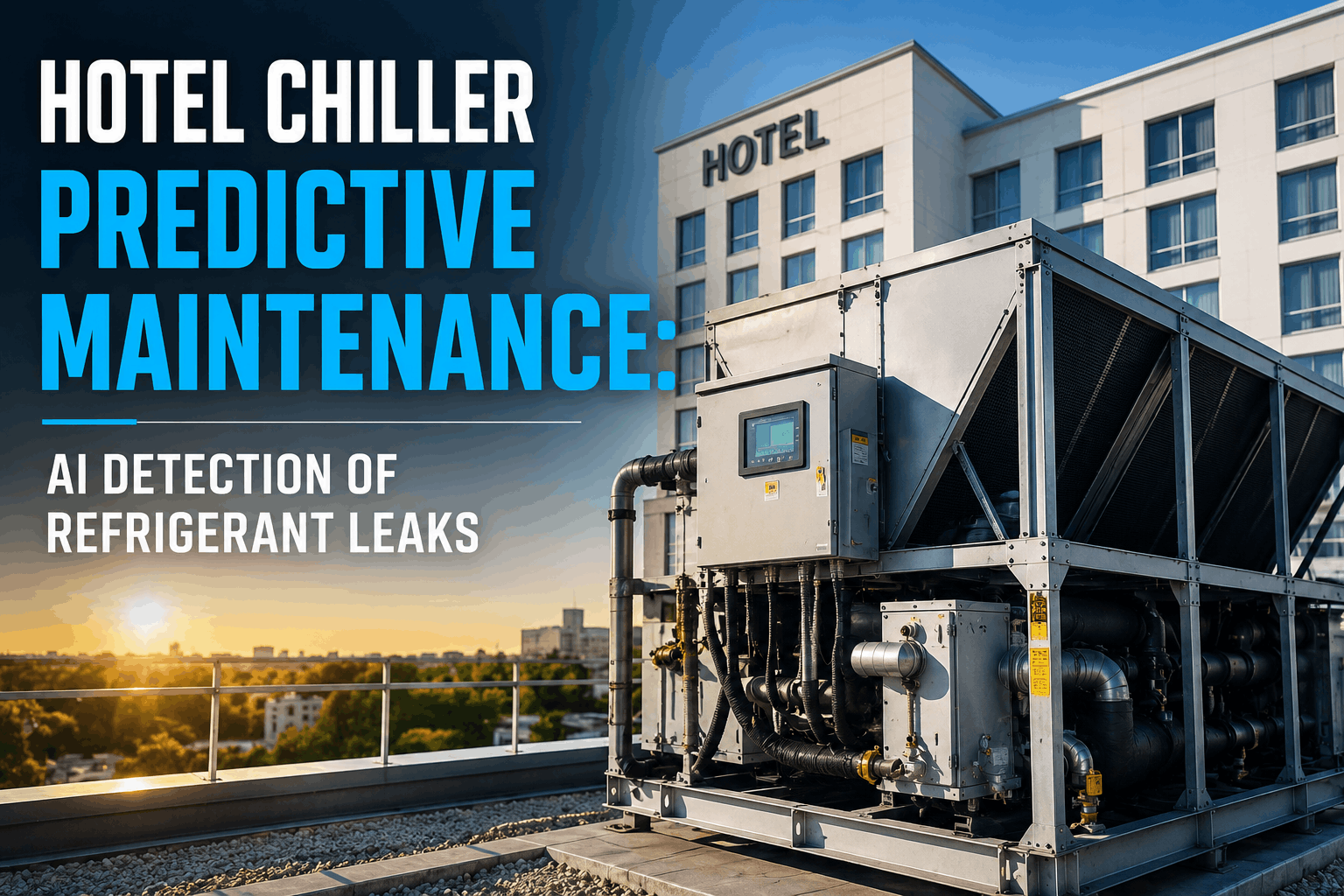
The building operations are manager got the call at 2:15 PM on the hottest Friday in July the data center on floors 8-10 was reporting temperatures are climbing past 82°F. The chiller had tripped on high head pressure 45 minutes earlier but nobody noticed until server room alarms triggered. What the building automation system couldn't tell them: head pressure had been trending upward for three weeks. Condenser coils were 55% blocked with debris. One of three condenser fans had been running at reduced speed for 12 days. The compressor had been pulling 8% higher amps than baseline since early June. Emergency repairs totaled $34,000. The data center tenant's SLA violation penalty: $125,000. An AI monitoring system would have detected the pressure anomaly 19 days earlierwhen a $600 coil cleaning and $200 fan motor repair would have prevented everything.
Compressor Damage
$15-50K
AI Prevents: 70%
Energy Waste
10-30%
AI Reduces: 25%
Downtime Cost
$5K+/hr
AI Prevents: 60%
Emergency Repairs
3-5x Cost
AI Prevents: 80%
Equipment Life
-50%
AI Extends: 30%
70%
Of compressor failures trace to high head pressure conditions developing over weeks
2-4 wks
Average warning window when AI monitors head pressure trends continuously
91%
Detection accuracy for AI systems predicting high head pressure failures
AI-powered predictive maintenance transforms chiller management from reactive firefighting to proactive protection. Instead of waiting for high head pressure alarms—which trigger after damage has already begun—machine learning algorithms detect the subtle patterns that precede pressure problems weeks in advance. When facility teams implement AI-powered chiller monitoring, they're not just preventing failures—they're building the operational intelligence that turns catastrophic surprises into scheduled maintenance windows.
How AI Detects High Head Pressure Before Alarms Trigger
Traditional building automation systems monitor head pressure as a single data point—and alarm only when it exceeds safety thresholds. By then, the compressor has already been stressed, efficiency has dropped, and damage may have begun. AI takes a fundamentally different approach: analyzing dozens of correlated variables to identify the conditions that cause high head pressure before the pressure itself rises. This predictive capability provides weeks of advance warning instead of minutes.
1
Condenser Performance
Approach Temperature, Coil ΔT, Airflow Velocity
Fouling Detection
Fan Efficiency
Heat Rejection
2
Compressor Health
Amp Draw, Discharge Temp, Oil Pressure, Vibration
Valve Condition
Bearing Wear
Motor Load
3
Refrigerant Circuit
Subcooling, Superheat, Liquid Line Temp, Sight Glass
Charge Level
Non-Condensables
Restriction
4
Ambient Conditions
Outdoor Temp, Humidity, Solar Load, Wind Speed
Weather Forecast
Load Prediction
Trend Analysis
5
System Integration
Cooling Tower Performance, Pump Status, Valve Position
Water Temp
Flow Rate
System Balance
6
Historical Patterns
Baseline Data, Seasonal Trends, Failure History
Degradation Rate
Anomaly Score
Remaining Life
The AI Detection Process: From Sensor Data to Predictive Alert
Understanding how AI transforms raw chiller data into actionable maintenance intelligence helps facility teams evaluate and implement predictive systems. The process runs continuously, analyzing hundreds of data points every minute to identify developing problems invisible to traditional monitoring. When your team can see how AI detection works on your chillers, the potential for preventing high head pressure failures becomes immediately clear.
1
Continuous Data Capture
IoT sensors stream head pressure, discharge temp, condenser ΔT, amp draw, and ambient conditions every 30 seconds
2
Baseline Comparison
AI compares current readings against established baselines adjusted for ambient conditions and load
3
Pattern Recognition
Machine learning identifies subtle deviations matching known high head pressure failure signatures
4
Root Cause Analysis
AI determines probable cause—dirty coils, fan issues, refrigerant problems, or ambient factors
See What Your Chillers Are Trying to Tell You
AI-powered monitoring detects high head pressure conditions weeks before traditional alarms trigger. Find out what predictive analytics would reveal about your chiller health.
Common High Head Pressure Causes: What AI Detects Early
High head pressure doesn't appear suddenly—it develops through specific failure modes that AI can identify weeks before pressure readings exceed thresholds. Understanding these patterns helps facility teams appreciate why AI monitoring succeeds where traditional approaches fail. Each cause has distinct signatures that machine learning recognizes from historical failure data across thousands of chiller systems.
AI Detection Signals: Gradual increase in condenser approach temperature, higher discharge pressure at same ambient, reduced airflow velocity readings
3-4 weeks advance warning
AI Detection Signals: Abnormal motor amp draw patterns, vibration signature changes, uneven temperature distribution across coil face, reduced CFM calculations
2-3 weeks advance warning
AI Detection Signals: Elevated subcooling readings, higher than baseline head pressure at all conditions, flooded condenser indicators, reduced system efficiency
Immediate detection
AI Detection Signals: Elevated standstill pressure, inconsistent pressure-temperature relationships, erratic head pressure behavior, poor efficiency at partial loads
1-2 weeks advance warning
Traditional Monitoring vs. AI Predictive Detection
The fundamental difference between traditional building automation and AI predictive monitoring is timing. Traditional systems tell you there's a problem; AI tells you a problem is developing. This shift from reactive to predictive changes everything about how facilities protect their chiller investments. The U.S. Department of Energy confirms predictive maintenance delivers 40% cost savings over reactive approaches. Properties ready to see the difference can create a free account and start monitoring immediately.
Detection Timing:
After threshold exceeded
Warning Time:
Minutes to hours
Root Cause:
Manual diagnosis required
Trend Analysis:
Manual review needed
Work Orders:
Created after alarm
Detection Timing:
Pattern deviation detected
Warning Time:
2-4 weeks advance
Root Cause:
AI-identified probable cause
Trend Analysis:
Continuous automated
Work Orders:
Auto-generated with diagnosis
70%
fewer compressor failures
40%
lower maintenance costs
Implementation Lifecycle: From Pilot to Full Deployment
Successful AI chiller monitoring implementations follow a proven lifecycle—starting with baseline establishment, progressing through algorithm training, and culminating in fully automated predictive maintenance. This phased approach validates savings, builds internal expertise, and ensures the AI system learns your specific equipment characteristics before making critical predictions.
Baseline
Sensor deployment, Data collection, Normal operation mapping, Equipment profiling
Training
AI model calibration, Pattern library loading, Threshold optimization, Alert tuning
Validation
Prediction testing, False positive reduction, Technician feedback, Model refinement
Automation
CMMS integration, Auto work orders, Escalation rules, Dashboard deployment
Optimization
Continuous improvement, Accuracy tracking, Expansion planning, ROI measurement
ROI: What Facilities Actually Achieve with AI Chiller Monitoring
The business case for AI-powered high head pressure detection extends beyond prevented failures. Energy savings from optimized operation, extended equipment life, reduced emergency service premiums, and eliminated tenant SLA violations all contribute to ROI. Properties that discuss their specific situation with our team receive customized ROI projections based on their chiller inventory, criticality, and current maintenance approach.
Weeks 1-4
Baseline & Training
Sensor installation, Data collection, AI learning equipment behavior patterns
Foundation building
Months 2-3
Early Detection
First predictive alerts, Prevented issues identified, Energy anomalies flagged
15-25% savings begin
Months 4-6
Full Prediction
Mature AI models, Automated work orders, Comprehensive trending
30-40% savings
Year 1+
Sustained Value
Continuous improvement, Equipment life extension, Zero high head pressure failures
40%+ sustained
Typical Payback Period
3-6 Months
Expert Perspective: Why AI Succeeds Where Traditional Monitoring Fails
Industry Insight
"Traditional high head pressure alarms are like smoke detectors—they tell you there's a fire after it's already started. AI monitoring is like having a fire inspector watching your kitchen 24/7, spotting the grease buildup and frayed wires before anything ignites. The facilities that prevent compressor failures aren't better at responding to alarms; they're catching the conditions that cause high head pressure three weeks before the alarm would ever trigger."
— Senior HVAC Systems Engineer, 28 years critical facility experience
Pattern Recognition
AI identifies subtle correlations humans miss—like the relationship between morning dew point, afternoon head pressure, and coil fouling rate.
Continuous Baseline
Unlike fixed alarm thresholds, AI baselines adjust for ambient conditions, load, and seasonal variations—detecting true anomalies, not weather changes.
Failure Library
Machine learning leverages thousands of documented failures to recognize developing problems specific to your chiller make and model.
Implementation Requirements: What AI Monitoring Needs
AI chiller monitoring builds on existing infrastructure where possible but requires specific technical foundations for accurate high head pressure prediction. Understanding these requirements helps facility teams evaluate implementation feasibility and plan sensor deployment strategically.
Pressure transducers, Temperature sensors, Power meters, Vibration sensors, Ambient monitors
Comprehensive data capture
WiFi, cellular, or LoRaWAN gateway, BACnet/Modbus integration, Cloud platform connection
Real-time data streaming
Cloud AI platform, Machine learning models, CMMS integration, Mobile alerts and dashboards
Predictive intelligence
Stop High Head Pressure Before It Stops Your Chillers
Oxmaint's AI-powered predictive maintenance gives facility teams 2-4 weeks advance warning before high head pressure failures. Protect your compressors, protect your tenants, protect your budget.
Frequently Asked Questions
How accurately can AI predict high head pressure conditions?
Modern AI predictive maintenance systems achieve 85-95% accuracy in detecting conditions that lead to high head pressure 2-4 weeks before traditional alarms would trigger. This compares to essentially 0% predictive capability from traditional BAS monitoring, which only alerts after thresholds are exceeded. Accuracy improves over time as AI learns your specific equipment characteristics, operating patterns, and environmental factors. The key is sufficient sensor data—systems monitoring head pressure, discharge temperature, subcooling, condenser approach, and compressor amps achieve the highest accuracy.
What causes high head pressure that AI can detect early?
AI excels at detecting the gradual conditions that cause high head pressure: dirty condenser coils (60-70% of cases), condenser fan issues (15-20%), refrigerant overcharge (8-12%), non-condensables in the system (5-8%), and ambient/airflow restrictions. Each cause has distinct signatures—coil fouling shows as gradual approach temperature increase, fan problems create uneven temperature distribution, refrigerant issues affect subcooling readings. Traditional monitoring only sees the final result (high pressure); AI sees the developing causes.
How much does AI chiller monitoring cost to implement?
Initial implementation typically costs $500-2,000 per chiller for sensors (if not already present), plus $200-500 for gateway equipment, with ongoing cloud platform subscriptions of $100-300/month depending on chiller count. Most facilities recover this investment within 3-6 months through a single prevented failure. A compressor replacement costing $15,000-50,000 versus a $600 scheduled coil cleaning demonstrates the value proposition. Many implementations leverage existing BAS sensors, reducing initial hardware costs significantly.
How long before AI starts making accurate predictions?
AI systems require a baseline learning period of 2-4 weeks to understand normal equipment behavior before making reliable predictions. During this period, the system collects operating data across varying ambient conditions and load profiles to establish performance baselines. Industry-wide failure pattern libraries allow some predictions even during baseline collection. Full prediction accuracy is typically achieved within 60-90 days as the AI accumulates enough data to distinguish true anomalies from normal operational variation.
Does AI monitoring work with existing building automation systems?
Yes—AI monitoring platforms are designed to integrate with existing BAS infrastructure via BACnet, Modbus, or API connections. Many implementations leverage data already being collected by building automation systems, adding AI analysis without replacing existing controls. Where BAS sensor coverage is insufficient for predictive accuracy (particularly condenser approach temperature and refrigerant circuit monitoring), supplemental IoT sensors can be added. The AI platform operates as an analytics layer above the BAS, not a replacement for it.
Ready to Predict High Head Pressure Before It Happens
Join thousands of facility managers using Oxmaint to predict chiller failures weeks in advance. Start protecting your equipment today.