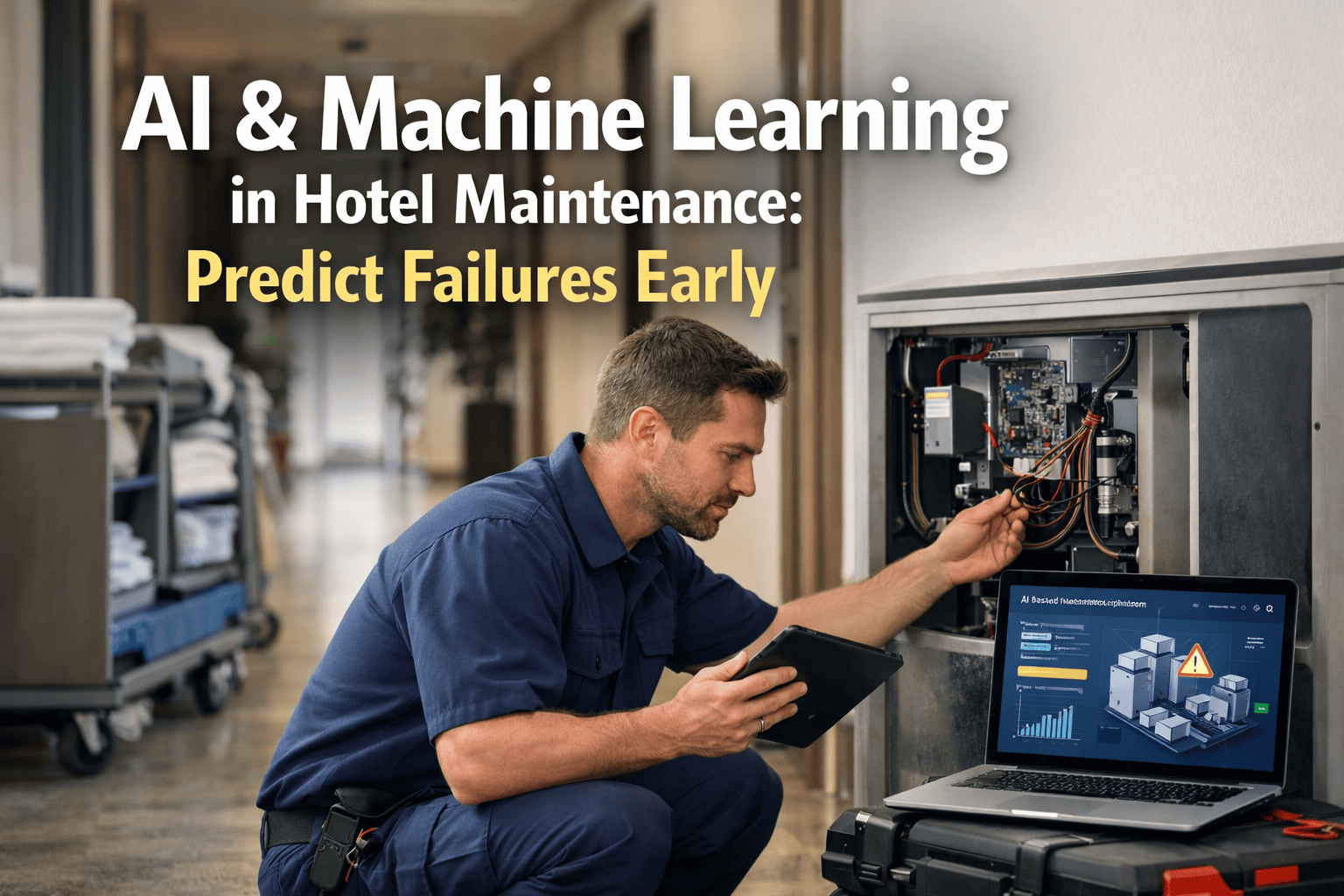
The elevator in a 340-room full-service hotel outside Atlanta gave no visible warning before it went offline on a Saturday morning in peak season. The motor had been running hot for eleven days. The vibration signature had shifted measurably three days before failure. The current draw had spiked twice in the week prior. Every signal was there — captured by sensors already installed on the equipment. Nobody was analyzing it. A machine learning model running on that same sensor data would have flagged the anomaly on day two and generated a work order before the weekend rush. Instead, the hotel spent $18,400 on emergency repair, relocated fourteen guests, and issued nine comp nights. The data existed. The intelligence did not.
AI in Hotel Engineering
Machine Learning Predicts Hotel Equipment Failures Days Before They Happen
Sensors already installed on your HVAC, elevators, and critical equipment are generating failure signals right now. Machine learning reads those signals. Traditional maintenance does not.
What Machine Learning Actually Does in Hotel Maintenance
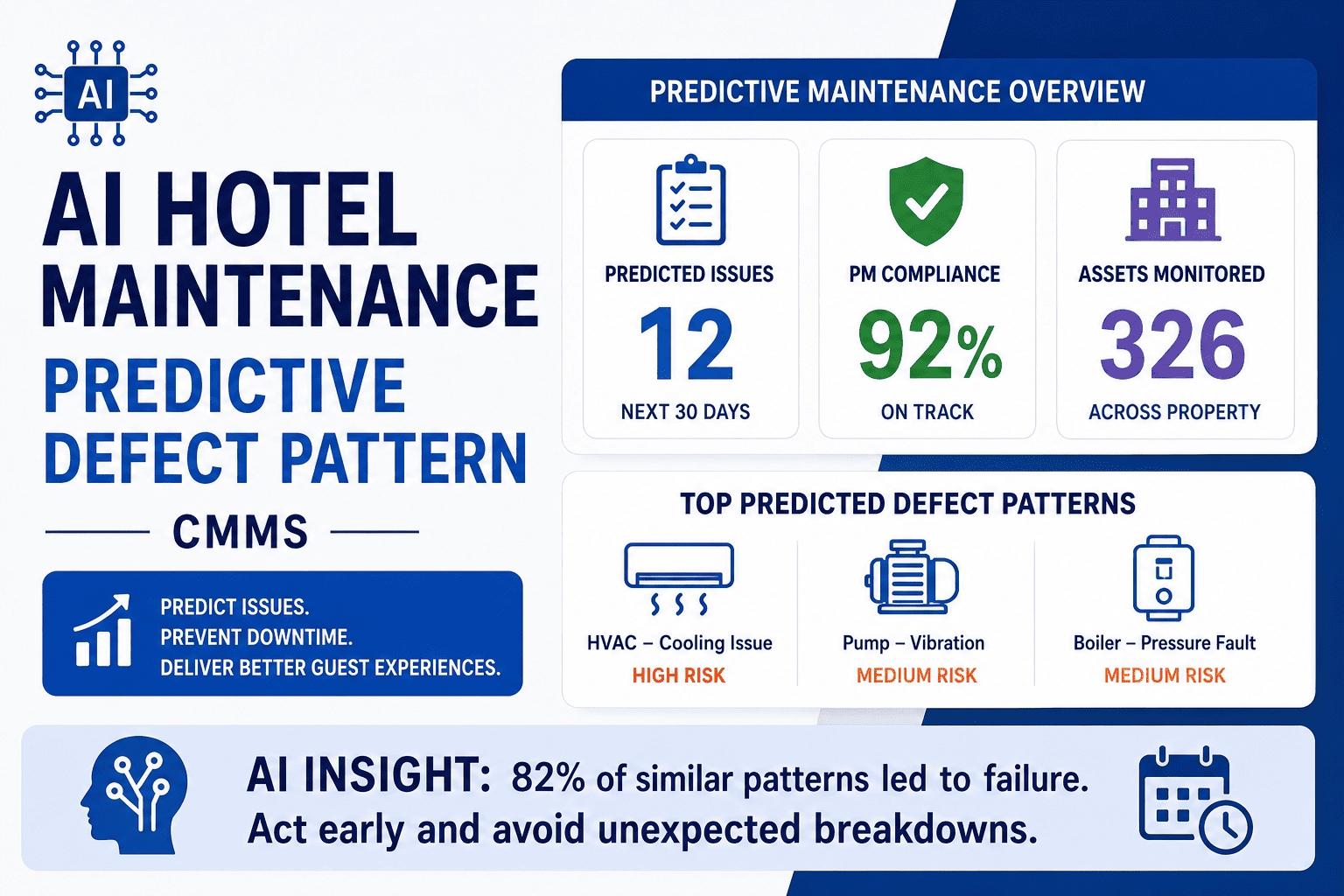
Machine learning does not replace your engineering team. It gives them information they cannot generate manually. A trained ML model watches hundreds of data points — temperature, vibration, current draw, runtime hours, pressure differentials — and learns what normal looks like for each piece of equipment in your specific building. When a pattern deviates from normal, the model flags it as an anomaly and classifies its likely cause. Your engineer gets a work order that says "Chiller 2 showing early bearing wear — inspect within 72 hours" instead of a phone call at midnight saying the chiller is down. Hotels ready to move from reactive to predictive can start a free trial to see how ML-driven work orders integrate with existing equipment.
01
Data Collection
Sensors on HVAC units, elevators, pumps, and boilers stream temperature, vibration, current, and pressure data continuously — every 30 to 60 seconds.
02
Baseline Learning
The ML model trains on 30–90 days of historical data to understand what normal operating patterns look like for each asset under each set of conditions.
03
Anomaly Detection
When live sensor readings deviate from learned baselines, the model flags the anomaly, scores its severity, and classifies the likely failure mode.
04
Work Order Creation
A prioritized work order is automatically generated in the CMMS with equipment context, failure classification, and recommended action — before the failure occurs.
The Six Equipment Categories ML Models Watch in Hotels
Machine learning delivers the highest ROI on equipment that fails expensively, fails unpredictably, or generates significant guest impact when it goes down. In hotels, six asset categories meet all three criteria. Hotels that book a demo typically identify two to three of these categories where failure prediction would have prevented recent emergency repairs.
| Asset |
Key ML Signals |
Typical Failure Warning |
Avg. Emergency Cost |
ML Lead Time |
| Chiller / Central Plant |
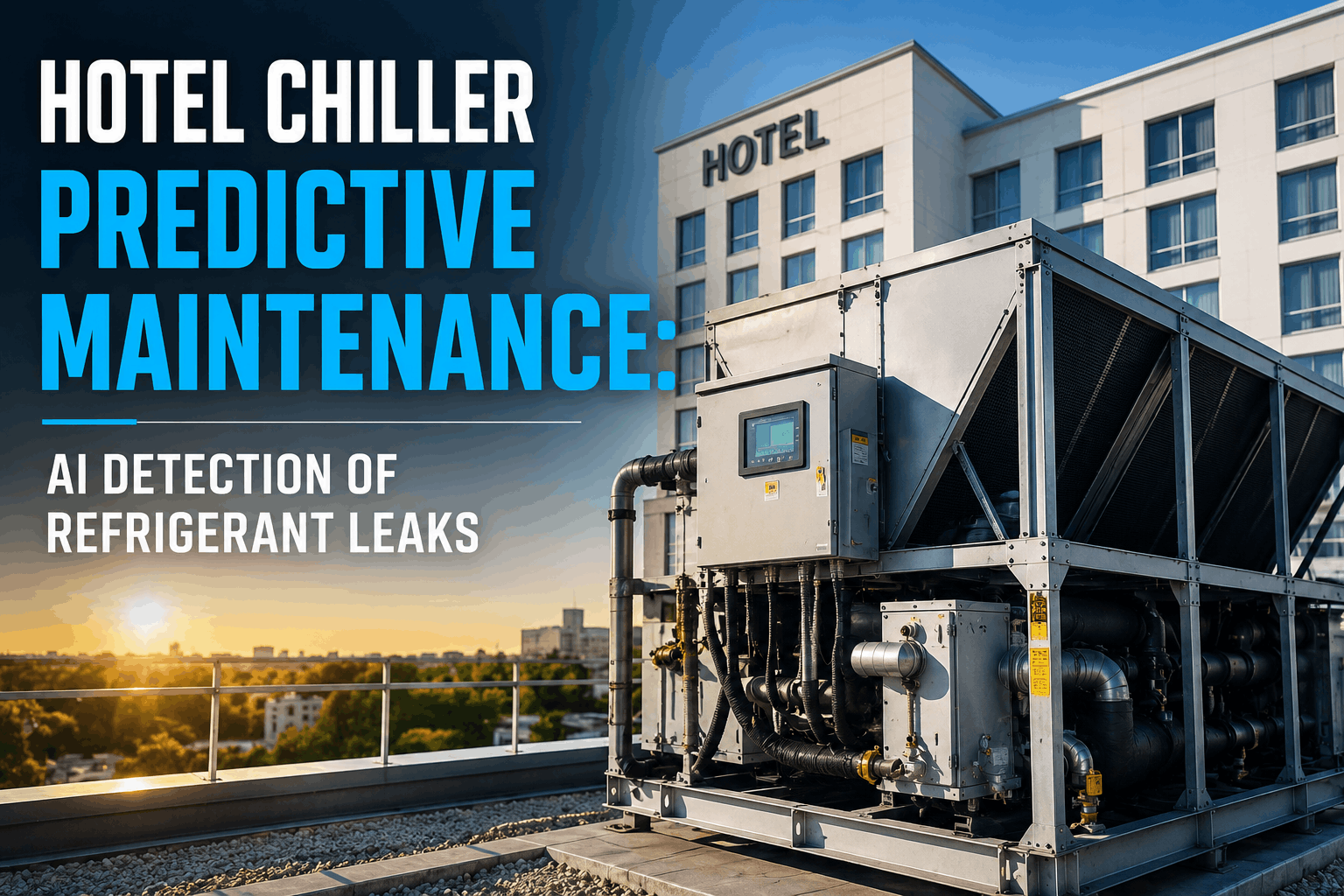
Refrigerant pressure, compressor current, leaving water temp delta, vibration |
Compressor bearing wear, refrigerant leak, condenser fouling |
$12,000–$45,000 |
3–14 days |
| Elevators |
Motor current draw, door cycle time, leveling accuracy, vibration signature |
Motor brush wear, door operator failure, hoist rope tension |
$8,000–$22,000 |
5–21 days |
| HVAC Air Handlers |
Fan VFD current, filter differential pressure, supply air temp, belt tension |
Belt slippage, bearing failure, coil fouling, VFD overheating |
$3,500–$12,000 |
2–10 days |
| Hot Water / Boiler |
Flue gas temp, heat exchanger delta-T, combustion efficiency, stack temp |
Heat exchanger scaling, burner degradation, stack blockage |
$5,000–$18,000 |
4–12 days |
| Pool / Spa Equipment |
Pump flow rate, filter pressure, heater cycling frequency, chemical dosing |
Pump impeller wear, filter bypass, heater element failure |
$2,500–$8,000 |
2–7 days |
| Kitchen Refrigeration |
Compressor run time, evaporator coil temp, door seal delta, defrost cycles |
Evaporator coil ice, door gasket failure, compressor overload |
$4,000–$15,000 + food loss |
1–5 days |
Swipe to see full table
Before ML vs. After ML: The Maintenance Timeline Shift
The difference between reactive and ML-predictive maintenance is not just cost — it is when in the failure timeline your team intervenes. Every piece of equipment passes through the same degradation curve. ML moves your intervention point from the emergency zone to the early warning zone.
Normal Operation
Early Degradation
Accelerated Wear
Failure Imminent
Scheduled PM
Maybe catches it
Reactive Response
After failure
Reactive Maintenance
$18,400 avg repair
72–96 hrs downtime
Emergency contractor rates
Guest impact inevitable
ML-Predictive
$1,200–$3,500 planned repair
2–4 hrs scheduled window
Standard contractor rates
Zero guest impact
What ML Models Cannot Do — And Why That Matters
Machine learning is not a crystal ball. Understanding its actual capabilities helps hotel engineering leaders set expectations correctly and deploy it where it delivers real results.
ML Can Do This
Detect statistical deviations from baseline equipment behavior before they are visible or audible
Classify anomaly patterns that historically correlate with specific failure modes
Score equipment health continuously and rank assets by failure probability
Reduce false alarms over time by learning from confirmed vs. unconfirmed fault events
Correlate multiple weak signals across different sensors to identify compound failure risk
ML Cannot Do This
Predict random failures caused by sudden physical damage or supply chain contamination
Learn accurately from fewer than 4–6 weeks of consistent sensor data
Replace the engineer's judgment on when and how to act on a flagged anomaly
Compensate for miscalibrated or failed sensors feeding bad data to the model
Predict failures on equipment with no sensor coverage or insufficient data points
How Hotels Are Using ML Failure Prediction Right Now
Full-Service Hotel — 280 Rooms
Chiller failed twice in 18 months. Second failure occurred 6 weeks after a scheduled PM that found nothing wrong. Total downtime and repair cost: $61,000.
ML model deployed on chiller plant. Within 90 days, flagged abnormal compressor current signature on Chiller 1 — 11 days before measured performance degradation. Planned repair scheduled during low-occupancy period.
$38,000 repair avoided
Zero guest impact
Repair cost: $2,800
Boutique Hotel — 95 Rooms
Hot water failures were the top guest complaint category for two consecutive quarters. Three heater replacements in 14 months. No pattern identified by engineering team.
ML monitoring on water heating system identified short-cycling pattern correlated with high-occupancy demand spikes — indicating undersized buffer tank, not heater defects. Root cause fixed, not just the symptom.
Hot water complaints down 84%
No heater replacement in 11 months
$14,000 saved
Convention Property — 520 Rooms
Elevator out-of-service events averaging 4.2 per year, always on weekends or during peak occupancy — generating comp rooms and serious guest satisfaction damage.
ML model on elevator systems began flagging door operator current anomalies 8–14 days ahead of observed failures. Maintenance team began scheduling door adjustments during overnight windows instead of responding to shutdowns.
Out-of-service events down from 4.2 to 0.6/year
$26,000 in avoided emergency costs
Your Equipment Is Already Sending Failure Signals
Oxmaint's ML-powered CMMS reads the sensor data your equipment already generates and converts it into predictive work orders — before failures reach guests.
Sign up free to connect your first asset and see the health score dashboard live.
The Data Requirements: What You Actually Need to Start
Minimum to Start
BACnet, Modbus, or API-connected BAS with trend logging enabled
30+ days of historical sensor data on target equipment
Basic equipment metadata: install date, model, service history
Internet connectivity from equipment network to cloud platform
Better Results With
Dedicated vibration and current sensors on rotating equipment
90+ days of historical trend data across all seasons
Past maintenance records and failure event logs in CMMS
Sub-metering on individual equipment for energy anomaly detection
Maximum Accuracy
Vibration, temperature, current, and acoustic sensors per asset
12+ months of labeled historical data including known failure events
Occupancy integration for demand-correlated load modeling
Full CMMS work order history tied to equipment asset records
Frequently Asked Questions
How accurate is machine learning at predicting hotel equipment failures?
Well-trained ML models on hotel HVAC and mechanical systems achieve 75–90% precision on flagged anomalies — meaning that when the model raises an alert, the equipment genuinely has a developing issue the majority of the time. Recall rates (catching failures before they happen) range from 65–85% depending on sensor coverage and data history. Models improve significantly over the first 6–12 months as they accumulate property-specific failure event data to refine classifications.
Do we need to replace our sensors or BAS to use ML failure prediction?
Most hotels with a BAS installed after 2010 already have enough sensor data for meaningful ML baseline models. The platform connects to your existing BAS via BACnet or Modbus and reads whatever sensor data is already being trended. For equipment without existing sensors — older standalone chillers, legacy elevator systems — targeted sensor additions typically cost $800–$3,000 per asset and pay back within months from the first prevented failure.
How long does it take for the ML model to start generating useful predictions?
Initial anomaly detection begins within 2–4 weeks of data connection as the model establishes operational baselines. High-confidence failure predictions with specific fault classification typically emerge at 60–90 days. Full model maturity — where the system is accurately predicting failure 5–14 days ahead with specific component-level diagnosis — usually occurs between 4–6 months of continuous operation.
What is the ROI of ML predictive maintenance for a mid-size hotel?
For a 150–300 room property, ML predictive maintenance typically delivers $40,000–$120,000 in annual savings through avoided emergency repairs, reduced comp nights, and lower preventive maintenance labor costs from more targeted PM scheduling. Implementation costs — sensors, integration, and platform subscription — range from $15,000–$40,000 for a typical property. Most hotels reach payback within 6–14 months, with the first prevented chiller or elevator failure often covering the first year's platform cost entirely.
Can ML maintenance prediction work in older hotels with aging infrastructure?
Older properties actually benefit more from ML monitoring because aging equipment is more susceptible to developing failures between scheduled PM intervals. The key requirement is sensor connectivity — not equipment age. Hotels with older pneumatic BAS systems or standalone equipment can add BACnet gateway adapters and IoT sensors to bring legacy assets into ML monitoring. The model learns the specific degradation patterns of older equipment and often delivers higher precision predictions because aging assets exhibit more pronounced anomaly signatures before failure.
Stop Reacting. Start Predicting.
Oxmaint ML Gives Your Hotel Engineering Team a 5–14 Day Head Start on Every Equipment Failure
Connect your existing BAS data to Oxmaint's machine learning platform and start receiving equipment health scores, anomaly alerts, and predictive work orders — without replacing a single sensor or controller. Book a demo to walk through a live failure prediction dashboard built on a property similar to yours.
75–90%
ML alert precision rate
5–14 days
average failure warning window
6–14 mo
typical payback period