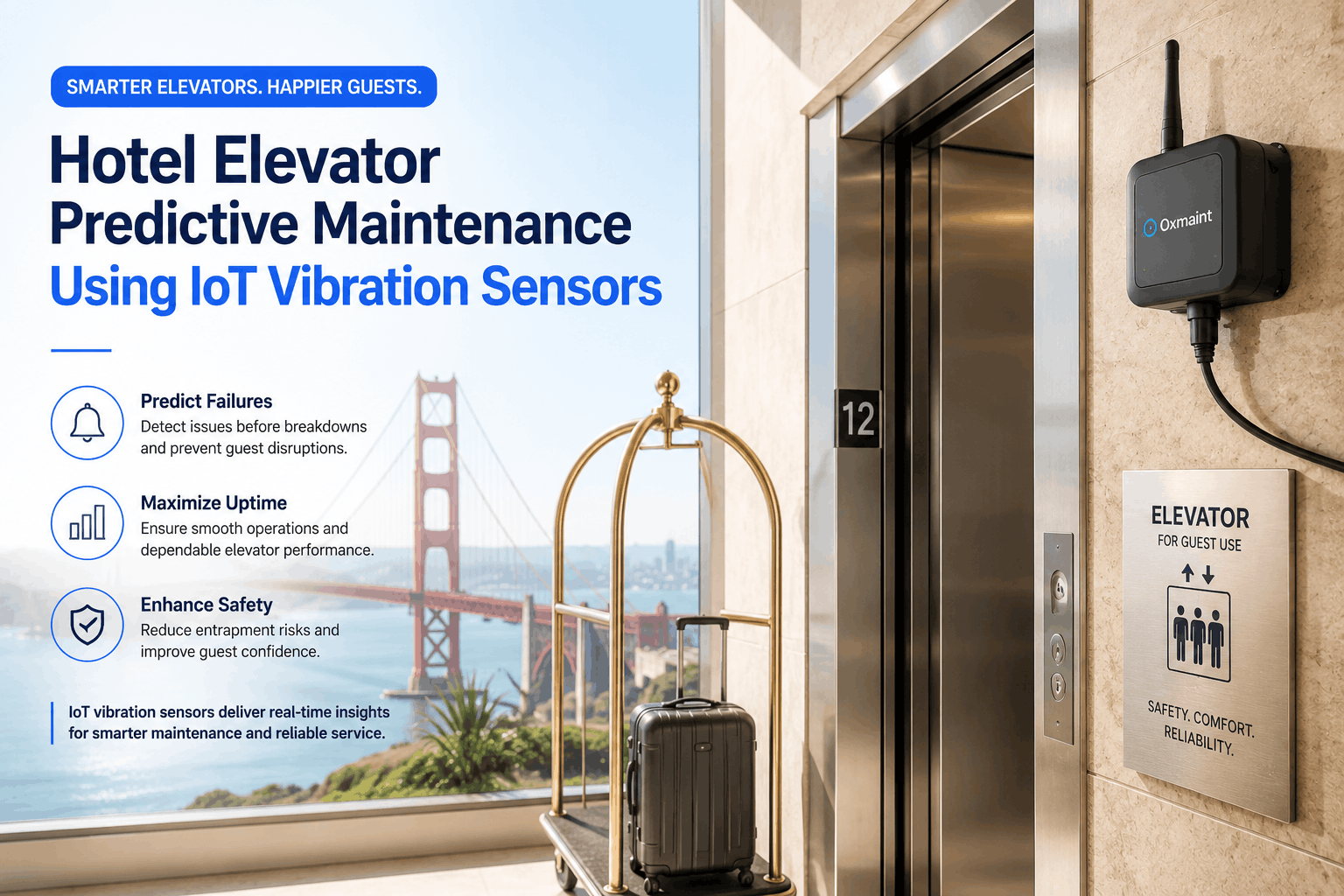
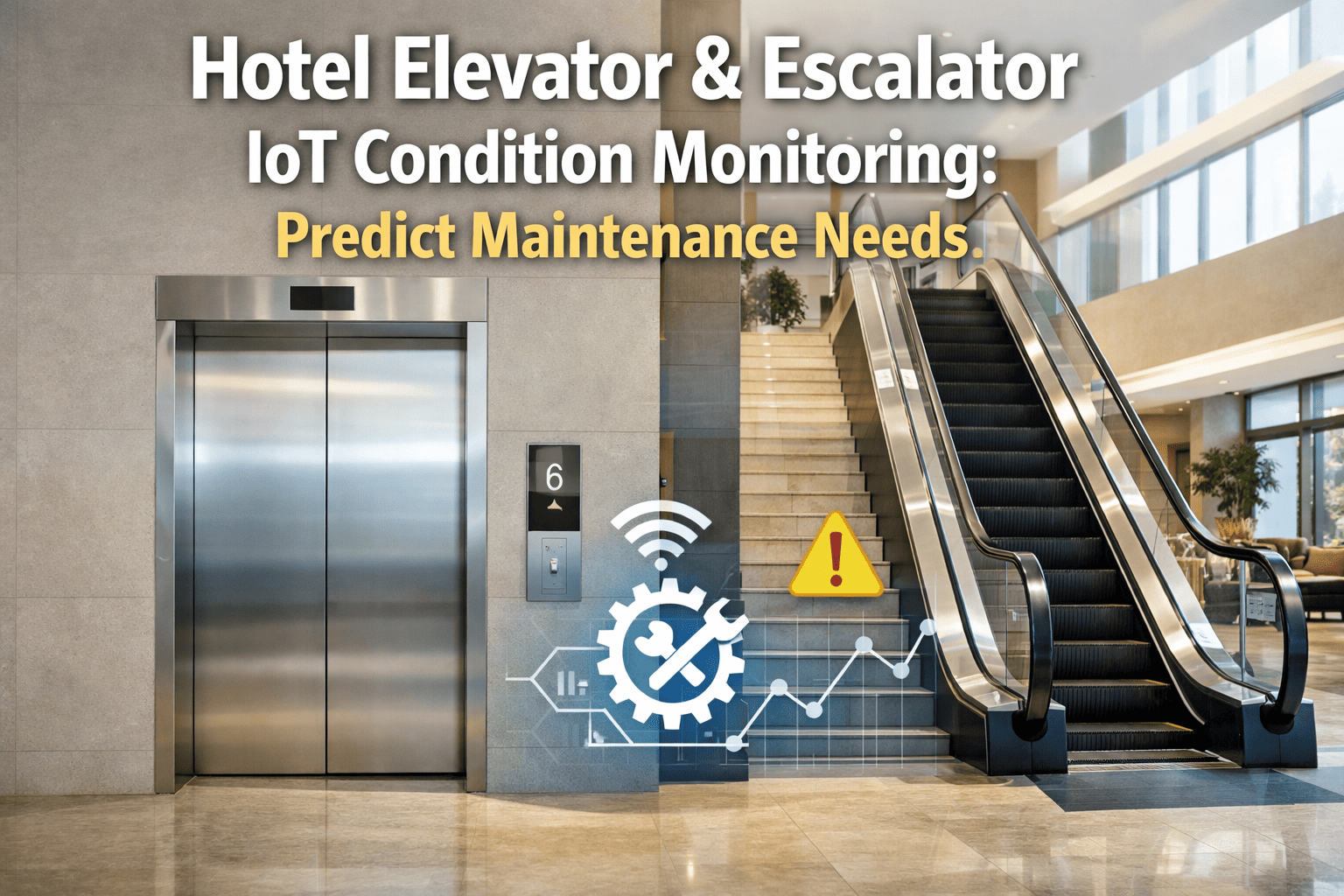
Hotel elevator failures trap guests, disrupt operations, and generate liability claims. A single entrapment during peak check-in costs $18,000 in emergency repair, guest compensation, and lost revenue — yet 92% of elevator failures are detectable 10-30 days in advance through vibration monitoring. Traditional reactive maintenance waits for failure; predictive maintenance prevents it. IoT vibration sensors on elevator motors, sheaves, and guide rails detect bearing wear, misalignment, and degradation patterns weeks before mechanical failure. The difference is measurable: hotels with sensor-monitored elevators report zero unplanned shutdowns, 100% compliance audit readiness, and elevator vendor SLA improvements from unmeasured to 94% compliance. OxMaint's elevator predictive maintenance module integrates with IoT vibration sensors, trains AI models on your equipment's baseline, and triggers work orders when degradation patterns emerge.Book a demo to see elevator monitoring configured for your property.
Vertical Transportation Intelligence
IoT Vibration Sensors + AI. Predict Elevator Failures 10-30 Days Early.
Oxmaint connects to elevator vibration sensors, trains AI models on your equipment's baseline, and triggers work orders when degradation patterns emerge — eliminating unplanned shutdowns and guest entrapment.
$18K
average cost per unplanned elevator shutdown — repair, comp, revenue loss
92%
of elevator failures detectable 10-30 days in advance with vibration monitoring
6.2 hrs
average elevator downtime per incident without predictive monitoring
What IoT Elevator Vibration Monitoring Actually Detects — and Why Manual Inspections Miss It
Traditional elevator maintenance relies on calendar-based inspections — quarterly or semi-annual visits where a technician listens, looks, and logs observations. The problem is that degradation happens continuously between inspections. A bearing wears gradually over 6-12 months, producing vibration frequencies that change by 0.1-0.3 in/s per month. A sheave develops misalignment that shifts vibration phase by 2-5 degrees weekly. A guide rail irregularity creates impact vibration that increases by 5-10% every 30 days. Human inspection cannot detect these trends because the changes between visits are too small to perceive. IoT vibration sensors measure continuously, capturing the rate of change. The distinction matters enormously for guest safety: an elevator with continuous vibration monitoring has a fundamentally different reliability profile than one inspected only quarterly.
Bearing wear detection
Audible noise or overheating — after significant damage
Vibration spectrum analysis — detects 0.15 in/s increase above baseline, 6-10 weeks advance warning
Sheave misalignment
Visible rope tracking issues or uneven wear
Phase angle analysis — detects 2° shift, 4-6 weeks advance warning
Guide rail irregularities
Ride quality complaints from guests
Impact vibration monitoring — detects 5% increase, 8-12 weeks advance warning
Door system degradation
Door jams or entrapment — after failure
Cycle time trend analysis — detects 15% increase, 2-4 weeks advance warning
Motor temperature drift
Thermal overload shutdown — after overheating
Continuous thermocouple monitoring — detects 8-12°F rise, 2-4 weeks advance warning
The 6 Elevator Components IoT Vibration Sensors Monitor Continuously
Modern elevator IoT systems monitor six critical components in real time. Each component has defined baseline vibration signatures, degradation patterns, and alert thresholds. Understanding what is measurable — and the intervention required — allows facility managers to build predictive maintenance programs around objective, continuous data rather than subjective, infrequent manual inspections.
Traction Motor Bearings
Accelerometer: velocity (in/s) at bearing frequencies (BPFO, BPFI, BSF, FTF)
Alert threshold0.15 in/s increase above baseline or BPFI amplitude >0.20 in/s
Advance warning6-10 weeks before bearing seizure
Motor bearings are the #1 cause of unplanned elevator shutdowns. Vibration spectrum analysis detects inner race, outer race, ball, and cage defect frequencies before audible noise or temperature rise occurs. Trending identifies rate of degradation — accelerating wear triggers immediate intervention.
0.15 in/s alert
Traction Sheave and Rope System
Accelerometer + phase angle sensor: 1× RPM amplitude + phase shift
Alert thresholdPhase angle shift >5° or 1× RPM amplitude >0.25 in/s
Advance warning4-6 weeks before rope tracking failure
Sheave misalignment causes uneven rope wear, increased vibration, and eventual rope tracking failure. Phase angle analysis detects misalignment before it affects ride quality. Rope tension sensors identify individual rope elongation requiring replacement before safety system triggers emergency stop.
5° phase shift
Guide Rails and Roller Guides
Accelerometer: vertical and horizontal impact vibration (g-force)
Alert thresholdImpact amplitude >0.1g above baseline or frequency >50 Hz
Advance warning8-12 weeks before ride quality complaint
Guide rail irregularities produce impact vibration at each rail joint or irregularity. Vertical vibration indicates rail misalignment; horizontal indicates roller guide wear. Impact frequency and amplitude trend identifies specific rail locations requiring adjustment before guests notice ride roughness.
0.1g impact
Door Operator System
Current sensor + cycle timer: door open/close duration (seconds)
Alert thresholdCycle time increase 15% above baseline or current spike >20%
Advance warning2-4 weeks before door jam entrapment
Door system failures cause the most frequent guest entrapments. Cycle time trending detects increasing friction from track debris, worn rollers, or door operator degradation. Current spikes indicate motor strain from binding. Trending identifies which doors need cleaning or adjustment before they jam.
15% slower
Motor Temperature and Drive System
Thermocouple + VFD current monitoring: temperature (°F) and motor current (amps)
Alert thresholdTemperature rise 10°F above baseline or current >15% above nominal
Advance warning2-4 weeks before thermal overload shutdown
Traction motors operate continuously during peak hours. Temperature trending detects cooling system degradation, bearing friction increase, or insulation breakdown before thermal overload shutdown. Current trending identifies mechanical binding or increased friction in the hoistway.
10°F rise
Car Position and Leveling Accuracy
Encoder + leveling sensors: floor positioning error (inches)
Alert thresholdLeveling error >0.5 inches above baseline
Advance warning4-6 weeks before guest complaint or trip hazard
Leveling accuracy degrades gradually as encoder drift, brake wear, or controller calibration shifts. Leveling error above 0.5 inches creates tripping hazard and ADA violation. Trending enables calibration during planned maintenance before guests notice step height difference.
0.5 inch
Zero Unplanned Shutdowns
Predictive Alerts → Auto Work Orders → Guest Impact Eliminated.
Oxmaint's AI models detect degradation patterns 10-30 days before failure, auto-generate work orders, and route to your elevator vendor with full diagnostics — all before guests ever notice a problem.
Predictive vs Reactive — The Cost and Guest Impact Gap
The operational difference between reactive and predictive elevator maintenance is dramatic across every metric that matters to hotel operations and guest satisfaction. Data from Oxmaint's hospitality customers shows consistent improvement patterns: unplanned elevator shutdowns drop from 2-3 per year to zero within 6 months of sensor deployment. Guest entrapment incidents eliminated entirely. Emergency repair costs reduced by 75-90% as component replacements happen during planned maintenance, not emergency callouts. And elevator vendor SLA compliance improves from unmeasured or inconsistent to 94% tracked and enforced.
Unplanned shutdowns per year
Guest entrapment incidents
Emergency repair cost per year
Vendor SLA compliance
Unmeasured / 65% (reactive)
Reactive MaintenancePredictive IoT Monitoring
Elevator Compliance Across Jurisdictions — Automated Audit Readiness
Elevator regulations vary by country, state, and municipality. ASME A17.1 in the USA, CSA B44 in Canada, AS 1735 in Australia, EN 81 in Europe, and Saudi Building Code in the Kingdom each have specific inspection intervals, documentation requirements, and penalty structures. Oxmaint builds jurisdiction-specific inspection templates and audit-ready digital trails into every elevator maintenance workflow automatically. Digital inspections with e-signatures replace paper logs. Timestamped inspection records with one-click export satisfy any regulator. A hotel that can produce 12 months of continuous vibration monitoring data, documented corrective actions, and vendor compliance records has a fundamentally different audit outcome than one with missing or illegible paper logs.
USA
ASME A17.1
Annual full inspection + 5-year load test + continuous monitoring logs
Canada
CSA B44
Annual inspection (Ontario TSSA, BC TSSA, Alberta ABSA) + continuous monitoring
Australia
AS 1735
12-month maximum inspection interval + continuous monitoring logs for high-rise
Germany / UK
EN 81
Annual TUV inspection + EU compliance records + continuous monitoring
Saudi Arabia
SBC
Annual TRA certification + Civil Defense safety records + continuous monitoring
Implementation Roadmap — From Reactive to Zero Unplanned Shutdowns
Hotels can deploy elevator predictive maintenance in phases, starting with sensor installation and baseline data collection, then moving to AI model training and alert configuration. Most properties see first predictive alerts within 2-3 months and achieve zero unplanned shutdowns by month 6. The key is integrating sensor data with a CMMS that can trend baseline values, detect degradation patterns, and auto-generate work orders.
Phase 1
Elevator Asset Registry & Baseline (Week 1)
Every elevator unit logged with make, model, age, service history. Vibration sensors installed on motor bearings, sheave, and guide rails. 7-day baseline data collection establishes normal vibration signatures for AI model training.
Phase 2
Compliance Digitization & Vendor Onboarding (Weeks 2-4)
Digital inspection templates configured for jurisdiction requirements. Elevator vendor added to Oxmaint with work order routing and SLA tracking. Audit-ready from day one.
Phase 3
AI Model Training & Alert Calibration (Months 2-3)
AI models learn baseline vibration signatures per elevator. Alert thresholds calibrated — distinguish normal wear from critical degradation. First predictive alerts generated (typically door cycle time, motor temperature, or bearing vibration).
Phase 4
Zero Unplanned Shutdown Operation (Months 4-6)
AI prediction accuracy exceeds 90%. All maintenance planned during low-occupancy windows. Emergency callouts eliminated. Vendor SLA compliance tracked automatically. Zero unplanned elevator shutdowns sustained.
How Oxmaint Elevator Predictive Maintenance Works
Sensor Integration
Real-time data
Connect vibration, temperature, door cycle, and load sensors via standard APIs. Live health dashboard for every elevator across every property.
AI Predictions
10-30 days early
Machine learning models trained on your elevator data detect degradation patterns and predict failures before they cause shutdowns or safety incidents.
Auto Work Orders
Instant dispatch
Sensor alerts auto-generate work orders routed to the right technician with full elevator history, fault codes, and repair context attached.
Compliance
Audit-ready
Digital inspections with e-signatures, timestamped records, and one-click export. Every jurisdiction covered — from ASME A17.1 to EN 81.
Vendor Tracking
SLA enforced
Track elevator service vendor response times, SLA compliance, and repair quality across every contract and every property.
CapEx Planning
Condition-based
Condition-based lifecycle tracking replaces age-based replacement schedules. Defer or accelerate modernization decisions using real data, not vendor recommendations.
Total Risk Reduction Value: $25K–$50K per year for a 4-elevator hotel with predictive maintenance — eliminated entrapments, zero emergency callouts, deferred CapEx, and improved vendor performance
Frequently Asked Questions — Hotel Elevator Predictive Maintenance
What sensors does Oxmaint support for elevator predictive maintenance?
Oxmaint connects to vibration accelerometers (motor bearings, sheave, guide rails), temperature probes (motor, drive), door cycle sensors, load cells, and controller diagnostic outputs via standard APIs. Most modern elevators already have these sensors installed — they are simply not connected to a monitoring platform. For older units, retrofit sensor kits are available from elevator OEMs and third-party providers for $500-1,500 per elevator.
Book a demo and bring your elevator specs for compatibility assessment.
How accurate is AI failure prediction for elevator components?
After 60-90 days of baseline training on your specific elevators, AI models achieve 90-95% accuracy in predicting degradation patterns 10-30 days before failure would occur. False positive rate is 5-8% — meaning occasional alerts for normal wear that doesn't progress, but no missed critical failures.
Start free to see accuracy improve as your elevators train the model.
Does Oxmaint replace our elevator service vendor?
No. Oxmaint works alongside your elevator vendor by providing independent monitoring and vendor SLA tracking. You gain visibility into vendor response times, repair quality, and contract compliance — data most hotels do not have today. Many hotels find vendor accountability improves significantly once performance is tracked.
Start free trial — vendor tracking is included.
How does compliance work for properties in different countries?
Oxmaint includes jurisdiction-specific elevator inspection templates — ASME A17.1 (USA), CSA B44 (Canada), AS 1735 (Australia), EN 81 (Germany/UK), and Saudi Building Code (KSA). Each property gets the correct templates automatically based on location. All inspections produce audit-ready digital records with e-signatures and timestamped trails.
Book a demo to see compliance configured for your jurisdictions.
Can one Oxmaint instance monitor elevators across multiple hotel properties?
Yes. Oxmaint's multi-property architecture supports portfolio-wide elevator monitoring from a single dashboard. Every elevator across every property visible in one view — with property-level drill-down for compliance, sensor data, and work order tracking. Role-based access ensures property teams see their scope while corporate sees the full portfolio.
Start with your first property — free trial, no credit card.
What is the ROI timeline for elevator predictive maintenance?
Most hotels see positive ROI within 4-8 months. Avoiding one unplanned shutdown saves $18,000 in emergency repair, guest compensation, and revenue loss. Eliminating 2-3 emergency calls per year saves $36,000-54,000 annually. Extended component life from condition-based replacement adds $10,000-20,000.
Book a demo for site-specific ROI analysis.
Zero Unplanned Shutdowns. 100% Compliance. Starting This Week.
Your Elevators Are Either Monitored or Waiting to Fail. There Is No Middle Ground.
92%
failures detectable early
0
unplanned shutdowns achieved