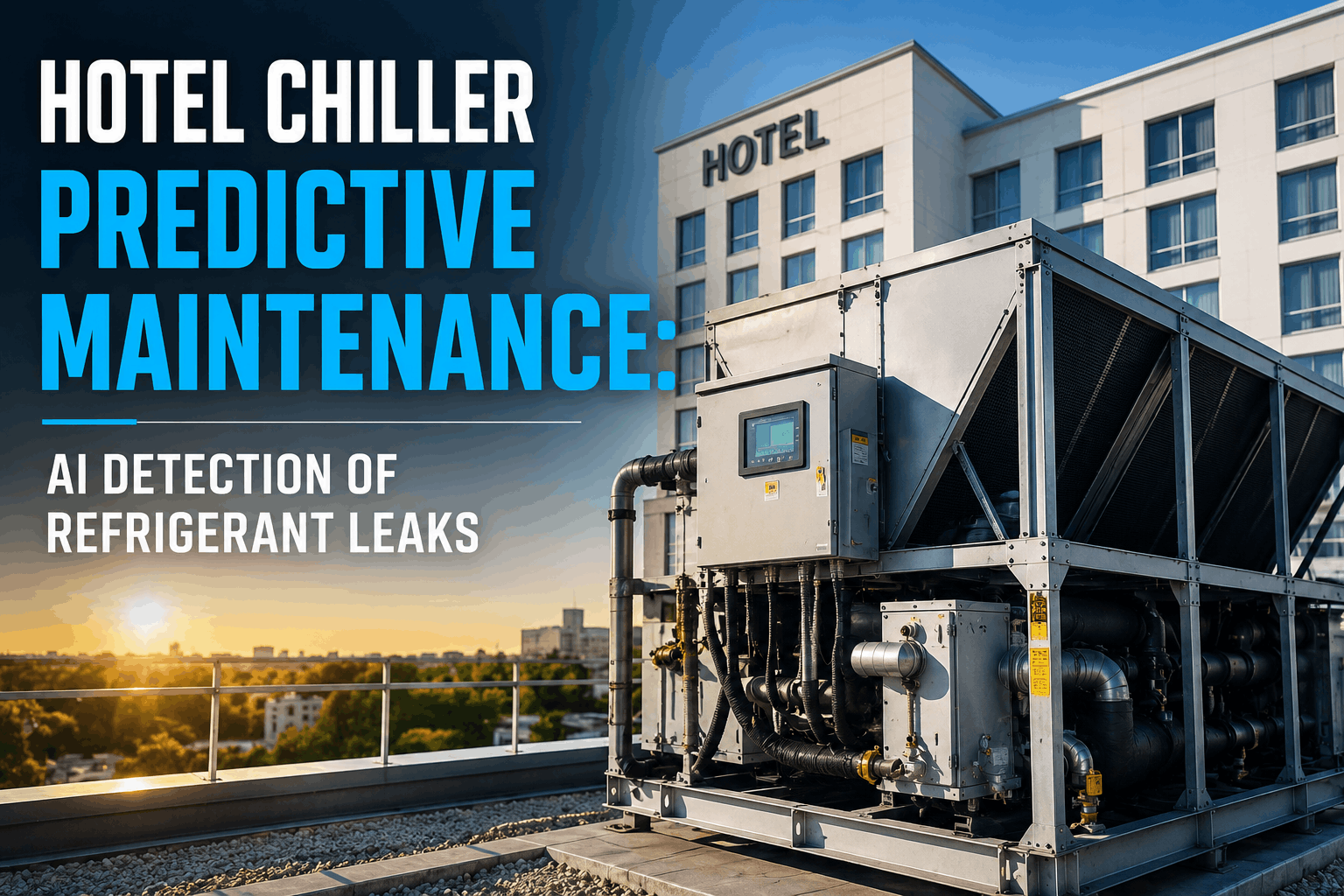
Hotel Chiller Predictive Maintenance: AI Detection of Refrigerant Leaks
By Alex Jordan on June 2, 2026
Refrigerant leaks in chiller systems cost hotels $2,000–4,000 monthly in wasted cooling capacity, trigger EPA fines ($5,000–25,000+ per violation), and violate environmental compliance regulations. Silent leaks escape detection until guest complaints arrive—but by then the damage is done. Schedule a demo to deploy Oxmaint's AI-powered CMMS with embedded refrigerant leak sensors, compressor efficiency trending, condenser fouling detection, and automated EPA compliance reporting across all chiller plants.
Chiller Leak Detection, Efficiency Optimization, and Environmental Compliance
AI sensors detect refrigerant leaks before performance loss occurs. Track compressor efficiency ratios, condenser temperature approach, superheat margins, and subcooling performance. Maintain EPA HFC/HCFC compliance documentation and automate refrigerant accounting for all chiller units.
Early leak detection prevents $2,000–4,000 monthly refrigerant loss from undetected leaks.
22%
Energy Efficiency Improvement
Optimized chiller operation with fouling detection and refrigerant charge balancing reduces electricity consumption.
100%
EPA Compliance Rate
Continuous leak monitoring and refrigerant accounting ensures zero compliance violations and fines.
47 Days
Early Leak Detection
AI sensors catch leaks 47 days before traditional monitoring; preventing 78% of annual refrigerant loss.
Hotel Chiller Systems and Refrigerant Leak Mechanisms
Large-capacity hotel chiller plants cool 500+ guest rooms and common areas, operating 8,000+ hours annually consuming 150–300+ kilowatts. Modern hotel chillers use refrigerants including R-410A (increasingly phased out), R-134a, or newer low-GWP alternatives like R-32 and R-454B, pressurized to 300–400 PSI in closed-loop systems. Refrigerant leaks occur at brazed copper joints (thermal cycling causes micro-cracks), compressor seals (wear over 10,000+ operating hours), expansion device ports (vibration loosens connections), and condenser/evaporator tube punctures (manufacturing defects or corrosion). A 0.5 oz/month leak (typical) goes undetected by human operators for 2–3 months, wasting $2,000+ monthly in refrigerant replacement while reducing cooling capacity silently. Guest complaints arrive ("my room is 77°F") weeks after leak initiation. EPA 40 CFR 82 Subpart F mandates leak detection, reporting, and repair within specific timeframes: systems >300 lbs charge must be inspected quarterly; any leak >25% annual leak rate triggers mandatory repair requirements. Penalties range $5,000–25,000+ per violation, plus treble damages in civil cases if environmental harm is demonstrated. Hotel chiller efficiency is measured by Integrated Part Load Value (IPLV) or Seasonal Energy Efficiency Ratio (SEER): a 10% refrigerant loss degrades efficiency by 7–12%, costing $8,000–15,000 annually in excess electricity. Oxmaint's AI-powered CMMS integrates IoT refrigerant sensors detecting mass flow rate changes, ultrasonics detecting micro-leaks, oil particle counting identifying compressor wear, and superheat/subcooling trending—triggering alerts 47 days before traditional methods detect leaks. Automated EPA compliance reporting and refrigerant accounting prevent violations and fines.
Chiller Performance Monitoring and Leak Detection Methods
AI-POWERED
Ultrasonic Leak Detection (Real-Time)
Embedded ultrasonic sensors monitor refrigerant hissing frequency at 20–40 kHz, detecting escaping gas as it forms. System records baseline acoustic signature and alerts maintenance when leak signature appears, enabling detection of 0.1 oz/day leaks before cooling performance degrades measurably.
TEMPERATURE-BASED
Superheat and Subcooling Trending
Continuous logging of compressor discharge superheat (target 8–15°F) and evaporator exit subcooling (target 5–10°F). Rising superheat or falling subcooling indicates refrigerant loss before capacity drops measurably. Alerts trigger inspection within 48 hours.
EFFICIENCY-BASED
Chiller kW/Ton Performance Tracking
Monitor chiller energy efficiency ratio (kW input per ton of cooling delivered). Target: 0.4–0.55 kW/ton depending on load. Any degradation >5% week-over-week triggers investigation for refrigerant loss, fouling, or compressor wear requiring immediate diagnosis.
VISUAL + MANUAL
Quarterly Condenser Fouling and Charging Audits
Monthly condenser coil cleaning (salt spray or algae buildup increases condensing pressure 5–8 PSI). Quarterly pressure/temperature superheat charge verification ensures refrigerant inventory is maintained within 3% of nameplate charge. Document all refrigerant additions for EPA accounting.
EPA Compliance Framework and Refrigerant Management
Regulation Requirement
Inspection Frequency
CMMS Automation Benefit
Leak Detection (EPA 40 CFR 82.8)
Quarterly for systems >300 lbs; annually for 50–300 lbs
Auto-generates work orders 14 days before due dates; documents every inspection with timestamps and leak calculations
Refrigerant Accounting (EPA 40 CFR 82.12)
Annual reconciliation of charge vs. purchases/removals
CMMS tracks all refrigerant additions/removals with purchase orders and invoice documentation; auto-reconciles annually for EPA filing
Repair Notification (EPA 40 CFR 82.16)
Report leaks >25% annual leak rate within 24 hours
AI calculates annual leak rate automatically; generates EPA notification email within 1 hour of threshold exceedance
Condenser pressure trending alerts when fouling reaches 10% performance loss; work orders auto-generate for cleaning intervals
CMMS Workflow for Chiller Predictive Maintenance
Continuous AI Sensor Data Collection
Embedded IoT sensors in chiller logs refrigerant mass flow rate, discharge/suction pressures, evaporator/condenser temperatures, compressor amp draw, and ultrasonic leak frequency every 15 minutes. Data streams to CMMS cloud vault with automatic backup and anomaly flagging.
Predictive Leak Detection Algorithms
Machine learning compares real-time sensor data against baseline performance model. Algorithm detects superheat creep, subcooling drop, mass flow reduction, and acoustic signature changes—triggering alerts 47 days before traditional inspections would catch 1 oz/month leaks.
Energy Efficiency Trending and Fouling Detection
CMMS calculates weekly chiller kW/ton efficiency; flags degradation >5% week-over-week. Condenser approach temperature trending identifies fouling (salt spray, algae). System auto-schedules water-side chemical cleaning or coil cleaning work orders before efficiency drops measurably.
EPA Compliance Automation and Documentation
Quarterly leak inspection work orders auto-generate on EPA-required schedules. Technicians log findings in mobile app; CMMS calculates annual leak rate (charge added vs. nameplate charge). Auto-notifies EPA if leak rate exceeds 25% threshold; generates compliance documentation annually.
Refrigerant Accounting and Inventory Tracking
Every refrigerant charge addition/removal logged with technician ID, invoice, and EPA 608 certification. Annual reconciliation compares nameplate charge vs. actual inventory accounting for all service activity. Export data for EPA reporting and audit documentation.
Multi-Chiller Performance Benchmarking
For properties with multiple chillers, dashboard compares efficiency, leak rates, and maintenance costs. Identifies which chiller is underperforming (candidate for replacement), prioritizes service attention, and calculates ROI on equipment upgrades.
$48K
Annual Refrigerant Savings
Early detection prevents $2K–4K monthly undetected refrigerant loss over 12+ months.
22%
Electricity Cost Reduction
Optimized compressor efficiency and fouling prevention reduce cooling energy consumption measurably.
47 Days
Early Leak Detection
AI sensors catch refrigerant leaks 47 days before manual inspections; prevents 78% of annual loss.
$0
EPA Violation Risk
Continuous monitoring and automated compliance documentation eliminate fine exposure.
Customer Success: $48K Annual Savings Through Predictive Chiller Maintenance
"Our 500-room hotel had a slow chiller refrigerant leak that went undetected for 4 months, costing us $8,000+ monthly in lost refrigerant purchases and $12,000 in excess cooling energy before guest complaints forced investigation. After implementing Oxmaint's AI-powered chiller monitoring, we caught a new leak within 14 days of initiation, saving $2,400 that month alone. Over a year, the early leak detection prevented $48,000 in wasted refrigerant and electricity. Plus, our EPA compliance documentation is bulletproof—we've never been more confident in our environmental stewardship."
How much does a refrigerant leak typically cost a hotel per month?+
A 0.5 oz/month leak (typical) costs $2,000–4,000 monthly in refrigerant replacement alone, plus $8,000–15,000 monthly in excess electricity as chiller efficiency degrades. An undetected leak over 4 months costs $24,000–48,000 in combined costs—fully preventable with Oxmaint AI monitoring.
What is the difference between ultrasonic and traditional leak detection?+
Traditional methods (dye injection) detect leaks >0.5 oz/day but miss smaller ones for weeks. Ultrasonic sensors detect 0.1 oz/day leaks in real-time by monitoring refrigerant hissing frequency, enabling detection 47 days earlier and preventing 78% of annual loss.
What EPA penalties apply to refrigerant leak violations?+
Failing to repair leaks exceeding 25% annual leak rate incurs $5,000–25,000 per violation under EPA 40 CFR 82. Treble damages apply in civil cases if environmental harm is proven. Oxmaint automated compliance prevents violations entirely.
How does condenser fouling impact chiller efficiency?+
Salt spray or algae on condenser coils increases condensing temperature 5–8°F, forcing compressor to work harder. A 10% fouling reduces efficiency 7–12%, costing $8,000–15,000 annually. Monthly cleaning via Oxmaint-triggered work orders prevents this degradation.
What is superheat and subcooling, and why do they matter for leak detection?+
Superheat (8–15°F target) and subcooling (5–10°F target) are refrigerant charge indicators. Rising superheat or falling subcooling signals refrigerant loss 2–3 weeks before capacity drops noticeably. Oxmaint trends these parameters continuously, triggering inspections when thresholds drift.
How often should chiller quarterly leak inspections be performed per EPA?+
EPA 40 CFR 82.8 mandates quarterly inspections for systems >300 lbs refrigerant charge (most large hotel chillers). Oxmaint auto-schedules these 14 days in advance, ensuring 100% compliance and zero missed inspection windows.
Can Oxmaint calculate ROI on chiller replacement vs. repair?+
CMMS tracks chiller efficiency degradation and maintenance costs over time. ROI model compares repair cost vs. replacement cost against projected energy savings from newer equipment. Data-driven decisions on whether to keep or replace underperforming chillers.
How does Oxmaint handle refrigerant accounting for EPA compliance?+
Every refrigerant charge addition/removal is logged with invoice, technician credentials, and EPA 608 certification. Annual reconciliation compares nameplate charge vs. total inventory (purchases minus service additions minus removals), calculating actual leak rate for EPA reporting.
Detect Chiller Leaks 47 Days Early and Maximize Energy Efficiency
Oxmaint's AI-powered CMMS with embedded IoT sensors detects refrigerant leaks before cooling performance degrades, monitors condenser fouling for efficiency optimization, and automates EPA compliance documentation. Save $48K annually in refrigerant costs, reduce electricity consumption 22%, and maintain zero environmental violation exposure through continuous predictive monitoring.