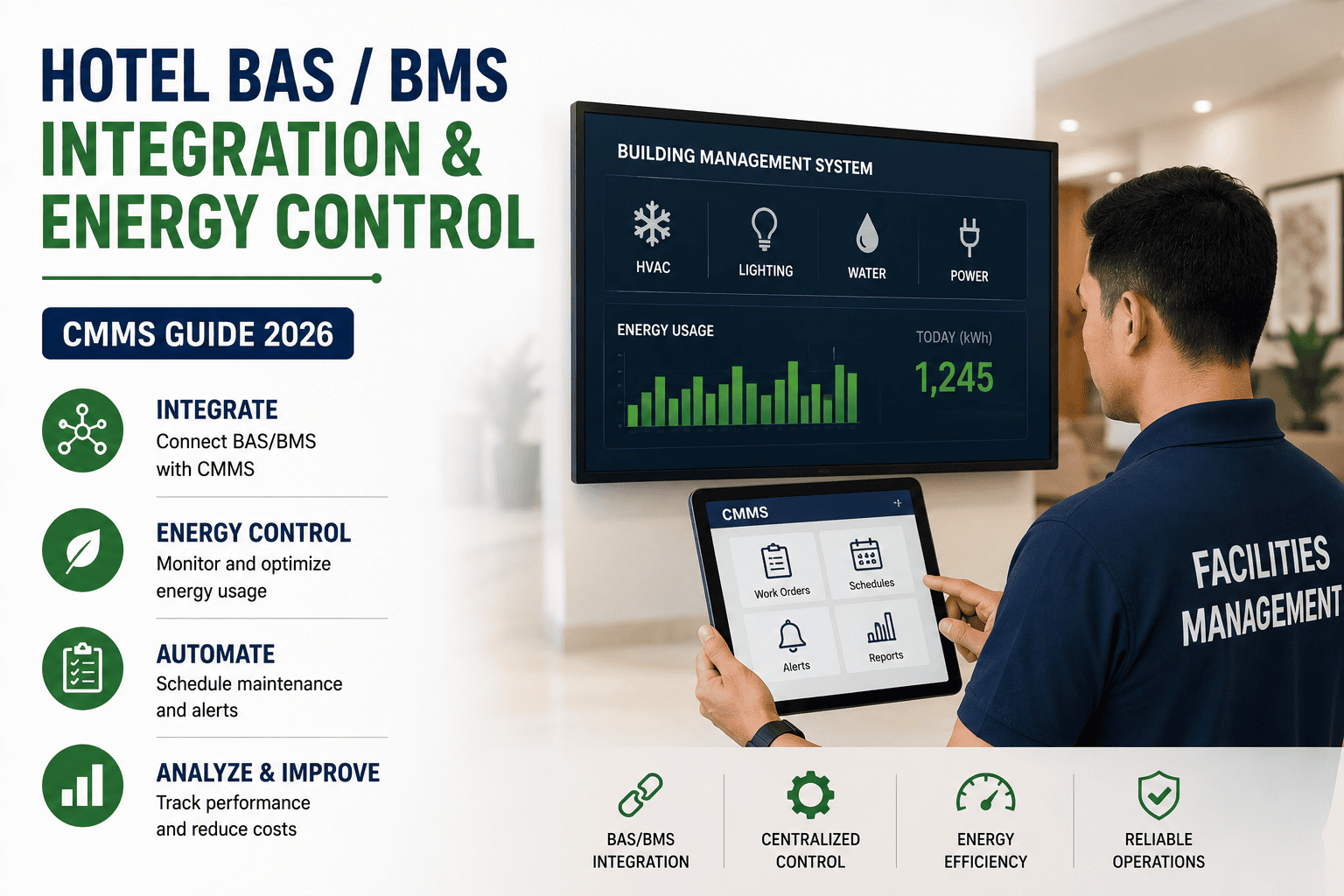
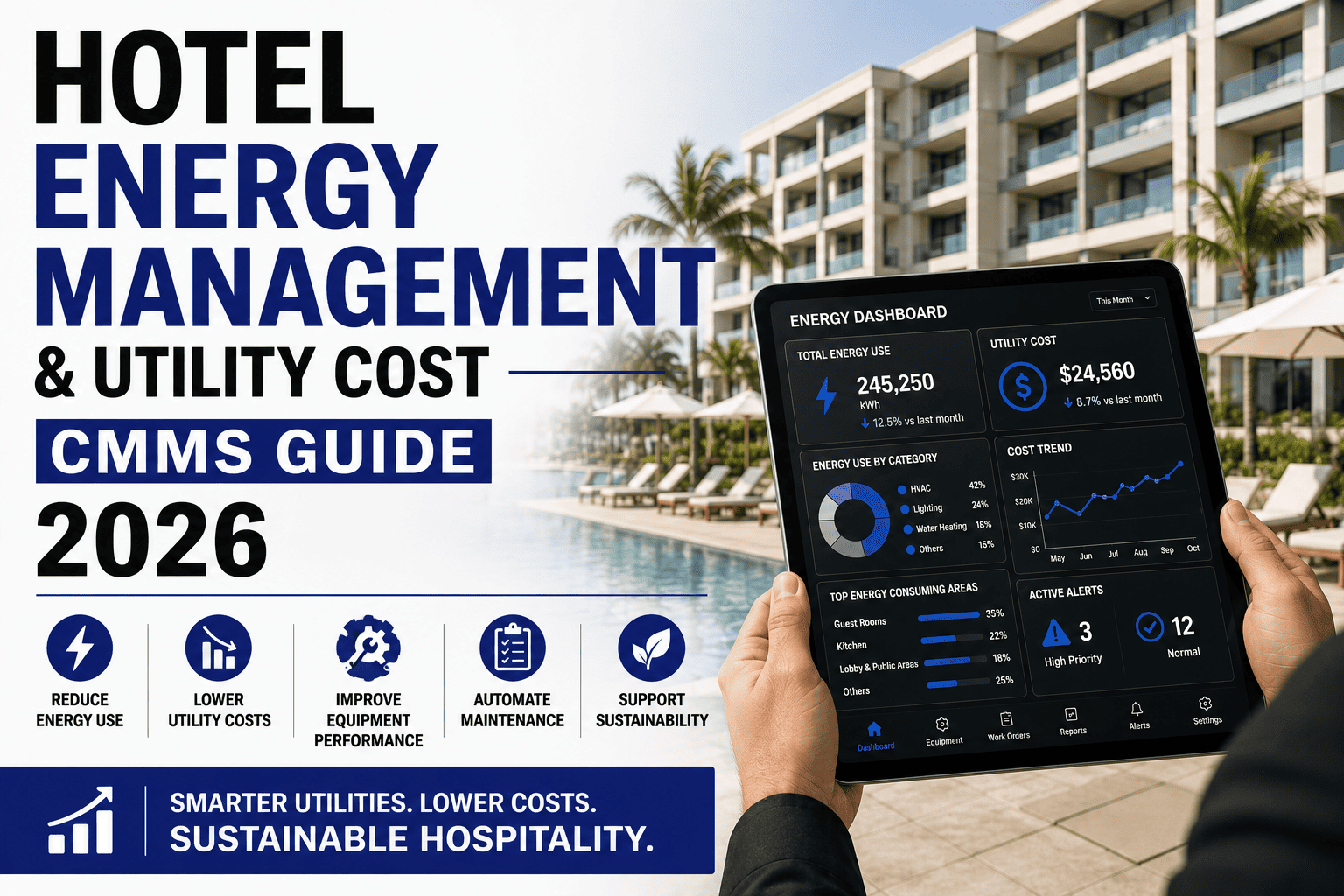
Hotel BAS/BMS integration is the pivot point where energy management either pays for itself or quietly becomes another line item with no measurable return. For a 250-key property running 24/7 HVAC, lighting, and domestic hot water loads, even a 3% drift in setpoints or stale occupancy schedules can bleed $18,000–$35,000 a year in avoidable kWh. This guide walks engineering and facilities teams through the four levers that actually move the meter — setpoint and schedule review, sensor calibration, retro-commissioning, and CMMS-BMS integration — and how connecting building automation data to a CMMS turns invisible drift into scheduled, accountable work. Ready to stop estimating and start measuring? Start Free Trial and connect your BAS in under a week.
Is your hotel's BAS quietly burning 18% more energy than the spec promised?
Most building automation systems are commissioned once and forgotten. Within 24 months, occupancy overrides stack up, sensors drift 2–4°F, and schedules no longer match real guest behavior — turning a system meant to save energy into one that wastes it. The fix isn't new hardware. It's disciplined CMMS-driven control of the BAS you already own.
Where hotel BAS integration actually delivers savings
Roughly 80% of measurable hotel energy savings come from four repeatable disciplines — not from ripping out controllers. Each lever below is a CMMS-trackable workstream with a defensible payback.
Setpoint & Schedule Review
Quarterly audit of every guest-floor, corridor, and back-of-house schedule against actual occupancy logs. Aligning deadband setpoints to ASHRAE 90.1 (heating 70°F, cooling 74°F, ±2°F deadband) typically recovers 4–8% of HVAC energy in properties where overrides have crept in.
Sensor Calibration
CO₂, temperature, and humidity sensors drift 1–4°F or 50–100 ppm per year. A 6-month calibration cycle — tracked as recurring CMMS work orders — prevents the BAS from controlling against phantom conditions and protects the entire control logic downstream.
Retro-Commissioning
Every 3–5 years, a full RCx pass — damper actuators, valve sequencing, economizer lockouts, reset curves. ASHRAE Guideline 0.2 RCx on existing hotels routinely returns 11–16% whole-building energy savings with a 1.5–2.5 year payback.
CMMS–BMS Integration
The connective tissue. Alarms, run-hours, and trend logs flow from the BAS into the CMMS as auto-generated, prioritized work orders — so a failed OA damper or a stuck VAV becomes a tracked task, not a quarterly surprise.
A 250-key hotel bleeding $29,400 a year in BAS drift
Consider an upper-scale 250-room property in a mixed climate spending $168,000 annually on electricity and gas. An ASHRAE Level 1 walkthrough reveals the BAS has not been recommissioned in 4 years.
| Lever | Annual Savings | One-Time Cost | Payback | Confidence |
|---|---|---|---|---|
| Setpoint & schedule review (Q1) | $6,720 | $2,100 | 3.8 mo | High |
| Sensor calibration (6-mo cycle) | $4,200 | $1,400 | 4.0 mo | High |
| Retro-commissioning (Year 1) | $14,500 | $9,800 | 8.1 mo | Medium-High |
| CMMS–BMS integration (one-time + SaaS) | $3,980 | $2,400 + $180/mo | 11.2 mo | High |
| Stacked Program | $29,400 | $15,700 + SaaS | ~7.5 mo | High |
The property recovers nearly $30K in year one and locks in ~$26K of recurring annual savings thereafter — the integration and discipline keep paying back long after the RCx report is filed.
From BAS data to scheduled work orders in 12 weeks
A realistic rollout for a mid-size hotel connecting a legacy BMS (BACnet/Modbus) to a modern CMMS. Each phase produces a tangible artifact — not just a status update.
Discovery & Point Mapping
Inventory every BMS point — typically 1,200–2,800 in a 250-key property. Tag each as critical, advisory, or informational. Deliverable: a point-to-CMMS mapping matrix signed off by the Chief Engineer.
Protocol Bridge & Read-Only Live
Stand up the BACnet/Modbus gateway. Push live trend data into the CMMS asset register. At this stage the team can see real-time conditions against asset records — but no auto work orders yet.
Alarm-to-Work-Order Rules
Define the rule library: 12–18 core alarms (stuck VAV, OA temp lockout, CHW pump fault, CO₂ >1,000 ppm for 30 min) auto-generate prioritized work orders with the correct craft, parts, and SLA.
Predictive Triggers & KPIs
Layer in run-hour-based PMs (fan belts, filters, actuator cycles) and energy KPI dashboards — kWh/occupied-room-night, RTU runtime variance, and setpoint deviation minutes.
Hand-off & 90-Day Review
Train the engineering team on triage workflows. Set a 90-day checkpoint to recalibrate thresholds, retire low-value alarms, and confirm MTTR and energy KPI baselines are tracking.
What a healthy CMMS-BMS connection looks like
Once integrated, these five KPIs tell you whether the connection is generating value or just data. Review them monthly in the Chief Engineer's report.
Target ≥90% of critical alarms generating a CMMS work order within 60 seconds — no manual entry.
From alarm acknowledgement to on-site assessment. Pre-integration baseline is often 18–36 hours.
Benchmark for full-service hotels. Properties above 18 kWh/ORN have clear integration upside.
Target ≤2°F sustained deviation across guest floors. Above 3°F indicates override or sensor drift.
Year-over-year drop in unplanned work orders once predictive triggers and run-hour PMs are live.
All-in labor + software cost per ticketed alarm. Manual triage typically runs $0.55–$0.90.
Turn your BAS data into scheduled, accountable work orders
Connect BACnet or Modbus to a CMMS built for hotel engineering teams — and see your first auto-ticketed alarm within a week.
Hotel BAS integration, answered
How long does CMMS–BMS integration take for a typical hotel?
A 150–300 key property with a modern BACnet or Modbus BAS can be fully integrated in 8–12 weeks. The longest phase is usually point mapping and alarm-rule design — not the technical gateway. Properties with legacy proprietary controllers may need a protocol converter, adding 2–4 weeks. You can Book a Demo to get a property-specific scoping estimate.
Do we need to replace our existing building automation system?
No. The entire premise of CMMS-BMS integration is to extract more value from the BAS you already own. As long as the controller network exposes BACnet, Modbus, OPC-UA, or an API, the CMMS can consume alarms, trends, and point data without touching the field hardware. Replacement is only warranted when the BAS is fully proprietary with no open protocol.
What energy savings are realistic after integration?
Properties that pair integration with quarterly schedule review, 6-month sensor calibration, and a one-time retro-commissioning pass typically see 12–18% whole-building energy savings in year one. Integration alone — without the commissioning discipline — delivers 3–6% by catching drift and failures faster. The stack is what compounds.
How does occupancy-based HVAC scheduling actually work with the CMMS?
The BAS reads occupancy from the PMS (check-in/check-out), key-card signals, or in-room sensors and adjusts setbacks per zone. The CMMS side schedules the filter changes, coil cleanings, and actuator inspections triggered by runtime hours logged by that same BAS — so maintenance is driven by actual equipment use, not a calendar guess. You can pilot this on one floor by Start Free Trial and mapping a single AHU's points first.
Who on the hotel team owns the integration once it's live?
The Chief Engineer or Director of Engineering owns day-to-day alarm triage and KPI review. The GM and Ownership review the monthly energy + MTTR dashboard. Most integrations also designate a "BAS champion" — often the senior tech — who owns point-mapping updates, alarm-threshold tuning, and the 90-day recalibration cycle.
Stop estimating. Start measuring every kWh, every alarm, every work order.
Join hotel engineering teams using oxmaint to turn BAS drift into scheduled, accountable savings — no new hardware required.
Free 14-day trial · No credit card


-and-cmms-integration.png)