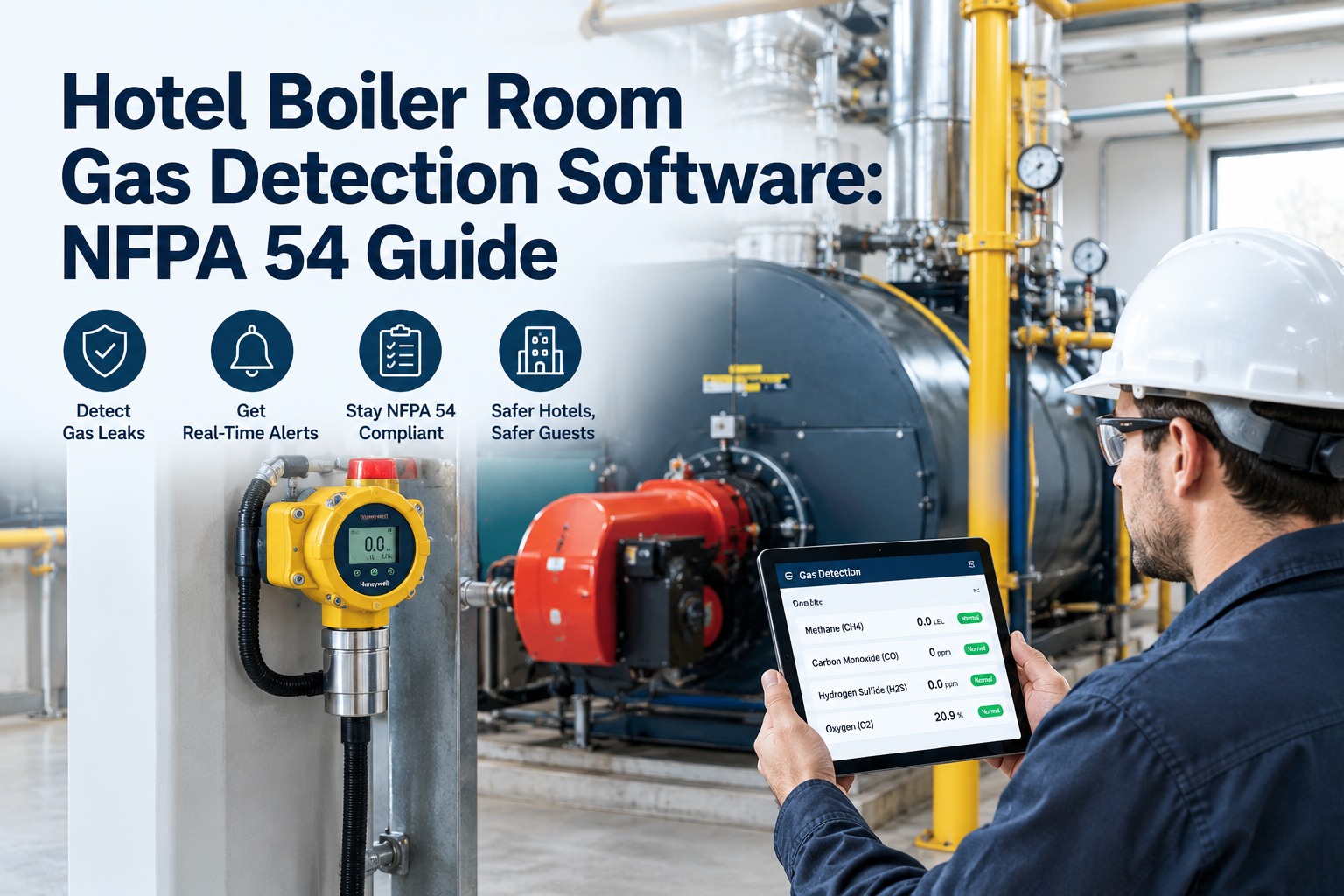
A boiler room is a confined mechanical space where two gases can accumulate without a single visible sign: carbon monoxide from incomplete combustion, and methane from a fitting or line that's slowly failing. Neither has a smell in its natural state, neither is visible, and both can go from "normal" to "immediate danger" while the readout sits quietly on a wall nobody's looked at that shift. Hotels and large residential properties account for roughly 23% of commercial gas incidents, with boiler rooms consistently identified as the primary source — and CO poisoning alone causes more than 400 fatalities a year in the US, with hotels classified as a high-risk occupancy under NFPA 101. The detection hardware — the sensors, the shutoff interlocks — is what NFPA 54 and the related codes require you to install. What software adds is the layer those codes don't specify: proof the sensors were calibrated on schedule, a record every alarm was actually investigated, and a system that catches a missed calibration before an inspector does. This guide covers what NFPA 54-aligned gas detection software needs to track, where paper-based compliance quietly fails, and how OxMaint turns boiler room gas safety into a documented, audit-ready program. Book a free gas safety compliance demo for your property.
CO and Methane Give No Warning Except the Sensor
A working detector on an untracked calibration schedule is a false sense of security.
35 / 200
CO action threshold (ppm): OSHA 8-hr exposure limit / immediate danger level
10-25%
Of the Lower Explosive Limit at which methane detectors are typically set to alarm
23%
Of commercial gas incidents occur at hotels and large residential properties
18 mo
Typical maximum interval between required CO detector calibrations
What NFPA 54-Aligned Gas Detection Software Must Track
The physical detectors and shutoff interlocks satisfy the code requirement to install them. The software layer exists to prove they're actually working, on schedule, with a record to show for it. These are the six things that record has to cover.
01
CO Threshold & Interlock Status
Confirmation that each CO detector's alarm threshold matches code and that it's correctly interlocked to shut down the burner it's monitoring.
02
Methane / LEL Monitoring
Combustible gas readings tracked against the property's set alarm point, with sensor placement logged against where methane actually accumulates — high, near the ceiling.
03
Shutdown Interlock Testing
Scheduled functional tests confirming the burner actually shuts down when a CO or gas alarm triggers — not just that the sensor reads correctly.
04
Calibration Scheduling & Records
Every sensor's calibration date tracked against the manufacturer-specified interval, with the record posted and retrievable the moment an inspector asks.
05
Alarm Event Logging
Every alarm — real or false — logged with timestamp, reading, and the response taken, closing the loop on why it happened and what changed.
06
Detection Zone Coverage Mapping
A record of which sensors cover which zone, so a renovation or equipment change doesn't quietly leave part of the boiler room uncovered.
Get Your Boiler Room Gas Safety Records Audit-Ready
Walk through your current calibration and interlock testing schedule with our team. We'll show where OxMaint closes the gap between "installed" and "provably compliant."
Where Paper-Based Gas Safety Compliance Breaks Down
Every property with a boiler already has detectors installed — that's the code requirement. These are the four ways the paperwork behind them quietly fails.
Calibration Interval Slips Past Due
A wall calendar or a sticky note is easy to lose track of over 18 months. A sensor that's drifted out of calibration can read normal right up until it doesn't.
No Proof the Interlock Actually Works
A sensor reading correctly doesn't confirm the burner shutdown wiring is intact. Without a documented functional test, that link is assumed, not verified.
Alarms Cleared Without Investigation
An alarm silenced and forgotten leaves no record of whether it was a false positive or an early warning that needed follow-up. The pattern that would flag a failing sensor never gets seen.
Coverage Gaps After Renovation
Equipment gets moved, a wall goes up, a new appliance is added — and nobody re-checks whether the existing sensor layout still covers the room the way it did on day one.
Paper Compliance Log vs. Digital Gas Safety Tracking
The detectors and code requirements are identical either way. What changes is whether the proof exists when an inspector asks for it.
Paper Log / Wall Calendar
Calibration due dates tracked by memory or a sticky note
Interlock function assumed, rarely tested and documented
Alarm events cleared with no logged cause or response
Sensor coverage map exists only in someone's memory
Inspection prep means searching for records that may not exist
OxMaint Gas Safety Tracking
Calibration work orders auto-generate on the code-required interval
Interlock tests scheduled and logged with pass/fail per sensor
Every alarm timestamped with reading, cause, and response taken
Sensor coverage mapped per zone, flagged when equipment changes
Compliance report exported in minutes, full history included
How Gas Safety Compliance Runs Inside OxMaint
Once the calibration intervals and interlock schedule are set per sensor, this cycle runs automatically, without relying on someone remembering a due date.
1
Schedule. Calibration and interlock-test intervals are set once per sensor, matching the manufacturer spec and applicable code, and OxMaint tracks the due date automatically.
2
Log & Verify. Technicians complete calibration or interlock tests from mobile, logging the pass/fail result and any adjustment made directly against the asset.
3
Alert & Escalate. A live alarm, a missed calibration, or a failed interlock test all trigger an immediate alert to the responsible engineer — nothing waits for a shift review.
4
Audit & Report. Full calibration history, interlock test records, and alarm logs export as an audit-ready report the moment an inspector or insurer asks for one.
Why Hotel Engineering Teams Choose OxMaint
OxMaint is a purpose-built maintenance management platform trusted by hotel chains, resorts, and hospitality groups to keep boiler room gas safety compliant and audit-ready year-round.
Schedule
Automated Calibration Work Orders
Every CO and methane sensor's calibration interval tracked automatically, with a work order generated before the due date, not after.
Verify
Interlock Function Testing
Scheduled functional tests confirm the burner shutdown actually fires on alarm, logged pass or fail per sensor, per test date.
Alert
Real-Time Alarm & IoT Integration
Where sensors are network-connected, live readings and alarm events flow directly into OxMaint alongside manual test records.
Prove
Audit-Ready Compliance Reports
Calibration history, interlock tests, and alarm logs export in minutes for fire marshals, insurance auditors, or brand-standard reviews.
Map
Sensor Coverage by Zone
Detection zone coverage tracked per sensor, flagged for review whenever equipment or layout changes in the boiler room.
Deploy
Works Everywhere Your Team Does
Mobile apps, offline mode, and QR asset tags cover boiler rooms, mechanical spaces, kitchens, and rooftops alike.
Turn Gas Detector Compliance Into a System, Not a Memory
See how OxMaint schedules calibration, verifies shutdown interlocks, and keeps an audit-ready record for every sensor in your boiler room. Free forever plan available.
Frequently Asked Questions
What does NFPA 54 actually require for boiler room gas detection?
NFPA 54, the National Fuel Gas Code, governs the installation of fuel gas piping and appliances, and works alongside standards like NFPA 72 and local building codes to define detector placement, alarm thresholds, and shutdown requirements for combustible and toxic gas monitoring in mechanical spaces. Requirements vary by jurisdiction, so always confirm the specific code edition and any local amendments adopted in your area with your fire marshal or code official.
Book a walkthrough to map your compliance program against your current setup.
What are typical alarm thresholds for CO and methane in a boiler room?
Carbon monoxide detectors commonly reference an 8-hour exposure limit around 35 ppm and treat 200 ppm as an immediate danger level, with some codes requiring burner shutdown interlocks around 50 ppm. Methane detectors are typically set to alarm at 10-25% of the Lower Explosive Limit. Exact thresholds depend on the applicable code and local amendments, so confirm the specific numbers required for your property with your AHJ.
How often do gas detectors in a boiler room need to be calibrated?
Many code and manufacturer schedules call for calibration at least every 18 months, though this varies by sensor type, manufacturer specification, and local code requirements. A record of each calibration is often required to be posted at or near the boiler, which is exactly the kind of documentation that gets lost on paper but stays retrievable in a digital log.
Does gas detection software replace the physical sensors and alarms?
No — software manages the compliance program around the physical hardware, it doesn't replace it. The detectors, wiring, and shutdown interlocks are the safety system itself; software schedules their calibration, logs their test results and alarm events, and produces the audit trail that proves the physical system is being maintained as required.
Does OxMaint support multi-property gas safety compliance tracking?
Yes. OxMaint tracks calibration schedules, interlock test records, alarm logs, and sensor coverage maps across individual properties or full hospitality portfolios, with audit-ready reporting available on demand. A free forever plan is available to try the full workflow.
Sign up free to get started.