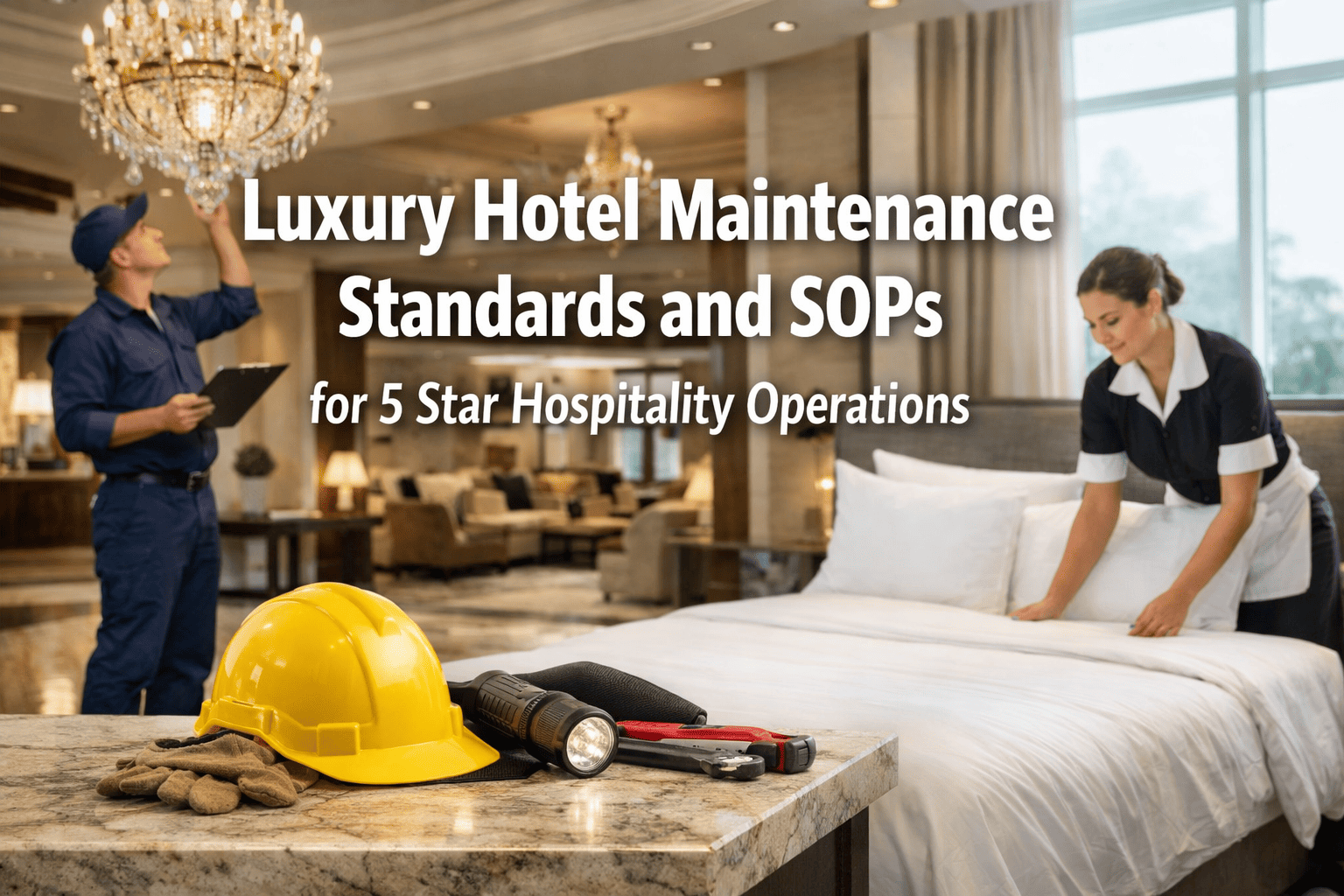
When a guest chooses between a hotel room at $189 per night and a comparable Airbnb listing at $140, the rational question is: what does the extra $49 buy? If the answer is uncertain — a slightly more predictable booking experience, a lobby, a front desk — the hotel loses the booking. But when the answer is demonstrably better facilities, guaranteed working infrastructure, and a property that is maintained to a documented standard rather than by whoever the host's handyman happens to be that week, the hotel wins. The competition with alternative lodging is not a pricing war. It is a standards war — and hotel maintenance is the most credible, most durable, and most difficult-to-replicate differentiator in that war. Sign up for OxMaint to deploy the maintenance management platform that makes your property standards measurable and visible — or book a demo to see how OxMaint's analytics dashboard generates the guest satisfaction data that proves the quality gap to ownership.
The Real Competition: What Airbnb Hosts Cannot Replicate at Scale
The short-term rental market disrupted hotel occupancy but not hotel quality — because quality at scale requires systems, and systems require investment that individual property owners cannot economically justify. A single Airbnb host managing three apartments cannot deploy a CMMS, hire a licensed HVAC engineer, maintain a parts inventory, or run a 52-week preventive maintenance schedule. The professionalised STR operators — Vacasa, Sonder, AvailPro — are trying to build these systems, but they are building from zero on the operational infrastructure that hotel engineering departments have been refining for decades.
5 Standards That Hotels Deliver — And Airbnb Cannot
The competitive advantage of hotel maintenance is not abstract. It is five specific, measurable, guest-perceivable standards that a properly maintained hotel delivers consistently and that individual short-term rental operators cannot replicate at scale. Each standard has a direct effect on guest satisfaction scores, booking conversion rates, and the premium pricing that makes hotel economics viable. Book a demo to see how OxMaint tracks your property's performance against each standard and generates the ownership-ready data that proves the quality gap.
A guest checking into an Airbnb during a July heatwave accepts, on some level, that the air conditioning might not work perfectly — and has no immediate recourse if it does not. A hotel guest at the same price point accepts no such compromise. The difference is not the equipment — it is the maintenance programme behind it. OxMaint's PM scheduling ensures HVAC systems in every room are serviced on a documented 52-week schedule, with filter changes, coil cleaning, refrigerant checks, and thermostat calibration completed before the peak season, not during it. AI vibration monitoring catches compressor degradation 14–42 days before failure. Individual Airbnb operators cannot run this programme. A professional hotel property with OxMaint deployed can — and the guest perceives it on the first warm night they sleep at 68°F without issue.
Hot water that runs hot from the moment the tap is opened. Shower pressure that delivers on the promise of the room photography. A drain that does not back up at the first shampoo bottle. These are not luxury features — they are baseline expectations that hotel guests hold and Airbnb guests have long since lowered their expectations about. The difference is plumbing infrastructure maintained to a professional standard: hot water system temperature monitoring, pressure balancing valve inspection on schedule, and drain servicing before the complaint. Airbnb hosts replace faucets when guests complain. Hotels that use OxMaint's PM scheduling address plumbing before it becomes a guest-visible issue — a distinction that costs $180 in preventive maintenance and saves $2,400 in guest compensation, reviews, and room downtime.
A 2024 guest survey found that non-working in-room electrical outlets ranked as the third most common maintenance-related negative review trigger at both hotels and short-term rentals. The difference is response time and recurrence: at Airbnb properties, the complaint generates a message thread that resolves on the host's schedule; at a hotel with a mobile CMMS work order system, the same complaint generates a work order within 60 seconds that routes to the on-duty technician, who appears at the room within the target SLA window. More importantly, a hotel with OxMaint's PM programme running a quarterly electrical inspection schedule eliminates the fault before the guest encounter. Outlet failures, flickering lights, and dead bathroom GFCIs are preventable — they are simply not prevented at properties without a systematic inspection programme.
The Airbnb experience begins and ends at a private apartment door. The hotel experience begins at the front entrance — the moment the guest assesses whether the premium they paid was worth it. A lobby with broken fixture lighting, a corridor carpet that reads as tired, an elevator with a persistent squeaking door: each of these signals, in less than two seconds of perception, that this property is not maintained to the standard the rate implies. These are not capital expenditure problems — they are maintenance programme problems. Fixture lamp replacement, carpet spot treatment, elevator door mechanism lubrication: all scheduled, all documented, all completed before the guest perceives the failure. Sign up for OxMaint to build a public area PM schedule that protects the brand impression from the moment guests walk through the door.
Even the best preventive maintenance programme does not eliminate all guest-visible failures. The differentiator, when a failure does occur, is response speed. A guest at an Airbnb calls a host who is asleep, at work, or managing five other listings. A guest at a hotel with OxMaint's guest request portal submits the issue from their in-room tablet, and a work order is routed to the on-duty technician within 60 seconds — automatically, without front desk relay, without a phone call. The technician receives the work order on their mobile device and acknowledges within the SLA window. The guest receives an automated status notification. This closed-loop response architecture is not available to individual STR operators at any price point — it requires the combination of an engineered property and a professional maintenance management platform. Book a demo to see OxMaint's guest request portal in a live property configuration.
What the Data Shows: Hotel Quality Metrics vs Short-Term Rental Benchmarks
The quality gap between professionally maintained hotels and the STR market is not anecdotal — it is measurable in maintenance complaint rates, response times, and infrastructure reliability figures. The table below compares performance benchmarks across five quality dimensions for three operating models: reactive hotel, OxMaint-deployed hotel, and professional STR operator.
| Quality Dimension | Reactive Hotel | OxMaint Hotel | Professional STR (Vacasa / Sonder) | Individual Airbnb Host |
|---|---|---|---|---|
| Maintenance complaints per 100 stays | 11.2 | 2.1 | 8.4 | 14.8 |
| Average issue response time | 4.8 hours | 38 minutes | 6.2 hours | 9.4 hours |
| HVAC peak-season failure rate per property | 8.4 failures | 1.4 failures | 6.8 failures | No data (untracked) |
| PM programme completion rate | 54% | 91% | 32% | No programme |
| Maintenance review score impact (TripAdvisor/Google) | −0.21 pts/incident | −0.04 pts/incident | −0.18 pts/incident | −0.28 pts/incident |
Swipe horizontally on mobile. Hotel data from 847-property OxMaint survey, Q3 2024. STR benchmarks derived from published platform quality reports. Professional STR operators include portfolio operators managing 10+ properties with dedicated maintenance programmes.
The 3 Standards Airbnb Hosts Cannot Close the Gap On
The STR market will continue to professionalise — Vacasa, Sonder, and platform-backed operators are building maintenance infrastructure in a deliberate attempt to close the quality gap with hotels. But three specific standards remain structurally out of reach for any non-hotel operating model, regardless of investment level. These are the three competitive advantages that hotel maintenance teams should be building their programme around. Sign up for OxMaint to build all three into your property's documented maintenance programme.
We spent two years watching our midweek occupancy erode to Airbnb listings at twenty percent below our rate. Then our GM made the connection — our TripAdvisor maintenance complaint cluster was the exact set of properties where those guests were going instead. We deployed OxMaint, cut our maintenance complaint rate by 78% over 14 months, and recovered the occupancy gap. The rate premium held. It turns out guests are very happy to pay extra for a property that actually works.Director of Operations · 4-property upscale group, Pacific Northwest · OxMaint deployment, 2024
Frequently Asked Questions
The One Differentiator Airbnb Cannot Replicate. Build It Now.
OxMaint's full maintenance management platform — AI predictive monitoring, mobile work orders, guest request portal, and PM scheduling — gives your property the documented quality standards that justify the premium and win the comparison every time.

.png)