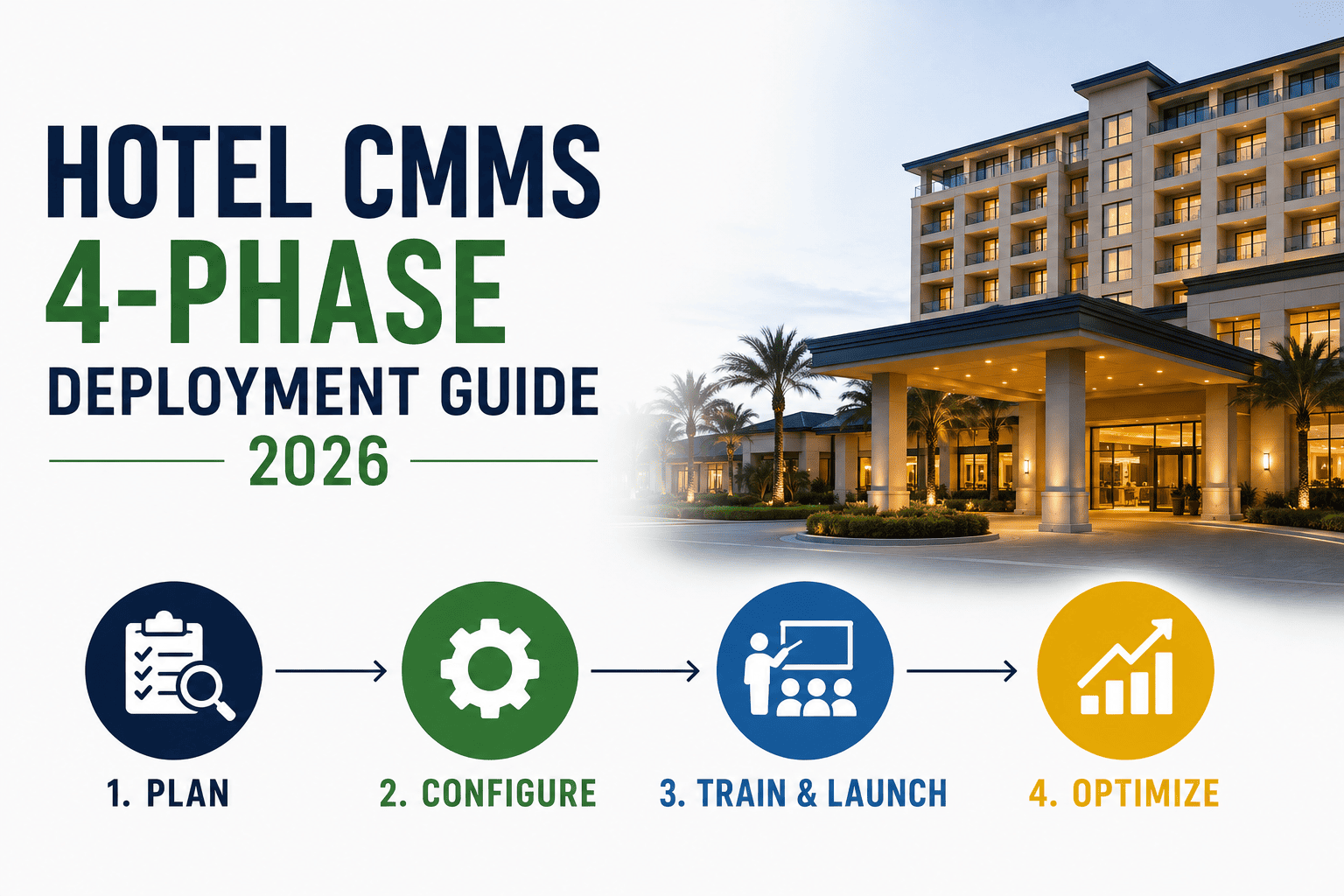
A hotel CMMS that goes live across every floor in a single weekend usually lands on the shelf within ninety days — housekeeping never opens it, engineering reverts to paper WOs, and the GM's compliance dashboard quietly drifts out of date. The 2026 fix is a disciplined four-phase rollout: discovery, configuration, pilot property, then portfolio expansion, each gated by a measurable handoff. This guide breaks down what happens in every phase, the change-management rituals that actually drive daily adoption, and where teams lose momentum — so you can Start Free Trial with a deployment plan rather than a launch date.
Why do 68% of hotel CMMS rollouts become shelfware within the first quarter?
Because properties skip phasing. A four-phase deployment — discovery, configuration, pilot, portfolio — is the difference between an engineering team that opens the CMMS every shift and one that abandons it by week six.
before full portfolio go-live
Four phases, four gates, zero shelfware
Each phase ends with a binary go/no-go handoff. Skip the gate and the next phase inherits broken data, untrained users, and silent compliance gaps.
Discovery & Asset Registry
Extract asset lists from PMS, BMS, and existing spreadsheets. Normalize naming against a single taxonomy, tag parent-child hierarchy for AHUs, FCUs, pumps, and laundry equipment. Target 95% asset confidence before configuration begins.
PM & Compliance Configuration
Build preventive maintenance triggers by asset class, attach OEM service intervals, and map statutory checks — fire dampers, elevator certs, backflow preventers, legionella flushes. Every PM auto-generates a WO with checklist, parts, and labor estimate.
Pilot Property Go-Live
Roll mobile WOs to one property's engineering team. Run two full PM cycles, measure wrench-time, close-out rate, and first-time-fix. Tune checklists based on real technician feedback before any portfolio expansion.
Portfolio Rollout & GM Dashboard
Replicate the validated configuration across every property in waves of 3–5. Launch the GM dashboard with live compliance, backlog, and MTTR metrics. Regional directors get a roll-up view; property GMs see their own KPIs.
A 16-week roadmap from kickoff to portfolio go-live
Worked example: a 4-property, 9,600-asset hotel group allocating one engineering lead, one CMMS admin, and a district director. Gates marked in gold — miss one and the timeline slips by a full wave.
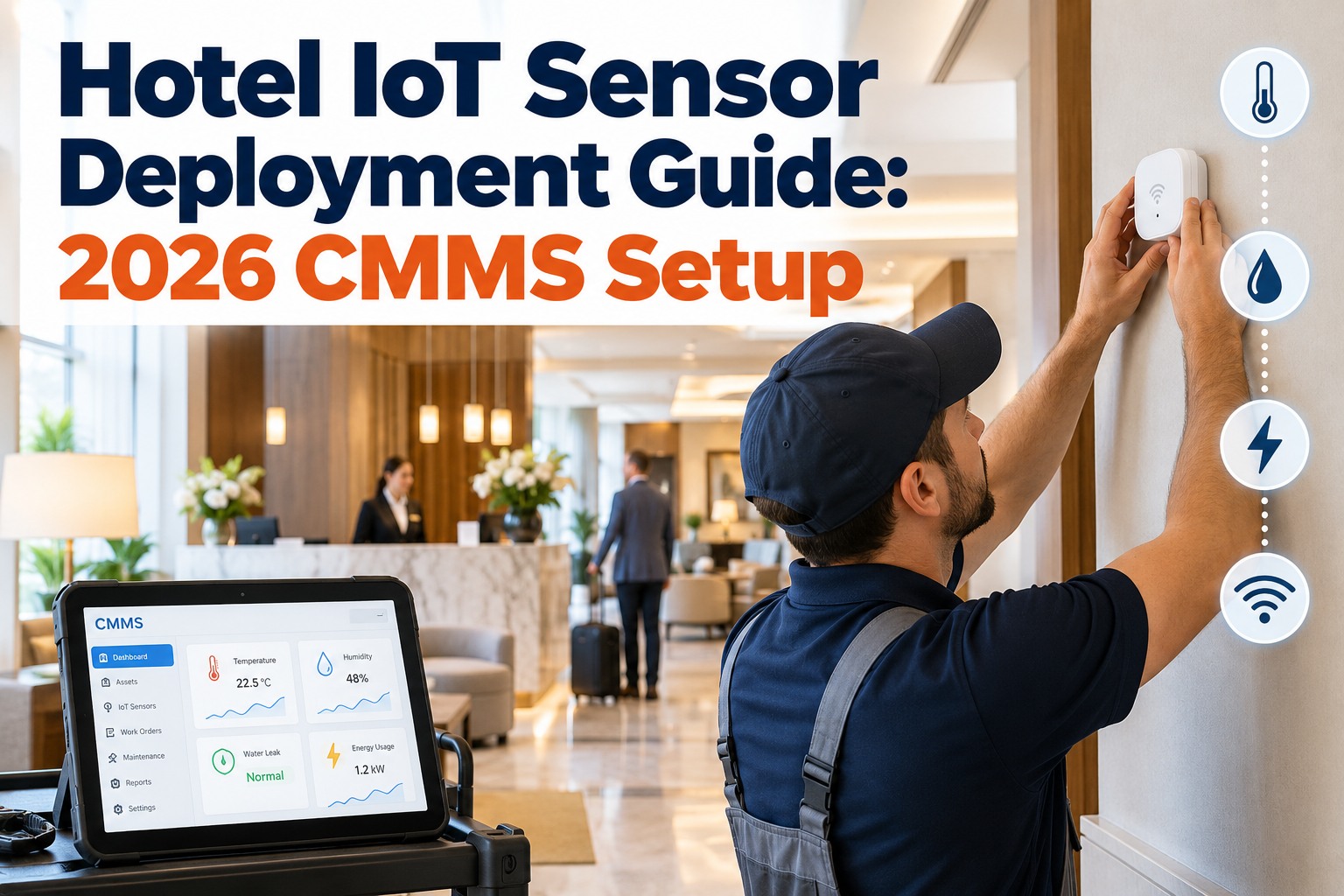
Asset registry import
PMS + BMS extract complete. Naming taxonomy locked. 95% confidence threshold met.
PM library build
OEM intervals, statutory tasks, and checklists authored. Parts and labor estimates attached.
Pilot mobile launch
Single property. Technicians carry tablets. Two PM cycles run end-to-end before any tuning.
Checklist refinement
Field feedback folded in. Repeat tasks merged. Parts library pruned of obsolete SKUs.
Wave 1 expansion
3 properties go live. Regional director onboards to roll-up dashboard. Daily standups for 2 weeks.
Portfolio go-live
All properties live. GM dashboard published. Monthly compliance review cadence begins.
What a single-weekend rollout actually costs
A 180-key full-service hotel carries roughly 2,400 tracked assets. Flipping the switch on all of them in 48 hours — without phased gates — produces a predictable failure pattern within 90 days.
| Dimension | Single-weekend launch | Four-phase rollout |
|---|---|---|
| Asset data confidence at go-live | ~60% — naming chaos, duplicates, missing hierarchy | 95%+ — validated against BMS and walk-downs |
| Technician adoption by day 30 | 22% — most revert to paper WOs | 88% — mobile WOs closed in-system daily |
| Compliance audit readiness | Reactive — evidence assembled manually per audit | Continuous — every statutory task auto-logged |
| Time to first GM dashboard report | 9–14 months — often never | 16 weeks — live at portfolio go-live |
| 12-month shelfware risk | 68% — system abandoned or bypassed | Under 12% — embedded in daily engineering rhythm |
Five rituals that make engineers open the CMMS every shift
Software features don't drive adoption — operational habits do. These five rituals, embedded during the pilot phase, are what separate live systems from shelfware twelve months later.
Shift-start WO assignment huddle
Every morning, the chief engineer opens the CMMS on a wall screen, assigns open WOs by technician, and confirms PM priorities. Ten minutes, every shift, no exceptions.
Mobile-first close-out at the asset
Technicians close WOs on a tablet at the physical asset — photos, parts consumed, labor hours, and checklist signatures captured in real time. No paper, no end-of-shift data entry.
Weekly backlog burn-down review
The engineering lead reviews overdue WOs every Friday, reassigns stuck tickets, and escalates chronic offenders. Backlog aging is the single most predictive adoption metric.
Monthly GM compliance snapshot
The GM receives a one-page compliance score — fire, elevator, water, life safety — pulled directly from the CMMS. No spreadsheet reconciliation, no manual evidence gathering.
Quarterly configuration tuning
Every quarter, prune obsolete PMs, merge duplicate tasks, and adjust intervals based on failure history. A CMMS that never gets tuned is a CMMS that gets ignored.
We ran the four-phase rollout across six properties in 14 weeks. By month four, 91% of WOs were closing in-system. Our old weekend launch sat at 24% for two years.
— Director of Engineering, 6-property hotel group
The numbers that say your pilot is ready to scale
Before Wave 1 expansion, the pilot property must hit these five thresholds. Falling short on any one means the configuration isn't ready — fix it before replicating it.
Map your four-phase rollout before the next audit cycle
Book a 30-minute deployment scoping call and walk away with a property-by-property timeline tailored to your portfolio.
Hotel CMMS deployment — answered
How long should a hotel CMMS deployment take end-to-end?
A single full-service property typically completes all four phases in 9–12 weeks. A multi-property portfolio rolling out in waves of 3–5 reaches full go-live in 14–16 weeks, assuming the pilot gate is met on time and configuration tuning doesn't surface major gaps in the asset registry.
What size hotel needs a phased rollout instead of a quick launch?
Any property above 120 keys with more than 1,500 tracked assets benefits from phasing. Below that, a compressed discovery-and-pilot in 4–6 weeks is often sufficient. The trigger isn't room count — it's asset complexity and the number of statutory compliance regimes the property must satisfy. You can Book a Demo to scope your specific property.
Which compliance tasks must be configured before pilot go-live?
Fire damper inspections, sprinkler and extinguisher checks, elevator certifications, backflow preventer tests, legionella flushing, kitchen hood cleanings, and life-safety device tests. These carry statutory weight and must have automated PM triggers, evidence capture, and an audit-ready log from day one of the pilot.
How do we prevent technicians from reverting to paper work orders?
Mobile-first close-out at the asset, a shift-start WO huddle that makes the CMMS the single source of truth, and a weekly backlog review that surfaces anyone working outside the system. Adoption is a habit problem, not a software problem — the five change-management rituals embedded during pilot are what keeps engineers in-system twelve months later.
What does the GM dashboard show at portfolio go-live?
Live compliance scores by category, open WO backlog with aging bands, MTTR trend, PM completion rate, and labor hours by asset class — all rolled up by property and region. The GM sees their property; the district director sees the portfolio. Data refreshes in real time from in-system WO close-outs, with no manual report assembly.
Start your four-phase deployment this week
Free 14-day trial · No credit card · Configure your asset registry and PM library on day one.
Free 14-day trial · No credit card