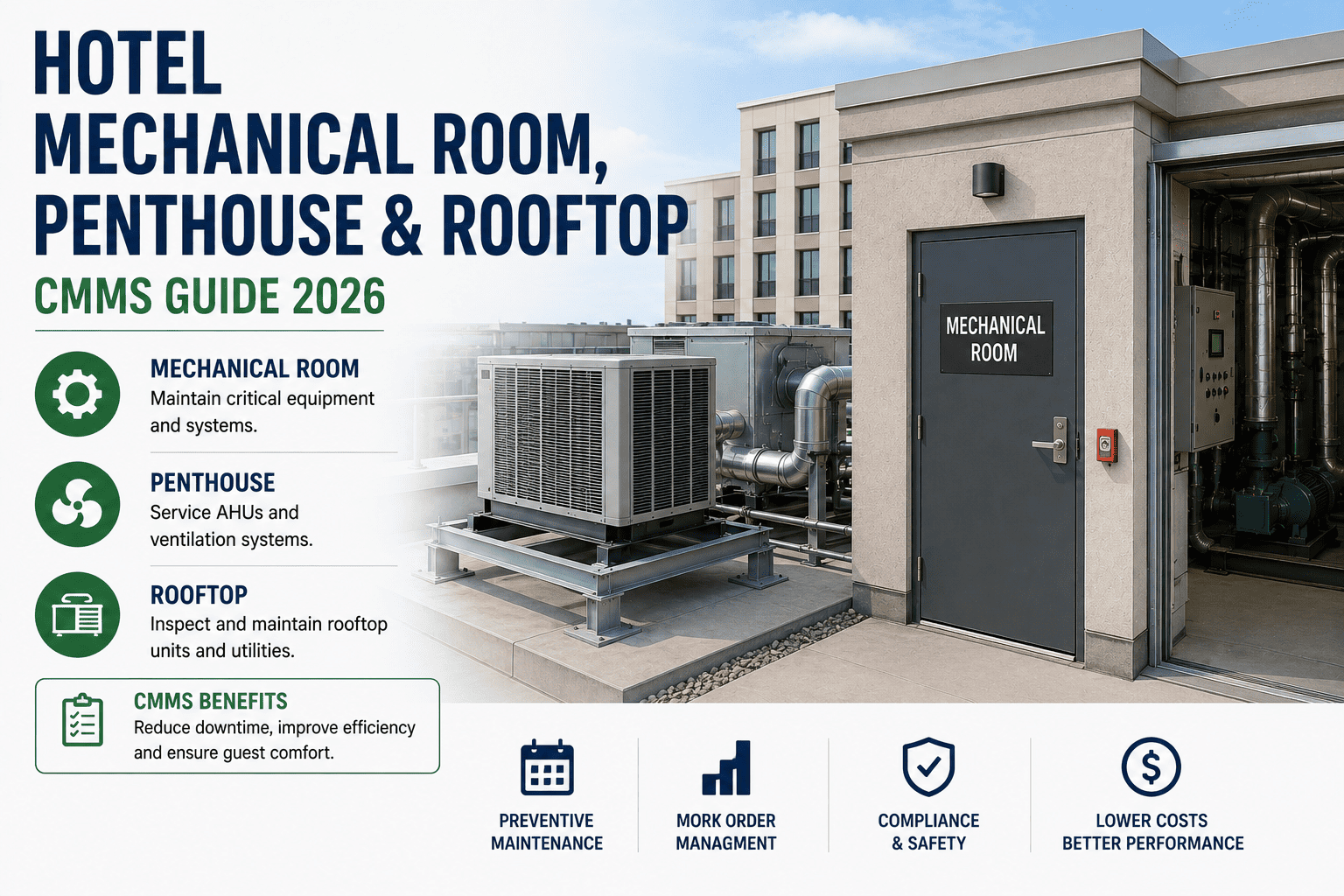
Hotel mechanical rooms, penthouses, and rooftops house the most failure-prone — and least inspected — equipment in any property: cooling towers, RTUs, exhaust fans, makeup air units, and satellite arrays. Industry studies show 60–70% of catastrophic hotel HVAC failures originate in these hard-to-access spaces, where water damage from a single leaking condensate line can exceed $80,000 in guestroom and corridor repairs. A CMMS built for hard-to-reach assets closes the visibility gap by scheduling enforced PM cadence, logging condition photos, and routing work orders to the right technician. Start your Start Free Trial to put every rooftop unit under the same disciplined tracking as your boiler plant.
The equipment you can't see is the equipment that fails first. Are your rooftops, penthouses, and drop ceilings truly under management?
Cooling towers, RTUs, and exhaust fans sit 12 stories up, behind locked penthouse doors, or hidden above lobby ceilings — invisible to daily rounds until a $40K water event or a July guestroom blackout forces attention. A CMMS built for hard-to-access hotel spaces brings every asset back into view.
Access safety before the first reading is taken
Rooftop and penthouse inspections send technicians into the highest-risk zones on the property. Lockout-tagout, fall protection, and permit-to-work documentation must be enforced before any CMMS work order is opened — not after.
Rooftop Access Permit
Verify guardrail integrity, skylight covers, and roof-edge fall protection per OSHA 1926.501 before issuing the CMMS work order.
Penthouse LOTO
Lockout-tagout on RTU disconnects, exhaust fan breakers, and gas valves. CMMS enforces a digital LOTO checklist before status moves to "in progress."
Confined-Space Drop Ceiling
Atmosphere test for CO and refrigerant before entry above lobby ceilings. Two-person rule logged in CMMS with timestamped sign-in.
Weather & Wind Check
No rooftop work above 25 mph sustained winds or during lightning radius. CMMS auto-pulls local weather API and blocks dispatch when thresholds breach.
The PM cadence that catches failures before guests do
A 240-room full-service hotel typically runs 14–22 rooftop and penthouse assets. The cadence below reflects ASHRAE Guideline 32 and hospitality industry averages — enforced through CMMS auto-generation so no unit slips past its interval.
Cooling tower visual + makeup water
Inspect basin for scale, verify float valve operation, log conductivity. Catching a fouled fill early prevents a 15–20% efficiency loss that compounds over a season.
RTU filter & belt inspection
Replace or clean filters (MERV 11+), check belt tension and sheave alignment. Dirty filters alone account for 7–12% of hotel HVAC energy waste.
Exhaust fan & kitchen hood deep check
Bearing temp, vibration, and amperage readings. Kitchen exhaust above a 500-CFM hood is a top-3 source of hotel fires — quarterly is the minimum defensible interval.
Condensate line flush + leak sensor test
Clear lines with pressurized water, test overflow pan sensors, verify CMMS photo log of pan condition. This single task prevents the majority of $40K+ ceiling collapses.
Full rooftop structural + satellite sweep
Membrane walk, flashing check, dish mounting torque verification, lightning protection continuity. Document with geo-tagged photos uploaded directly to the CMMS asset record.
Make rooftop assets as visible as the boiler in the basement
The reason rooftops fail isn't ignorance — it's that they sit outside the daily walking route. CMMS structure closes the gap by treating every rooftop unit as a first-class asset with location, criticality, and a full PM history — searchable in two clicks.
| Attribute | Without CMMS | With CMMS Structure |
|---|---|---|
| Asset visibility | "Up on the roof somewhere" — 14 units, 6 unaccounted | Each unit tagged with floor, zone, photo, serial, and criticality score |
| PM scheduling | Wall calendar, ~40% interval compliance | Auto-generated work orders, 95%+ compliance, escalation on overdue |
| Condition history | Paper logs in three different filing cabinets | Photo timeline per asset, vibration/trend data, failure-mode tags |
| Failure response | 2–4 hour dispatch delay locating access keys and drawings | Tech receives work order with drawings, LOTO steps, and last-known condition on phone |
| Audit readiness | 3-week scramble before brand audit | One-click PM completion report exported to PDF |
The math: what disciplined rooftop PM actually returns
A 180-room property running 19 rooftop and penthouse assets spends roughly $42,000 per year on reactive rooftop repairs — leak damage, emergency RTU swaps, guest relocation. Here's the payback when that same portfolio moves into a CMMS with enforced cadence.
What to monitor continuously, not just on PM day
Calendar-based PM catches maybe 60% of developing failures. The other 40% — bearing wear, refrigerant slow leaks, electrical hot spots — announce themselves between visits. Low-cost IoT sensors feeding into the CMMS close that window.
RTU & exhaust fan bearings
A 1× rise in RMS vibration velocity predicts bearing failure 30–60 days out. CMMS auto-creates a high-priority work order when thresholds cross.
Electrical connections
IR sensors on disconnects and contactors catch loose lugs before arc-flash. A 15°C rise above ambient is the trigger threshold.
Condensate overflow pans
A $35 conductivity probe in the secondary pan prevents the $40K ceiling collapse. Alert routes to CMMS within 10 seconds of contact.
Refrigerant low-pressure switch
Slow leaks drop head pressure over weeks. Continuous monitoring catches the trend; calendar PM catches it only when the unit is already short-cycling.
Your rooftops are either under management or under neglect. There is no third option.
Stand up a full CMMS structure for every penthouse, rooftop, and drop-ceiling asset in under 14 days. Import your existing asset list and the PM cadence auto-builds.
Answers to the questions hotel engineering directors ask first
How long does it take to import rooftop and penthouse assets into the CMMS?
Most 150–250 room properties complete a full asset import in 2–4 hours using a CSV template. Each asset needs a name, location (floor + zone), manufacturer, model, serial, install date, and criticality. The CMMS then auto-suggests a PM cadence based on asset type and ASHRAE benchmarks, which you confirm or adjust.
Can technicians complete rooftop inspections from a phone without cell signal?
Yes. The CMMS mobile app caches assigned work orders offline, including drawings, LOTO steps, and photo capture. Once the technician returns to signal range, photos and readings sync automatically to the asset record with the original timestamp. See it in action — Book a Demo and we'll walk through a real rooftop inspection workflow.
What's the typical payback period for a hotel mechanical room CMMS rollout?
Properties rolling out across rooftops, penthouses, and mechanical rooms see payback in 3–5 months on average. The savings come from avoided reactive repairs (water damage, emergency RTU swaps), reduced energy waste from dirty filters and fouled towers, and fewer guest-displacement nights. A 180-room property typically nets $30K–$35K in year-one savings.
How does the CMMS handle access safety and permit-to-work for rooftops?
Every rooftop or penthouse work order includes a mandatory pre-work checklist — fall protection verification, LOTO confirmation, weather check, and two-person sign-in. The work order cannot move to "in progress" until each item is timestamped. This creates a defensible audit trail for OSHA and brand inspections.
Does the CMMS integrate with existing hotel BMS or building automation systems?
Yes. The CMMS accepts alarm and trend data from major BMS platforms via API or BACnet gateway. When a rooftop unit trips or a sensor crosses threshold, the CMMS auto-generates a work order with the fault code, asset ID, and last-known condition — no manual dispatch required.
Stop losing sleep over what's happening 12 stories up.
Stand up a full CMMS for your hotel mechanical rooms, penthouses, and rooftops in under two weeks. Import your assets today, auto-build PM cadence tomorrow, and catch the next leak before it becomes a ceiling collapse.
Free 14-day trial · No credit card