Your CMMS already contains the data that reveals your electrical panel health — the problem is that 73% of hotel operators never conduct thermal imaging scans until a circuit fails or an inspector flags a violation. Every electrical panel in your hotel contains multiple connections that, when loose, generate heat that can ignite nearby insulation before any smoke detector responds. A loose breaker terminal creates resistance that generates heat — 40°F above ambient at the connection signals imminent failure. NFPA 70B mandates annual comprehensive infrared thermography scans of all distribution panels, with quarterly thermal imaging recommended for high-risk commercial facilities. Hotels implementing quarterly IR thermography report 74% fewer electrical failures and 68% fewer unplanned outages [citation:2]. The panel that shows a 25°F temperature rise on a bus bar connection is not a random event — it is a pattern that will escalate to catastrophic failure if not addressed. That pattern is sitting in your maintenance records right now, invisible because nobody has built the thermal imaging schedule that surfaces it. Oxmaint's electrical maintenance module tracks your infrared scanning schedule automatically — generating work orders for quarterly thermal imaging, flagging hotspot findings for immediate action, and creating the audit trail NFPA 70B requires. The data is already yours, and the analysis that prevents the next electrical fire takes minutes to configure, not months. If your hotel is still treating electrical panels as "set it and forget it" infrastructure instead of proactively scanning them, start a free trial or book a demo to see how Oxmaint schedules and tracks thermal imaging scans from your existing asset data.
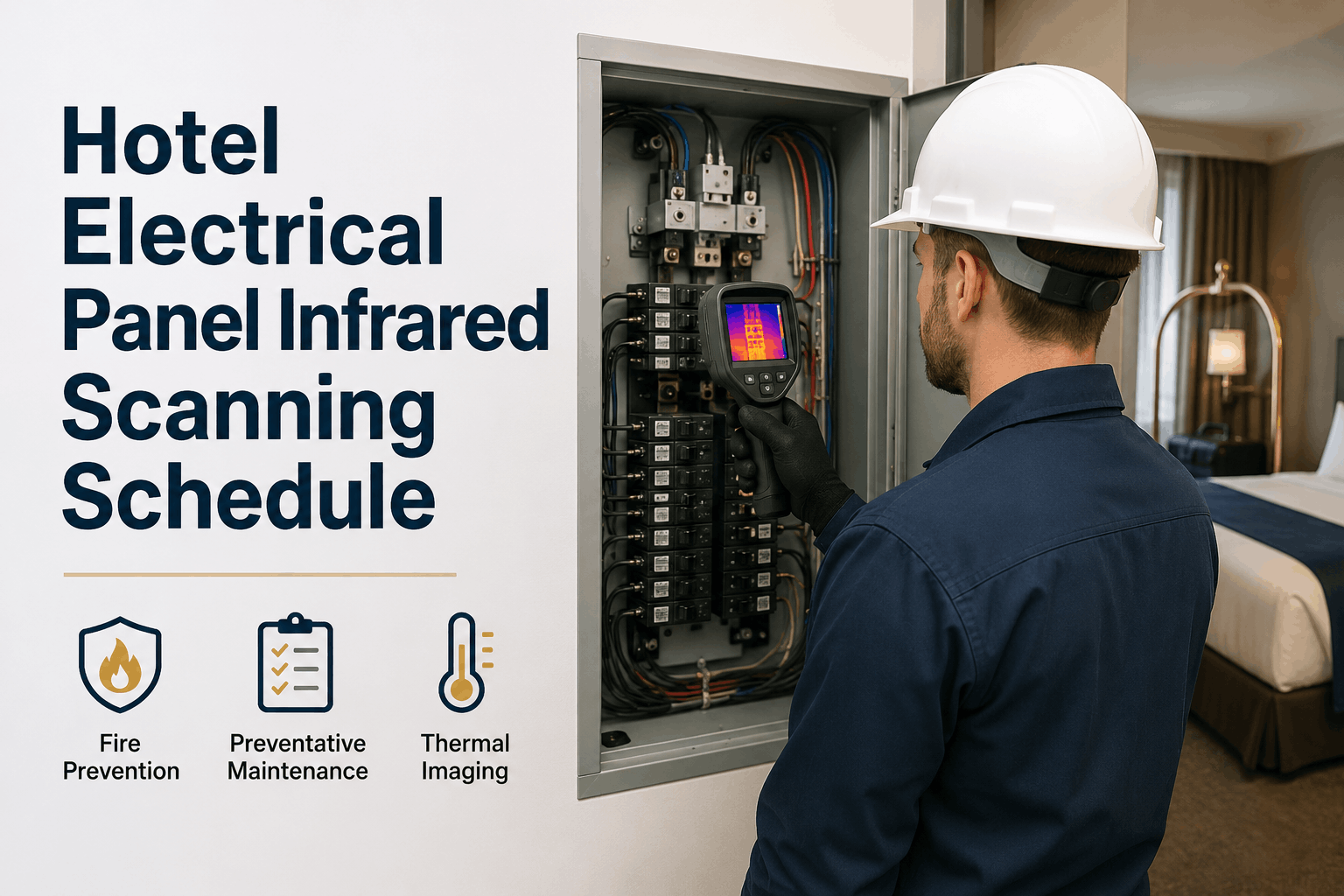
Hotel Electrical Panel Infrared Scanning Schedule
Quarterly thermal imaging for hotel electrical panels to detect loose connections, prevent fires, and comply with NFPA 70B — a complete inspection schedule for electrical reliability.
You Already Have the Assets — You Just Need the Scanning Schedule
Every electrical panel in your hotel contains critical connections that degrade over time. Thermal imaging identifies hidden hotspots — loose connections, overloaded circuits, and failing breakers — before they cause fires or outages. Oxmaint does not require new cameras or thermal consultants — it schedules scans, tracks findings, and generates work orders for corrective action automatically. Hotel engineering leaders ready to implement a thermal imaging program can start a free trial or book a demo to see how Oxmaint schedules and tracks thermal scans from your asset data.
NFPA 70B and the Electrical Panel Inspection Requirement
NFPA 70B (2023) mandates annual comprehensive infrared thermography scans of all energized electrical distribution systems. The standard states that routine infrared inspections of energized electrical systems should be performed annually prior to shutdown, with more frequent inspections — quarterly or semiannually — recommended where warranted by loss experience, installation of new equipment, or changes in environmental, operational, or load conditions [citation:2][citation:4].
For hotels, the risk profile justifies quarterly scanning. Hotels operate 24/7 with high electrical loads from guest rooms, kitchens, mechanical systems, and life safety equipment. A single loose connection creates resistance that generates heat — 40°F above ambient signals imminent failure [citation:2]. Thermal imaging identifies these hotspots before they ignite insulation and escalate to fire.
Electrical Equipment Requiring Infrared Scanning in Hotels
Thermal imaging should cover all energized electrical components carrying significant load. The following equipment should be included in every hotel scanning schedule [citation:1][citation:4][citation:5].
Infrared Scanning Protocol for Hotel Electrical Panels
A standardized scanning protocol ensures consistent results and reliable thermal data for trend analysis. The protocol below follows industry best practices for hotel electrical panel inspections [citation:1][citation:2][citation:5].
All electrical equipment should be operating under normal load during scanning. Equipment covers must be removed to expose energized parts for scanning. For safety, two qualified personnel must be present — one to remove covers and one to perform the scan. Any equipment that cannot be safely opened due to interlocks or safety concerns should be noted as "skipped" [citation:1].
Capture thermal images of every bus bar connection, breaker terminal, wire termination, and main disconnect. Document temperature readings at key connection points. Record ambient temperature and load conditions at the time of scan. Images should be archived with date and ambient temperature noted for future comparison [citation:2].
Any connection >20°F above adjacent connections should be flagged for immediate investigation. Connections >40°F above ambient are red-flag, requiring immediate tightening or replacement [citation:2]. Identify the root cause — loose connection, overloaded circuit, or failing component — and document findings in the CMMS.
Corrective Action Workflow for Thermal Findings
Thermal imaging findings require timely corrective action to prevent escalation. The workflow below ensures identified hotspots are addressed before they cause failure or fire [citation:2].
| Finding Severity | Temperature Differential | Required Action | Timeline |
|---|---|---|---|
| Caution | 10°F - 20°F above adjacent | Document; schedule investigation within 30 days | 30 days |
| Warning | 20°F - 40°F above adjacent | Immediate investigation; torque verify connection; re-test within 72 hours | 72 hours |
| Critical | 40°F+ above ambient | Immediate de-energize (if safe); repair or replace | 4 hours |
Implementing a Quarterly Infrared Scanning Program
Implementing a quarterly thermal imaging program for hotel electrical panels requires a structured approach that ensures all equipment is scanned on schedule and findings are tracked to resolution [citation:2].
Create a complete inventory of all electrical panels by location and priority. Categorize by criticality — primary distribution (Priority 1), secondary panels serving guest rooms (Priority 2), and specialized equipment (Priority 3). Use Oxmaint to track panel locations, manufacturer, capacity, and scan history.
Configure Oxmaint to generate quarterly thermal imaging work orders for every electrical panel. Set schedules by panel category — all panels quarterly, with high-priority panels scanned at the beginning of each quarter. Include scanning protocol requirements in each work order .
Perform thermal scans per protocol. Document findings in Oxmaint — thermal images, temperature readings, hotspot classification, and recommended corrective action. Tag findings requiring immediate attention for urgent work order generation.
Generate work orders for corrective actions identified in scans. Track completion and verify corrective action effectiveness with follow-up thermal scans. Maintain historical records for trend analysis — sustained temperature rise at the same connection indicates progressive degradation requiring accelerated replacement [citation:2].
Electrical Panel Inspection Frequency Matrix
The inspection frequency matrix below provides a complete schedule for hotel electrical panel maintenance, including thermal imaging and complementary inspection tasks [citation:2].
| Inspection Task | Frequency | NEC/NFPA Standard | Compliance |
|---|---|---|---|
| Visual Breaker Condition Check | Biannual | NFPA 70 Article 408 | ✓ |
| Thermal Imaging Scan | Quarterly | NFPA 70B Section 3.1 | ✓ |
| Phase Load Analysis | Annual | NFPA 70 Article 220 | ✓ |
| GFCI/AFCI Testing | Biannual | NEC 210.12 / 210.13 | ✓ |
| Grounding Continuity Test | Annual | NEC 250.21 | ✓ |
| Arc Flash Label Update | Annual | NFPA 70E-2021 Article 130.5 | ✓ |
ROI of Quarterly Infrared Scanning
Hotels implementing quarterly IR thermography report 74% fewer electrical failures through early detection of loose connections and overloaded circuits [citation:2]
Identifying and addressing thermal issues before failure prevents costly unplanned outages that disrupt guest stays and operations [citation:2]
Electrical equipment damage and loose connections cause 25-30% of failures to switchboards, switches, circuit breakers, and cables — all detectable through thermal imaging [citation:5]
IR scanning program typically pays for itself within 6 months through prevented failures and avoided outages
Frequently Asked Questions
How often should electrical panels be scanned with infrared in a hotel?+
What equipment should be included in a hotel infrared scanning program?+
What temperature differential indicates a problem in electrical panel scanning?+
Can infrared scanning be performed while the hotel is occupied?+
Your Next Electrical Fire Is Already Heating Up in Your Panel — Find It Before It Finds Your Guests
Every electrical panel in your hotel contains connections that degrade over time. Quarterly thermal imaging catches loose connections before they ignite. Oxmaint schedules your scans, tracks your findings, and generates work orders for corrective action automatically — creating the NFPA 70B audit trail that protects your property and your guests. No thermal consultants. No missed scans. Import your panel inventory, configure your scanning schedule, and start finding hotspots in your first 30 days.