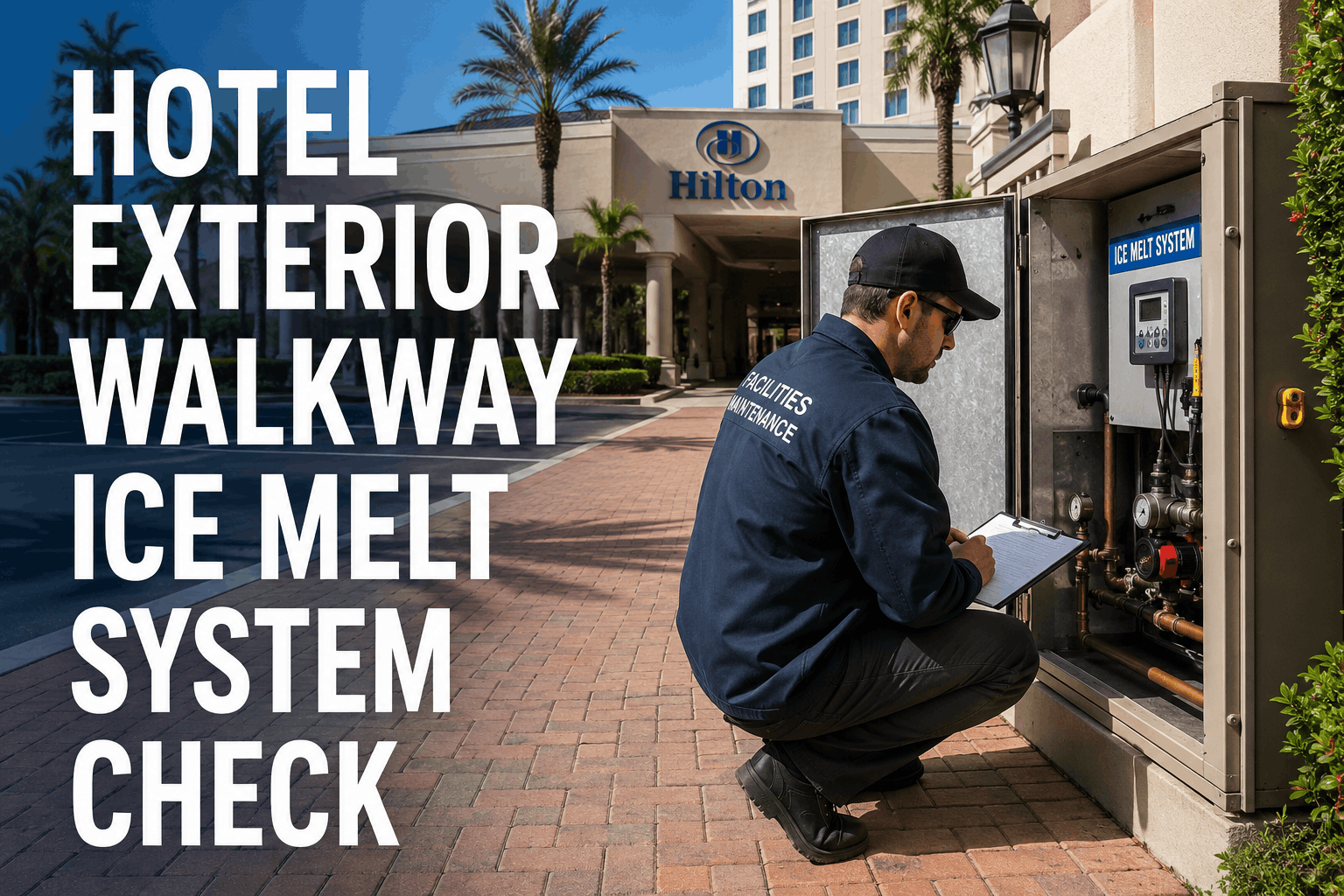
A single slip-and-fall lawsuit from an icy hotel walkway can cost $500,000–2,000,000 in settlements, legal fees, and increased insurance premiums — not to mention the reputational damage from a guest injury at arrival. Yet most hotels treat ice melt systems as a maintenance afterthought, discovering failures only when the first winter storm arrives and the walkway is already treacherous. The difference between a hotel that prevents slip-and-fall incidents and one that reacts to them is a pre-winter inspection checklist that verifies every component of the ice melt system — heating cables, glycol levels, circulator pumps, and snow melting mats — before the first freeze. Start a free trial with Oxmaint to schedule your pre-winter ice melt system inspection, or book a demo to see how hotel engineering teams use Oxmaint's seasonal maintenance module to prevent slip-and-fall incidents and protect guests.
Hotel Exterior Walkway Ice Melt System Check: Pre-Winter Inspection Checklist for Guest Safety and Liability Protection
Walkway heating cable inspection, glycol level verification, circulator pump testing, snow melting mat maintenance, slip-and-fall prevention, and winterization protocol — the complete guide to preparing hotel exterior walkway ice melt systems for winter.
Why Ice on Hotel Walkways Is a Multi-Million Dollar Risk
Hotel walkways are the first and last points of guest contact. A guest arriving in winter expects a clear, safe path from the parking area to the lobby. When ice melt systems fail, the alternative is manual salting — which is inconsistent, environmentally damaging, and often ineffective during heavy snowfall. The liability exposure is substantial: slip-and-fall claims against hotels average $50,000–200,000 for minor injuries, and can exceed $1,000,000 for serious injuries involving elderly guests or permanent disability. Insurance carriers increasingly require documented proof of regular ice melt system maintenance — without it, claims may be denied.
Heating cables can fail due to age, physical damage, or electrical issues. Without pre-winter testing, the first indication of failure is ice accumulation on the walkway — and a guest fall. Annual resistance testing identifies failed cables before the first freeze.
Hydronic ice melt systems rely on glycol for freeze protection. Over time, glycol degrades, becomes acidic, and loses its freeze-protection properties. Low or degraded glycol levels allow pipes to freeze and burst — rendering the entire system inoperable.
Circulator pumps that sit idle during summer months can seize or develop bearing issues. A failed pump means no heat transfer to the walkway — even if the boiler is running. Pre-winter pump testing prevents mid-winter failures.
Snow melting mats (electric or hydronic) can be damaged by snowplows, salt corrosion, or physical wear. Damaged mats create cold spots where ice forms — and guests assume the entire walkway is safe. Pre-winter mat inspection identifies damage before it causes a fall.
Complete Ice Melt System Inspection: 8 Critical Checks Before the First Freeze
The pre-winter ice melt system inspection should be completed at least 4–6 weeks before the expected first freeze. The checklist below covers every component of a typical hotel exterior walkway ice melt system. Oxmaint's seasonal maintenance module generates this checklist automatically and tracks completion per walkway zone.
For electric ice melt systems, measure the resistance of each heating cable circuit. Compare to manufacturer specifications. A resistance reading outside the acceptable range (typically ±10% of spec) indicates a damaged cable that needs replacement. Document readings for each walkway zone.
For hydronic systems, verify glycol level in the expansion tank and concentration (typically 30–50% propylene glycol). Use a refractometer to measure concentration. Low concentration risks freeze damage; high concentration reduces heat transfer efficiency. Top up or replace as needed.
Test glycol pH and inhibitor levels. Aged glycol becomes acidic and can corrode system components. pH should be 8.0–10.0. If pH is below 8.0 or if the glycol appears discolored, consider replacement or treatment with inhibitor additives.
Run each circulator pump for a minimum of 15 minutes. Listen for unusual noise (bearing wear), check motor amp draw against nameplate rating, and verify flow through the system. Replace or rebuild pumps with high amp draw or audible bearing noise.
Visually inspect all snow melting mats for physical damage, loose connections, and corrosion. For electric mats, test continuity. For hydronic mats, check for leaks and kinks. Document the condition of each mat with photos in your CMMS.
If the system uses a dedicated boiler or heat pump, perform a full operational test. Verify setpoint temperature, burner operation, and safety controls. Ensure the system reaches the required temperature (typically 100–120°F for hydronic walkway systems).
Pressurize the hydronic system and verify it holds pressure for 24 hours. A pressure drop indicates a leak in the piping or mats. Leaks in walkway systems are often invisible until the system is activated — finding them early is critical.
Test all temperature sensors, thermostats, and controllers. Verify the system activates at the correct temperature setpoint (typically 38°F). Test moisture sensors if equipped. Replace any malfunctioning sensors or controllers.
Pre-Winter Ice Melt System Inspection Timeline
| Timeline | Inspection Activity | Responsible Team | Compliance Check |
|---|---|---|---|
| 8 Weeks Before First Freeze | System pressure test and visual inspection of all walkway zones | Engineering Team | Document all zones and identify repair needs |
| 6 Weeks Before First Freeze | Heating cable resistance test, glycol level and concentration check, pH testing | Engineering Team + HVAC Specialist | Log all readings in CMMS |
| 4 Weeks Before First Freeze | Circulator pump test, boiler/heat source test, control system verification | Engineering Team + HVAC Specialist | Functional test completed and documented |
| 2 Weeks Before First Freeze | Final system run test — verify heat on all walkway zones | Engineering Team | Every walkway zone reaches operating temperature |
| First Freeze Event | System activation monitoring — verify automatic start and heat distribution | Engineering Team | Walkway clear of ice and snow within 2 hours of precipitation |
All inspection records should be stored in your CMMS with photos, readings, and technician sign-offs. Insurance carriers and legal counsel may request these records in the event of a slip-and-fall claim.
Documented Inspections = Defensible Liability Position
Liability Position: Weak. No proof of system maintenance. Attorney: "When was the last inspection?" Hotel: "We don't have records." Settlement: $250,000–1,000,000.
Liability Position: Strong. Complete inspection records. Attorney: "When was the last inspection?" Hotel: "30 days before the incident. Here are the records." Settlement avoided or reduced by 60–80%.
Premium Impact: Documented maintenance programs reduce liability premiums by 5–15%. Multiple properties with documented programs may see portfolio-wide premium reductions.
Winter Arrival Impact: A clear, ice-free walkway creates a positive first impression. Guests feel safe and cared for. Winter reviews mention "walkways were clear" — reinforcing the hotel's attention to detail.
The Cost of Prevention vs. Cost of Liability
Engineering time: 8–12 hours annually (depending on walkway length and system complexity). Parts and glycol top-up: $200–1,000. Total annual cost: $500–3,000.
Legal defense: $50,000–150,000. Settlement: $100,000–1,500,000. Insurance premium increase: $10,000–50,000/year for 3–5 years. Total cost: $160,000–1,700,000+.
$500–3,000 inspection cost vs. $160,000–1,700,000 liability cost. ROI: 50–3,000×. Even preventing one minor claim pays for decades of inspections.
A guest who falls at check-in will never return. A guest who arrives safely during a winter storm becomes a loyal advocate. Impact: Average guest lifetime value: $5,000–20,000. Preventing falls protects lifetime revenue.
Without vs. With Documented Pre-Winter Inspection
Frequently Asked Questions — Ice Melt System Inspection
What is the optimal glycol concentration for a hydronic ice melt system?+
How often should ice melt heating cables be tested?
What are the signs of ice melt system failure?
Signs of failure include: ice forming on walkways while the system is supposed to be active, uneven melting (some areas clear, others icy), unusual noise from pumps, glycol leaks visible on walkways or in mechanical rooms, and system pressure drop. Pre-winter inspection catches most of these before failure occurs. Start free to set up inspection schedules.
Can I use an ice melt system with snow melting mats and manual salting together?
Yes — but manual salting should be a backup, not the primary method. Salt can damage snow melting mats (corrosion) and concrete surfaces. If you must use salt, use magnesium chloride or calcium chloride (less damaging than rock salt) and apply sparingly. The best practice is to rely on the automated system and use manual methods only for emergency spot treatment. Start free to document winter maintenance methods.
How does a CMMS help with ice melt system maintenance?
A CMMS like Oxmaint provides five ice melt system advantages: (1) Seasonal scheduling — pre-winter inspections generated automatically, (2) Documentation — photos, readings, and sign-offs stored for liability defense, (3) Asset tracking — each walkway zone, heating cable circuit, and pump tracked separately, (4) Maintenance history — repairs and replacements recorded for warranty and insurance, (5) Compliance readiness — complete records available for insurers and legal counsel.
From the Director of Engineering — 400-Room Convention Hotel, US Northeast
"We had a guest slip on an icy walkway in December 2023 — our heating cables had failed and we didn't know. The guest suffered a broken wrist and sued for $250,000. We settled for $180,000. The insurance company asked for our maintenance records, and we had none. After that, we implemented Oxmaint's pre-winter inspection program. Now every heating cable is tested before the first freeze, glycol levels are checked and documented, and all pumps are tested. Our insurer gave us a 12% premium reduction when we showed them our documented program. The $2,000 annual inspection cost saved us $180,000 in one incident — and we'll never have another claim from an icy walkway."
Director of Engineering — 400-Room Convention Hotel, US Northeast
Protect Your Guests and Your Hotel — Schedule Your Pre-Winter Ice Melt Inspection Today
A single slip-and-fall lawsuit can cost $500,000–2,000,000 — far more than the annual cost of a documented ice melt system inspection program. Oxmaint's seasonal maintenance module generates pre-winter checklists, tracks glycol levels and cable resistance readings, and stores all inspection records for liability defense. Start your free trial today.