A hotel that waits for the first winter freeze to discover a failed boiler or the first summer heatwave to find an underperforming chiller will spend 3–5 times more on emergency repairs than one that works to a seasonal maintenance schedule. Cooling systems account for 40–50% of a hotel's energy bill during summer — a poorly tuned chiller running at 70% efficiency for three months costs more than a full annual PM contract. The principle is the same across every system and every season: the cost of prevention is always a fraction of the cost of failure. Sign up free to load seasonal PM templates into Oxmaint for your property, or book a demo to see automated weather-based scheduling in action.
3–5×
Higher cost of emergency repairs vs. scheduled preventive maintenance
40–50%
Of hotel energy bill consumed by cooling during summer peak season
10–15%
Energy savings from a 2–3°F setpoint adjustment during unoccupied periods
4 windows
Seasonal transition periods when the highest concentration of failures occur
Your Hotel's Year-Round Maintenance Calendar
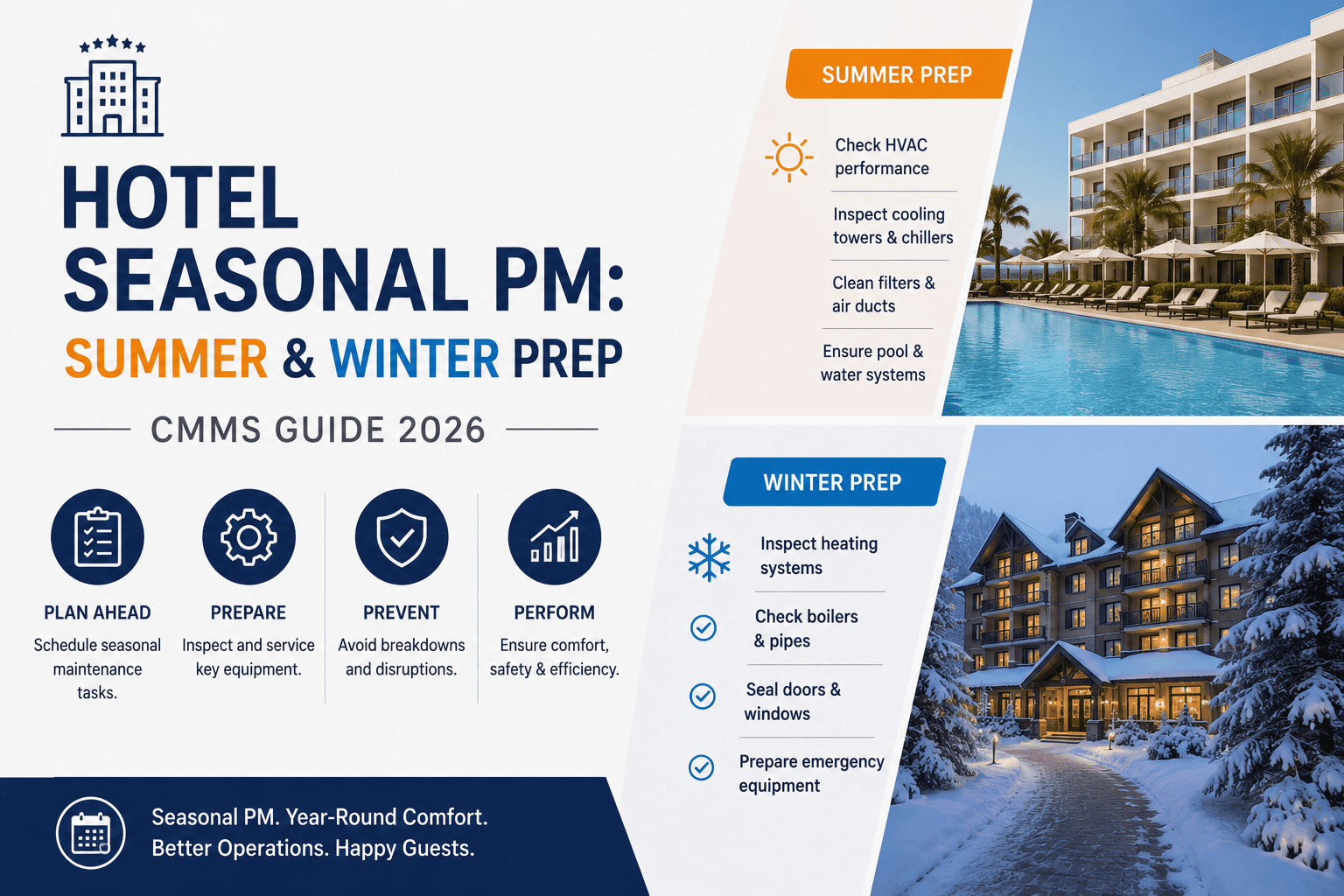
Seasonal maintenance is not four separate checklists — it is one continuous cycle. Each season prepares systems for the next. Fall winterization prevents spring water damage. Spring commissioning prevents summer HVAC failure. The calendar below maps every major system to its optimal maintenance window. Book a demo to see how Oxmaint auto-generates seasonal work orders on a weather-based schedule.
Recover from winter. Commission cooling. Inspect envelope.
HVAC cooling commissioning
Roof and drainage inspection
Pool/spa opening and chemistry
Exterior and grounds prep
Gutter and downspout clearing
Peak occupancy. Monitor cooling performance. Energy management.
Monthly HVAC filter replacement
Chiller/condenser performance checks
Pool chemistry and equipment
Refrigeration system monitoring
Storm preparedness check
Fall
September – November
Winterize. Commission heating. Protect the envelope.
Heating system commissioning
Pipe and outdoor plumbing winterization
Pool/spa winterization or closure
Roof inspection before rain season
Window and door seal inspection
Winter
December – February
Protect pipes. Monitor heating. Prevent ice and moisture damage.
Freeze protection monitoring
Ice and snow removal protocols
Boiler and heating system checks
Roof ice dam prevention
Emergency heating backup readiness
Spring Checklist — Recovery and Cooling Commissioning
HVAC and Cooling
Replace all HVAC air filters property-wide — filters loaded with winter heating particulates reduce summer cooling airflow from the first day of the season. Replace before first cooling run, not after.
Inspect and clean evaporator and condenser coils on all cooling equipment. Dirty coils at season start force compressors to work against increased heat load — efficiency losses compound over the entire cooling season.
Verify refrigerant levels on all DX cooling systems. A system low on refrigerant by 10% loses approximately 20% of its cooling capacity — invisible without a gauge check.
Clear condensate drain lines and verify drain pan condition. Blocked drains from winter debris cause water overflow during the first humid week of spring — creating ceiling water damage before occupancy peaks.
Test all thermostats in cooling mode. Calibrate against a reference thermometer. A thermostat reading 4°F high will overcool rooms — guest comfort complaints and energy waste from day one of summer season.
Roof and Envelope
Inspect roof surface for winter damage — cracked or lifted shingles, damaged flashing around penetrations, and membrane blistering on flat roofs. Spring rain season is the first test of any winter damage.
Clear all gutters, downspouts, and roof drains of winter debris. A blocked drain during a spring storm delivers water to the building envelope at the point of least resistance — typically a soffit or parapet.
Inspect exterior caulking and sealant at all window frames, door frames, and facade penetrations for winter freeze-thaw cracking. Re-seal before spring moisture season.
Summer Checklist — Peak Season Performance
HVAC Monitoring and Energy
Replace HVAC air filters monthly during summer — high occupancy loads and maximum system runtime during peak season mean filters reach saturation faster than the standard 90-day residential cycle.
Monitor chiller and cooling tower performance monthly — log entering and leaving water temperatures, record approach temperatures, and compare against design specification. Approach temperature creep is the earliest warning of condenser fouling.
Verify thermostat setback programming in all unoccupied rooms. Even a 2–3°F setpoint increase during unoccupied periods reduces cooling costs by 10–15%. Train housekeeping staff on proper thermostat operation — guest-mode override should be the default.
Inspect cooling tower basin, fill media, and distribution nozzles monthly during operation. Legionella risk is elevated in warm water systems — water treatment program verification is a health compliance requirement during operation.
Storm and Weather Readiness
Verify emergency generator fuel level and test under load monthly during storm season. A generator that fails to start during a summer power outage during peak occupancy is a full guest evacuation event.
Inspect and trim all trees and vegetation within 15 feet of the building. Storm-downed branches account for a significant share of summer roof and HVAC equipment damage at hotel properties.
Fall Checklist — Winterization and Heating Commissioning
Heating System Commissioning
Commission boiler or furnace systems before first heating demand — fire up the system at least 3 weeks before expected cold weather to allow time for identified repairs. A boiler that fails on the first cold night of October generates emergency repair costs and guest complaints simultaneously.
Inspect and clean heat exchanger surfaces on all boilers and furnaces. Scale and soot buildup reduce heat transfer efficiency — a 1mm scale layer increases fuel consumption by up to 7%.
Bleed and balance hydronic heating systems. Air-locked radiators or fan coil units produce guest complaints from day one of heating season — a 2-hour balancing procedure prevents 40 work orders over the winter.
Test all carbon monoxide detectors property-wide — heating season is peak CO risk. Replace any detector with a low battery or end-of-life alert immediately. CO detector failures in occupied rooms are a direct life safety liability.
Plumbing Winterization
Drain and shut off all outdoor hose bibs, irrigation systems, and ornamental water features. A frozen outdoor line that bursts inside a wall cavity is a water damage event that will not be discovered until spring or until a guest reports wet drywall.
Insulate all exposed pipes in unheated areas — parking garages, utility corridors, attic spaces, and exterior mechanical rooms. Heat tape on freeze-risk locations should be tested and activated before the first freeze date.
Verify that make-up air units and DOAS units are properly configured for economizer mode — free cooling from outside air below 55°F reduces mechanical cooling energy and allows cooling coil defrost during the transition period.
Winter Checklist — Freeze Protection and Heating Reliability
Freeze Protection and Pipe Monitoring
Monitor pipe temperatures in all freeze-risk zones during cold snaps — unheated corridors, exterior mechanical rooms, and garage-adjacent utility spaces. Set low-temperature alarms at 40°F to allow intervention before freeze damage occurs.
Inspect roof surface and gutters after every significant snowfall for ice dam formation. Ice dams form when heat escapes through the roof deck — melt water refreezes at the eave and forces water under shingles. Attic insulation condition determines ice dam frequency.
Verify minimum heating in all unoccupied guest rooms — rooms should maintain a minimum of 55°F to protect plumbing while minimizing energy consumption. Monitor room temperatures remotely where BAS integration permits.
Heating System Reliability
Replace HVAC filters monthly during heating season — heating systems move large volumes of air and load filters faster in winter. A clogged filter during peak heating demand increases static pressure and risks heat exchanger overheating in gas systems.
Verify emergency heating backup availability — portable electric heaters, backup boiler if installed, or service provider emergency response commitment. During extended cold weather events, a heating system failure without backup creates an obligation to relocate all guests.
Inspect all expansion tanks and pressure relief valves on heating systems monthly. A waterlogged expansion tank causes system pressure to exceed relief valve set point — relief valve discharge is the first visible symptom of a system that has been failing silently for weeks.
Seasonal PM Templates
Weather-Based Scheduling
Automated Task Generation
Seasonal maintenance without the seasonal scramble.
Oxmaint auto-generates your seasonal PM work orders on a weather-based schedule — spring commissioning fires when temperatures rise, fall winterization tasks deploy before the first freeze date. Load seasonal templates once. Run them every year. Book a demo.
Seasonal Task Quick-Reference by System
| System |
Spring |
Summer |
Fall |
Winter |
| HVAC — Cooling |
Commission, coil clean, refrigerant check |
Monthly filter, performance log, setback check |
Decommission, cover outdoor units |
- |
| HVAC — Heating |
- |
- |
Commission, clean exchanger, balance system |
Monthly filter, expansion tank, backup readiness |
| Plumbing |
Inspect for freeze damage, test outdoor bibs |
- |
Drain outdoor lines, insulate exposed pipes |
Freeze monitoring, monthly filter replacement |
| Roof and Envelope |
Post-winter inspection, clear gutters, re-seal |
Post-storm check, trim vegetation |
Pre-rain inspection, flashing check |
Ice dam check after snowfall |
| Pool and Spa |
Opening, chemistry commissioning, equipment start |
2x daily chemistry, weekly equipment check |
Winterization or closure |
Closed or indoor pool monitoring |
| Emergency Generator |
Annual service, load test |
Monthly fuel and function check |
Pre-winter load test, fuel topped up |
Weekly function check, fuel monitoring |
| CO Detectors |
- |
- |
Property-wide test and battery replacement |
Monthly check during heating season |
Seasonal PM Templates
Weather-Based Scheduling
Automated Task Generation
Load the Template Once. Run It Every Season.
Pre-built seasonal PM templates for all hotel systems and all four seasons
Weather-based scheduling triggers spring and fall tasks automatically
Work orders auto-generated with correct technician and asset assigned
Timestamped completion records retained for every seasonal inspection


-preventive-maintenance-checklist.png)