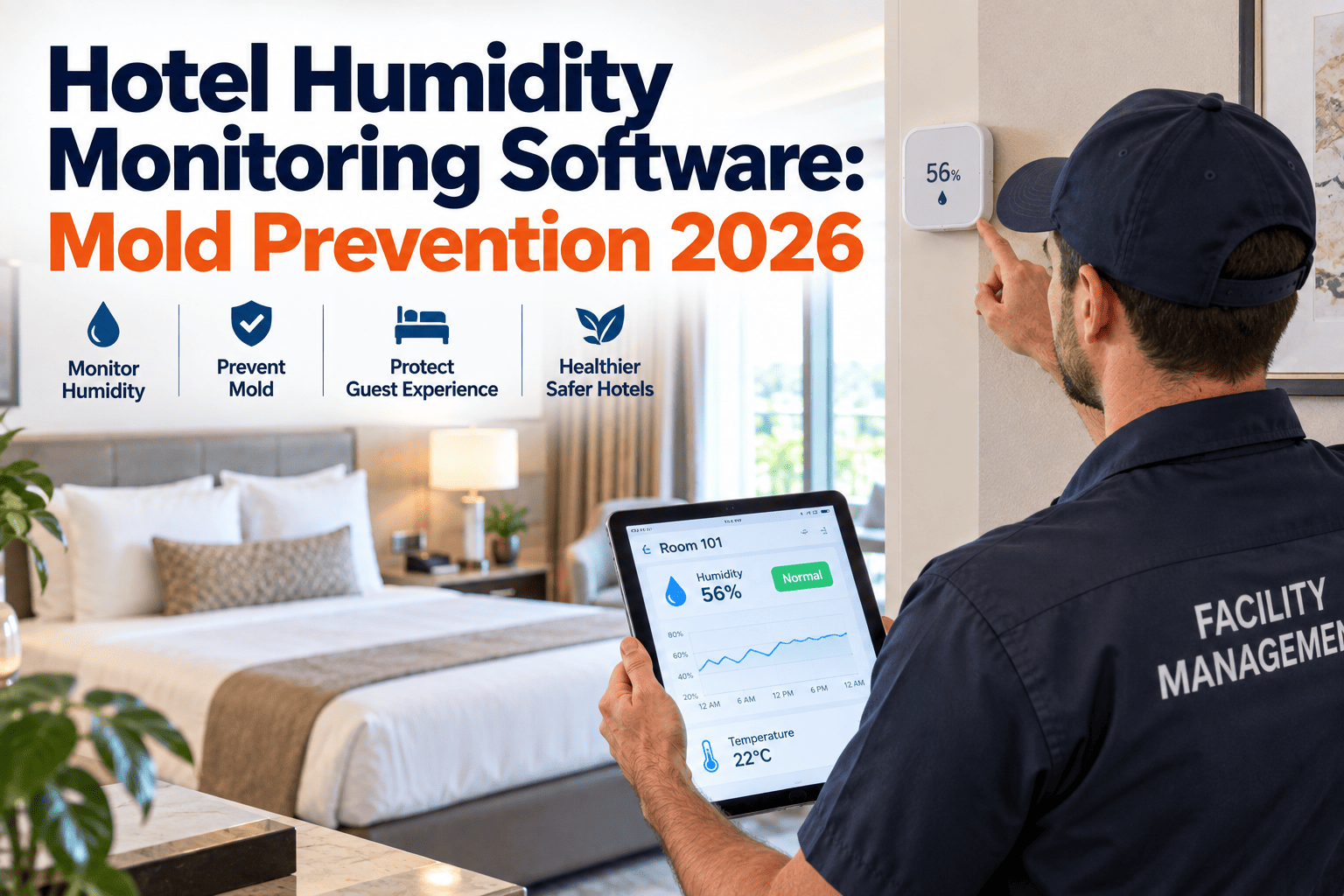
Hotel Humidity Monitoring Software: Mold Prevention 2026

By William Jerry on September 23, 2026

hotel-humidity-monitoring-software-mold-prevention-2026

A hotel doesn't need to flood to grow mold. All it needs is a bathroom exhaust fan that's been quietly dead for three weeks, a coastal room where the guest sets the AC to 62°F and leaves the balcony door cracked, or a mattress that spent a night below the dew point of the wall it's pushed against. Three days later a musty smell shows up. Three weeks later, drywall behind the headboard is discolored. Three months later, that room is out of service for remediation costing the equivalent of six months of its ADR. Preventing all of this is a records discipline — a network of humidity sensors, threshold rules, alert workflows and audit trails. This guide walks it using OXMAINT AI, the AI-powered CMMS for hotel humidity monitoring at scale.

Hospitality Facilities · Humidity Monitoring · Mold Prevention 2026

A Room Doesn't Need To Flood. It Just Needs 72 Hours Above 65% RH.

OXMAINT AI, the AI-powered CMMS/maintenance management software, holds the full hotel humidity programme on one platform — sensor-fed RH readings by zone, dew-point calculated per space, threshold alerts routed to engineering, corrective WOs tracked, and every reading retained as audit-defensible evidence.

Zone-RH Threshold Rules Dew-Point Calculation Alert-to-WO Chain
72 hrs
above 65% RH — mold colonies begin to establish
6 Zones
each with a different target RH range and alert threshold
5 Signals
RH · temp · dew-point · surface temp · trend direction
1 Chain
from sensor reading to closed corrective WO — evidenced

The 6 Hotel Zones — Each Has Its Own Humidity Rule

A guest room's target RH is not a kitchen's target RH is not a pool deck's target RH. A monitoring programme that applies one threshold to a hotel misses failures in every space that lives outside that number. OXMAINT AI holds each zone with its own target range and alert threshold. Sign up free and build your zone RH library in OXMAINT AI.

01 · Guest Rooms
Guest Rooms & Suites
Target Range
40–55% RH
Comfort band for occupied rooms · alerts on sustained >60% (48h) or dew-point-to-surface delta <3°F
02 · Bathrooms
Guest & Public Bathrooms
Target Range
40–65% RH
Elevated during use, must clear within 2 hours of last use · exhaust fan runtime feedback essential
03 · Corridors & BOH
Corridors & Back-of-House
Target Range
40–55% RH
Central to the envelope pressurisation strategy · alerts on cross-zone imbalance (e.g. corridor > rooms)
04 · Kitchen
Kitchens & Prep Areas
Target Range
45–60% RH
Hood makeup air must balance · sustained high RH indicates hood balance failure or dishwash exhaust issue
05 · Pool & Spa
Pool Deck & Spa
Target Range
50–60% RH
Dedicated dehumidification required · surface temperature vs dew-point critical — condensation on structural steel is a design failure
06 · Storage / MEP
Storage & MEP Rooms
Target Range
30–55% RH
Unoccupied spaces are often ignored — but mattress storage, linen rooms and MEP closets are common mold origins

Why RH Alone Doesn't Predict Mold — The Dew-Point Math

A room at 55% RH sounds safe. But if the exterior wall behind the headboard is at 62°F on a cold night, and the room air is at 72°F with 55% RH, the dew point is 55°F — the wall is above dew point, no problem. Drop the AC setpoint to 62°F, same 55% RH: dew point is now 47°F, and any cold surface at 47°F or below (uninsulated header, exterior stud) will condense. RH is the headline; dew-point-to-surface delta is the actual mold predictor. OXMAINT AI calculates it live per sensor. Book a demo to see dew-point trending live.

Dew-Point vs Surface Temperature — When Condensation Actually Forms
SCENARIO A · Safe
Room Temp
72°F
Room RH
55%
Dew Point
55°F
Wall Surface
62°F
Delta +7°F · No condensation risk
SCENARIO B · Marginal
Room Temp
68°F
Room RH
62%
Dew Point
55°F
Wall Surface
57°F
Delta +2°F · Condensation risk — WATCH
SCENARIO C · Failing
Room Temp
62°F
Room RH
65%
Dew Point
50°F
Wall Surface
48°F
Delta −2°F · Active condensation
The rule: as long as surface temperature stays comfortably above dew point, condensation cannot form — no matter what the RH reading says.

The 5 Signals A Humidity Sensor Actually Delivers

A modern IoT humidity sensor doesn't just report RH — it feeds five signals into the CMMS, and it's the combination that predicts mold. OXMAINT AI ingests and correlates all five per sensor. Start free and connect your first sensor in OXMAINT AI.

01
Relative Humidity (%)
Headline reading — compared against zone target range · sustained-exceedance rule triggers alert, not instantaneous spike
02
Air Temperature (°F/°C)
Paired with RH to derive dew point · setpoint compliance check · trend against occupancy pattern
03
Dew Point (°F/°C)
Calculated from RH and temp · compared against surface temperature to derive condensation risk delta
04
Surface Temperature (°F/°C)
From IR spot sensor or wall-embedded probe · gives the actual mold-risk surface, not just the air
05
Trend Direction
24-hour and 7-day rolling trend · rising RH ahead of a threshold alert enables preventive intervention, not reactive

The Alert-to-WO Chain — From Sensor Reading To Closed Repair

A sensor alert that never becomes a WO is expensive noise. The chain must be closed — reading in, threshold checked, alert raised, WO opened, root cause identified, corrective action logged, sensor returns to trend. OXMAINT AI closes the loop. Book a demo to see the closed loop live.

1
Sensor Reading Ingested
RH, temp, surface temp streamed live from IoT sensor to platform — sample rate per zone criticality (guest room 15 min, pool deck 5 min)
2
Threshold Rule Applied
Zone-specific rule evaluated — sustained-exceedance, dew-point delta, or trend rate all trigger separately with correct escalation
3
Alert Raised & Routed
Alert routed by zone and severity — bathroom exhaust to engineering on shift, pool dehumidifier to specialist crew, guest room to duty engineer
4
Corrective WO Opened
WO auto-opens against the affected asset — exhaust fan, dehumidifier, AHU, VRF unit — with the triggering reading attached as evidence
5
Root Cause Diagnosed
Field tech identifies cause — filter loaded, fan failed, condensate drain blocked, guest behaviour, envelope leak — coded to defect library
6
Repair & Return-to-Baseline
Corrective work logged · sensor reading returns to target range · WO closes only when trend confirms baseline restored

One Bad Sensor Reading. One WO Auto-Opened. One Room That Doesn't Become Remediation.

OXMAINT AI ingests sensor data live, applies zone-specific threshold rules, opens the WO before a guest notices the smell, and evidences the whole chain for the audit that follows.

The Root Causes A Humidity Alert Actually Reveals

A humidity alert almost never means "the sensor is broken." It means one of six things is happening in the space — and knowing which changes the trade the WO routes to. OXMAINT AI holds each as a defect classification with associated corrective procedure. Sign up free and load your defect library.

Root CauseWhere It Shows UpCorrective Trade
Bathroom exhaust fan failureGuest bathroom RH slow to clear after use, spike sustained past normal decay curveHVAC
Condensate drain blockageGuest room RH climbing steadily during AC operation — pan overflow risk imminentHVAC
VRF/fan-coil undersizedCorner rooms, top-floor rooms consistently above target during peak load — chronic patternEngineering
Envelope leak — window or doorIsolated room with rising RH during weather event · often paired with air-leakage complaintEnvelope
Guest AC setpoint below dew pointRooms set to 62°F or below during humid weather · dew-point-to-surface delta collapsesGuest Services
Kitchen hood makeup imbalanceKitchen and adjacent BOH corridor RH elevated during service · often paired with air draw complaintHVAC
Pool dehumidifier faultPool deck RH climbing above 65% · steel surface temperature approaching dew pointEngineering
Housekeeping wet-cleaning without dry-backPost-cleaning RH spike sustained >4 hours · pattern by cleaning crew or shiftHousekeeping

Portfolio-Level View — Reading The Whole Property At Once

A 300-room hotel with 400 humidity sensors doesn't need alert-by-alert scanning — it needs a live property view where the outliers surface and the pattern shows. OXMAINT AI rolls sensor state up to a live property panel. Book a demo to see the property view.

Illustrative Live Property Panel — Humidity Status by Zone
Guest Rooms (287 sensors)
Healthy 82%
Watch 14%
Action 4%
Bathrooms (287 sensors)
Healthy 76%
Watch 18%
Action 6%
Corridors & BOH (24 sensors)
Healthy 92%
Watch 8%
Kitchen & Prep (12 sensors)
Healthy 66%
Watch 34%
Pool & Spa (6 sensors)
Healthy 83%
Action 17%
Storage & MEP (28 sensors)
Healthy 95%
Watch 5%
Green = within target · Amber = trending toward threshold · Red = corrective WO open · refreshed live from sensor feed

What OXMAINT AI Gives A Hotel Engineering Team

Purpose-built for hospitality humidity monitoring at scale — one platform behind sensor ingestion, zone rules, alert routing, WO chain and the audit-defensible record. Start free and connect your first sensor network.

Zone-Rule Engine
Each zone carries its own target range and alert threshold — one hotel, six rule sets, unified reporting.
Live Dew-Point Calculation
Dew point derived per reading, compared against surface temperature, condensation risk delta surfaced in real time.
IoT Sensor Integration
Direct ingestion from major sensor manufacturers via MQTT, LoRaWAN, BACnet — plug into what's on the wall.
Alert-to-WO Automation
Threshold breach auto-opens WO against the affected asset with the triggering reading attached as evidence.
Root-Cause Defect Library
Eight common root causes mapped to defect codes, corrective procedures and correct trade routing.
Life-of-Room Ledger
Every reading, alert and corrective retained per room — pattern detection across seasons, years, guest occupancy.
"

We used to find mold when housekeeping flagged the smell. By that point, the sub-strate was already compromised and we were remediating drywall. When we started reading sensor trends against dew-point delta, we caught a pattern in three corner rooms on the tenth floor over an eight-week period — same rooms, same nights below a specific outdoor humidity threshold. It turned out to be a design issue with the header insulation. We fixed six rooms proactively and never lost another to remediation on that stack.

Director of Engineering · 400-Room Coastal Resort

Frequently Asked Questions

Can OXMAINT AI integrate with the humidity sensors we already have installed?
Yes — the platform supports MQTT, LoRaWAN, BACnet, Modbus and REST API ingestion, covering the major sensor manufacturers used in hospitality. Existing networks connect without hardware replacement in most cases. Sign up free and connect your existing sensors.
Does the platform work across multi-property hotel groups?
Yes — each property carries its own sensor register and zone rule set, and portfolio-level roll-ups compare humidity performance across properties. Corporate engineering teams see one dashboard covering every hotel. Book a demo to see the portfolio view.
How does the platform handle offline periods when sensors lose connectivity?
Sensor gateways buffer readings during network outages and sync when connectivity restores. Extended gaps trigger a sensor-health alert against the sensor itself, so silent sensors don't become silent failures. Start free and see sensor health tracking.
Can we correlate humidity data with guest complaints or housekeeping reports?
Yes — guest complaints and housekeeping observations link to the affected room's sensor record. Comfort complaints correlated to humidity readings surface patterns invisible to either data source alone. Book a demo to see the correlation view.
How long does typical implementation take?
Most hospitality teams go live on the sensor ingestion and zone rules within 3-4 weeks. Full portfolio rollout including alert routing and defect library configuration completes within 6-8 weeks per property. Sign up free and start this month.

Sensor Feed. Zone Rules. Live Dew-Point. Auto-WOs. Every Room Defended.

Move your hotel humidity programme onto OXMAINT AI — zone-rule engine, live dew-point calculation, IoT integration, alert-to-WO automation and life-of-room ledger on one platform, evidenced for every audit and every insurer question.
Share This Story, Choose Your Platform!