A $3.8M lawsuit. A 45-day partial closure. Permanent reputational damage across review platforms. A 320-room resort discovered Legionella in its cooling tower after two guests were hospitalised — bacteria that had been growing undetected for months in dead-leg piping where water temperatures sat in the 77–108°F danger zone. Quarterly testing had returned compliant results because samples were drawn from high-flow outlets, missing the stagnant zones entirely. This guide covers every water system zone hotels must manage, every monitoring interval that eliminates that blind spot, and exactly how OxMaint's Water Temperature Monitoring, Flushing Schedule Automation, and Risk Assessment Tools make the Water Management Program defensible. Sign up free to build your hotel WMP in OxMaint today.
A complete hotel Legionella prevention programme under ASHRAE 188 — covering all six water system zones, temperature monitoring parameters, flushing schedules, laboratory testing intervals, corrective action thresholds, and the OxMaint features that automate every element of documentation and scheduling. Applicable to hotels in the USA, UK (L8 ACoP), Australia (AS 3666), Germany (VDI 6023), and Saudi Arabia (DEWA / NCEC standards).
Automate Your Hotel Water Management Programme in OxMaint
Water Temperature Monitoring, Flushing Schedule Automation, and Risk Assessment Tools — every WMP control measure scheduled, documented, and audit-ready from the first day of deployment.
Why Hotels Are High-Risk Legionella Environments
Hotels combine every condition that Legionella thrives on: large, complex plumbing networks with dead-leg sections, variable occupancy creating stagnant water in unoccupied rooms, cooling towers generating aerosols, spa and pool systems with warm water, and decorative features operating in the Legionella growth temperature range. A hotel without a structured Water Management Programme is not operating safely — it is operating with undetected risk. Book a demo to see OxMaint's WMP configuration for hotel water systems.
The highest-risk zone in most hotels. Water heaters, storage tanks, distribution piping, and recirculation loops serving every guest room. Temperature in the danger zone triggers rapid colonisation overnight when circulation is reduced.
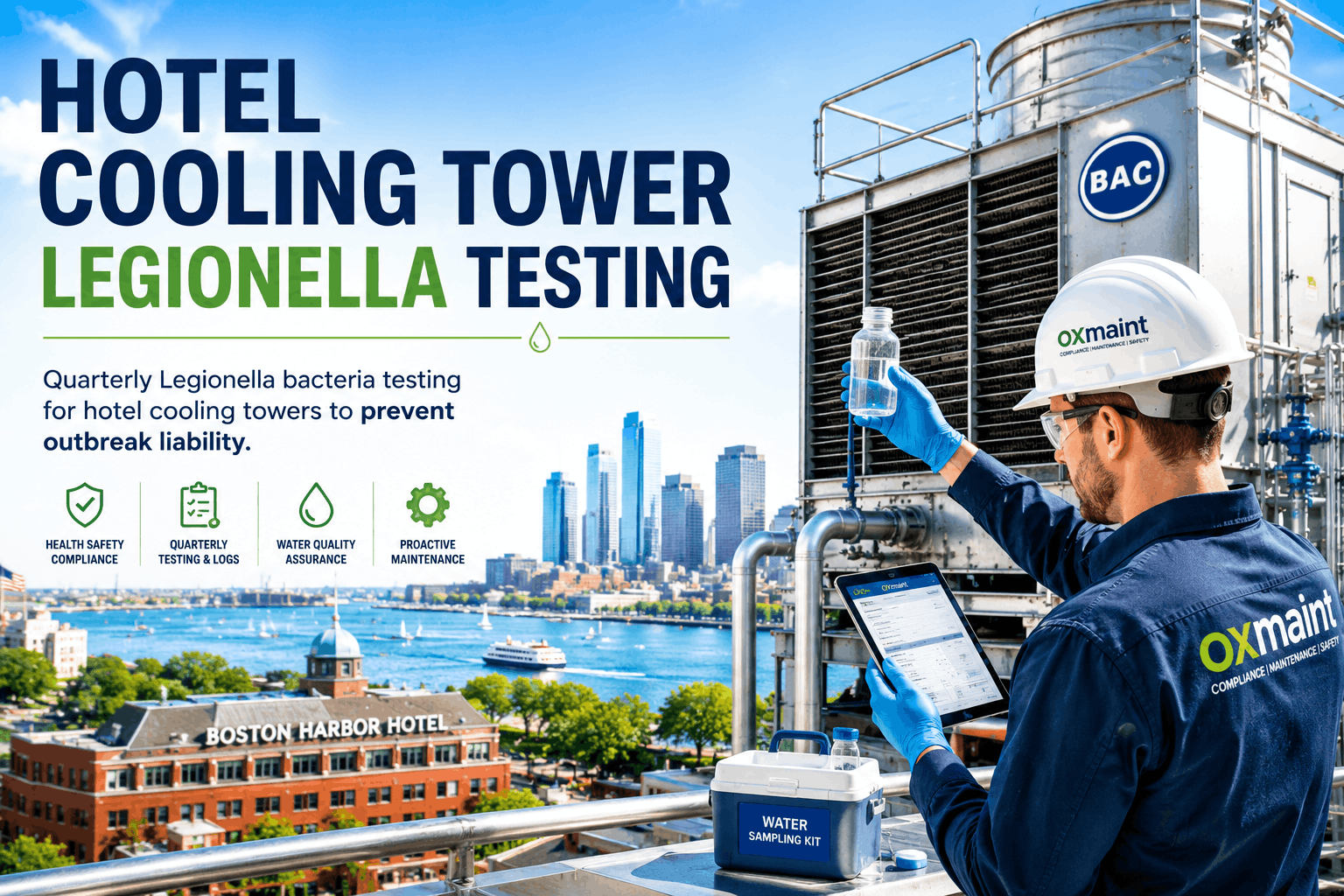
Generates aerosols that can carry Legionella across the property. The original 1976 outbreak was traced to a hotel cooling tower. Unmanaged towers with inadequate biocide treatment are the most significant outbreak source.
Operate at temperatures ideal for Legionella growth with constant aerosol generation and high bather loads that deplete disinfectant. Dead guests were linked to hotel spa Legionella colonisation in multiple UK cases.
Lobby and pool-area fountains create fine aerosols and warm stagnant water — a combination that supports Legionella biofilm without consistent biocide treatment and monitoring.
Rooms unoccupied for more than 7 days develop stagnant water in branch lines. Guest room showers, taps, and ice machine water lines in low-occupancy periods are persistent colonisation points that quarterly testing misses entirely.
Cold water stored above 68°F (20°C) supports Legionella growth. Tanks without lids, insulation failures, or proximity to heat sources create conditions where the cold feed into the hot water system becomes a secondary colonisation source.
OxMaint's Three Water Safety Modules — What Each One Does
Manual WMPs fail because monitoring is inconsistent, flushing schedules are forgotten during high occupancy, and documentation gaps are discovered during outbreak investigations rather than routine audits. OxMaint eliminates those gaps by automating every monitoring interval, flushing task, and documentation record from a single platform. Sign up free to activate all three modules for your property.
IoT sensors linked to OxMaint monitor hot water temperature at storage tanks, recirculation returns, and distal outlets continuously — not just at the scheduled check point. When temperature drops below 120°F at any recirculation return, an immediate alert fires and a corrective action work order is generated before the condition compounds. Every temperature reading is timestamped at the sensor level — tamper-evident records that satisfy ASHRAE 188 verification requirements and health department audit requests.
OxMaint generates weekly flushing work orders for every unoccupied guest room outlet — automatically, with occupancy data feeding from your PMS. When a room moves from occupied to extended vacancy, the flushing schedule activates within 7 days. Technicians complete the flush on mobile, confirm outlet temperatures post-flush, and close the work order with photo evidence. No flushing cycle falls through because of occupancy changes, shift handovers, or manual schedule management failures. Book a demo to see the PMS integration configured for your property.
OxMaint pre-loads all six water system zones as named assets with their ASHRAE 188 risk classifications, control measures, and monitoring schedules. The Risk Assessment dashboard shows current compliance status per zone — which systems are within control limits, which have open corrective actions, and which are approaching testing deadlines. Before a health department inspection or brand audit, one click exports the complete WMP documentation package covering every monitoring record, flushing log, and corrective action across the property. Sign up free to activate Risk Assessment Tools for your hotel.
Six Water System Zones — Monitoring Parameters and Intervals
Every hotel has between four and six distinct water system zones requiring individual Legionella risk assessment and monitoring programmes under ASHRAE 188. A WMP that manages domestic hot water without managing its cooling tower chemical programme — or monitors pool chemistry without monitoring decorative fountain biocide levels — is incomplete. All intervals below are auto-scheduled in OxMaint.
| Water System Zone | Control Parameter | Target Limit | Monitoring Interval | Culture Test Interval |
|---|---|---|---|---|
| Domestic Hot Water | Storage temp / Return temp | Store ≥140°F / Return ≥120°F | Every shift | When out-of-range or annually |
| Cold Water Storage | Storage temperature | ≤68°F throughout | Monthly | Annually or on indication |
| Cooling Tower | Biocide residual / Conductivity | Per treatment plan / Blowdown control | Daily biocide check / Weekly full test | Semi-annual (seasonal startup/shutdown) |
| Spa and Hot Tub | Free chlorine / pH / Temperature | 2–4 ppm Cl / pH 7.2–7.8 / ≤104°F | Daily (2–3 times per day in heavy use) | Quarterly (minimum ASHRAE 188) |
| Decorative Fountains | Biocide residual / Turbidity | Per treatment plan | Weekly biocide and turbidity | Monthly |
| Unoccupied Room Outlets | Flushing completion / Post-flush temp | ≥120°F after flush confirms return to range | Weekly flush — every outlet unoccupied >7 days | On indication or post-remediation |
Legionella Culture Test Action Levels — What to Do at Each Result
System is within acceptable limits. Continue scheduled monitoring programme. Review system conditions and document result against asset record. No corrective action required.
Investigate cause — temperature excursion, stagnation, biocide depletion. Implement enhanced biocide treatment, temperature adjustment, or targeted flushing. Re-test within 30 days. Do not wait for next scheduled test cycle.
Immediate response: hyperchlorination or thermal shock disinfection. Shut down aerosol-generating systems (cooling tower, spa) until remediated and re-tested. Notify health department. Review entire WMP for systemic failures.
Regional Compliance — What OxMaint Covers
| Region | Governing Standard | Key Requirements | OxMaint Output |
|---|---|---|---|
| USA / Canada | ASHRAE 188 / CDC WMP Toolkit / OSHA guidelines | WMP with all 6 zones, monitoring records, corrective action logs, annual review | ASHRAE 188-aligned zone monitoring records, corrective action chain documentation, annual WMP review package |
| United Kingdom | ACoP L8 (HSE) / HSG274 / COSHH Regulations | Written risk assessment, Responsible Person appointed, monitoring scheme, records retained 5 years | L8-aligned risk assessment documentation, monitoring logs with technician attribution, 5-year record archive per asset |
| Australia | AS 3666 / State health department WMP requirements | Cooling tower registration, WMP, monthly inspection reports, Legionella testing records | AS 3666-aligned inspection records, cooling tower registration documentation, monthly report exports |
| Germany | VDI 6023 / TrinkwV (Drinking Water Regulation) / DVGW guidelines | Legionella inspection every 3 years (large systems annually), hot water system records | VDI 6023-aligned inspection records, TrinkwV documentation packages, hot water system PM logs |
| Saudi Arabia / UAE | DEWA / SASO / Saudi MOH water safety guidelines | Water quality monitoring records, cooling system maintenance documentation, health authority reporting | DEWA-compliant water system records, cooling system maintenance logs, MOH reporting documentation |
A Documented WMP Costs $0 in Equipment. The Absence of One Costs Millions.
OxMaint gives hotel engineering teams the Water Temperature Monitoring, Flushing Schedule Automation, and Risk Assessment Tools that turn a legally expected programme into an automatically documented, audit-ready compliance system. Start free or book a 30-minute demo with our hospitality specialists.
Frequently Asked Questions
Is ASHRAE 188 legally required for hotels?
ASHRAE 188 is a voluntary consensus standard — it is not a federal regulation with direct enforcement authority over hotels. However, many US states and cities have adopted ASHRAE 188 into public health codes, making compliance legally mandatory in those jurisdictions. More significantly, in any Legionella outbreak litigation, ASHRAE 188 establishes the baseline expectation of care. A hotel without a WMP that follows ASHRAE 188 principles has no legal defence against a negligence claim following a guest Legionellosis diagnosis. In the UK, ACoP L8 carries similar legal standing under COSHH Regulations. Sign up free to build your ASHRAE 188-compliant WMP in OxMaint.
How often must hotel cooling towers be tested for Legionella?
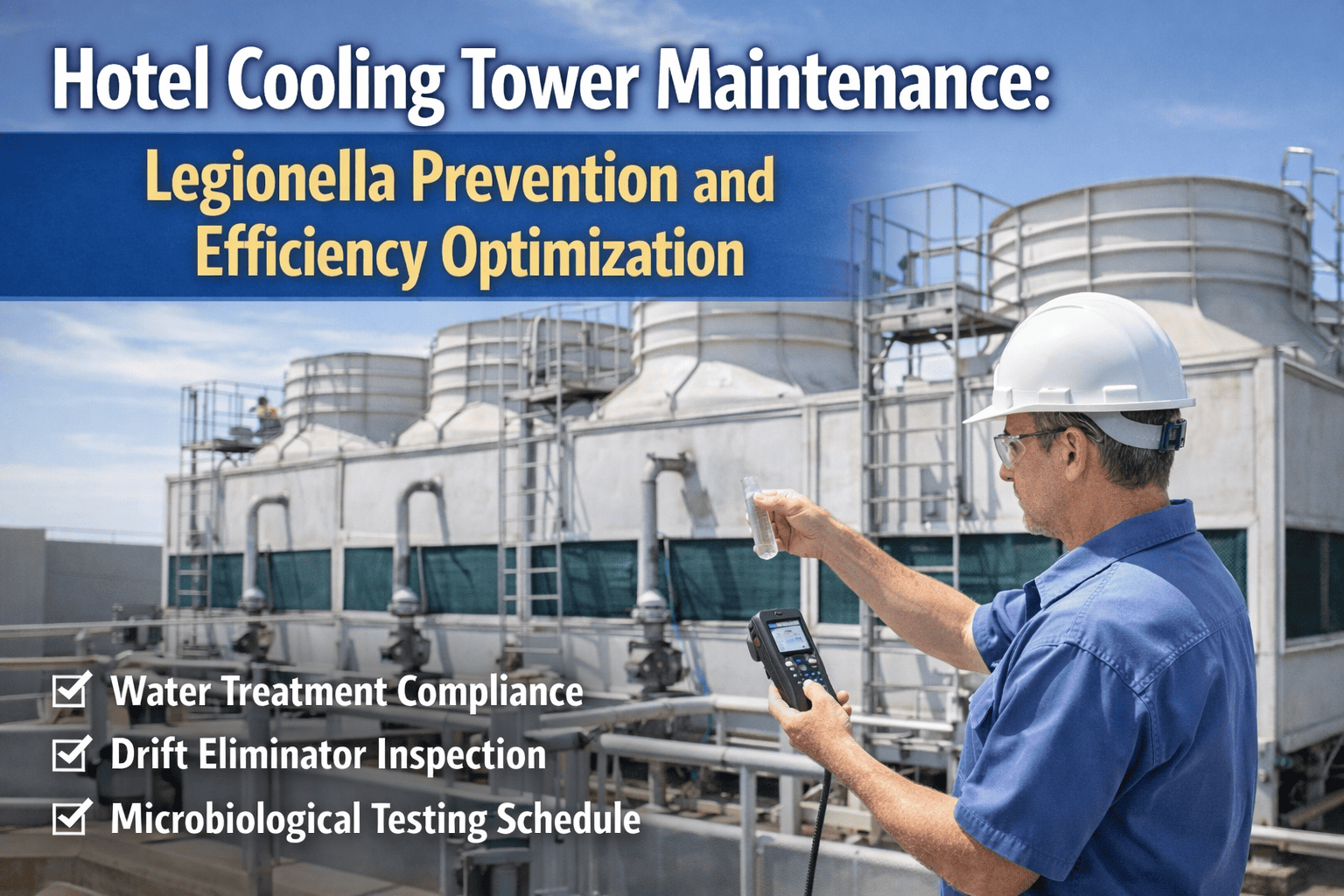
ASHRAE 188 requires semi-annual Legionella culture testing of cooling towers — at seasonal startup and at shutdown — plus testing after any system shutdown exceeding 7 days, after any maintenance that disrupts the water, and after any Legionellosis case associated with the building. OxMaint schedules all these testing triggers automatically — including the post-shutdown test that is most commonly missed. Book a demo to see cooling tower WMP configuration in OxMaint.
Why is weekly flushing of unoccupied rooms so important?
Rooms unoccupied for more than 7 days develop stagnant water in branch lines. Water temperature in these lines drifts into the 77–113°F Legionella growth range within days of the last use. Weekly flushing of all outlets — showers, basin taps — at sufficient flow to flush the entire branch back to the recirculation temperature eliminates this colonisation window. OxMaint generates these flushing work orders automatically, triggered by occupancy data from your PMS, with post-flush temperature confirmation required before the work order can close.
How does OxMaint handle a Legionella positive culture result?
When a culture result is entered against an asset in OxMaint, the system evaluates it against the ASHRAE 188 action levels — below 10 CFU/mL (monitor), 10–100 CFU/mL (corrective action and re-test within 30 days), above 100 CFU/mL (immediate remediation). At 10–100 CFU/mL, a corrective action work order is automatically generated and a re-test is scheduled. Above 100 CFU/mL, the emergency response chain is initiated with system shutdown work orders, remediation tasks, and a health notification evidence log — all timestamped and linked to the triggering result. Sign up free to configure action-level responses for your hotel's water system zones.