In 2015, a hotel rooftop cooling tower in New York City caused a Legionella outbreak that infected 138 people and killed 16. The tower had no documented water management program and no chemical treatment records. Every hotel with a cooling tower is now operating in a tightening regulatory environment — ASHRAE Standard 188 is referenced in brand audits, insurance underwriting, and litigation as the minimum defensible standard of care. Oxmaint tracks every water treatment test, every biocide addition, and every microbiological result so your Water Management Program is audit-ready 365 days a year.
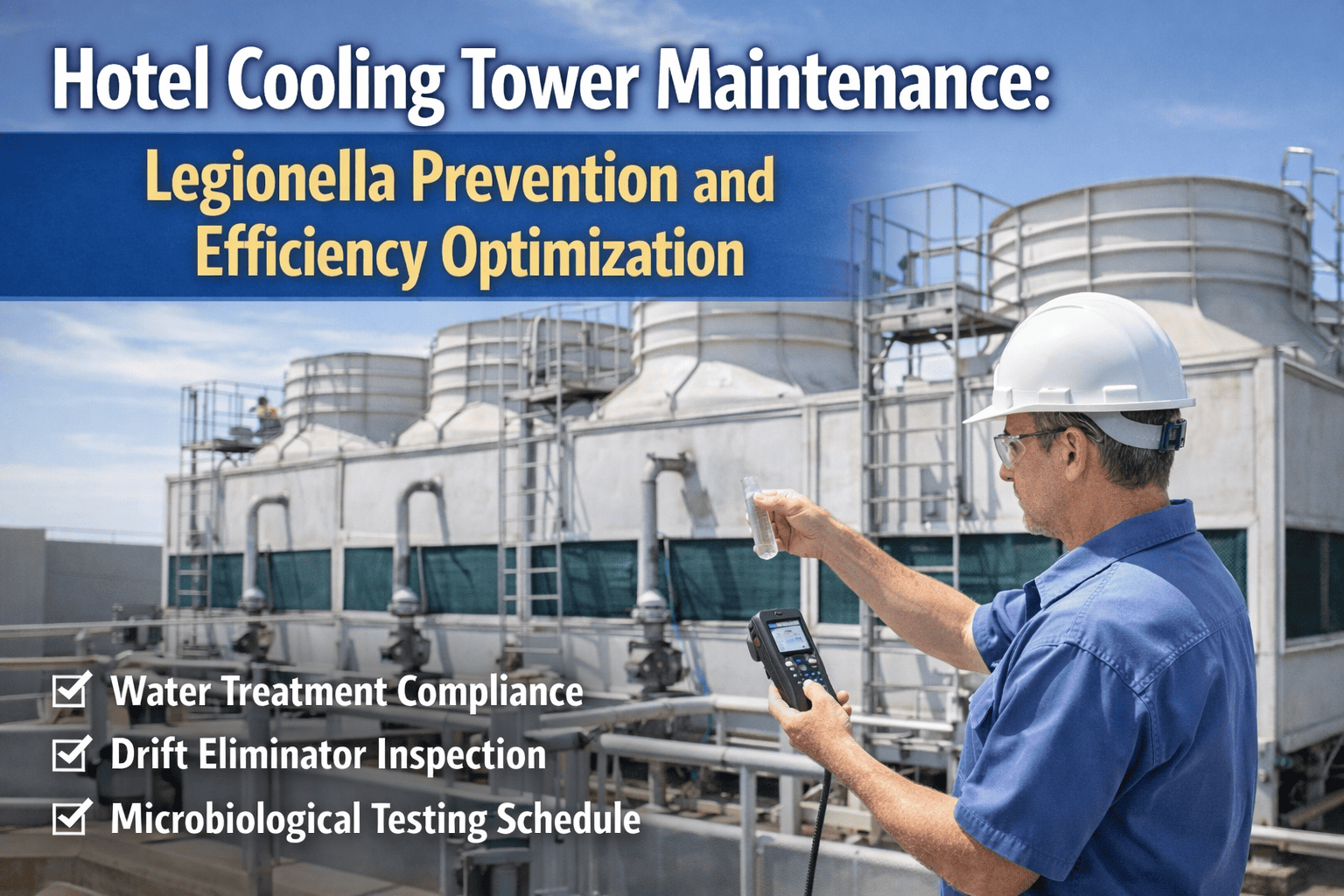
Hotel Cooling Tower Maintenance: Legionella Prevention and Efficiency Optimization
ASHRAE 188-compliant water management, microbiological testing schedules, drift eliminator inspection, and the digital documentation that keeps your property on the right side of every regulator and auditor.
Why Cooling Towers Are a P1 Compliance Priority
Legionella grows in water between 77°F and 108°F — the exact operating range of a cooling tower basin in summer. The bacteria is inhaled from the tower's drift plume, which can travel over a mile in urban conditions. Legal exposure from a confirmed outbreak traced to a hotel cooling tower routinely exceeds $1 million per affected individual. The annual cost of a compliant WMP, including chemical treatment and microbiological testing, is typically $8,000–$18,000 per tower. Sign up to load your ASHRAE 188 Water Management Program into Oxmaint.
Weekly and Monthly Cooling Tower Checklist
Every task must be documented with date, technician name, and result. An undocumented task is legally equivalent to a task never performed — for regulatory, insurance, and litigation purposes. Book a demo to see how Oxmaint automates task assignment and result logging.
Annual Cleaning, Disinfection, and Legionella Testing
Shut down fans, pumps, chemical feed. Drain completely. Apply lockout/tagout before any personnel entry. Residual basin water contains the highest biological load concentration of the operating cycle.
High-pressure wash all internal surfaces — basin, fill media, headers, eliminators, structural members. N95 respirator required during washing of fouled surfaces. Remove all sediment, scale, and biological fouling.
Refill and circulate at 5–10 ppm free chlorine at pH 7.0–8.0 for minimum 4 hours. Test residual at start, midpoint, and end. Any drop below 5 ppm requires re-dosing and restarting the hold period.
Submit sample to AIHA-LAP or NELAP accredited lab using ISO 11731 method. Field dip-slides do not satisfy ASHRAE 188. Confirm your jurisdiction's positive-result notification requirements before testing — not after. Book a demo for the positive-result workflow in Oxmaint.
Inspect fan blades, gear or belt drives, fill support structure, and eliminator frames. Photograph all findings and attach to the Oxmaint asset record. Structural failures during peak cooling load cannot be deferred.
File inspection reports with the local regulatory authority. Conduct the mandatory ASHRAE 188 annual WMP review — document date, participants, and all changes made. A WMP not reviewed in 12+ months is non-compliant regardless of its original content. Oxmaint tracks WMP review dates with automated alerts.
A NYC Department of Health inspector asked for 12 months of cooling tower water treatment records on the spot. Our chief engineer pulled the complete record from Oxmaint in under three minutes — every weekly biocide test, every monthly HPC result, the annual disinfection log, and both Legionella culture results. The inspector made no citations and left in 45 minutes. Before Oxmaint, that same request required locating and photocopying records from three binders across two locations — a two-hour process that assumed all the entries were actually there.