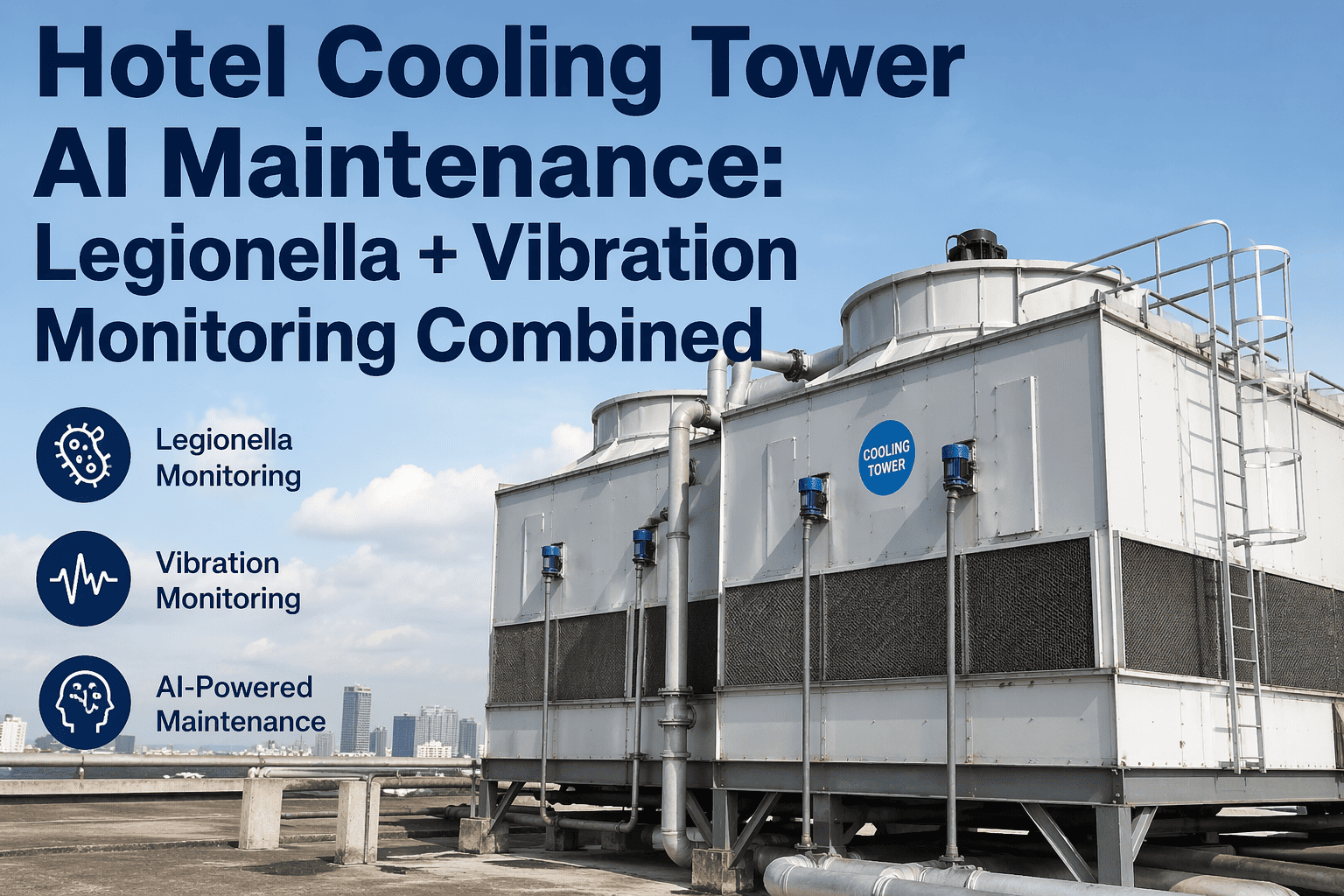
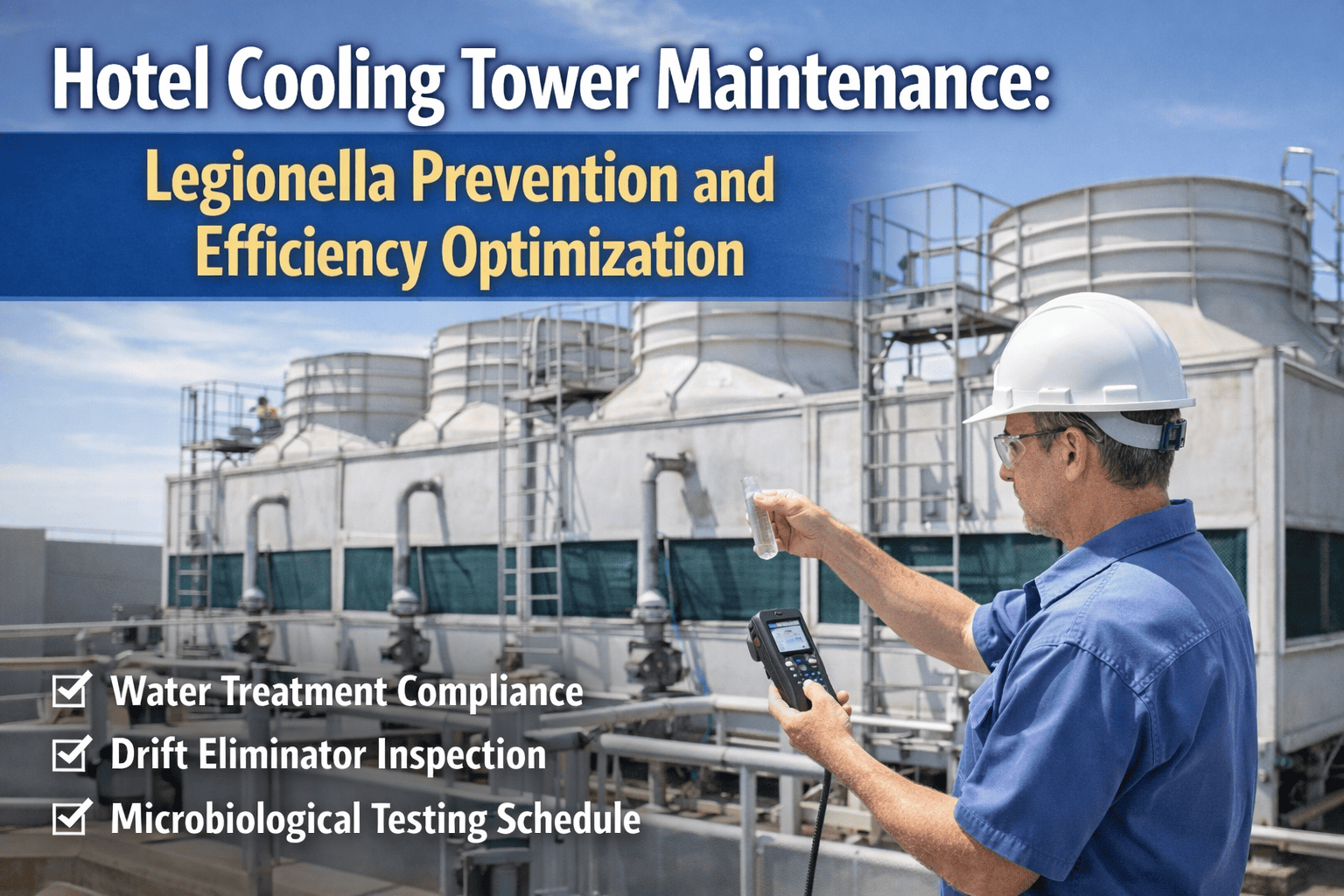
Hotel Cooling Tower AI Maintenance: Legionella + Vibration Monitoring Combined
By Mark Strong on April 22, 2026
A hotel cooling tower runs continuously, outdoors, in humidity and heat — and most properties inspect it once a month if they are lucky. Between those visits, fan bearings are wearing, biofilm is building, approach temperatures are drifting, and ORP levels that should be triggering a biocide dose are dropping silently. By the time a quarterly Legionella test returns a positive result, the problem is weeks old. AI-powered continuous monitoring changes that equation: sensors stream data every 30 seconds, machine learning detects the earliest signatures of degradation, and OxMaint converts the alert into a work order before the risk reaches a guest or a regulator. Book a demo to see OxMaint's cooling tower monitoring configured for your property.
Hotel Cooling Tower AI Monitoring
Legionella risk, fan vibration, and water quality — detected weeks before they become emergencies
21 days
Average lead time for AI to detect fan failure before functional breakdown occurs
$0.5–2.8M
Average financial exposure per Legionella outbreak — remediation, legal, and reputation
99.8%
Fan uptime achieved by facilities running continuous AI vibration monitoring
45%
Reduction in unplanned cooling tower maintenance costs after AI monitoring deployment
What Monthly Inspections Cannot See — and AI Can
Cooling tower degradation is continuous. It does not wait for inspection day. A fan bearing developing early-stage brinelling generates a detectable vibration harmonic 30–45 days before failure. An ORP level dropping below the biocide threshold creates Legionella growth conditions within 24–48 hours. A 5% approach temperature drift compounds silently over weeks, forcing the chiller to work harder every day. None of these signals appear on a monthly visual inspection. All of them are visible to a sensor sampling every 30 seconds and an AI model trained on cooling tower failure modes.
Calendar-Based Inspection
Monthly checks miss weeks of degradation
A bearing developing wear generates detectable vibration signals 30–45 days before failure. Monthly visual inspection catches nothing until the failure is imminent or complete.
ORP drops go undetected for days
Biocide depletion creates Legionella growth conditions within 24–48 hours. Weekly water chemistry checks leave a 6-day window where bacterial amplification can begin undetected.
Legionella test results arrive too late
Quarterly culture testing takes 7–14 days for results. By the time a positive is confirmed, contamination may be weeks old and already aerosolised across the property and surrounding area.
AI Continuous Monitoring
Vibration anomaly detected weeks early
Accelerometers on fan bearings sample continuously. AI detects the specific vibration harmonic of early bearing wear 21–45 days before failure — a planned bearing replacement replaces an emergency crane-and-shutdown event.
ORP drop triggers immediate work order
Continuous ORP monitoring detects biocide depletion the moment it occurs. OxMaint generates a P1 treatment work order automatically — the gap between "ORP normal" and "Legionella risk" is closed to minutes, not days.
Risk detected before testing confirms it
AI correlates thermal performance degradation with biological growth patterns. When approach temperature drops faster than scale alone explains and ORP is low, the system flags Legionella risk and triggers enhanced monitoring protocol — before any culture result is required.
AI Cooling Tower Monitoring — Live in Your Hotel in Under 2 Weeks
OxMaint connects vibration sensors, water chemistry probes, and temperature monitoring to an AI analytics engine that detects degradation weeks before failure. Every alert becomes a prioritised, ASHRAE 188-documented work order automatically. No proprietary hardware required — works with any standard industrial sensor.
Continuous ORP sensor · pH probe · Conductivity meter
AI detects:
ORP dropping below 300 mV — biocide depleted, Legionella growth conditions beginning. pH drift reducing biocide effectiveness before total depletion. Conductivity exceeding setpoint — scaling and corrosion risk rising simultaneously.
P1 treatment work order generated the moment ORP crosses threshold — compliance record created automatically for ASHRAE 188 audit trail.
Fan Failure
Vibration Analysis — Fan & Motor
Accelerometers on bearing housings · Motor current analyser · Temperature probe
AI detects:
Bearing wear vibration harmonic 21–45 days before seizure. Shaft misalignment signature — gearbox stress before tooth wear becomes visible. Fan blade imbalance pattern emerging from debris accumulation or physical damage. Motor current spike indicating electrical degradation.
Planned bearing replacement scheduled during low-occupancy window — replaces emergency crane access and unplanned shutdown costing $5,000–$15,000 per week.
Thermal Performance
Approach Temperature & Efficiency
Basin temperature sensor · Supply/return differential · Ambient wet-bulb reference
AI detects:
Approach temperature increasing faster than ambient conditions explain — fill fouling, scale on heat exchange surfaces, or biological growth degrading performance. A 5% effectiveness drop forces chiller to work 5–10% harder — compounding energy costs daily until the root cause is found.
Fill cleaning work order generated at the 5% degradation trigger — intervention at the optimal cost-benefit point, not after 15% performance loss forces emergency action.
Basin Integrity
Water Level & Make-Up Valve
Basin level sensor · Make-up valve position monitor · Flow meter
AI detects:
Make-up valve failure — level hunting pattern indicates valve not seating correctly, causing excessive water consumption. Unusual make-up water consumption spike indicating basin leak or overflow condition. Low-level shutdown risk before it triggers a dry-run pump failure.
Valve fault detected before the next manual inspection — eliminates the water waste and pump damage that a failed valve causes across the weeks between visits.
Compliance
Drift Eliminator & Blowdown
Blowdown flow meter · Cycles of concentration calculation · Drift monitoring
AI detects:
Cycles of concentration exceeding safe threshold — scaling and corrosion risk rising. Blowdown controller malfunction — chemistry drifting without the team noticing. Conductivity trends that indicate the water treatment program is not performing to specification.
Every blowdown event, chemical dose, and chemistry reading is timestamped and logged — exportable as an ASHRAE 188-compliant audit record in one click.
Energy Efficiency
Fan Speed & Power Draw
VFD data feed · Power meter · Fan amp draw
AI detects:
Fan running at excessive speed for ambient conditions — VFD control logic error or setpoint drift wasting energy. Amp draw rising above baseline for the same cooling load — fan mechanical inefficiency increasing running costs before the fault becomes visible. Energy waste visible in the monitoring data long before the utility bill.
VFD fault work order generated before the energy waste compounds — condition-based intervention replaces the calendar PM that would have missed the issue entirely.
Frequently Asked Questions
For bearing degradation, OxMaint's AI typically detects the distinctive vibration harmonic of early bearing wear 30–45 days before functional failure occurs. For other failure modes — shaft misalignment, blade imbalance, motor electrical faults — detection typically occurs 21–30 days before failure. This lead time is enough to order parts, schedule a maintenance window during low-occupancy, and avoid the emergency crane access and unplanned shutdown that characterise reactive bearing replacements.
No — and it is not designed to. Mandatory Legionella culture testing per ASHRAE 188, NYC Local Law 77, and CMS requirements cannot be replaced by sensor monitoring. What AI monitoring does is provide early warning that creates risk conditions for bacterial growth — ORP dropping, thermal performance degrading, conductivity exceeding setpoints — so the engineering team can intervene and trigger enhanced testing before a positive culture result confirms a problem that is already weeks old. AI monitoring and scheduled culture testing work together, not as alternatives.
OxMaint integrates with standard industrial sensors from any manufacturer — accelerometers for vibration, ORP and pH probes for water chemistry, temperature sensors, conductivity meters, and flow meters. OxMaint does not supply hardware but will specify compatible sensor types for your tower configuration. If your BMS already collects cooling tower data, OxMaint can pull from that existing infrastructure via API without additional hardware. A connectivity assessment at demo stage identifies which parameters you already have covered and where gaps exist.
Every sensor reading, threshold breach, work order, chemical treatment event, and closure is timestamped and attributed to the technician in OxMaint's compliance record. When a regulator, insurer, or brand auditor requests documentation, the complete ASHRAE 188 Water Management Program evidence — monitoring logs, corrective actions, testing schedules, and inspection records — is exported from OxMaint as a single audit package. No manual assembly, no spreadsheet reconciliation, no gaps from missed paper log entries.
OxMaint requires 30 days of operating data to establish reliable baselines for each cooling tower. During this period the system observes performance across varying load conditions — peak summer occupancy, overnight reduced load, and shoulder-season partial cooling — to build an accurate normal operating profile. Physics-based fault detection (ORP threshold breaches, temperature exceedances, conductivity alarms) activates immediately from day one, before AI model training is complete.
Yes. OxMaint registers each cooling tower, chiller, pump, and AHU as a separate asset with its own sensor feeds, baselines, and alert thresholds. A central portfolio dashboard shows health status, open alerts, and compliance record currency across all towers and all properties simultaneously — with site-specific alerts routed to the engineering team at each location and portfolio-level KPIs visible to engineering leadership.
Stop Waiting for Legionella Tests and Bearing Failures to Tell You About Your Cooling Tower
OxMaint's AI monitoring detects fan bearing wear 21–45 days before failure, flags Legionella risk conditions the moment ORP drops, and maintains a complete ASHRAE 188-compliant audit trail — automatically. Every alert converts to a prioritised work order with full sensor context attached. No proprietary hardware. Live in under 2 weeks.