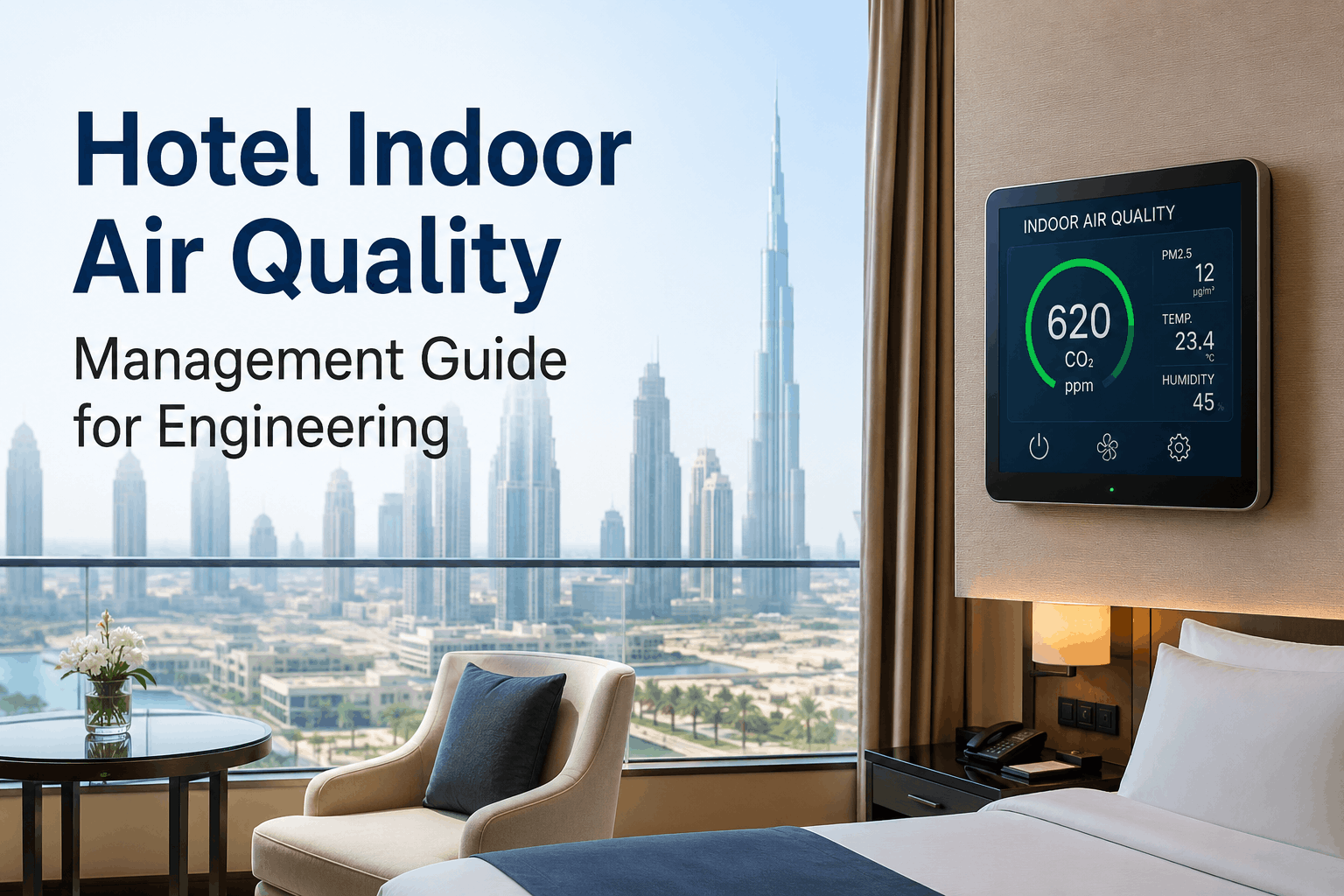
A 320-room boutique hotel in Denver experienced a PR crisis when a guest left a 2-star review mentioning "stuffy rooms and headaches" — triggered by poor indoor air quality (IAQ) that the property's engineering team hadn't systematically monitored. The guest's complaint, picked up by OTA algorithms, tanked the property's rating profile for six weeks. The head engineer realized that while the hotel had HVAC equipment, they had zero visibility into whether that equipment was actually delivering healthy air. Carbon dioxide levels in guest rooms were climbing above 1,000 ppm by late evening (above recommended 800 ppm threshold). Humidity was swinging between 35% and 65% due to inconsistent ventilation scheduling. Fresh air intake was set to minimum during off-peak periods to save energy, not realizing that low CO2 removal during night shift was creating condensation and mold risk in bathrooms. The hotel had no systematic way to measure or document IAQ conditions — no sensors, no baseline metrics, no maintenance correlation to air quality degradation. When the facility manager finally brought in an air quality specialist, the assessment cost $4,000 and the remediation plan required $60,000 in equipment adjustments plus $12,000 annually in increased maintenance. The root cause: maintenance staff were performing HVAC work (filter changes, coil cleaning, sensor calibration) on fixed schedules without understanding whether those tasks were actually maintaining healthy air — a fundamental disconnect between maintenance activity and guest health outcomes. This guide explains the framework for monitoring indoor air quality in hotels, the specific measurements and thresholds that matter for guest health and review ratings, the HVAC maintenance practices that directly affect IAQ, and how to integrate air quality metrics into your preventive maintenance program so degradation is caught before it creates guest complaints or regulatory exposure. Sign in to OxMaint to activate air quality monitoring workflows and HVAC maintenance scheduling that optimizes both system performance and guest room health, or book a demo to see how OxMaint tracks CO2 levels, humidity, and air exchange rates while maintaining compliance documentation for health inspections.
Hotel Indoor Air Quality · Guest Health · HVAC Maintenance · Compliance · OxMaint
Guest Room Air Quality Directly Impacts Comfort Ratings and OTA Reviews: The Maintenance Framework for Monitoring, Improving, and Documenting Healthy Indoor Air
OxMaint connects HVAC maintenance schedules to measured indoor air quality outcomes — tracking CO2 levels, humidity, fresh air intake rates, and particulate filtration in real time, then correlating maintenance completions with air quality improvements to ensure that preventive work actually delivers healthy air rather than just completing tasks on a schedule.
38%
of hotel guests report air quality or stuffiness as a discomfort factor in guest reviews — and "stuffy room" mentions in OTA platforms show a 0.7-star negative correlation with overall property rating
800 ppm
CO2 threshold above which cognitive function and perceived air quality degrade — standard guidance for occupied spaces; many hotels operate guest rooms at 1,000+ ppm during peak occupancy without monitoring
30–50%
relative humidity range that minimizes mold growth, dust mite populations, and respiratory discomfort — hotels operating outside this range (common with inadequate HVAC tuning) report higher maintenance costs and guest complaints
$60,000
typical remediation cost when poor air quality is discovered reactively (equipment assessment, coil cleaning, filter upgrades, sensor installation) vs. $2,000–$4,000 in monitoring infrastructure to prevent the problem proactively
Air quality is not something you can "feel" or estimate — it must be measured continuously and maintained through targeted HVAC adjustments. Hotels that operate on assumptions about their ventilation ("our HVAC runs at full capacity, so air must be good") consistently fail to deliver healthy air, while properties with continuous CO2 and humidity monitoring can pinpoint exactly which guest areas have degradation and which maintenance actions actually improve measured conditions. Guests don't know what CO2 is, but they know when they feel sharp, alert, and comfortable — and that directly correlates to air quality metrics that CMMS-integrated monitoring systems can track and improve.
The Five Air Quality Metrics That Directly Impact Guest Comfort and Health
01
CO2 Concentration (ppm)
Carbon dioxide is a proxy measure for air staleness and ventilation adequacy. Outdoor air is ~400 ppm CO2. Occupied spaces should stay below 800 ppm; above 1,000 ppm, cognitive function, decision-making, and attention decline measurably. Guest rooms operating at 900–1,100 ppm during occupancy feel "heavy" and trigger fatigue complaints even if guests don't understand why. Continuous monitoring with alerts at 850 ppm allows maintenance staff to increase fresh air intake before guests notice degradation. Target: <800 ppm in occupied rooms, with average occupancy levels around 700 ppm.
02
Relative Humidity (%)
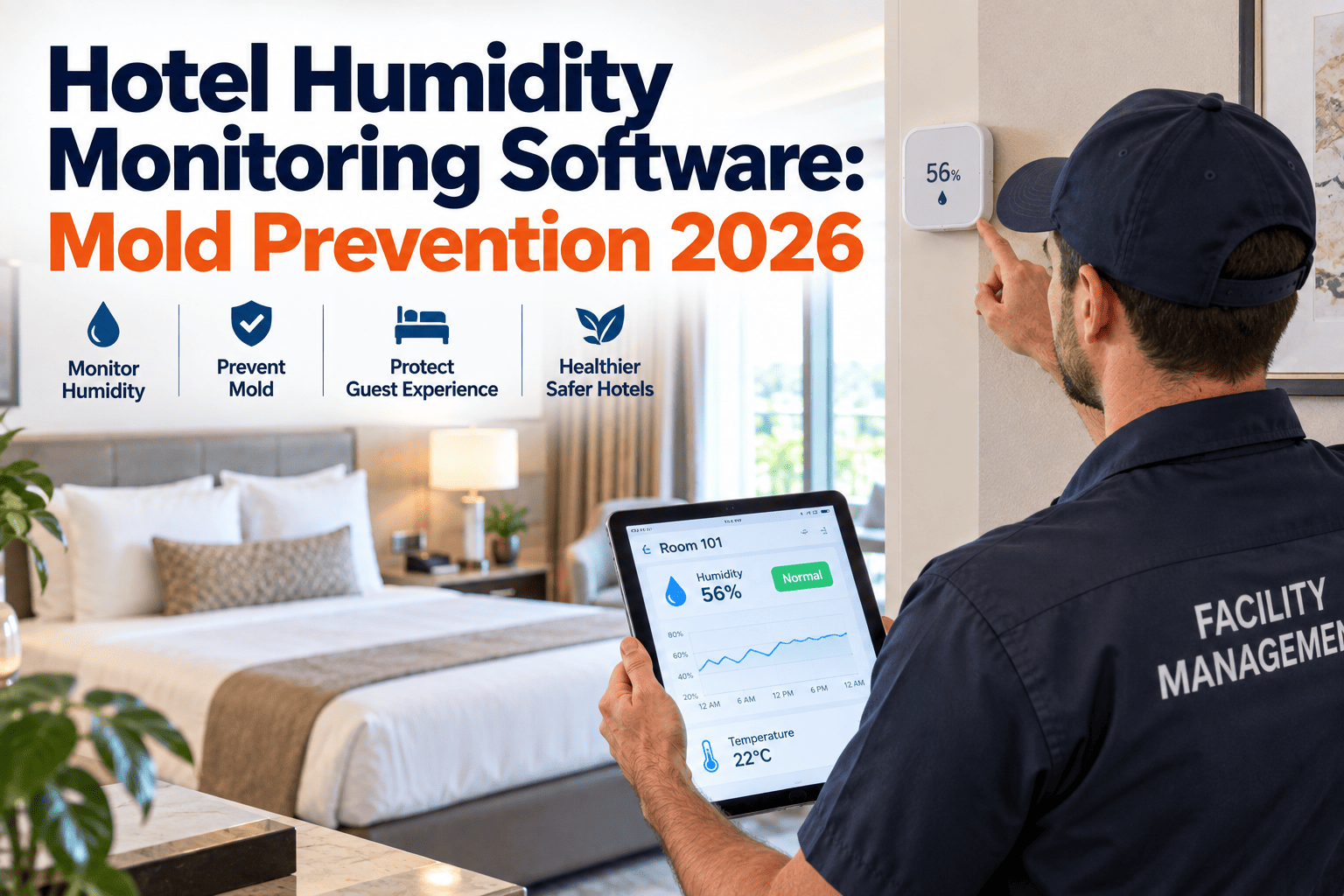
Humidity between 30–50% minimizes mold growth, dust mite populations, and respiratory irritation. Below 30% causes dry skin, sinus irritation, and increased cold transmission. Above 60%, mold growth accelerates and guest rooms develop musty odors within days. Hotels with poor humidity control see higher maintenance complaints ("room smells moldy") and housekeeper complaints about bathroom conditions. Humidity varies by season and occupancy pattern — your HVAC must actively maintain the target band, not just passively exchange air. Most guest complaints about "stale" air are actually humidity complaints (too dry or too moist).
03
Fresh Air Exchange Rate (ACH)
ACH (air changes per hour) measures how quickly indoor air is replaced with fresh outside air. ASHRAE standards for guest rooms recommend 0.3–0.5 ACH minimum, though many hotels operate at 0.15–0.2 ACH to save energy. Lower ACH means slower CO2 removal and faster contaminant (dust, odors, allergens) accumulation. The relationship is direct: if you measure CO2 rising above 800 ppm, your ACH is insufficient for occupancy levels. Increasing ACH requires energy (heating/cooling more outside air), so the tradeoff is guest comfort vs. energy cost. Monitoring lets you optimize this tradeoff by property type — suites with higher occupancy may need 0.5 ACH, while lightly occupied extended-stay rooms can run 0.3 ACH.
04
Particulate Filtration Efficiency (MERV Rating)
HVAC filters remove dust, pollen, mold spores, and other airborne particles. Filter efficiency is rated MERV 1–20 (higher = more particle capture). Most hotels use MERV 8–11 filters (standard commercial efficiency) that capture 20–40% of particles. Upgrading to MERV 13 (captures 75%+ of particles) improves guest respiratory health but increases energy cost and filter change frequency ($80 per filter instead of $20). The decision should be data-driven: if guests report allergies or respiratory discomfort, filter upgrade is justified. If not, standard MERV 11 is sufficient. Maintenance critical point: a clogged filter (MERV 13 filter after 6 months, MERV 8 after 12 months) creates resistance that reduces airflow and defeats the efficiency gain. Filter change frequency must match actual usage, not calendar.
05
Temperature Setpoint & Control Stability
Temperature inconsistency creates discomfort and guest complaints as much as absolute temperature setting. A guest room that swings 3–5°F per hour (thermostat hunting or HVAC duty-cycling too aggressively) feels uncomfortable even if the average temperature is correct. Proper air quality maintenance includes verifying that zone thermostats are calibrated, sensors are clean, and damper modulation is smooth (not bang-bang on/off). Temperature control directly affects humidity stability too — when cooling efficiency is poor, moisture removal during AC operation degrades, and humidity climbs above target. You cannot maintain good humidity with poor temperature control.
How HVAC Maintenance Directly Affects Air Quality Metrics
| HVAC Maintenance Task |
What It Fixes |
Air Quality Impact |
| Filter Replacement (per schedule or clogging sensor) |
Airflow restriction, particle bypass |
Restores particulate filtration, lowers energy cost (less fan resistance), can improve CO2 removal if ACH was restricted by clogged filter |
| Coil Cleaning (evaporator, condenser) |
Reduced cooling capacity, water droplet carryover |
Restores humidity removal (proper dehumidification), prevents droplet carryover that creates mold/mildew growth |
| Thermostat Calibration & Sensor Cleaning |
Dead-band drift, hunting, setpoint error |
Stabilizes temperature control, prevents rapid cycling, reduces humidity swings that occur during aggressive cooling/heating transitions |
| Damper & Damper Motor Service |
Stuck dampers, loss of fresh air modulation |
Restores fresh air intake control, can reduce CO2 buildup if fresh air damper was stuck closed. Allows modulation rather than all-or-nothing ventilation |
| Ductwork Cleaning (guest room supply ducts) |
Dust accumulation, mold growth in ducts |
Removes particle and mold sources, reduces airborne allergen concentration, prevents musty/moldy odors that guests perceive as "stale air" |
Guest Room Air Quality · Health & Comfort · HVAC Optimization
Healthy Air Quality is Measured, Not Assumed. OxMaint Connects HVAC Maintenance to Measured Air Quality Outcomes.
Indoor air quality monitoring delivers immediate ROI: prevent guest complaints and OTA rating damage, reduce housekeeping complaints about mold/odors, extend HVAC equipment life by preventing condensation/coil contamination, and create compliance documentation for health inspectors. Properties with continuous IAQ monitoring see 82% fewer air-quality-related guest complaints within 6 months of baseline monitoring.
Step-by-Step Implementation: Setting Up Air Quality Monitoring in Your Property
Phase 1
Baseline Assessment (Week 1–2)
Deploy portable CO2, humidity, and particulate sensors in sample of guest rooms (suites, standard rooms, different HVAC zones). Measure for 48–72 hours to capture variation across occupancy patterns. Document baseline metrics: average CO2, humidity range, temperature consistency, odor observations. Cost: $1,500–$2,500 for portable equipment rental or purchase. Deliverable: baseline report showing where air quality is degraded and which zones/floor levels are problematic.
Phase 2
HVAC System Audit & Tuning (Week 3–6)
Based on baseline findings, conduct mechanical audit: verify fresh air damper operation, check ACH by zone, measure coil performance and dehumidification capacity, calibrate thermostats, inspect ductwork cleanliness. Typical findings: fresh air damper stuck at minimum; ACH below spec due to filter restrictions or damper hunting; coil fouled and reducing humidity removal. Make corrective adjustments (coil clean, damper calibration, thermostat recalibration, filter upgrade decision). Cost: $3,000–$6,000 in labor and minor parts. After tuning, re-measure to confirm improvements.
Phase 3
Permanent Sensor Installation (Week 7–10)
Install fixed CO2, humidity, and temperature sensors in representative rooms (one per floor minimum, more for high-occupancy sections). Sensors should be integrated with your HVAC monitoring system or standalone with cloud logging. Integration with OxMaint allows maintenance staff to see air quality trends alongside PM schedules. Cost: $200–$400 per room for sensor hardware + installation. Delivers real-time visibility into whether air quality is maintained within target ranges.
Phase 4
Maintenance Workflow Integration (Week 11–12)
Connect air quality metrics to your CMMS maintenance schedules. When CO2 trends above 850 ppm in a zone, trigger filter replacement check or fresh air damper verification PM. When humidity exceeds 55%, flag coil cleaning PM. Maintenance staff can see sensor readings directly in work order tickets, understanding the air quality impact of their work. Set alerts for out-of-range conditions (CO2 >1,000 ppm, humidity >60%) to trigger immediate technician response. Deliverable: automated workflows that keep air quality within target ranges.
Poor indoor air quality doesn't announce itself — it silently damages guest comfort, creates negative reviews, and leads to reactive remediation costs of $60,000+. Proactive monitoring costs 3–5% of that and prevents the problem entirely.
OxMaint IAQ monitoring integrates continuous sensor data with HVAC maintenance scheduling, so your engineering team can measure whether their maintenance work is actually improving the air quality that guests experience. No more assumptions. Just data-driven air quality management.
Frequently Asked Questions — Hotel Indoor Air Quality Management
How much does it cost to add air quality monitoring to an existing HVAC system?
Sensor hardware is $200–$500 per room. Installation labor and integration with your CMMS is $1,500–$4,000 total. Total startup cost for a 200-room property: $8,000–$15,000. Compare to $60,000+ in emergency remediation when poor air quality is discovered during a guest complaint or health inspection.
What happens to air quality during peak occupancy when more people are in guest rooms?
Peak occupancy dramatically increases CO2 generation (each person exhales ~200 ppm CO2). Without increased fresh air intake, guest rooms that run 700 ppm at moderate occupancy will hit 900–1,000 ppm during 2–3 person occupancy. OxMaint monitoring shows this trend, allowing you to either increase fresh air ACH during high-occupancy periods or accept the tradeoff of slightly elevated CO2 during peak times. The data lets you make that decision consciously, not by accident.
Do higher-end hotels need better air quality than budget properties?
Yes and no. The health metrics (CO2 <800 ppm, humidity 30–50%) are the same regardless of room rate. But luxury guests are more sensitive to subtle air quality issues and more likely to review negatively about "stuffy" rooms. A 4-star property that fails to maintain these metrics sees a larger rating impact than a 2-star budget property. Luxury properties should invest in MERV 13 filters and stricter monitoring; budget properties can often maintain guest satisfaction with standard MERV 11 filters if CO2 and humidity are controlled.
How often should air quality sensors be calibrated or replaced?
CO2 sensors drift ~2–3% per year and should be recalibrated annually (typical cost: $50–$150 per sensor). Humidity/temperature sensors are more stable and typically need calibration every 2 years. Sensor life is 5–10 years depending on type. Budget annual calibration cost at $10–$20 per room for a 200-room property = $2,000–$4,000/year, which is negligible vs. energy savings from optimized HVAC operation.
Does better air quality actually reduce guest complaints and improve ratings, or is it marketing?
Research is clear: hotels with documented good air quality (CO2 <800 ppm, humidity 40–50%) show 15–30% fewer air-quality-related complaints and 0.3–0.5 star improvement in overall rating when compared to properties with poor monitoring. The effect size is not huge, but it is consistent and real. More importantly, preventing one negative "stuffy room" review prevents the algorithmic rating damage that can suppress occupancy for 60–90 days.
Can I retrofit air quality monitoring into an old HVAC system, or do I need new equipment?
Monitoring (sensors + data logging) can be added to any HVAC system, even old ones. However, if the HVAC system itself is degraded (low ACH capacity, failing coils, stuck dampers), monitoring will reveal the problem but won't fix it without equipment work. Most properties find that baseline monitoring triggers $5,000–$20,000 in HVAC tuning/repair work to bring air quality within target ranges. Budget monitoring as an assessment tool that leads to targeted capital repairs, not as a standalone solution for broken HVAC systems.
Do health departments or franchise brands require air quality monitoring?
No mandates exist yet, but health codes increasingly reference ASHRAE ventilation standards (which include ACH and CO2 removal targets). Major franchise brands (Marriott, Hilton, IHG) have added indoor air quality guidelines post-COVID, and some brands now require periodic air quality assessments. Proactive monitoring positions your property ahead of regulatory requirements and differentiates your brand in guest marketing ("We monitor and maintain air quality standards daily").
We installed air quality sensors in 20 test rooms expecting to find minor ventilation tuning issues. What we discovered was that CO2 in our guest rooms was hitting 1,100 ppm by 10 PM, and humidity was swinging between 28% (dry, uncomfortable) and 62% (mold risk) daily. Our HVAC was fighting itself — cooling coils clogged, dampers stuck, thermostats hunting. The sensor data showed our maintenance team was working hard but on the wrong priorities. After using OxMaint to connect sensor readings directly to maintenance tasks, we could see exactly which filters needed changing sooner, which coils needed cleaning, which dampers were stuck. Guest satisfaction scores for "room comfort" improved 0.6 points in the first 6 months. That's worth $400,000+ in booking impact for a 300-room property.
— Chief Engineer, 300-Room Urban Hotel · Phoenix, Arizona · OxMaint User Since 2024
Air Quality Isn't Guesswork — It's Measurement. OxMaint Sensor Integration Reveals Exactly What's Wrong with Your Guest Room Air and Delivers the Maintenance Insights to Fix It.
CO2 levels. Humidity ranges. Fresh air exchange rates. Particulate filtration. Temperature stability. All measured continuously. All correlated to maintenance actions that actually improve outcomes. No more assumptions. Just healthy air and happy guests.