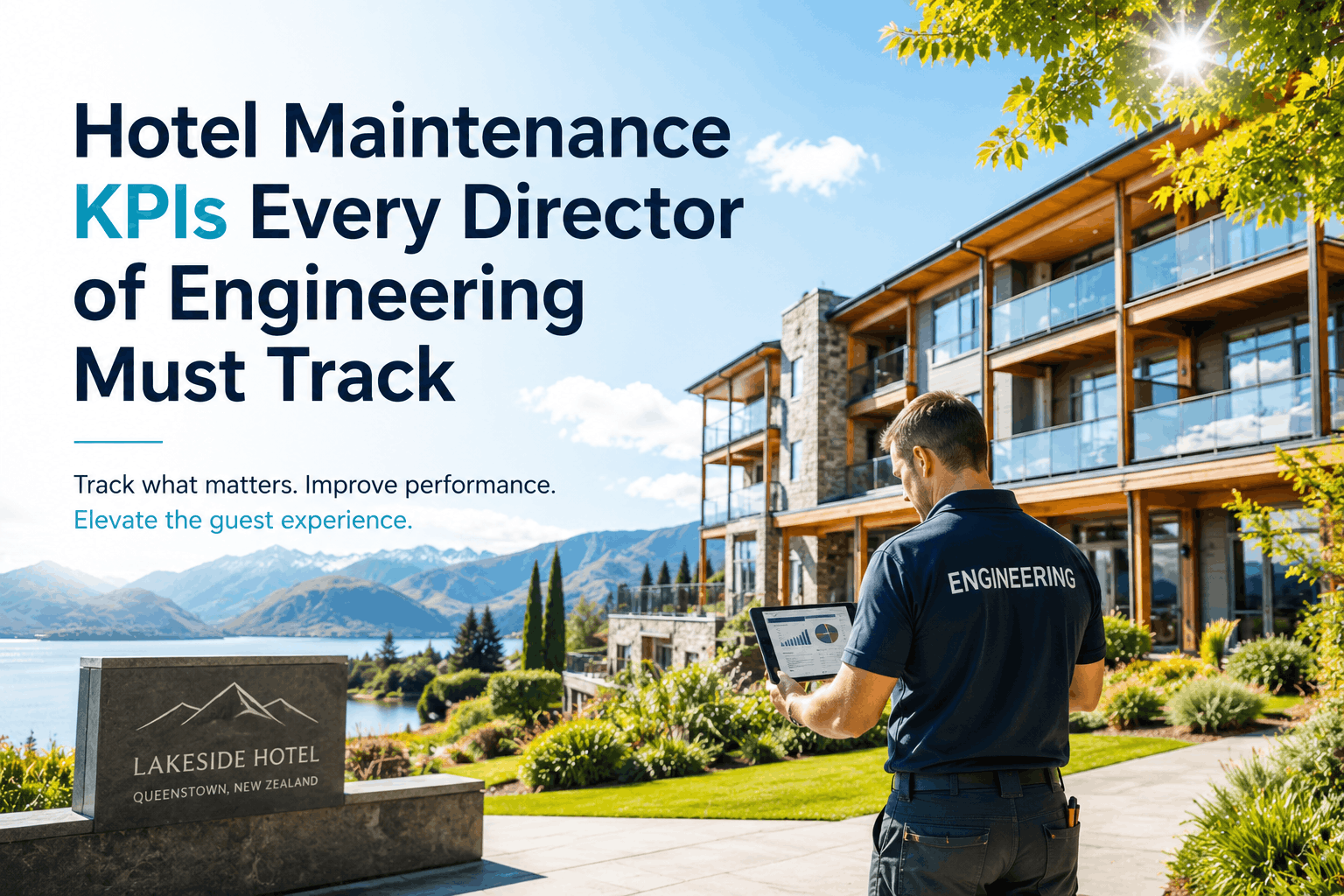
Hotel Maintenance KPIs Every Director of Engineering Must Track
By Alex Jordan on June 12, 2026
The average Director of Engineering tracks 3–5 maintenance metrics — mostly work order counts and MTTR. But work order volume doesn't tell you if your team is effective. MTTR doesn't measure guest impact. And neither metric predicts equipment failure or capital planning needs. The 12 KPIs below move beyond operational trivia to strategic performance measurement — connecting maintenance activity to guest satisfaction, asset longevity, and financial performance. OxMaint's engineering dashboard tracks all 12 KPIs automatically, benchmarked against industry standards and presented in real-time for weekly engineering reviews and monthly owner reports.
HOTEL ENGINEERING · KPI DASHBOARD · 2026
Hotel Maintenance KPIs Every Director of Engineering Must Track
PM compliance, guest complaint rate, response time, cost per occupied room, equipment uptime, asset health score, backlog management — the essential engineering metrics that drive performance and prove value to ownership.
Preventive maintenance is the foundation of engineering effectiveness — but only if you measure it. PM compliance percentage tells you whether scheduled work is actually happening. PM on-time percentage adds a timeliness dimension. Properties that track both consistently outperform those that track neither. OxMaint's PM dashboard shows compliance by asset category, technician, and property — so you can identify where PM is falling behind before it becomes an equipment failure.
KPI 1: PM Compliance %
Foundation
Formula: (PM work orders completed on schedule ÷ Total PM work orders due) × 100. Target: ≥85%. Below 70% indicates systemic PM failure — emergency repairs will increase within 6 months.
KPI 2: PM On-Time %
Timeliness
Formula: (PM work orders completed within SLA window ÷ Total PM work orders) × 100. Target: ≥90% within 7 days of due date. Measures scheduling effectiveness, not just completion.
KPI 3: PM vs. Corrective Ratio
Balance
Formula: (Total PM labor hours ÷ Total maintenance labor hours) × 100. Target: 60–70% PM, 30–40% corrective. Below 50% PM indicates reactive culture — emergency costs will be elevated.
KPI 4: PM Aging
Backlog
Percentage of PM work orders overdue by >30 days. Target: <5%. PM aging over 10% predicts equipment failures within 12 months. Review weekly to catch slippage early.
KPI Category 2: Guest-Facing Performance
Guest satisfaction with maintenance is the ultimate measure of engineering effectiveness — yet most departments track only "work orders completed." Response time and guest complaint rate are better indicators of guest experience. OxMaint's guest satisfaction module integrates with your PMS to correlate maintenance response times with guest survey scores — proving the revenue impact of engineering performance.
Guest-Facing KPIs — What Guests Actually Notice
KPI 5: Guest Complaint Rate
FormulaMaintenance-related guest complaints ÷ Total occupied room nights × 1,000
Target: <2 per 1,000 room nights
KPI 6: Response Time (Minutes)
FormulaTime from work order creation to technician acknowledgment
Target: <15 minutes for P1/P2; <4 hours for P3
KPI 7: First-Time Fix Rate
FormulaWork orders requiring one visit ÷ Total completed work orders × 100
Target: ≥75% for guest room requests
KPI 8: Guest Satisfaction Score
FormulaAverage rating of "Maintenance responsiveness" from post-stay surveys
Target: ≥4.5/5
KPI Category 3: Operational Efficiency
Engineering efficiency metrics measure resource utilization and cost control. These are the numbers that appear in monthly owner reports and annual budget reviews. OxMaint's efficiency dashboard tracks technician productivity, cost per work order, and overtime percentage — benchmarking your department against industry standards and your own historical performance.
Operational Efficiency KPIs — What Owners Track
K9
Cost per Work Order
Formula: Total maintenance spend (labor + parts + contractors) ÷ Total work orders completed. Target: Varies by property class. Track trend — increasing cost without volume change indicates inefficiency.
K10
Cost per Occupied Room (CPOR)
Formula: Total maintenance operating spend ÷ Total occupied room nights. Industry benchmark: $1.50–3.50 depending on property class. Critical metric for ownership reporting and budget justification.
K11
Technician Utilization %
Formula: Billable/maintenance hours ÷ Total paid hours × 100. Target: 65–75% (remaining time is training, meetings, breaks, travel). Below 60% indicates under-scheduling or inefficient routing.
K12
Overtime Percentage
Formula: Overtime hours ÷ Total paid hours × 100. Target: <5% for planned operations. Above 10% indicates understaffing or poor scheduling — review emergency volume and PM backlog.
Advanced KPIs: Asset Health & Capital Planning
The KPIs above measure current operations. The metrics below predict future performance — equipment failure risk, capital replacement timing, and deferred maintenance accumulation. Directors of Engineering who track asset health KPIs never get surprised by a chiller failure in July. OxMaint's asset health module calculates equipment health scores automatically from repair frequency, parts consumption, and age data — generating replacement forecasts that feed directly into capital planning.
A1
Asset Health Score
Weighted score based on: age (30%), repair frequency (40%), parts availability (15%), energy efficiency (15%). Scale 0–100. Target: >80 for critical assets. Any asset <60 requires replacement planning.
Predicts failure 6–12 months out
A2
Mean Time Between Failures (MTBF)
Average operating hours between asset failures. Trend declining over 12 months = accelerated deterioration requiring capital intervention. Critical for laundry, HVAC, and elevator assets.
Tracks deterioration rate
A3
Deferred Maintenance Backlog ($)
Estimated cost of all overdue maintenance and capital replacements. Target: <5% of replacement value. >15% triggers ownership concern and impacts property valuation.
Quarterly ownership metric
A4
Capital Reserve Adequacy
(Current reserves ÷ Required reserves for 10-year plan) × 100. Target: ≥80%. Below 50% = significant capital shortfall — deferred maintenance will accelerate.
Annual board metric
The Engineering Dashboard — Monthly KPI Review Template
KPIs are useless without regular review. The monthly dashboard below consolidates all 12 core metrics into a single-page view for engineering meetings and owner reports. OxMaint's KPI dashboard populates automatically from your work order and asset data — no manual entry, no spreadsheet manipulation, no data lags.
KPI Category
Metric
Target
Current
Status
Preventive Maintenance
PM Compliance %
≥85%
—%
●
Preventive Maintenance
PM On-Time %
≥90%
—%
●
Preventive Maintenance
PM vs. Corrective Ratio
60–70% PM
—%
●
Guest-Facing
Guest Complaint Rate
<2 per 1K
—
●
Guest-Facing
Response Time (P1/P2)
<15 min
— min
●
Guest-Facing
First-Time Fix Rate
≥75%
—%
●
Efficiency
Cost per Work Order
$—
$—
●
Efficiency
Cost per Occupied Room
$—
$—
●
Efficiency
Technician Utilization
65–75%
—%
●
Asset Health
Deferred Maintenance ($)
<5% of value
$—
●
Industry Benchmarks — What "Good" Looks Like
KPIs without context are just numbers. The benchmarks below show typical performance ranges for full-service hotels (150–400 rooms) and select-service properties. Use these to assess your department's performance against industry peers. OxMaint's benchmarking module compares your actual performance to anonymized peer data — giving you objective evidence for ownership discussions about staffing, budget, and capital needs.
Industry Benchmarks — Full-Service vs. Select-Service Hotels
PM Compliance
Full-service: 80–88% · Select-service: 75–85%
Top quartile properties achieve >90% PM compliance. Bottom quartile (<65%) typically have elevated emergency repair costs 30–50% above benchmark.
Properties spending >50% of engineering hours on corrective work are in reactive mode — emergency costs will be elevated.
"
I was reporting work order counts to ownership for three years. They never seemed interested. When I switched to CPOR, PM compliance, and guest complaint rate, suddenly they were engaged. They started asking what resources I needed to improve PM compliance from 72% to 85%. The right KPIs changed the conversation from "how many things broke" to "how well are we managing the asset." I got approval for two additional technicians in the next budget cycle.
Director of Engineering — 425-room convention hotel, US Southeast
Frequently Asked Questions
How often should hotel engineering KPIs be reviewed?
Daily: Response time, emergency work order volume, PM tasks due today. Weekly: PM compliance percentage, technician utilization, overtime hours. Monthly: All 12 core KPIs presented to GM and ownership. Quarterly: Asset health scores, deferred maintenance backlog, capital reserve adequacy. The dashboard should be live — no manual data gathering. OxMaint's KPI dashboard updates automatically.
What is a good PM compliance target for hotel engineering?
85% is the industry standard for well-managed hotels. Top quartile properties achieve 90–95%. Below 70% indicates systemic PM failure — emergency repairs will increase within 6 months. Calculate PM compliance as scheduled PM tasks completed ÷ total PM tasks due, measured weekly and monthly. Seasonal variations are normal (lower compliance during peak summer occupancy) but should not drop below 75%.
How do you benchmark Cost per Occupied Room (CPOR)?
CPOR varies significantly by property class. Full-service hotels: $2.00–3.50. Select-service: $1.20–2.00. Extended-stay: $1.50–2.50. Luxury properties can exceed $4.00. Compare month-over-month and year-over-year for your own property — significant increases without corresponding volume changes indicate inefficiency. Use industry benchmarking services (e.g., STR, PKF) for competitive set comparison.
How does a CMMS help track engineering KPIs?
A CMMS like OxMaint automates KPI calculation from work order, asset, and inventory data — no manual entry, no spreadsheet manipulation, no data lags. PM compliance calculates automatically from scheduled vs. completed work orders. CPOR pulls from integrated labor and parts costs. Asset health scores update with every repair. The time saved on manual reporting (typically 5–10 hours weekly) is reallocated to actual maintenance work — which improves the KPIs themselves.
Stop Reporting Work Order Counts. Start Proving Engineering Value.
OxMaint's engineering dashboard tracks all 12 essential KPIs automatically — with real-time views for daily management and report-ready exports for owner presentations. Free to start.