Hotel Water Conservation Guide for Engineering Teams
By Alex Jordan on June 12, 2026
Hotel water conservation is not just an environmental initiative; it is a direct reduction of operating expenses. A single running toilet wastes up to 7,000 gallons per month, and a neglected cooling tower can double a property's water bill. For engineering teams, the challenge is moving from reactive fixes (responding to guest complaints about low pressure) to proactive management (using submeter data to find leaks before complaints occur). OxMaint's water management platform helps engineering teams structure these efforts through automated leak detection, fixture retrofit tracking, and preventive maintenance schedules for cooling towers and irrigation systems.
HOTEL ENGINEERING · WATER CONSERVATION · 2026
Hotel Water Conservation Guide for Engineering Teams: Leak Detection, Low-Flow Fixtures, and Cooling Tower Optimization
Systematic leak detection, guest room fixture retrofits, cooling tower efficiency, laundry water reuse, landscape irrigation optimization, and sub-metering — the engineering-led water conservation strategies that reduce utility costs and meet ESG targets.
20–30%Potential water consumption reduction through systematic conservation measures
15–25%Water savings from low-flow guest room fixtures
30–40%Cooling tower water reduction with conductivity control
6–18 monthsTypical payback for water conservation investments
1. The 6 Water Conservation Categories — Where Hotels Use Water
Hotel water consumption clusters into six operational categories — each with distinct conservation strategies and ROI profiles. Guest rooms and public restrooms represent the largest volume but also the longest payback for retrofit. Cooling towers and laundry offer shorter payback but require ongoing maintenance attention. OxMaint's water tracking module allows sub-metering by category, so you can measure savings from each conservation investment separately — proving ROI to ownership and identifying underperforming measures.
Guest Rooms & Public Restrooms
45–55% of use
Toilets (3.5–5.0 gpf older vs. 1.28 gpf low-flow), showers (2.5 gpm vs. 1.75 gpm), faucets. Largest volume category. Payback: 2–4 years for fixture replacement.
Laundry Operations
15–20% of use
High-volume commercial washers. Ozone laundry systems reduce water by 20–30%. Water reuse from final rinse to pre-wash saves additional 15–20%.
Cooling Towers & HVAC
10–15% of use
Evaporative cooling consumes water via drift, blowdown, and evaporation. Conductivity control reduces blowdown by 30–50% with payback under 12 months.
Kitchen Operations
5–10% of use
Dishwashers (1–2 gallons per rack with efficient units vs. 5–8 gpr older), pre-rinse spray valves (1.6 gpm low-flow vs. 3.0+ gpm standard), steaming equipment.
Landscape Irrigation
5–10% of use
Weather-based controllers (smart irrigation) reduce outdoor water by 20–40%. Drip irrigation for planters, native/xeriscape planting reduces irrigation demand permanently.
Pool & Spa
3–8% of use
Backwash cycles, evaporation, splash-out. Filter backwash water recycling (2–3 year payback), pool covers reduce evaporation by 50–70%.
2. Leak Detection — The First Priority (Zero-Cost Savings)
Leaks are the only water waste category with zero capital cost to address — a running toilet at 1 gallon per minute wastes 1,440 gallons daily, costing $3,000–5,000 annually in water and sewer charges. Yet most hotels discover leaks only when a guest complains. Systematic leak detection — nightly flow monitoring, weekly fixture audits, and sub-meter trend analysis — finds leaks before they become utility bill surprises. OxMaint's leak detection module ingests water meter data, identifies off-hours consumption anomalies, and generates work orders automatically when consumption exceeds baseline thresholds.
1. Nightly Monitoring
Review submeter data between 2 AM – 4 AM. Any flow >0 indicates leak in that zone.
↓
2. Weekly Audits
Dye tablet test on guest toilets, check aerators, inspect mechanical room PRVs.
↓
3. Auto Work Order
CMMS generates work order from anomaly alert. Technician dispatched within 24 hours.
↓
4. Post-Repair Verify
Re-check off-hours flow. Close work order only when anomaly resolved.
Financial Impact: A single running toilet (1 gpm) wastes $3,000–$5,000 annually. Nightly monitoring finds it before the utility bill does.
3. Guest Room Low-Flow Retrofit — Water Savings by Fixture
Guest room fixtures represent the largest water consumption category — and the most visible conservation measure to guests. The table below shows water savings from replacing standard fixtures with EPA WaterSense-certified low-flow alternatives. OxMaint's fixture tracking module records installation dates, models, and water savings estimates per room — so you can calculate actual vs. projected savings and prioritize retrofit sequences.
2.22–3.72
Gallons saved per flush
Old (3.5–5.0 gpf) → New (1.28 gpf)
0.5–0.75
Gallons saved per minute
Old (2.5 gpm) → New (1.75–2.0 gpm)
0.7
Gallons saved per minute
Faucet aerators: Old (2.2 gpm) → New (1.5 gpm)
Guest Room Fixture Retrofit — Water Savings Summary
WaterSense-certified fixtures maintain guest satisfaction while reducing consumption
Toilets
Annual savings per room: 800–1,300 gallons. Payback: 5–7 years for full replacement.
Showerheads
10-minute shower saves 5–7.5 gallons per use. Payback: 6–12 months.
Faucet Aerators
Lowest-cost retrofit ($3–5 per aerator). Payback: 2–4 months.
4. Cooling Tower Water Efficiency — Engineering-Intensive Savings
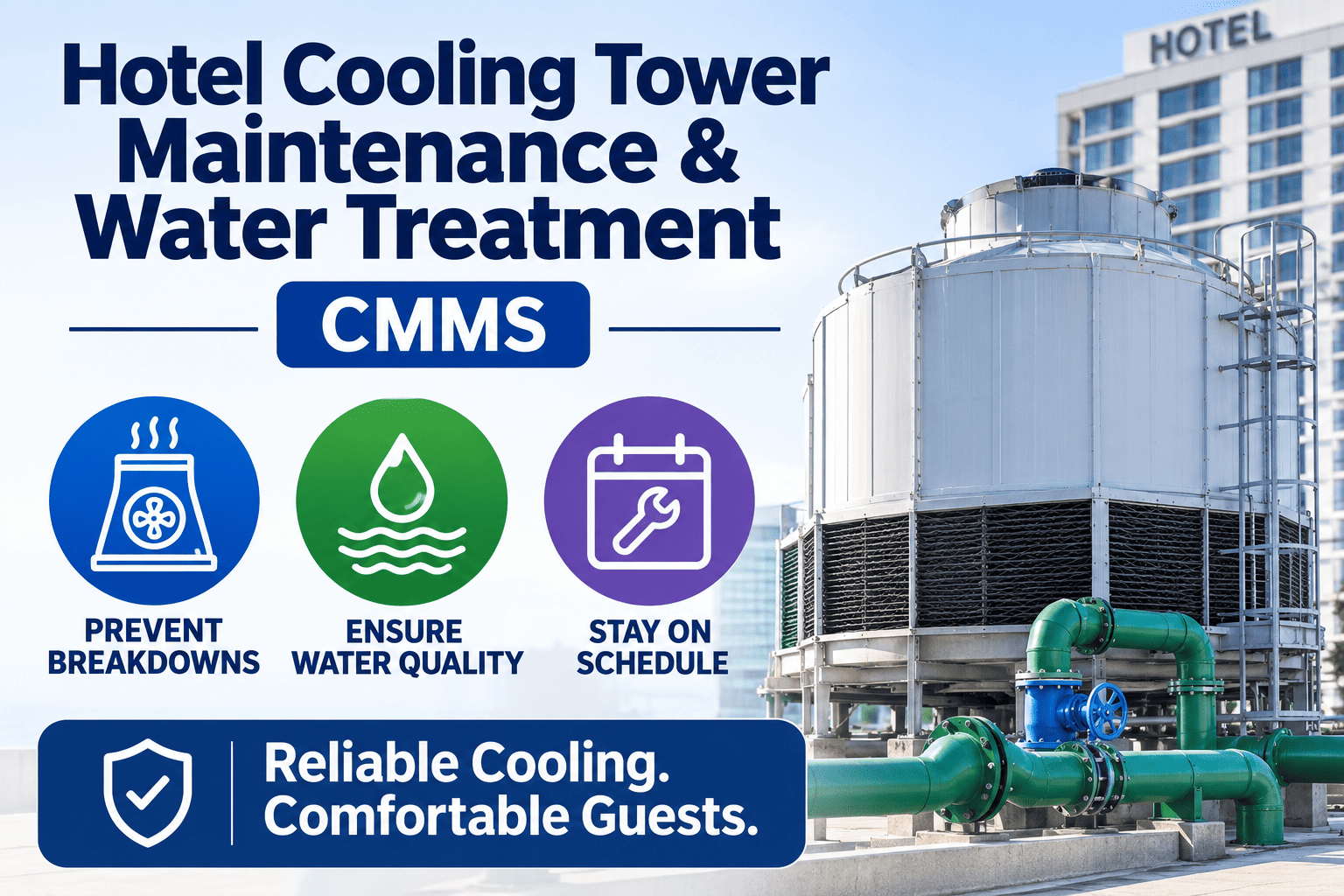
Cooling towers are the most water-intensive HVAC component and the most engineering-intensive conservation opportunity. Cycles of concentration (COC) — the number of times water recirculates before blowdown — directly determines water use. Increasing COC from 3 to 6 reduces blowdown by 50%, saving 15–25% of total cooling tower water consumption. OxMaint's cooling tower module tracks conductivity setpoints, cycles of concentration, and blowdown volume — alerting engineering when COC falls below target and triggering maintenance work orders for conductivity probes or chemical feed systems.
Conductivity Control
30–50%
Blowdown reduction
Replace timer-based blowdown with conductivity-triggered. Payback: 6–12 months.
Rainwater capture, gray water, or HVAC condensate for cooling tower makeup. Payback: 2–5 years.
"
We installed sub-meters on our cooling towers and discovered one tower was using 40% more water than an identical unit serving the same load. Investigation found a stuck blowdown valve — running continuously for an estimated 6 months. Estimated water waste: 2.5 million gallons at $18,000. The sub-meter paid for itself with that single finding.
Director of Engineering — 500-room convention hotel, US Southwest
5. Laundry & Irrigation Water Conservation
Hotel laundry operations consume 3–5 gallons per pound of linen — 30,000–50,000 gallons daily for a 300-room property. Reuse systems capture final rinse water and redirect it to pre-wash cycles, reducing total water use by 15–25%. Ozone laundry systems save 20–30% water. For landscape irrigation, smart controllers (ET-based) reduce outdoor water by 20–40%. OxMaint's laundry and irrigation modules track consumption per machine and controller programming, alerting engineering to inefficiencies.
Laundry Water Conservation
Rinse Water Reuse System — 15–25% reduction · Payback: 18–30 months
Ozone Laundry System — 20–30% reduction + energy savings · Payback: 12–24 months
Native/xeriscape conversion — 50–80% savings · Payback: 3–7 years
6. Water Conservation Maturity Scoring
Water conservation maturity exists on a spectrum from reactive leak-fixing to fully integrated submetering with automated CMMS triggers. The scoring framework below lets engineering directors assess their current programme — identifying the gaps that cost money every day.
Every zone submetered. Nightly anomaly alerts. Leaks trigger automatic work orders. Post-repair verification confirms savings. Full ROI tracking per work order.
Profile: Maximum water savings. Every leak generates a documented repair with measured ROI. Utility bills actively managed.
4
Submetered · Manual Review · Scheduled Audits
Submeters installed. Data reviewed weekly. Leaks found and fixed. No automated CMMS integration. Savings calculated manually.
Action: Add automated anomaly detection. Connect submeters to CMMS for automatic work order generation.
3
Monthly Utility Review · Reactive Leak Fixes
Utility bills reviewed monthly. Leaks found when bills spike. No submeters. No proactive leak detection. Irrigation and cooling tower efficiency unknown.
Gap: Significant water waste occurs between monthly bill reviews. Install submeters on major water-using equipment.
2
Reactive Only · Leaks Found via Complaints
No submeters. No scheduled leak detection. Leaks discovered only when guests complain or visible damage occurs. Significant undetected waste.
Risk: Leaks costing thousands annually go undetected. Implement nightly flow monitoring and weekly fixture audits immediately.
1
No Water Management Programme
No submeters. No leak detection. No conservation measures. Utility bills paid without analysis.
Risk: Significant water waste and unnecessary utility expense. Start with leak detection protocol — zero capital, immediate savings.
Frequently Asked Questions — Hotel Water Conservation
What is the cheapest way to start saving water today (zero capital)?
Off-hours flow monitoring. If your building management system or submeters show water flowing at 3:00 AM when the hotel is asleep, you have a leak. Fixing that leak costs a technician's hour but saves thousands of gallons monthly. OxMaint automates this with nightly anomaly detection.
Do low-flow showerheads actually annoy guests?
Modern low-flow (1.75 GPM vs. old 2.5 GPM) uses air induction technology. The water droplets feel larger and pressure stays high. Guest complaints usually occur only with very low flow restrictors (<1.5 GPM) or fixtures clogged with sediment. Select WaterSense-labeled products with positive guest reviews.
How does a CMMS help with water conservation?
A CMMS like OxMaint links meter data to maintenance action. If the "Cooling Tower" meter shows a 30% usage spike, OxMaint triggers a PM work order to inspect the float valve and blowdown controller. It closes the loop between performance monitoring and repair — and proves ROI with consumption reports before/after each maintenance action.
What is a realistic payback for low-flow toilet retrofits?
For a 300-room hotel replacing 3.5 gpf toilets with 1.28 gpf models: annual water savings of 600,000–900,000 gallons. At $0.012/gallon (water + sewer), that's $7,200–10,800 annually. Retrofit cost: $150–250 per toilet installed → $45,000–75,000. Payback: 5–7 years. Shorter payback if toilets are failing and would need replacement anyway.
Turn Water Data into Water Savings — Starting Tonight.
OxMaint's water management module tracks consumption by zone, alerts engineering to leaks automatically, and schedules preventive maintenance on water-using equipment. Free to start.