Hotel Maintenance Mobile App for Work Orders Inspections and Engineering Teams

By Mark Strong on March 26, 2026

hotel-maintenance-mobile-app-work-order-management

A maintenance technician in a 310-room hotel receives a work order by radio at 9:47 AM. He writes it on a notepad, walks three floors to check the asset history in a binder, then walks back to the guest floor. By the time he starts work, 34 minutes have passed. The repair takes 11 minutes. The guest waited 45 minutes for an 11-minute fix — and nothing was documented. That gap is where guest satisfaction is lost and maintenance costs compound. It is a tooling problem — and one that a mobile maintenance app solves directly. Start a free trial on OxMaint and your engineering team closes that gap on day one.

Hotels that equip engineering teams with a mobile maintenance app reduce reactive maintenance spend by up to 40% and cut mean time to repair to under 30 minutes — without adding headcount.

Why Paper and Radio Still Run Most Hotel Engineering Departments

Walk into the engineering office of most full-service hotels and you will find the same setup: a whiteboard, a radio on a charger, a binder of PM schedules, and a logbook the outgoing shift fills in before they leave. It works — until a compliance audit asks for records from six months ago, or a missed PM becomes a guest-facing breakdown at peak occupancy.

Most CMMS platforms were built for manufacturing facilities with stationary workstations — not for teams moving across 15 floors, into basements, onto rooftops in the same shift. A system that requires a desktop is a system technicians cannot use at the point of work. Book a demo to see how OxMaint is built differently.

34 min
Average time lost per work order on paper-based systems before repair even begins
40%
Reduction in reactive maintenance costs when teams move to mobile CMMS
30%+
Productivity improvement reported by mobile CMMS engineering teams on average
Day 1
Time to operational for most hotel engineering teams on OxMaint mobile

What a Hotel Maintenance Mobile App Actually Changes

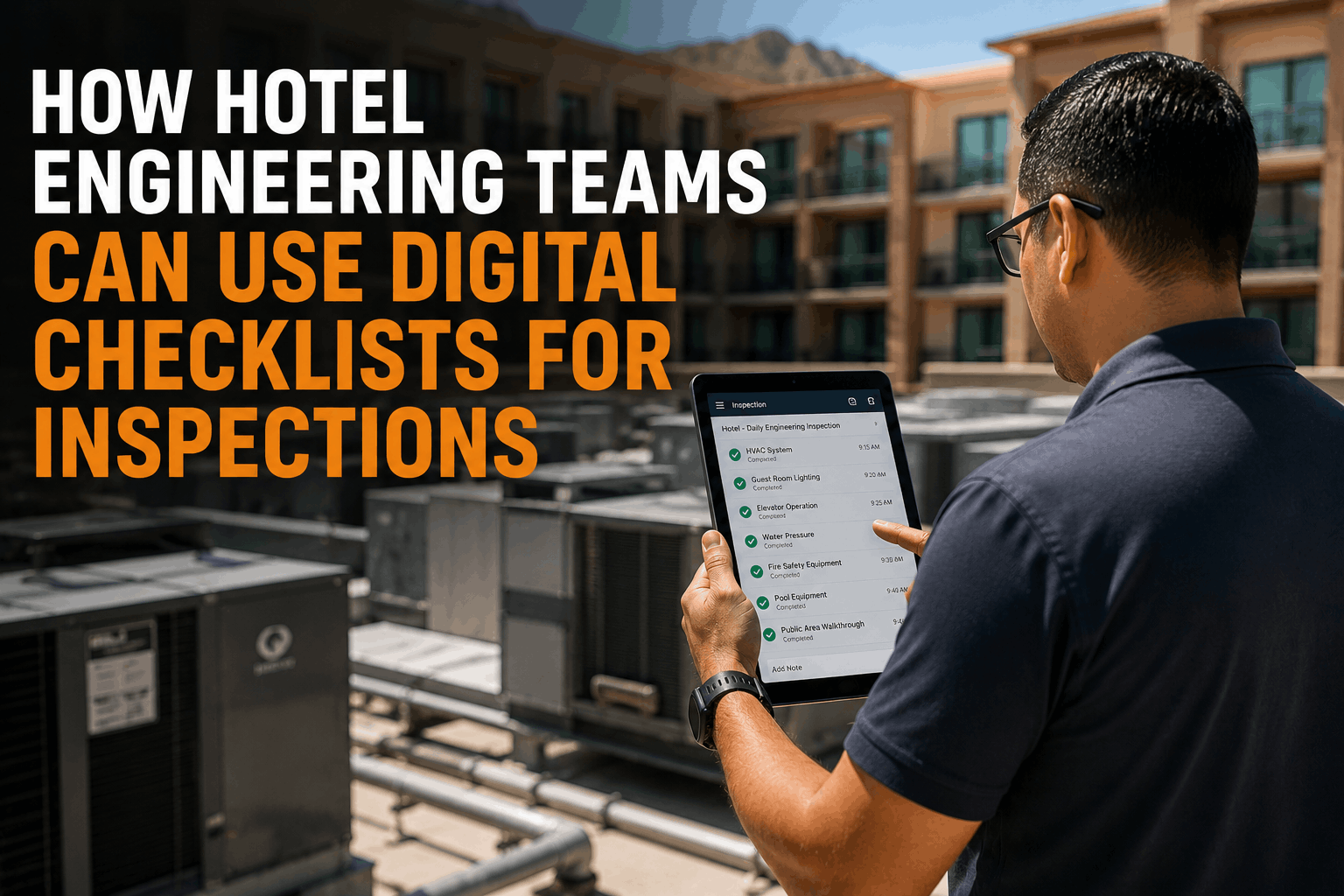
A hotel maintenance mobile app is not a digital logbook — it is a fundamentally different way of running engineering operations. Work orders, asset history, documentation, and management visibility all happen at the same moment, at the same location, without anyone returning to a desk.

When a fault is reported, the technician receives a push notification with the room, fault, priority, and asset history before leaving the engineering office. When the repair is done, they photograph it, log the parts, and close the work order on site. The director's dashboard updates in real time. Start a free trial and see what that looks like for your property.

Paper and Radio vs. Mobile Maintenance App
The same four operational moments — completely different outcomes
Without a Mobile App
Fault Reported
Radio call — verbal, no record, no timestamp, no priority assigned
Technician Response
Walks to plant room binder to check asset history — 15–20 minutes lost
Repair Completed
No photo, no parts log, no timestamp — outcome unverifiable
Management Informed
Next morning shift report — 12+ hours after the event
With OxMaint Mobile App
Fault Reported
Push notification with room, fault, priority, and asset history — instant
Technician Response
Full service history on screen before leaving engineering office
Repair Completed
Photo attached, parts logged, voice note recorded — work order closed on site
Management Informed
Live dashboard updates the moment the work order status changes

The Four Features That Make OxMaint Work for Hotel Engineering Teams

OxMaint's mobile app is built around how hotel engineering teams actually work — on iOS and Android, offline in signal-dead zones, with QR codes that pull full asset history instantly, and photo plus voice capture at the point of repair. Each is a deliberate design decision, not a feature checklist item.

iOS and Android — Native on Every Device Your Team Already Carries

OxMaint runs natively on iOS and Android — no new hardware, no IT rollout. Engineering teams deploy on phones already in their pockets. Work orders are created, updated, and closed from the app. PM checklists are completed in the field. Shift handover logs are on every technician's device before their shift begins. Start a free trial — most teams are completing work orders on day one.


Work orders created, updated, and closed entirely from mobile — no desk required

PM checklists completed in the field — failed items auto-generate work orders instantly

Shift handover log on every team member's device — incoming shift briefed before first step

Live management dashboard — open, in-progress, and completed orders visible in real time
QR Code Asset Scanning — Full History at the Asset, Not in the Plant Room

Every asset — HVAC units, pumps, lift cars, panels, kitchen equipment — gets a QR label from OxMaint. Scan it and the full asset record opens in under three seconds: service history, fault log, last PM date, stored manuals. A new work order is created from the scan in under 15 seconds, asset pre-populated. Book a demo to see QR scanning in action across a live hotel asset register.


Scan any asset to access full service history, fault log, and PM schedule — 3 seconds

New work order created from scan in under 15 seconds — asset pre-populated automatically

Recurring fault patterns flagged — three scans on same asset in 30 days triggers escalation

Repair cost history per asset — data-driven repair vs. replace decisions at the point of work
Offline Mode — Works Where Mobile Signal Does Not

The most critical hotel assets sit in the worst-signal locations — basement switch rooms, rooftop chiller plant, cold rooms, back-of-house mechanical areas. A maintenance app that requires connectivity fails precisely where documentation matters most. OxMaint's offline mode keeps the full app functional: asset histories cached on device, work orders queued locally, photos attached on reconnection — auto-sync with no manual upload required.


Full asset history accessible offline — previously synced records available without any signal

Work orders created and updated offline — auto-sync on reconnection, no manual upload

Photos and voice notes captured offline — attached to work order on device reconnection

No data loss — every offline action preserved until successful server sync is confirmed
Photo and Voice Notes — Documentation That Happens at the Repair, Not After It

The most common documentation failure is deferral — a technician intends to write up the repair later, and never does. OxMaint eliminates it: a before-repair photo, a 20-second voice note, parts logged from a dropdown, and the work order closed before leaving the asset. The full record is permanently attached to asset history, timestamped and photo-verified. Start a free trial and document your first repair properly today.


Before-repair photo captures fault condition — timestamped, geotagged, asset-linked automatically

Voice note recorded in 20 seconds — faster than typing in gloves, under a panel, or on a ladder

After-repair photo closes the record — proof of resolution before technician leaves the location

Insurance, contractor disputes, and compliance audits answered with timestamped photo evidence
Your Engineering Team Should Never Walk to a Plant Room to Look Up an Asset History
OxMaint's mobile app — iOS and Android, QR scanning, offline mode, photo and voice documentation — gives hotel engineering teams everything they need at the point of work. Most teams are operational on day one. No IT infrastructure. No new hardware.

What Hotel Engineering Directors See When the Team Goes Mobile

On a paper-based system, the engineering director's visibility is retrospective — the shift report, the logbook, the end-of-week summary. Decisions are made on data hours old. Problems caught on Tuesday become expensive failures by Friday.

On OxMaint, the director has a live dashboard: every open work order, every PM due today, every asset in degraded mode, every technician's current assignment — updated as the team works. Book a demo to see what live engineering visibility looks like for a property your size.

Mean Time to Repair
Target: Under 30 min
Mobile dispatch, QR asset access, and inline documentation remove the travel and transcription time that inflates MTTR in paper-based operations.
PM Completion Rate
Target: Above 90%
Mobile checklists with push reminders and escalation for overdue tasks consistently outperform paper PM schedules on completion rate.
Work Order Dispatch Time
Target: Under 60 sec
Push notification dispatch replaces radio relay — technician confirmed and en route within 60 seconds of any fault report from any department.
Reactive vs. Planned Ratio
Target: 70% planned
QR-enabled asset history and mobile PM programs shift teams from reactive to preventive — reducing emergency callouts at 3–4x planned repair cost.
When the team is on OxMaint, the engineering director stops managing from yesterday's shift report and starts managing from today's live dashboard.

Who Should Be Using a Hotel Maintenance Mobile App

The answer is not just the engineering team. Housekeeping can scan a QR code in a guest room to report a fault — the work order goes directly to the engineering queue, assigned and tracked. Front desk agents submit fault reports without a radio call. F&B staff flag a failing refrigeration unit before it becomes a HACCP breach. Every department becomes a fault-detection point, and every report is tracked from submission to resolution. Start a free trial and connect every department to one maintenance workflow.

For multi-property operators, OxMaint gives consolidated visibility across all sites — which properties have the highest open work order counts, which assets generate repeat faults across locations, which PM schedules are running behind — all from a phone, without waiting for a compiled report. Book a demo to see multi-property dashboard management in practice.
Frequently Asked Questions

Yes. OxMaint's offline mode keeps the full app functional without any mobile signal. Asset histories are cached on the device. Work orders created offline queue locally and sync automatically when signal returns — no manual upload required. Photos and voice notes captured offline attach to the work order on reconnection. This is specifically designed for the locations hotel technicians work in most: basement switch rooms, rooftop plant, cold rooms, and back-of-house areas where connectivity is routinely unavailable.
Each asset gets a QR label printed from OxMaint and affixed to the equipment. Scanning opens the full asset record in under three seconds: service history, fault log, last PM date, parts previously used, and any stored manuals or diagrams. A new work order is created from the scan in under 15 seconds with the asset already pre-populated — no manual entry of asset details required. QR labels can be applied to HVAC units, pumps, panels, lifts, kitchen equipment, and individual guest rooms.
Yes. Any team member can submit a work order request by scanning a QR code in a guest room or common area, or through the OxMaint mobile app without needing to understand engineering systems. The request goes directly to the engineering team's work order queue with priority assigned automatically. This eliminates radio calls, verbal relay errors, and lost requests — every fault report is tracked from submission to resolution with a full audit trail.
Most hotel engineering teams complete their first work orders on OxMaint within the same working day. The mobile interface is built for maintenance technicians — not software users — so the learning curve is minimal. Asset setup, QR label printing, and PM schedule configuration typically complete within one week. No IT infrastructure, no server installation, and no developer involvement is required at any stage of deployment.
Every Hour Your Engineering Team Runs on Paper Is an Hour of Preventable Delay, Lost Documentation, and Unrecorded Asset History
OxMaint gives hotel engineering teams a mobile-first maintenance platform — iOS and Android native app, QR code asset scanning, offline mode for every signal-dead zone, photo and voice documentation at the repair point, live management dashboards, and automated PM scheduling. Deploy in under a week. No IT infrastructure required. Most teams are operational on day one.

Share This Story, Choose Your Platform!