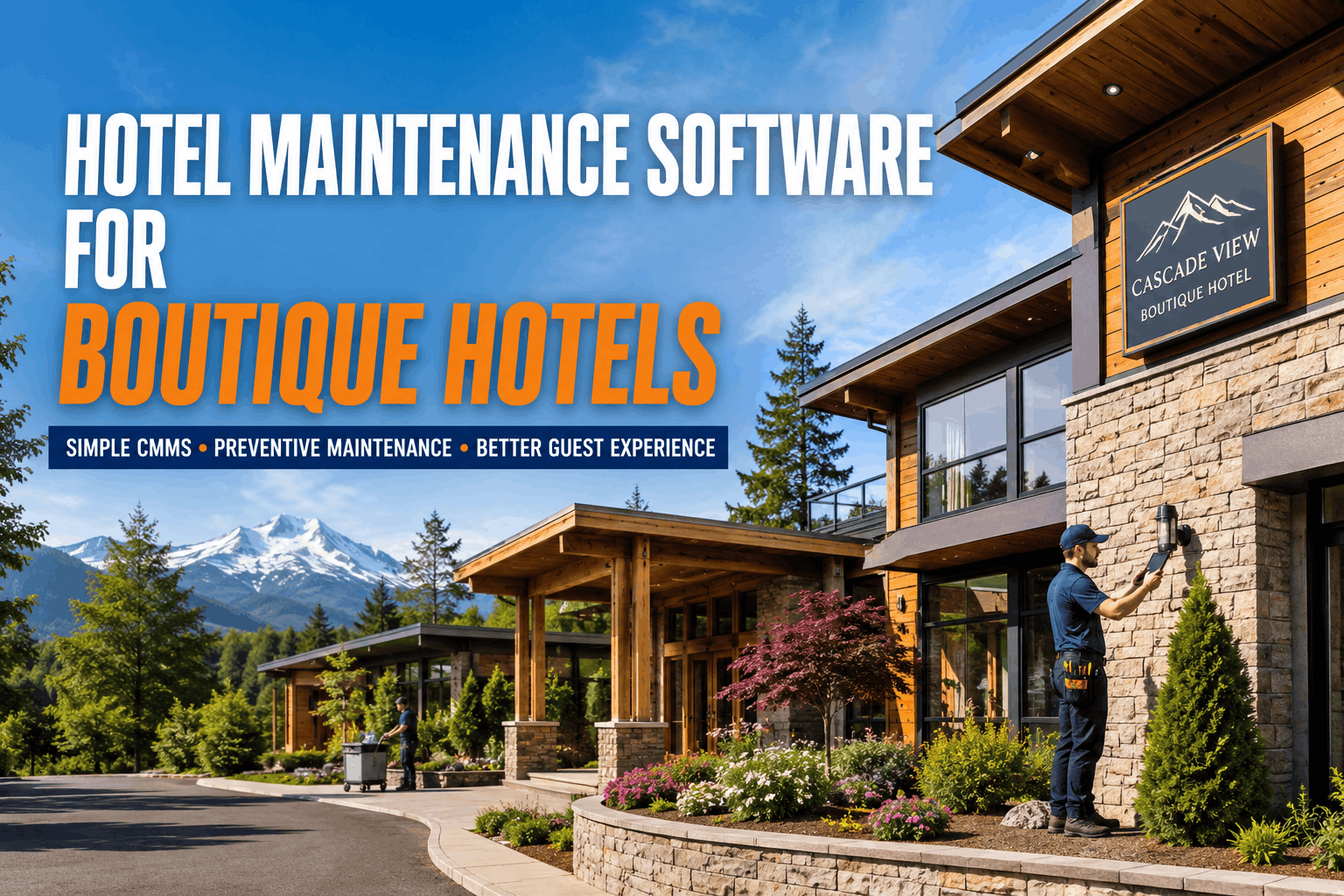
Boutique hotels operate under a fundamentally different maintenance reality than corporate chains and resort properties. You're managing complex, aging assets with lean staffing — typically 3–6 maintenance team members for 75–150 rooms, often with multi-skilled technicians who balance emergency response, preventive maintenance, capital project management, and vendor coordination entirely on their shoulders. Corporate hotel companies have dedicated CMMS specialists and regional support; boutique properties don't. That means your software choice is binary: either the platform works intuitively for your small team with minimal training and support burden, or it becomes overhead that consumes precious technician time instead of freeing it. Enterprise CMMS platforms designed for 50+ person maintenance departments feel bloated for boutique operations. Legacy hospitality platforms (HotSOS, Quore) were designed for mid-size and corporate properties and often include unnecessary complexity. What boutique hotels need is different: straightforward preventive maintenance scheduling, mobile dispatch for technicians balancing multiple locations, integrations that automate routine coordination, and transparent pricing that doesn't penalize smaller team sizes. This guide walks through what boutique hotels actually need from maintenance software, common pitfalls that boutique operators fall into, and how OxMaint's mobile-first, hotel-specific platform delivers simplicity without sacrificing capability. Schedule a demo tailored to boutique hotel operations.
Why Boutique Hotels Fail with Corporate CMMS Platforms and Succeed with Simplified Alternatives
Boutique hotels frequently adopt enterprise CMMS platforms designed for 50+ maintenance staff, only to discover they're managing software complexity instead of maintenance operations. The platform requires dedicated IT support, configuration overhead, and training time that boutique properties don't have budget or staff capacity for. Preventive maintenance discipline suffers because your small team is fighting software bureaucracy instead of executing work. The reality is that boutique hotels need different CMMS characteristics than corporate properties. Your maintenance team is typically one generalist and two technicians managing everything from HVAC to plumbing to electrical. You can't afford specialized staff; instead, you invest in cross-training and capability building. Your guests have higher expectations for personalization and rapid issue resolution compared to chain hotel guests — service recovery is more important, and downtime is more visible. Your assets are often older and more quirky (boutique charm means 1920s construction with modern mechanical systems trying to coexist), requiring flexible maintenance approaches. Your capital budget is tighter, so preventive maintenance that extends asset life matters more. Corporate CMMS platforms built around enterprise scale, role-based separation, and audit trail compliance are overkill. What you need is simplified, mobile-first software that your small team can adopt in 60–90 days and operate without IT overhead. See how OxMaint simplifies boutique hotel operations.
Seven Essential CMMS Capabilities for Boutique Hotels: What Matters, What Doesn't
Boutique hotel maintenance software evaluation is different from corporate software decisions because your needs are more specific and your budget is tighter. Rather than evaluating 40+ features, focus on seven core capabilities that directly impact your operational reality. Ignore features designed for enterprise scale (complex role-based access, audit trails, compliance reporting) that your small team doesn't need. Instead, prioritize capabilities that help your team work efficiently, maintain preventive discipline despite reactive pressure, and communicate with guests about repairs. Evaluate OxMaint against this boutique hotel framework.
Simple Preventive Maintenance Scheduling That Works With Lean Staffing
Your team can't afford to slip PM schedules because asset failures are catastrophic in small properties. You need a system that helps you schedule PM around reactive work and occupancy constraints, not a system that requires you to manually coordinate conflicting demands. OxMaint's scheduling engine lets you define PM intervals (e.g., HVAC inspection every 90 days) and automatically assigns tasks to available technician capacity. When reactive work threatens PM compliance, the system alerts you so you can make deliberate prioritization decisions instead of accidentally letting PM slip due to overload.
Mobile Dispatch That Your Team Actually Wants to Use
Boutique hotel technicians spend more time in the field than at a desk. Your maintenance workflow needs mobile-first design — task assignment, status updates, photo documentation, and parts logging all happen from mobile devices without requiring office work. Enterprise CMMS platforms often have mobile apps that feel bolted-on; work still requires desktop entry. OxMaint is built mobile-native from the foundation. Technicians receive tasks, complete work, and update status entirely on mobile. Adoption is high because workflow matches how your team actually works.
Easy PMS Integration for Guest Request Workflow Without Manual Data Entry
Your front desk submits maintenance requests through the PMS. Without integration, someone has to manually re-enter requests into your CMMS, creating duplicate data and coordination chaos. You need tight PMS integration where guest requests flow automatically into your work queue, and completed repairs update back to PMS for guest communication. OxMaint integrates with major boutique-friendly PMS platforms (Cloudbeds, Remotec, Hix) so guest requests become work orders automatically, eliminating manual entry overhead.
Asset Tracking That Helps You Plan Capital Replacement, Not Audit Compliance
Boutique hotels manage aging asset portfolios carefully — you can't just replace equipment when it fails; you need to plan replacements into annual budgets. You need asset tracking that helps you see which equipment is aging, predict failure risk, and schedule replacement strategically. Enterprise CMMS systems track assets for depreciation and compliance; boutique-focused systems track assets for maintenance planning and capital budgeting. OxMaint lets you log asset acquisition dates, maintenance history, and repair costs — then helps you forecast which equipment needs replacement in the next 12–24 months so you can budget appropriately.
Simple Reporting and Cost Visibility for Owner/GM Conversations
Your owner or GM wants to understand maintenance spend, efficiency trends, and capital equipment outlook. They don't need compliance reports or audit trails; they need simple dashboards showing maintenance cost trends, equipment reliability, and capital planning. Enterprise CMMS platforms generate 50-page compliance reports; you need one-page dashboard showing maintenance spend by category, aging equipment list, and capital replacement forecast. OxMaint's reporting is designed for boutique decision-making: cost by category, equipment age/reliability, maintenance trends — presented in formats you can share with ownership in two minutes.
Vendor and Contractor Coordination Without Complicated Access Management
Your small maintenance team relies on outsourced contractors for specialized work (HVAC service, elevator maintenance, roof repairs). You need to coordinate with contractors, track their work, and maintain asset history without giving them complex system access. Enterprise platforms require detailed role-based access provisioning; that's overhead you don't need. OxMaint lets you share task details with contractors, receive their work reports, and integrate their work into your asset history through simple sharing links — no complex access management required.
Transparent Pricing That Doesn't Penalize Small Team Size or Grow with Hidden Fees
Enterprise CMMS vendors charge per-user, which means your cost grows every time you add a technician, contractor, or supervisor to the system. Per-room pricing also penalizes smaller properties. Per-property pricing (flat fee regardless of team size) is ideal for boutique hotels — cost is predictable and doesn't penalize team growth. OxMaint's per-property pricing includes all users, all features, and all support in a single monthly fee. No surprise add-ons, no feature upgrades at higher cost, no per-user escalation.
Real Boutique Hotel CMMS Usage: How Small Teams Use Software Differently Than Corporate Properties
Boutique hotel maintenance workflows look different from corporate operations because team capacity and priorities are different. Understanding how smaller teams actually use CMMS software helps you select the right platform and avoid enterprise-focused solutions that won't fit your reality. Let's examine three common boutique hotel scenarios and show how OxMaint-style platforms support these workflows better than alternatives.
Boutique Hotel CMMS Implementation Roadmap: How Small Teams Successfully Adopt Software
Boutique hotel CMMS implementation looks different from corporate deployments because you have limited staff capacity and higher learning curve risk. Enterprise CMMS implementations often stall because your team can't spare technician time for training and configuration. Successful boutique implementations use compressed timelines with hands-on onboarding that fits your team's schedule and capability level. Here's how OxMaint supports boutique hotel adoption differently than enterprise platforms.
Week 1: Baseline Assessment and Quick Configuration (Not Long-Form Discovery)
Boutique hotels don't need 4-week discovery processes. OxMaint's implementation team spends 2 days understanding your property: asset types, maintenance priorities, PMS setup, and team structure. We then configure the system using hotel-standard templates — no lengthy customization. You review configuration and approve by end of week, avoiding multi-week delays.
Week 2: Historical Data Migration and Mobile Training
We export your current work orders, asset list, and PM schedules (if they exist) and import into OxMaint. Your team attends mobile training focused on technicians — how to receive tasks, update status, and log work. Training is hands-on and practical; no slide decks or compliance modules. Most boutique teams get proficient in 1–2 days because mobile interface is intuitive.
Week 3: PMS Integration Testing and Go-Live Preparation
OxMaint validates PMS integration (guest requests flowing automatically into work queue) and tests end-to-end workflow. Your team tests on sample work orders and approves before go-live. We identify edge cases (what happens if guest submits repair after hours, how do you handle parts ordering) and document simple processes for each scenario.
Week 4: Go-Live and 30-Day Support Intensive
OxMaint becomes your primary system. Your team operates independently but has dedicated support team on standby for questions. We check in daily for first week, then weekly for 30 days. Typical issues are minor (how to export a report, how to handle recurring PM differently) and resolved in minutes. By week 4, team is operationally independent and confident.
Week 5+: Continuous Optimization and Owner/GM Onboarding
After technician team is confident, we train your GM or owner on dashboard and reporting — showing maintenance cost trends, equipment aging, and capital planning data. This builds buy-in and ensures leadership sees the value that technicians are creating through consistent PM execution. Ongoing support continues indefinitely at no additional cost.
Frequently Asked Questions: Boutique Hotel CMMS Software and Small Property Operations
Is hotel CMMS software necessary for boutique properties, or can we continue using spreadsheets and manual processes?
Spreadsheet-based maintenance tracking works at very small scale (50 rooms, 2 staff) but breaks down quickly. You lose asset history, duplicate efforts, and miss PM compliance. Even at boutique scale, structured CMMS provides ROI through better capital planning and reduced guest-impacting downtime. Software investment pays for itself through fewer emergency repairs within 12–18 months.
What CMMS features are most important for boutique hotels and which can we skip?
Must-have: mobile dispatch, preventive maintenance scheduling, PMS integration, asset tracking, cost reporting. Nice-to-have but not critical: detailed role-based access control, compliance audit trails, advanced analytics, multi-language support. Skip anything requiring dedicated IT overhead or extensive customization. Boutique-optimized platforms give you essentials without enterprise overhead.
How long does CMMS implementation typically take for boutique hotels with small teams?
Boutique hotel implementation typically takes 4–6 weeks (not 12–16 weeks like corporate deployments). Configuration uses templates rather than custom setup. Training focuses on mobile workflow, not role-based security. Most boutique teams reach operational independence in 60–90 days with simplified, hotel-native platforms.
What's the monthly cost of CMMS software for a 100-room boutique hotel with small maintenance team?
OxMaint's per-property pricing ranges $350–$450/month for boutique hotels (100–150 rooms), regardless of team size. Total includes unlimited users, all features, support, and updates. This compares favorably to per-user pricing that charges $25–$50/user/month — which would cost $150–$300/month for small teams anyway, often with limited features and support.
Can boutique hotels benefit from asset condition monitoring or predictive maintenance, or is that only for large facilities?
Yes, predictive maintenance benefits boutique hotels significantly because capital budgets are tight. Predicting which equipment will fail in 30–60 days lets you plan replacement strategically instead of reacting to failure. OxMaint's predictive models track asset aging and failure patterns, helping boutique properties extend equipment lifecycle and plan capital expenditure more effectively.
Should boutique hotels implement CMMS across multiple properties at once or pilot at one property first?
Pilot at one property first. Success at one property builds team confidence and demonstrates ROI to ownership. Lessons learned inform deployment across additional properties. Phased rollout also spreads implementation cost and reduces execution risk. OxMaint's portfolio features enable you to standardize processes across properties once first property is operational.
How does CMMS software help boutique hotels make capital replacement decisions and justify equipment investment to ownership?
CMMS platforms track maintenance cost history, repair frequency, and asset reliability trends. Over time, you see which equipment is becoming unreliable (frequent repairs, aging) versus which is still performing. This data lets you build capital justification: "This HVAC system is 15 years old, failed twice this year, repair costs are rising — replacement is more economical than continued repair." Ownership approves capital based on data, not guesswork.
What's the most common reason boutique hotels fail with CMMS adoption and how can we avoid it?
Most boutique failures result from platform complexity and slow adoption. Systems designed for large departments overwhelm small teams. Avoid this by: (1) choosing mobile-native platforms built for small teams, (2) starting with core workflows (mobile dispatch, PM scheduling) before advanced features, (3) getting dedicated training focused on your team's reality, not generic features. OxMaint prioritizes boutique adoption success through simplified onboarding and mobile-first design.
.png)


