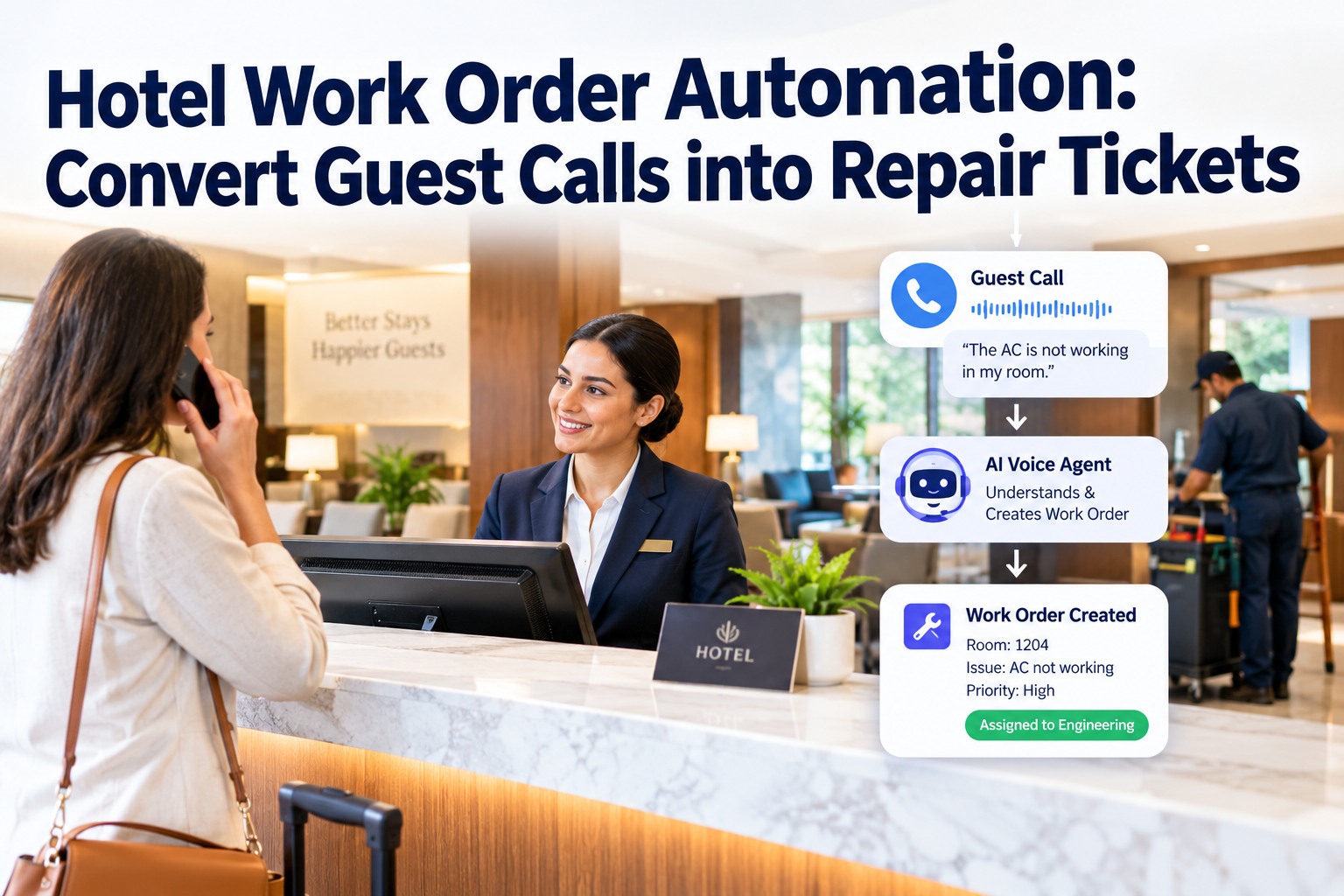
A guest in 412 calls down at 11 p.m. — the AC is blowing warm and they have an early flight. The front desk is checking in a tour group, the call rolls to a sticky note, and by the time engineering sees it at 7 a.m. the guest has already left a one-star review about a hot room and nobody answering. The gap is not effort; it is that a phone call and a work order live in two different worlds. OxMaint AI-powered CMMS closes that gap: an AI voice agent answers the guest, pulls the room and the problem out of plain speech, and opens a prioritized repair ticket that routes straight to the on-duty technician — call to ticket to fix, in one platform. This guide shows how that conversion works and how to put it on your own property. You can also book a demo to hear a guest call become a work order.
From "The AC Isn't Working" to a Dispatched Ticket in One Call
The moment a guest describes a problem out loud, OxMaint's AI voice agent turns it into structured data — no form, no sticky note, no waiting for the desk to free up. Here is the same call, as the guest says it and as the ticket records it.
What the guest says
"Hi, this is room 412 — the air conditioning's blowing warm air, it's really stuffy in here and I've got an early start tomorrow."
→
What the ticket records
Room412 — occupied
AssetIn-room HVAC / fan coil
IssueNot cooling, warm air
PriorityP2 — guest comfort, occupied
Routed toOn-duty engineering
Put an AI voice agent on your guest line and let every call open a tracked ticket on its own. Start free on your property, or hear the full call-to-work-order loop in a live demo.
The pain this page is built on is a specific one: there is no integration between guest calls and maintenance work orders. A call is a conversation that disappears the moment it ends unless a human writes it down, and the writing-down is exactly what falls apart when the desk is slammed, the shift changes, or the clock reads 2 a.m. Automating the conversion removes the fragile human step without removing the human touch — the guest still talks to a voice, but the request becomes a record the instant they speak.
What the AI Pulls Out of a Guest's Plain Words
Guests do not speak in form fields. They say "the shower's freezing" or "there's a dripping sound in the ceiling." The voice agent's job is to turn loose speech into the five things a work order actually needs.
01
Location
Room or area, confirmed against the reservation or the number the guest gives — so the technician is sent to the right door, not a guessed floor.
02
Asset or system
"Blowing warm air" maps to the in-room HVAC; "won't drain" to plumbing. The spoken symptom is matched to the equipment behind it.
03
Issue description
The guest's own words are kept verbatim alongside a clean summary, so the technician reads both the symptom and the plain report.
04
Urgency signals
"Water on the floor" or "no heat" carry weight a drippy tap does not. The agent flags the language that should raise a priority.
05
Guest & occupancy context
Whether the room is occupied, and the guest's tier, shape how fast the ticket needs an answer — an occupied VIP room is not a vacant one.
When it is not sure
If a detail is missing or unclear, the agent asks one short follow-up rather than guessing — "Which bathroom, the main or the ensuite?" — so the ticket is complete before it is raised.
This parsing is the whole difference between a transcript and a work order. A recording of a call still needs a person to read it, decide what it means, and type it somewhere; a structured ticket is already actionable. The guest hangs up and the technician already has the room, the asset, and the urgency in front of them in OxMaint.
How a Spoken Request Gets Its Priority
P1
Safety or habitability — act now
No heat in winter, flooding water, a stuck lock, a power or smoke concern. Dispatched immediately and escalated if not acknowledged; after hours it reaches the on-call technician directly.
P2
Guest comfort, occupied room — same shift
AC not cooling, no hot water, a noisy unit keeping a guest awake. The guest is in the room now, so it is handled on the current shift, not parked for morning.
P3
Comfort, non-urgent — scheduled soon
A flickering bulb, a slow drain, a loose fixture. Logged, scheduled, and visible — not lost — but not pulling a technician off an occupied-room emergency.
P4
Cosmetic or vacant — planned work
A scuff, a sticky drawer, an issue in a room nobody is in. Rolled into planned maintenance so it is fixed before the next check-in.
Priority is where automation either helps or hurts. Set your own thresholds once — what counts as P1, which words trigger it, how long before a ticket escalates — and the agent applies them to every call the same way, at 2 p.m. and 2 a.m. alike. The guest never has to argue that their problem is urgent; the language and the context decide, consistently.
The Calls That Used to Vanish: After-Hours and Overflow
Guest Line · 02:14
Call answered by AI voice agent
Room & issue captured
Priority set — P2
Routed to on-call engineering
No voicemail left unheard — ticket raised at 02:14
Every call answered
When the desk is busy or unstaffed overnight, the agent picks up instead of the call rolling to a voicemail box nobody checks until morning.
Voicemail becomes a ticket too
If a guest does leave a message, it is transcribed and parsed into the same structured work order — not a recording waiting in a queue.
Urgent reaches a human fast
A P1 after midnight routes to the on-call technician by push, message, and call — the automation triages, it does not sit on an emergency.
A record either way
Answered, missed, or left as a message, the request lands in the same queue with a timestamp, so nothing depends on who was at the desk.
Overnight and overflow are where guest-call maintenance quietly fails, because the failure is invisible until a review names it. A call that is never logged leaves no trace to learn from — nobody knows it happened. Turning every call, including the missed ones, into a timestamped ticket is what makes the small hours as accountable as the day shift.
The Full Loop, From Ringing Phone to Closed Ticket
1
Guest calls
AI voice agent answers
→
2
Request parsed
Room, asset, issue, urgency
→
3
Ticket raised
Prioritized & routed
→
4
Technician fixes
Mobile, with full context
→
5
Closed & logged
On the room's history
See a live guest call parsed into a prioritized ticket and dispatched to a technician — then logged against the room. Try it free on your property, or walk the loop with our team.
Where OxMaint Turns Guest Calls Into Closed Repairs
The call is only the start. OxMaint AI-powered CMMS carries each guest request from the spoken word to a prioritized work order, the right technician, and a closed, logged repair — so the request never lives on a sticky note.
AI voice agent on the guest line
Answers the call, captures the room and the problem from plain speech, and asks a short follow-up only when a detail is missing.
Call becomes a prioritized ticket
The request opens a work order with the room, asset, and urgency already set by your rules — no form, no re-keying.
Skill- and zone-based routing
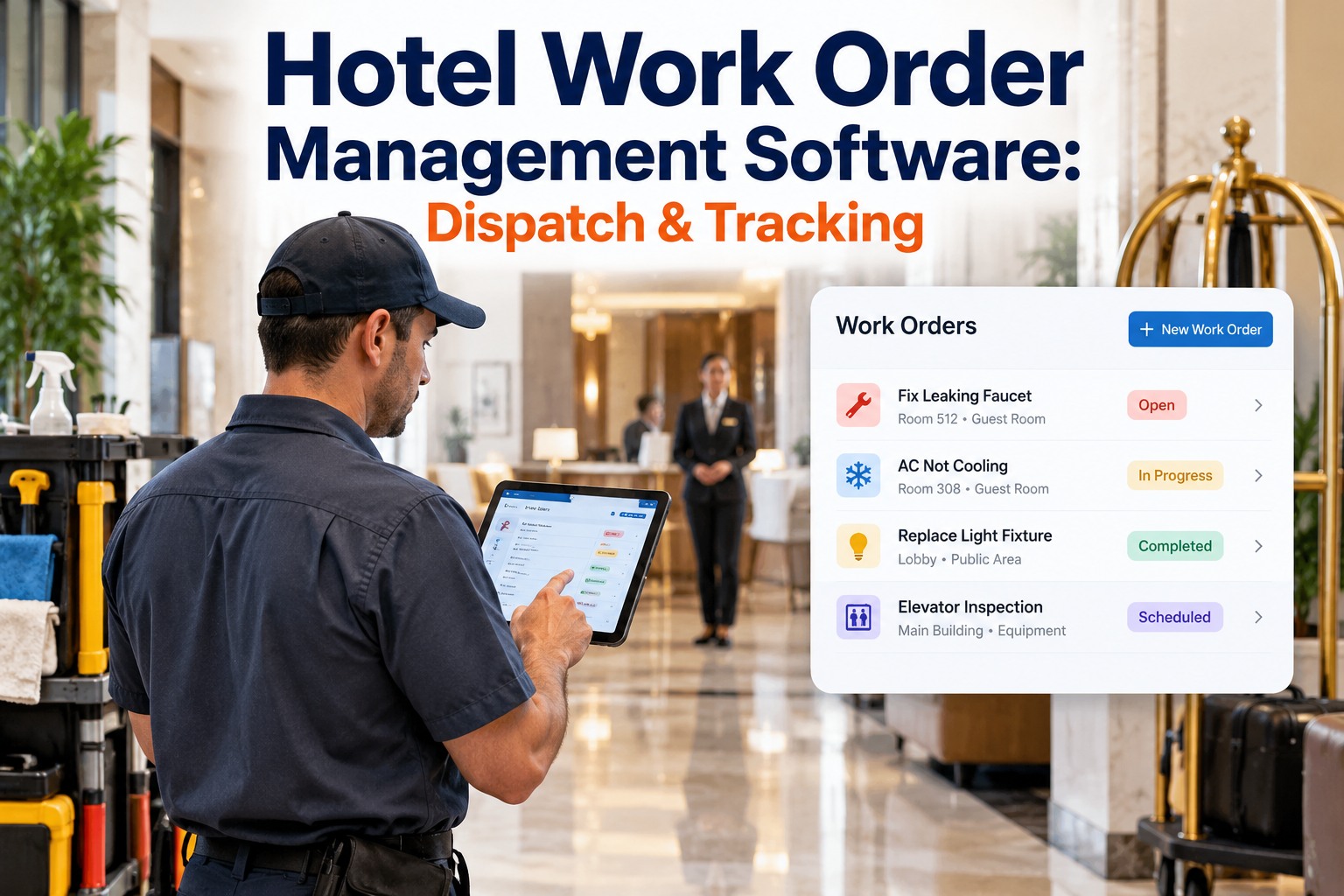
Tickets go to the on-duty technician by skill and floor, with P1s escalating automatically if not acknowledged.
One record per room and asset
Every call, repair, and part lands on the room's own history, so a recurring AC complaint is visible, not rediscovered each time.
Guest status updates
The guest can be kept informed as the ticket moves, turning a silent wait into a handled request.
Preventive maintenance alongside
Reactive guest tickets and scheduled PM share one queue, so a room pulled for a repair gets its due service in the same visit.
Expert Review
The call flow, parsing fields, priority tiers, and routing on this page describe how guest-call work order automation works as a general approach. They are a planning framework to adapt, not a specification for your property.
Set priorities and escalation to your property
What counts as P1, which spoken phrases trigger it, and how long before a ticket escalates should reflect your brand standards, staffing, and guest mix — not a default. Review the agent's priority calls during a pilot before trusting them unattended overnight.
Keep a human path for the edge cases
A voice agent handles the common request well; a distressed guest, a safety emergency, or a complex complaint should always be able to reach a person quickly. Design the hand-off, do not assume the automation covers every call.
Safety and compliance stay with qualified staff
A gas smell, a fire concern, or an electrical fault is a call for trained staff and your emergency procedures. The ticket records and routes the report — it does not replace the response plan behind it.
OxMaint is the system of record
OxMaint captures the request, holds the room and asset history, and raises and tracks the work order. It is not a substitute for your engineering team, your service standards, or your guest-relations judgment.
Frequently Asked Questions
Does an AI voice agent replace the front desk?
What happens to a call that comes in at 2 a.m.?
The agent answers it instead of the call rolling to a voicemail box nobody checks until morning. The room and issue are captured, a priority is set, and an urgent problem routes to the on-call technician by push, message, and call — while a non-urgent one is logged and scheduled. Even a voicemail is transcribed into the same structured ticket.
Sign up free and route your after-hours guest calls into tracked tickets.How does a spoken complaint become a structured work order?
The agent pulls five things out of plain speech — location, the asset or system, the issue in the guest's own words, urgency signals, and occupancy context — and opens a work order with those fields already filled. The guest hangs up and the technician has the room, the asset, and the priority in front of them, with no form in between.
Book a demo and watch a live call turn into a dispatched ticket in OxMaint.Will it understand how guests actually describe problems?
Guests say "the shower's freezing," not "fault code on the mixing valve," and the agent is built for exactly that — mapping a spoken symptom to the equipment behind it and keeping the guest's own words on the ticket. When a detail is missing, it asks one short follow-up rather than guessing, so the work order is complete before it is raised.
Start free and test it against the way your own guests report issues.How does this stop the same room issue from recurring unseen?
Stop Losing Guest Requests Between the Phone and the Work Order
Let an AI voice agent answer the call, pull the room and the problem from plain speech, and open a prioritized ticket that routes straight to engineering. OxMaint runs the whole loop — call to ticket to closed repair, logged on the room's history.