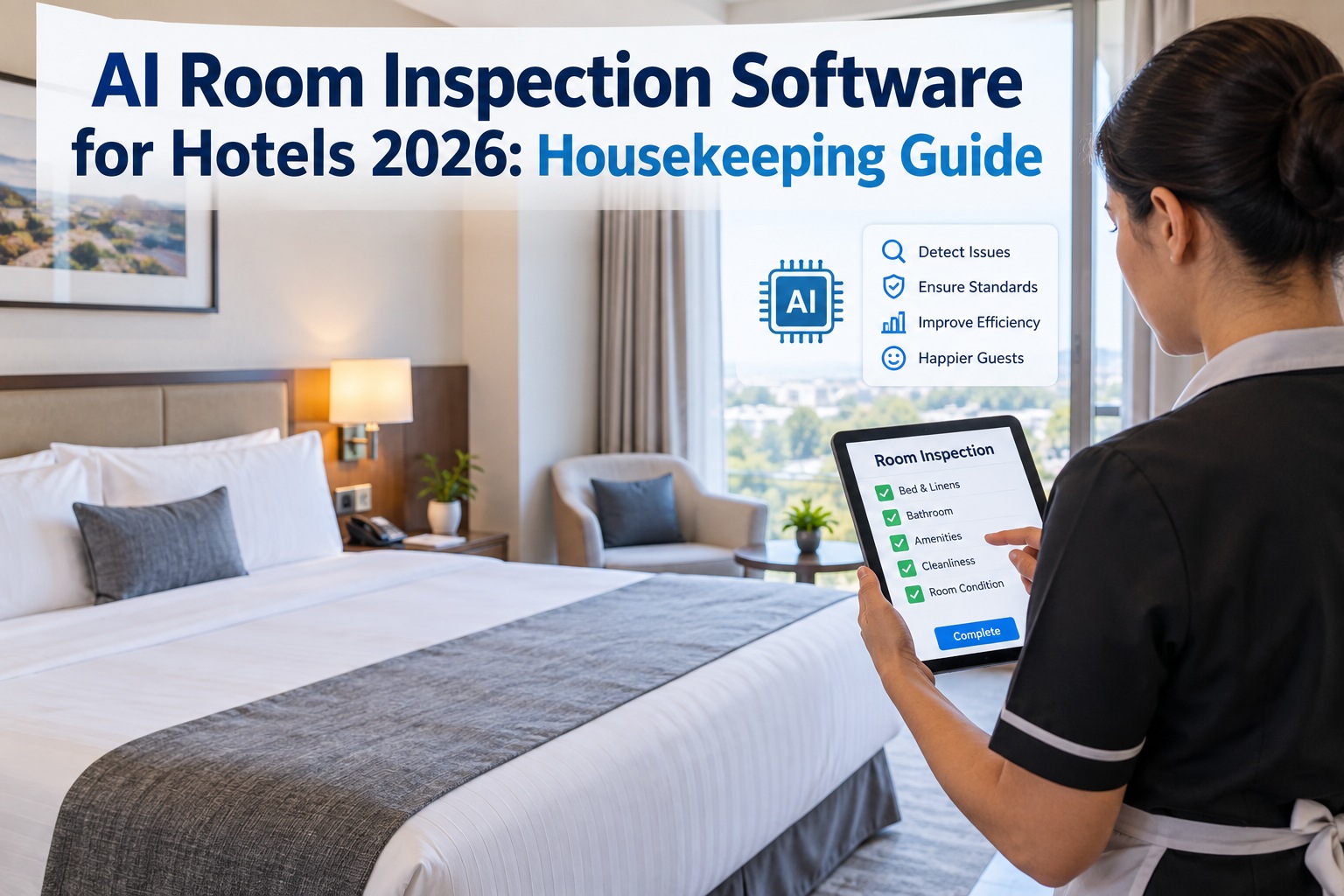
At 7:43 AM a housekeeper enters Room 217 to prepare it for an 11 AM arrival. The bathroom exhaust fan is making a grinding noise. She mentions it to her floor supervisor in passing. Her supervisor intends to tell the front desk. By 2:30 PM, the guest has checked in, the fan is still grinding, and the first call to the front desk comes at 10:15 PM — three hours before the guest gives up and asks to be moved. The housekeeper noticed the fault at 7:43 AM. Fifteen hours elapsed before it was treated as an actionable repair. A structured hotel room repair request management system turns that 7:43 AM observation into a timestamped work order in under 90 seconds — visible to engineering, trackable by management, and resolvable before the guest ever arrives.
Hotel Room Repair Request Management System Guide
How hotels structure, automate, and track room repair requests from first observation to confirmed resolution — and why the gap between observation and work order is where most guest satisfaction failures originate.
Why Hotel Room Repair Requests Fail Before They Reach Engineering
Most room repair failures are not engineering failures. They are information routing failures. The fault is observed by a housekeeper, a room attendant, or a previous guest — and the observation never becomes an actionable work order. It becomes a verbal mention, a sticky note on a supervisor's desk, or an entry in a paper log that nobody reads before the next guest checks in. A hotel room maintenance management software system replaces the information routing failure with a structured digital intake process that every department can access from any device in under two minutes.
The consequence of informal intake is not just delayed repairs. It is invisible asset history. When Room 412's HVAC unit is reported four times in three months — each time as a new issue because no one connected the reports — the property has spent four repair visits on an asset that needed root-cause attention after the second. A structured hospitality room repair management system links every report to the named asset, making the pattern visible after the second event, not the fourth. Sign up to start linking room repair requests to named assets in Oxmaint — free.
The Verbal Relay Chain
Guest tells front desk → front desk tells radio → engineer hears it while mid-job → information degrades at every handoff. Each relay adds latency and reduces accuracy. By the time the engineer acts, the fault description may be wrong, the room may be occupied, and nobody knows who was told first.
No SLA — No Accountability
Without a timestamped work order, there is no SLA to breach and no escalation to trigger. A guest room fault can sit open for six hours with zero visibility to management because there is no system tracking it. The supervisor believes it was handled. Engineering believes someone else confirmed it. Nobody checked.
Zero Asset Intelligence
Every verbal repair request that is resolved without a work order is a data point that does not exist. Six months of room repair history without structured records means no pattern analysis, no predictive PM, and no capital replacement data — just a reactive cycle that repeats indefinitely at increasing cost.
The Complete Hotel Room Repair Request Lifecycle
A properly structured hotel repair request automation system handles seven stages from first observation to confirmed resolution. Each stage has a defined input, output, and responsible party. The journey below maps what Oxmaint automates at each stage — and what breaks in systems that do not have structured intake.
Fault Detected by Guest, Housekeeper, or Engineer
The repair need originates from one of four sources: a guest report via phone or in-person, a housekeeper observation during room preparation or turndown, an engineer finding during a routine walkthrough, or an automated alert from a building management or energy monitoring system. In an unstructured system, the source determines whether the fault is logged — guest calls are usually captured by the front desk, but housekeeper observations and engineer findings frequently disappear into verbal channels. In a structured system, all four sources produce the same output: a digital intake event that begins a work order.
Priority Tier and Asset Link Assigned at Submission
Within seconds of submission, the fault is classified by priority and linked to the named asset in the room. A blocked drain in Room 217 is not just "plumbing complaint" — it is a work order against "Drain — Bathroom, Room 217, Third Floor South Wing" with a High priority tag and a 45-minute SLA target. Priority classification happens at intake, not at dispatch — which means the SLA timer starts immediately and the queue position is determined by urgency, not arrival order. Book a demo to see Oxmaint's classification configuration.
Qualified Technician Assigned Based on Skill and Availability
The work order routes to the technician whose skill profile matches the fault type and who has the lowest current workload. A guest room plumbing fault does not go to the HVAC-certified engineer on the fourth floor — it goes to the plumbing-qualified technician currently closest to Room 217 with the lightest active queue. Dispatch happens automatically at submission. The engineer receives a push notification on their mobile device with the room number, fault description, asset link, priority level, and room access status. No radio call. No relay. No delay from finding the right person. Sign up to configure skill-matched dispatch in Oxmaint — free.
Engineer Accepts, Arrives, and Logs the Repair in Real Time
The engineer accepts the work order on mobile, logs their arrival time, confirms room access (or notes room is occupied and schedules for next available window), performs the repair, logs parts used with quantities, and documents what was found versus what was done. All of this happens from the engineer's mobile device without returning to the engineering office or filling in a paper log. The arrival timestamp, repair time, and parts log are captured automatically — building the asset record with no additional administrative effort from the engineer beyond the 90 seconds of documentation required at closure.
Photo Documentation and Completion Sign-off
Before the work order can be marked complete, the engineer submits: completion notes (what was found, what action was taken), at least one photo of the repaired item in functional condition, and their mobile sign-off. The supervisor can optionally require a second verification for high-priority or guest-reported closures. This closure protocol produces a defensible repair record for every room fault — one that supports brand audit documentation, insurance claims, and guest dispute resolution. A work order closed with photo evidence is categorically different from a work order closed by checkbox. Book a demo to see photo-documented closure in Oxmaint.
Automated Escalation When SLA Is Breached or Fault Recurs
Two automated escalation triggers run continuously. SLA escalation: when a work order crosses 60% of its SLA window without a technician accepting it, an alert fires to the supervisor. When it crosses 100%, it fires to the duty manager. Recurrence escalation: when the same asset generates its second work order within a configurable timeframe (typically 30 days), an alert fires to the Director of Engineering with a root-cause PM recommendation. This is the escalation pattern that converts a repeat maintenance cost from invisible to managed — and it requires zero supervisor attention to operate once configured. Set up automated escalation rules in Oxmaint — free to start.
Closed Work Order Feeds Asset History and Informs Capital Decisions
Every closed room repair request is a data point in the property's asset intelligence program. After 30 days of complete records, patterns emerge: which rooms have the highest repair frequency, which asset types drive the most engineering time, which specific units (HVAC, plumbing fixtures, door hardware) are approaching replacement threshold based on cumulative repair cost versus replacement value. This is the data that transforms hotel engineering from a reactive operation into a managed asset program — and it is generated automatically as a byproduct of handling room repair requests through a structured system.
Who Does What in a Hotel Room Repair Request System
A hotel engineering request management system assigns clear responsibilities to each department. The cards below show what each role submits, what they monitor, and what Oxmaint does for them automatically — eliminating the coordination overhead that radio-based systems impose on every role.
Before and After: Hotel Room Repair Request System Performance
Operational benchmarks measured at 90 days post-implementation across hotel properties adopting Oxmaint's hotel maintenance issue tracking system. All metrics baseline from the 90 days prior to implementation.
Benchmarks derived from hospitality maintenance management program data. Results vary by property size and baseline process maturity.
How Oxmaint Powers Hotel Room Repair Request Management
Oxmaint is purpose-built for hotel operations — not adapted from a manufacturing or generic facilities platform. These are the six features that hotel engineering and operations teams use most actively in their room repair request workflow.
Multi-Channel Digital Intake
Guest QR codes, front desk web forms, housekeeping mobile submissions, and PMS integrations — all producing the same structured work order at submission, regardless of channel.
Priority Dispatch with SLA Timers
Automatic priority classification at intake, skill-matched technician assignment, and SLA countdown timers that fire escalation alerts before breaches occur — not after.
Mobile-First Engineer Workflow
Engineers accept, document, and close work orders from mobile — arrival log, repair notes, parts consumed, photo sign-off — without visiting the engineering office or filling in paper logs.
Asset-Linked Room History
Every repair request is stored against the named asset — not just the room. Recurring faults are auto-flagged after the second event, triggering root-cause PM escalation before the third repair visit.
Live Operations Dashboard
GMs and Directors of Engineering see every open work order, SLA status, and escalation in real time from any device — enabling morning briefings that take 10 minutes instead of 45.
Brand Audit Compliance Reporting
On-demand compliance reports covering repair history, PM completion rates, and SLA performance — generated in under 10 minutes from live work order data, with no manual compilation required.
The biggest change was not that we resolved maintenance faster — it was that we stopped losing requests entirely. Before Oxmaint, roughly 65% of the room repair requests our housekeeping team identified were never formally logged. They became verbal mentions that either got actioned by chance or disappeared. After three months with structured intake, we were logging 97% of faults. Our guest satisfaction maintenance scores improved more in those three months than in the previous two years combined.
Frequently Asked Questions
What is a hotel room repair request management system and how does it work?
How do guests submit room repair requests in Oxmaint?
How does a hotel room repair request system reduce repeat maintenance complaints?
Can a hotel repair request system integrate with our PMS?
What is the fastest way to get a hotel room repair request system operational?
Every Fault Logged. Every Repair Tracked. Every Room Protected.
Oxmaint turns the 15-hour gap between housekeeper observation and engineering action into a 90-second digital work order — visible to every department, tracked against an SLA, and closed with photo evidence that protects the property long after the repair is done.