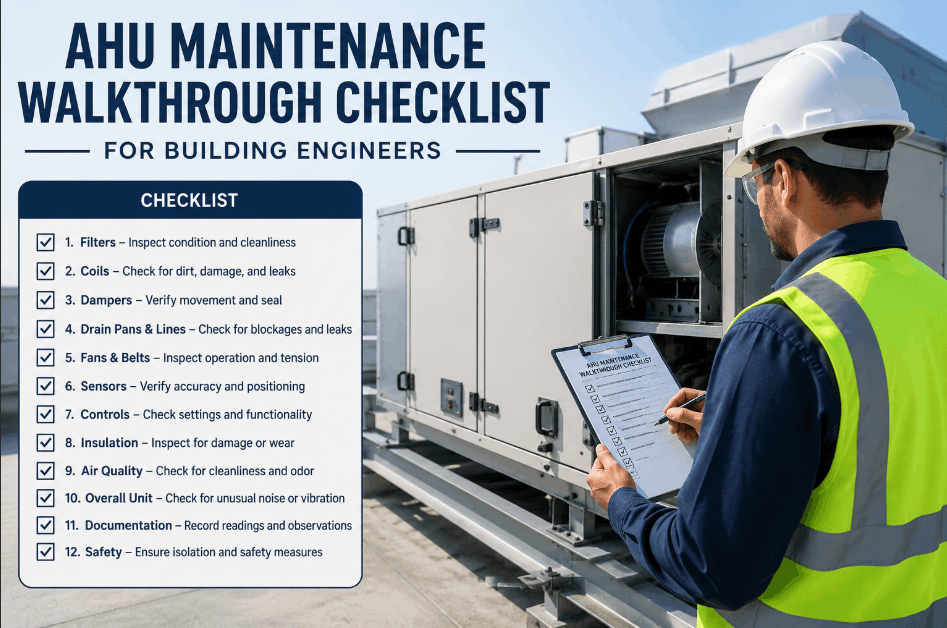
AHU maintenance walkthrough execution is one of the most consistently compressed tasks in building engineering — not because engineers lack the knowledge to inspect thoroughly, but because walkthrough scope is informally defined, inspection items vary by technician rather than by asset condition, and findings are captured on paper that never makes it into the work order system where corrective follow-up can be tracked. When AHU walkthroughs are unstructured, critical wear indicators in filters, coils, drain pans, dampers, and sensors go undocumented until degraded performance creates an occupant complaint or a component failure disrupts building conditioning. The operational gaps are consistent: no standardized inspection sequence, no condition-based findings linked to follow-on work orders, no review of sensor readings against baseline during the walkthrough, and no tracking of which findings were corrected before the next inspection cycle. This checklist helps building engineers, HVAC technicians, and facility maintenance leads confirm that every AHU walkthrough covers the components most likely to affect system stability, air quality, and energy performance before issues compound into unplanned downtime. Oxmaint's Sign Up Free platform gives building teams digital AHU inspection checklists, mobile work order creation at point of discovery, and walkthrough history tracking by unit, zone, and inspection category — so every finding is documented and every corrective action is scheduled before the next walkthrough opens. From filter loading assessment to sensor verification, unstructured AHU walkthroughs are one of the most correctable sources of deferred defects and energy waste in commercial building maintenance. Book a Demo to see how Oxmaint standardizes AHU inspection sequences across your building portfolio — so walkthrough findings drive corrective scheduling rather than disappearing into field notes that no one follows up. Use this checklist before your next AHU walkthrough to confirm that filters, coils, dampers, drains, and sensors are all assessed against defined acceptance criteria rather than general impressions.
1. Filter Assessment & Loading Condition Review
Filter condition is the single highest-impact inspection point in an AHU walkthrough. Loaded filters restrict airflow, increase static pressure, reduce coil efficiency, and accelerate motor wear — all before they fail completely. Confirm that filter condition is assessed against defined loading criteria, not by visual impression alone.
2. Coil Inspection — Condition, Cleanliness & Fin Integrity
Coil condition directly determines AHU thermal performance and energy efficiency. Fouled or mechanically damaged coils degrade heat transfer, reduce airflow, increase system runtime, and create condensation patterns that accelerate drain pan and casing deterioration. Confirm coil condition is assessed systematically during every scheduled walkthrough.
3. Damper Operation & Actuator Verification
Dampers that are stuck, drifting, or operating out of calibration silently degrade AHU performance without triggering alarms or occupant complaints until the deviation is large enough to affect space conditions measurably. Confirm damper position and actuator response are verified at each walkthrough — not assumed to be correct because no alarm has been generated.
4. Drain Pan & Condensate System Inspection
Drain pans and condensate systems are consistently under-inspected during AHU walkthroughs because they require physical access and produce no BAS alarm until the pan is overflowing or the unit trips on a high-water cutout. Confirm drain pan condition and condensate flow are verified at each walkthrough — not deferred to quarterly or annual service cycles.
5. Sensor Verification & Controls Baseline Review
AHU sensors that have drifted from calibration produce control decisions based on incorrect process values — running equipment harder than necessary, underconditioning spaces, or staging additional capacity to compensate for phantom load readings. Confirm that sensor readings are verified against independent measurement at each walkthrough rather than assumed accurate because no fault has been flagged.