The American Innovation and Manufacturing Act — the AIM Act — is the most consequential piece of US HVAC regulation since the Clean Air Act amendments that phased out R-22. Signed into law in December 2020, the AIM Act authorises the EPA to phase down hydrofluorocarbon production and consumption by 85% over 15 years, and it is already reshaping the economics of every HVAC system in the United States that contains R-410A, R-404A, or any other HFC refrigerant. By 2026, HVAC contractors, building operators, and facilities managers are navigating a landscape where R-410A refrigerant prices have risen 40–70% from 2022 baseline, where OEMs have already shifted their residential product lines to low-GWP alternatives, and where the compliance documentation requirements for refrigerant management are tightening. This guide explains exactly what the AIM Act requires, what has already changed, what is coming, and what your HVAC compliance programme needs to do now.
Keep Your Refrigerant Compliance Records AIM Act-Ready
OxMaint tracks refrigerant type, charge weight, service history, and technician certification for every HVAC asset — so EPA audit preparation takes minutes, not days, regardless of which refrigerant your equipment uses.
What Is the AIM Act and What Does It Actually Do?
The American Innovation and Manufacturing Act of 2020 is a federal statute that authorises the EPA to regulate HFCs (hydrofluorocarbons) — the family of refrigerants that includes R-410A, R-404A, R-134a, and dozens of other compounds widely used in HVAC, refrigeration, and automotive air conditioning equipment. Before the AIM Act, the EPA's authority to regulate HFCs had been challenged successfully in court, leaving the US without a clear legal basis for HFC restrictions. The AIM Act resolves that by giving the EPA explicit statutory authority to phase down HFC production and consumption, restrict their use in specific sectors and equipment types, and promote the adoption of safer alternatives.
The Act does not set a single "ban date" for any specific refrigerant. Instead, it establishes a framework under which EPA regulations progressively restrict which HFCs can be used in which applications, with timelines that vary by equipment category, refrigerant type, and whether the equipment is new or existing. Understanding this framework — rather than looking for a single headline date — is essential for HVAC professionals making decisions about equipment specification, refrigerant inventory, and service capability. Book a demo to see how OxMaint structures refrigerant compliance records for AIM Act requirements.
The Three Pillars of AIM Act Regulation: Phasedown, Restrictions, and Reclamation
The AIM Act operates through three distinct regulatory mechanisms. Each has a different practical consequence for HVAC contractors, building operators, and maintenance teams. Understanding all three is the foundation of an AIM Act-compliant refrigerant management programme. Sign up free to see how OxMaint tracks compliance requirements across all three mechanisms for your HVAC asset portfolio.
The HFC Phasedown Schedule
The phasedown is a cap on total HFC production and consumption in the US, expressed as a percentage of a historical baseline level. Each cap reduction step cuts how many HFC tonnes the US can produce and import — which directly reduces supply of high-GWP refrigerants including R-410A and drives up their price as the cap tightens.
- 2022: 90% of baseline — first phasedown milestone already in effect
- 2024: 60% of baseline — significant supply constraint driving the 2022–2024 price increases
- 2029: 30% of baseline — the steepest single step drop in the schedule
- 2034: 20% of baseline
- 2036: 15% of baseline — effectively the long-term operating level
Technology Transitions and Sector-Specific Use Restrictions
Separate from the overall phasedown, the AIM Act authorises EPA to issue "technology transitions rules" that restrict which HFCs can be used in specific equipment categories and when. These rules are the primary mechanism driving OEM product line changes — they set dates by which new equipment in a given category must use a refrigerant below a specified GWP threshold. The rules distinguish between new equipment and equipment already in the field at the effective date.
- Consumer comfort cooling (residential and light commercial AC): R-410A use in new equipment being phased out under SNAP rule updates
- Commercial refrigeration: restrictions already in effect for new equipment in many applications
- Automotive AC: R-1234yf now standard — R-134a restricted in new vehicles since model year requirements took effect
- Existing equipment in the field: may continue to operate and be serviced with the original refrigerant type throughout its useful life
Refrigerant Reclamation and Handling Requirements
The AIM Act includes provisions strengthening refrigerant reclamation requirements — the recovery, recycling, and reclaim rules that already exist under EPA Section 608. The Act builds on these requirements, with the EPA using its AIM Act authority to tighten standards for who can sell refrigerants, how recovered refrigerant must be handled, and what purity standards reclaimed refrigerant must meet before it can be resold. These requirements affect both the supply side (refrigerant manufacturers and reclaimers) and the demand side (contractors who recover refrigerant in the field).
- Sales restrictions on certain HFCs to certified technicians only — same framework as Section 608
- Reclaimed refrigerant standards tightened — affects availability and cost of recovered HFCs as virgin supply is restricted
- Enhanced record-keeping requirements for refrigerant transactions and technician certification
- Documentation requirements increasingly important as EPA enforcement focus on HFC management grows
AIM Act Timeline: What Has Already Happened and What Is Coming
The AIM Act's phasedown is already in effect and already changing refrigerant economics across the US HVAC market. The timeline below maps the milestones that have passed, those that are current, and those that HVAC professionals need to plan for now. The most important planning horizon for building operators is the 2029 step-down, when the phasedown cap drops from 60% to 30% of baseline — the steepest single reduction in the schedule.
First Phasedown Step: 90% of Baseline — Prices Begin Rising
The AIM Act's first HFC phasedown step took effect, reducing allowed US production and consumption to 90% of the 2011–2013 baseline. This step alone began tightening supply of R-410A and other high-GWP HFCs. Bulk R-410A prices began rising noticeably from late 2021 into 2022 as the market adjusted to the new supply ceiling. Contractors and building operators who had not yet noticed the regulatory change began feeling its economic effects in their annual refrigerant procurement and service costs.
60% of Baseline — Most Disruptive Step to Date for R-410A Pricing
The phasedown dropped to 60% of baseline in 2024, the sharpest single-step reduction in the early schedule. This step is the primary driver of the 40–70% R-410A price increase from 2022 levels that HVAC contractors and facilities managers are experiencing in 2026. OEMs have already responded by transitioning residential product lines to R-32 and R-454B. The technology transitions rules under the AIM Act have established effective dates for new equipment in the residential and light commercial comfort cooling category to transition to lower-GWP refrigerants — meaning new R-410A split systems and heat pumps in this category are no longer commercially available from most major OEMs as of the applicable effective dates.
Technology Transition Rules for Commercial Equipment Take Effect
EPA's technology transitions rules under the AIM Act establish effective dates for commercial HVAC and refrigeration equipment categories to transition to lower-GWP refrigerants in new equipment. The specific effective dates vary by equipment category — commercial split systems, rooftop units, chiller systems, and commercial refrigeration each have category-specific timelines. Building operators and facilities managers planning capital expenditure on commercial HVAC equipment during this window should confirm that new equipment specifications align with the applicable AIM Act effective date for their equipment category, rather than assuming that currently-available commercial R-410A equipment will remain compliant for new installations through 2028.
30% of Baseline — The Steepest Single-Step Reduction
The 2029 step drops the HFC cap from 60% to 30% of baseline — the largest single reduction in the entire phasedown schedule. This step is expected to produce the most significant single disruption to HFC availability and pricing. Building operators still running large R-410A fleets in 2029 will face the highest combination of refrigerant cost, scarcity, and maintenance budget pressure since the AIM Act's introduction. The 2025–2028 window represents the optimal planning horizon for facilities managers to model which assets should be prioritised for refrigerant transition ahead of this step.
15–20% of Baseline — Effective End State for HFC Production
By 2036, US HFC production and consumption will be at 15% of the 2011–2013 baseline — a near-total phasedown of high-GWP HFCs for new equipment applications. The economics of servicing remaining legacy R-410A equipment with virgin refrigerant will be prohibitive for most building operators at this stage. Reclaimed and recovered refrigerant will be the primary supply source for legacy equipment, at prices far above current levels. HVAC equipment purchased today with a 15–20 year expected lifespan should be specified for low-GWP refrigerants to avoid mid-life refrigerant availability and cost exposure in this period.
What the AIM Act Means for Existing R-410A Equipment
One of the most common misunderstandings about the AIM Act is that it immediately prohibits the use of R-410A or requires existing equipment to be replaced. This is not correct. The AIM Act's equipment restrictions apply to new equipment — existing equipment already in operation at the time a technology transition rule takes effect is generally grandfathered and may continue to be operated and serviced with its original refrigerant for the remainder of its useful life. The practical impact on existing R-410A equipment is economic, not regulatory — and it is already being felt. Sign up free to track your existing R-410A fleet's service costs and model your transition timing.
Rising Refrigerant Cost and Increasing Scarcity
The economic impact on existing R-410A equipment is real and compounding. The phasedown directly reduces the supply of R-410A available for service — meaning each service event on a legacy R-410A system will cost progressively more as the phasedown schedule tightens. Facilities managers should model the refrigerant cost escalation trajectory for their R-410A fleet against the capital cost of transition when planning equipment replacement cycles.
- Refrigerant cost per kg rising 40–70% from 2022 — with further increases locked in through 2029
- Refrigerant availability tightening — especially for large top-up volumes on aging equipment with higher leak rates
- Reclaimed refrigerant becoming the primary supply source as virgin supply shrinks
- Service cost per event increasing as refrigerant represents a larger share of total repair cost
Operation and Service of Existing Equipment Continues
Existing R-410A equipment that was in operation before the applicable technology transition effective date is not required to be replaced or retrofitted under the AIM Act. It can continue to operate, be serviced, and be recharged with R-410A (while it remains available) throughout its operational life. The grandfathering applies to operation — not to future new installations.
- No mandate to replace operating R-410A equipment ahead of its designed end of life
- Continued service and recharge of existing R-410A equipment is lawful
- Equipment decisions are driven by economics and operational reliability, not by regulatory deadline
- New installations in restricted equipment categories must use compliant lower-GWP refrigerants from the applicable effective date
Documentation and Record-Keeping — The Growing Obligation
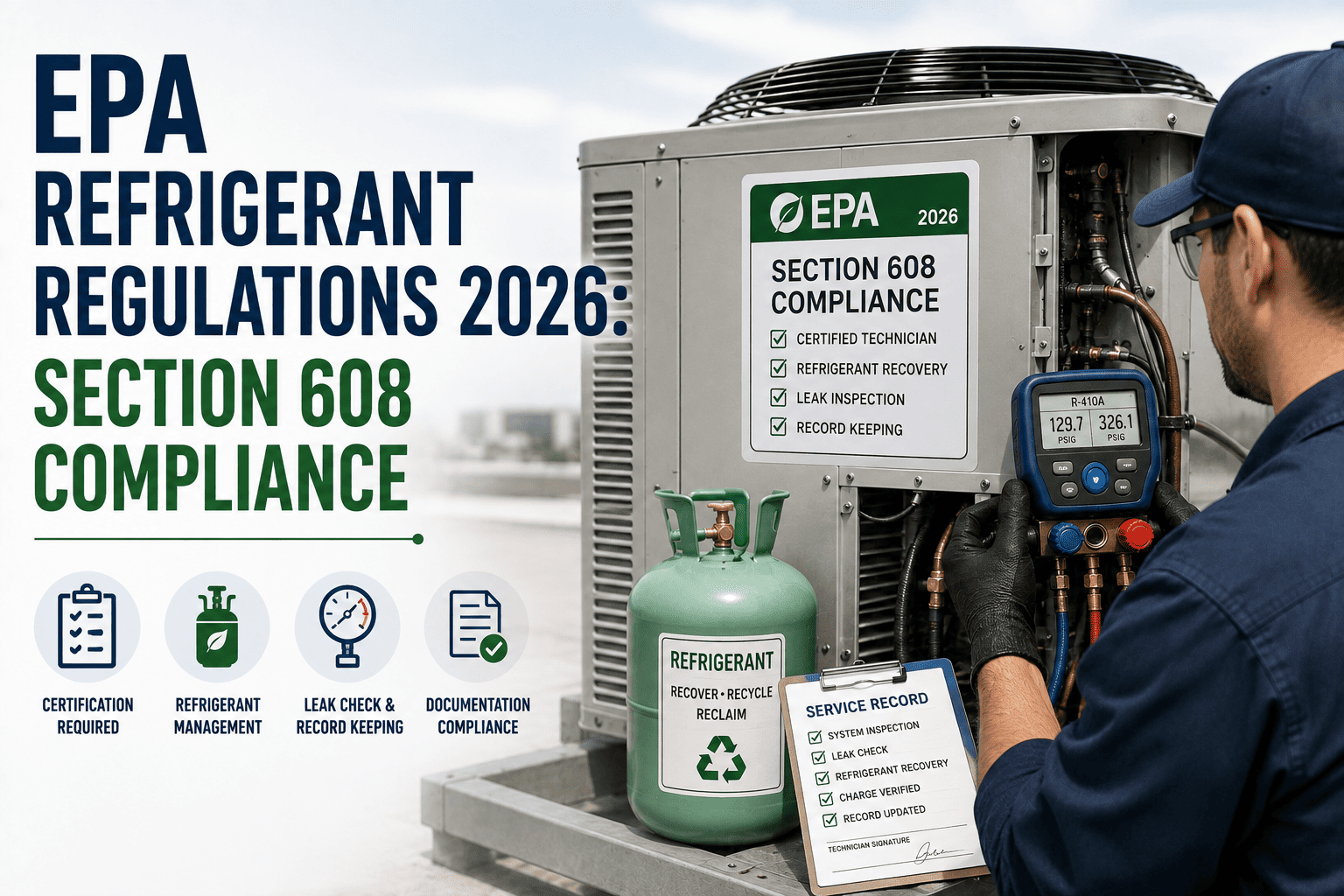
While existing equipment is grandfathered for operation, the AIM Act strengthens the documentation and record-keeping requirements that apply to refrigerant service events. EPA Section 608 compliance remains mandatory, and the AIM Act enforcement environment is increasing scrutiny of service records, technician certifications, and refrigerant recovery documentation.
- EPA Section 608 technician certification required for all refrigerant handling — no change but increasing enforcement
- Refrigerant recovery documentation required at every service event where refrigerant is removed
- Equipment with charges above 50 lbs subject to leak inspection and repair requirements
- Records of refrigerant type, quantity added, and disposal must be maintained — CMMS is the most defensible format
AIM Act Compliance Checklist for HVAC Contractors and Building Operators
Compliance with the AIM Act and its implementing regulations is not a single action — it is an ongoing operational requirement that touches equipment specification, technician certification, service documentation, and refrigerant procurement. The checklist below organises the actions that HVAC contractors and building operators need to have in place to maintain compliance across their operations in 2026 and beyond. Book a demo to see how OxMaint automates the documentation and tracking elements of this checklist.
Technician EPA 608 Certification — Current and Documented
Every technician who purchases, handles, or recovers refrigerant must hold current EPA Section 608 certification for the relevant equipment category. The AIM Act does not change this requirement, but its enforcement context does — as HFC supply tightens and refrigerant has higher economic value, EPA enforcement of certification requirements at the point of refrigerant purchase and during service is increasing. Maintain a record of every technician's certification number, category, and expiry status in your CMMS.
Refrigerant Inventory by Asset — Type, Charge Weight, GWP
Maintain a current refrigerant inventory at asset level showing the refrigerant type, original charge weight, and GWP for every piece of HVAC equipment under your management. This inventory is the foundation of AIM Act compliance — it enables you to calculate your total HFC portfolio GWP equivalent, identify assets that will be most economically impacted by rising refrigerant costs, and demonstrate to regulators that your refrigerant management is organised and documented.
Refrigerant Service Records — Per Event, Per Asset
Every service event involving refrigerant — leak check, recharge, recovery, or disposal — must be documented with the asset ID, date, refrigerant type, quantity added or recovered, and the technician's EPA certification number. Paper records are legally acceptable but create the same document management problems that make compliance defence difficult. CMMS-based service records are searchable, attributable, and exportable in a format that satisfies EPA audit requests without manual assembly.
Leak Detection and Repair — Mandatory for Larger Systems
Systems with 50 lbs or more of regulated refrigerant are subject to EPA Section 608 leak detection and repair requirements — mandatory leak inspections at defined intervals, mandatory repair timelines when leaks are found, and documentation of the leak rate, inspection method, and repair outcome. The AIM Act has not changed these thresholds but has increased the EPA's emphasis on enforcement. Leak inspection work orders should be created on a scheduled basis and completed with mandatory fields in your CMMS.
New Equipment Specification — AIM Act Compliant From Applicable Date
Any new equipment installation in a category covered by an AIM Act technology transition rule must use a refrigerant that meets or is approved under the applicable rule. For residential and light commercial comfort cooling, this means specifying R-32 or R-454B equipment from OEMs who have transitioned their product lines. Verify the applicable effective date for each equipment category before specifying new equipment — the effective dates differ between equipment categories and between new equipment manufacture and new equipment installation.
Refrigerant Transition Planning — Capital Budget Integration
Develop a refrigerant transition plan that maps your existing equipment fleet by age, refrigerant type, and remaining useful life against the AIM Act phasedown schedule and price trajectory. Equipment approaching end of life between now and 2029 should be replaced with low-GWP alternatives rather than run to failure — both to avoid the refrigerant cost exposure of the 2029 step-down and to take advantage of efficiency gains available in the new equipment generation. This plan should be integrated into your annual capital budget process, not managed as a separate environmental initiative.
R-410A vs Low-GWP Alternatives: Which Refrigerant for Which Application
Understanding where each refrigerant fits in the post-AIM Act equipment landscape is essential for making correct specification decisions. The table below reflects the current (2026) state of the market — what is available, what is approved, and what OEMs are shipping in each application category.
| Application Category | Legacy Refrigerant | AIM Act Approved Alternative | GWP Reduction | 2026 Market Status |
|---|---|---|---|---|
| Residential splits and heat pumps | R-410A (GWP 2,088) | R-32 (GWP 675) | 68% lower | Transition substantially complete — R-32 equipment standard from all major OEMs |
| Light commercial splits and VRF | R-410A (GWP 2,088) | R-32 or R-454B (GWP 466) | 68–78% lower | Transitioning — both refrigerants available in new equipment, OEM-dependent |
| Commercial rooftop units and packaged AC | R-410A (GWP 2,088) | R-454B (GWP 466) | 78% lower | Transitioning — Carrier, Lennox, Trane introducing R-454B commercial lines |
| Commercial refrigeration — supermarket | R-404A (GWP 3,922) | R-448A, R-449A, CO₂ (R-744) | 60–100% lower | Transition advanced — R-404A new equipment restrictions already in effect |
| Commercial refrigeration — stand-alone | R-404A / R-134a | R-290 (GWP 3) — hermetic equipment | 99.9% lower | Well established — R-290 dominant in European-spec and many US display cabinets |
| Large centrifugal chillers | R-134a (GWP 1,430) | R-1234yf or R-515B (GWP 4–299) | 79–99% lower | Transitioning — major chiller OEMs offer low-GWP options on new equipment |
| Automotive AC | R-134a (GWP 1,430) | R-1234yf (GWP 4) | 99.7% lower | Complete — R-1234yf mandated in new vehicles, effectively universal |
Track AIM Act Compliance Across Your Entire HVAC Portfolio
OxMaint stores refrigerant type, GWP, charge weight, service history, technician certification, and leak check records for every HVAC asset — producing audit-ready compliance documentation for EPA Section 608 and AIM Act requirements without manual record assembly.
Frequently Asked Questions: AIM Act 2026 for HVAC Professionals
QIs R-410A banned in the US in 2026?
Not in the sense of a complete prohibition. The AIM Act does not ban R-410A in existing equipment — systems already in operation containing R-410A may continue to operate and be serviced. What has changed is that new equipment in certain categories can no longer be manufactured or sold using R-410A from the applicable technology transition effective dates, and the supply of virgin R-410A for service is shrinking progressively as the HFC production phasedown tightens the overall cap. The economic effect of this restriction is already significant — R-410A prices have risen 40–70% from 2022 levels and will continue rising as the 2029 cap reduction approaches. "Banned" is an oversimplification; "economically constrained and progressively unavailable for new installations" is more accurate.
QCan I still buy R-410A refrigerant for servicing existing equipment?
Yes — R-410A remains available for purchase and use in servicing existing equipment in 2026. The AIM Act restricts total HFC production and consumption through a cap-and-trade mechanism, but it does not prohibit the sale or use of R-410A for servicing equipment that was already in operation. What changes over time is the available supply and therefore the price. Virgin R-410A for service will become progressively more expensive and harder to source as the phasedown cap tightens — particularly after the 2029 step to 30% of baseline. Reclaimed and recovered refrigerant, processed to meet purity standards, will become an increasingly important part of the supply available for legacy equipment servicing.
QWhat documentation does the AIM Act require me to keep as a building operator?
The AIM Act implements and in some areas strengthens the EPA Section 608 documentation requirements that have applied to refrigerant-containing equipment for decades. For building operators with systems containing 50 lbs or more of regulated refrigerant, the requirements include: maintaining records of the refrigerant type, charge size, and location of each affected appliance; documenting all leak inspections with dates, methods, and outcomes; recording all service events involving refrigerant with quantities added or recovered; keeping records of technician certification numbers for all refrigerant-handling work; and documenting the disposal of refrigerant-containing equipment. Records must be maintained for at least three years and be available for EPA inspection on request. CMMS-based records are significantly easier to produce on demand than paper records — which is why regulators and auditors increasingly view CMMS systems as a positive indicator of compliance maturity.
QMy existing rooftop unit uses R-410A and is 7 years old. Should I replace it now or run it to end of life?
This is the decision most facilities managers are working through in 2026, and the answer depends on three variables: the unit's current condition, its expected remaining useful life, and the refrigerant cost trajectory for R-410A. A rooftop unit at 7 years in good condition with well-maintained coils and compressor may have 8–12 years of remaining useful life. Running it to that point means absorbing 8–12 more years of rising R-410A refrigerant costs — including the significant price jump expected after the 2029 phasedown step. If the unit is in poor condition, has a high leak rate, or is approaching a major component replacement decision, the economic case for early replacement with an R-454B unit is typically strong. The calculation should be: projected refrigerant and service costs through assumed end of life, versus capital cost of early replacement amortised over the new unit's life. Model both scenarios in your CMMS using current and projected refrigerant cost inputs before making the decision.
QWhat happens to refrigerant pricing after the 2029 AIM Act step-down?
The 2029 reduction from 60% to 30% of baseline is the steepest single step in the AIM Act phasedown schedule. Its effect on R-410A and other high-GWP HFC pricing will depend on several factors: how efficiently the reclaimed refrigerant supply chain has developed by 2029, how quickly the overall installed base of R-410A equipment has transitioned, and whether any regulatory relief or adjustment is granted by EPA for specific equipment categories with transition challenges. The most likely outcome is a significant price increase — industry analysts estimate R-410A could reach $40–$70 per kg by 2029–2030, compared to approximately $12–$15 per kg in 2022 before the phasedown effects began. The practical implication for facilities managers is that any R-410A equipment still in operation in 2029 will carry substantially higher annual maintenance costs than the same equipment operated and serviced today.
QHow does a CMMS help with AIM Act compliance specifically?
A CMMS addresses the AIM Act's most operationally demanding compliance requirement — the need to maintain accurate, auditable records of refrigerant management across every asset in your portfolio simultaneously, at all times, without relying on manual record assembly. Specifically: it stores the refrigerant type, GWP, and charge weight for every HVAC asset at the asset level; it records refrigerant quantities added and recovered at every service event as part of the work order; it tracks technician EPA certification numbers and expiry dates; it schedules and records mandatory leak inspections for systems above the 50 lb threshold; and it produces an exportable refrigerant inventory and service history report that satisfies EPA record inspection requests without manual compilation. When an EPA inspector asks for your refrigerant service records, the difference between a CMMS-documented programme and a filing cabinet of paper forms is the difference between a 30-minute records production and a two-week search exercise.