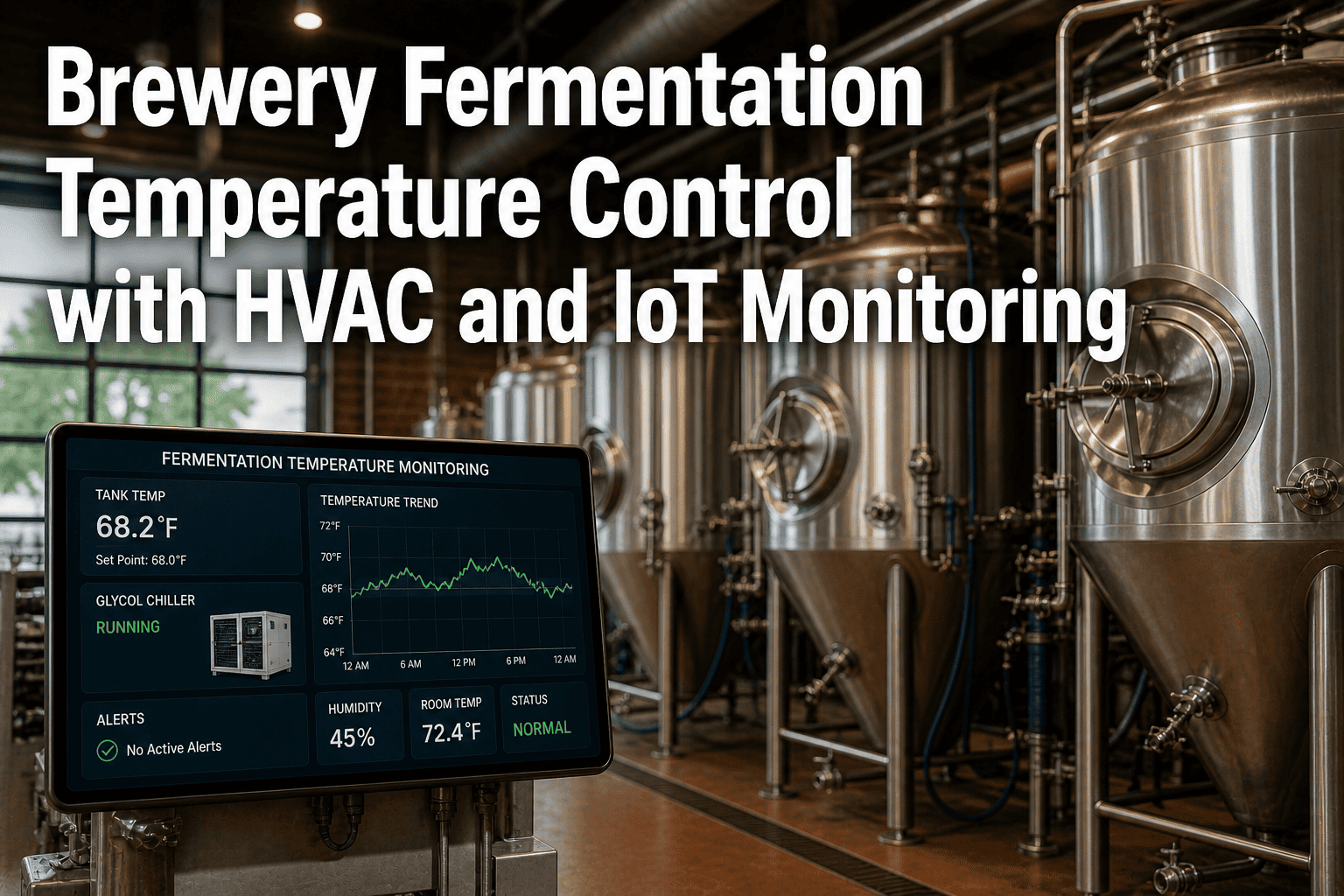
Fermentation temperature is not a comfort setting — it is a product quality control variable. A two-degree variance during primary fermentation can shift yeast behaviour, produce off-flavours, and cost a brewery an entire batch. Ridgeline Craft Brewing Co. produces 14,000 barrels annually across 22 fermentation vessels and integrated OxMaint CMMS with its glycol chiller network to achieve continuous temperature monitoring, automated alert escalation, and preventive maintenance scheduling for every piece of process cooling equipment on the floor.
Case Study · Food & Beverage Manufacturing
Brewery Fermentation Temperature Control with HVAC and IoT Monitoring
Glycol Chiller Monitoring · Fermentation Variance Alerts · Predictive HVAC Maintenance
Live Fermentation Monitor
● Live · OxMaint IoT
0
Batch Losses in 12 Months
±0.3°C
Temperature Variance Achieved
67%
Reduction in Emergency Chiller Callouts
4 min
Average Alert-to-Response Time
The Challenge: Temperature Drift Goes Undetected Until It Is Too Late
Before IoT integration with OxMaint, Ridgeline's brewers checked fermentation temperatures manually three times per shift using handheld probes. Between checks — sometimes a 4-hour window — glycol chiller faults, refrigerant pressure drops, or flow restrictions could allow vessel temperatures to drift outside the acceptable range for the active yeast strain. By the time the next check caught the variance, the yeast had already experienced stress conditions that affected attenuation and flavour profile.
Glycol chiller PM was scheduled quarterly on a calendar basis regardless of runtime hours or refrigerant pressure trends. Two chiller failures occurred in the 18 months prior to OxMaint deployment — one during peak production — resulting in a total batch write-off valued at $28,000.
Before
Manual checks every 4–5 hours per vessel
Chiller PM on calendar schedule only
No alert for refrigerant pressure drop
$28K batch loss in 18 months
After OxMaint
Continuous IoT monitoring — alert within 90 sec
PM triggered by runtime hours and pressure thresholds
Automated escalation to on-call technician
Zero batch losses in 12 months post-deployment
How OxMaint IoT Integration Was Configured
Week 1–2
Sensor Mapping and Asset Registration
Temperature sensors on all 22 fermentation vessels and glycol supply/return lines were connected to OxMaint's IoT gateway. Each chiller, pump, and heat exchanger was registered as an asset with criticality rating and PM interval.
Week 3
Alert Thresholds Configured per Beer Style
Different yeast strains and fermentation programmes require different temperature tolerances. OxMaint allowed the head brewer to configure threshold bands per vessel by active recipe — lagers at 9–11°C, ales at 18–22°C — with automated work order generation on breach.
Week 4
Predictive PM Triggers Activated
Chiller PM was reconfigured from calendar-based to runtime-hour and pressure-trend triggers. OxMaint flags refrigerant pressure trends that precede compressor failure 2–3 weeks ahead, allowing parts to be pre-staged before failure occurs.
Week 6+
Escalation Workflows and Reporting Live
Unacknowledged alerts escalate automatically to the on-call technician after 5 minutes, and to the head brewer after 15 minutes. Monthly IoT analytics reports show vessel temperature histories, alert frequency, and chiller performance trends.
12-Month Performance Results
| Performance Metric |
Pre-OxMaint (18 months) |
Post-OxMaint (12 months) |
Improvement |
| Temperature excursions detected within 10 min |
18% |
98% |
+80 pts |
| Batch quality failures linked to temp drift |
3 batches |
0 batches |
−100% |
| Emergency chiller callouts |
9 callouts |
3 callouts |
−67% |
| Mean time to respond to temp alert |
4.5 hours (manual check) |
4 minutes (automated alert) |
−98% |
| Planned vs reactive chiller maintenance |
41% planned |
84% planned |
+43 pts |
"
As a brewer, temperature is everything. If the fermentation vessel drifts by two degrees during primary fermentation and nobody catches it for four hours, you are no longer making the beer you planned. OxMaint eliminated that blind spot completely. The alert comes through in under two minutes and the work order is already in the technician's queue before I have finished reading the notification. We have not lost a batch to temperature control in over a year. For a craft brewery at our volume, that translates directly to margin.
Jakob Steiner, IBD Diploma
Head Brewer — Ridgeline Craft Brewing Co. · 14 Years Brewing and Process Engineering · Institute of Brewing and Distilling Diploma · Specialising in fermentation process control, glycol system reliability, and brewery CMMS integration
Fermentation Temperature Reference — Common Beer Styles
Lager
8–12°C
Alert at ±1.5°C variance
Ale
18–22°C
Alert at ±2°C variance
Wheat Beer
17–20°C
Alert at ±1.5°C variance
Sour / Wild Ale
22–28°C
Alert at ±3°C variance
Stop Discovering Fermentation Drift on the Next Manual Check
OxMaint IoT integration puts a continuous temperature monitor on every fermentation vessel and an automatic work order in your technician's queue the moment something drifts.
Frequently Asked Questions
Can OxMaint integrate with our existing glycol chiller sensors and temperature probes?
OxMaint's IoT gateway supports standard industrial sensor protocols including Modbus, BACnet, and 4–20mA analog inputs, which cover the majority of glycol chiller monitoring hardware and fermentation vessel temperature probes used in craft and commercial brewing. Where existing sensors are already installed, OxMaint can typically connect without additional hardware investment. For facilities starting from scratch, OxMaint's team provides a sensor selection guide optimised for the monitoring frequency required at your production volume. Once connected, every sensor reading is visible on the OxMaint dashboard and alert thresholds can be configured per vessel, per beer style, or per fermentation stage.
Book a demo to review your current sensor infrastructure with OxMaint's integration team.
How does OxMaint handle alert escalation when a fermentation temperature excursion occurs outside business hours?
OxMaint's escalation workflows are fully configurable by time of day, day of week, and alert severity. For a fermentation temperature breach, the typical configuration sends an immediate push notification and SMS to the on-call technician. If the alert is not acknowledged within a defined window — typically 5 minutes for critical process alerts — it automatically escalates to the head brewer or production manager. A second escalation tier can be set for senior management if the breach is not resolved within 30 minutes. All escalation acknowledgements and resolution actions are logged automatically in the work order, creating a complete response audit trail.
Start a free trial to configure your brewery's escalation workflow.
Does OxMaint only work for large breweries or can smaller craft operations benefit from IoT monitoring?
OxMaint scales from 4-vessel craft operations to 100+ vessel commercial breweries. For smaller craft breweries, the most immediate value is often not in the IoT layer but in the PM scheduling and work order management layer — getting filter changes, chiller services, and glycol concentration checks tracked and auto-reminded before they are missed. IoT monitoring is then added as an optional module when the team is ready. Ridgeline Craft Brewing deployed work order management in week one and added IoT temperature monitoring in week three — achieving full integration in under a month without disrupting production.
Book a demo tailored to your brewery size and production volume.
OxMaint · Brewery IoT Monitoring
Your Fermentation Process Runs 24 Hours. Your Temperature Monitoring Should Too.
OxMaint connects your glycol chillers, fermentation vessels, and process cooling systems into a single live dashboard — with automatic alerts, PM scheduling, and zero-gap monitoring.