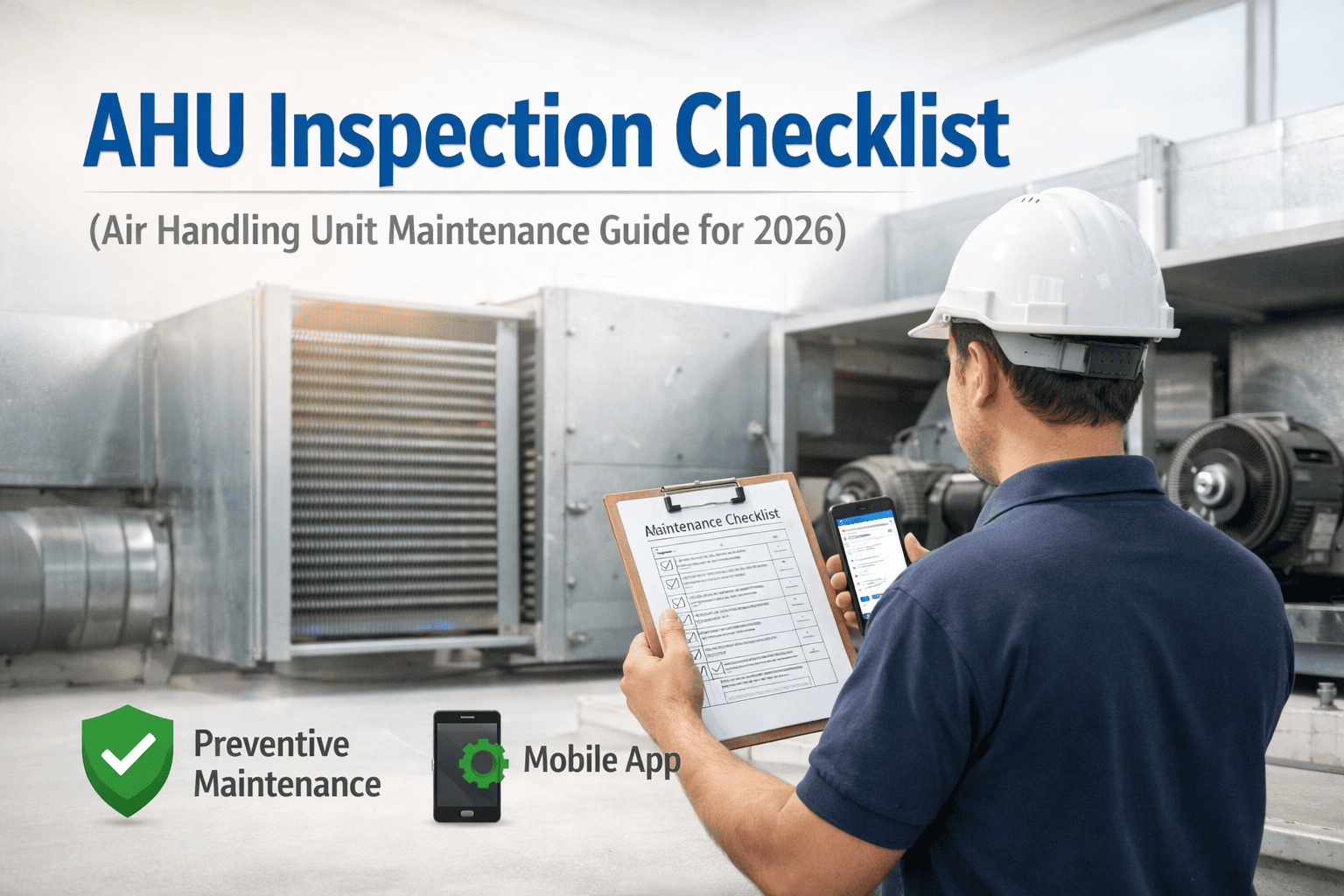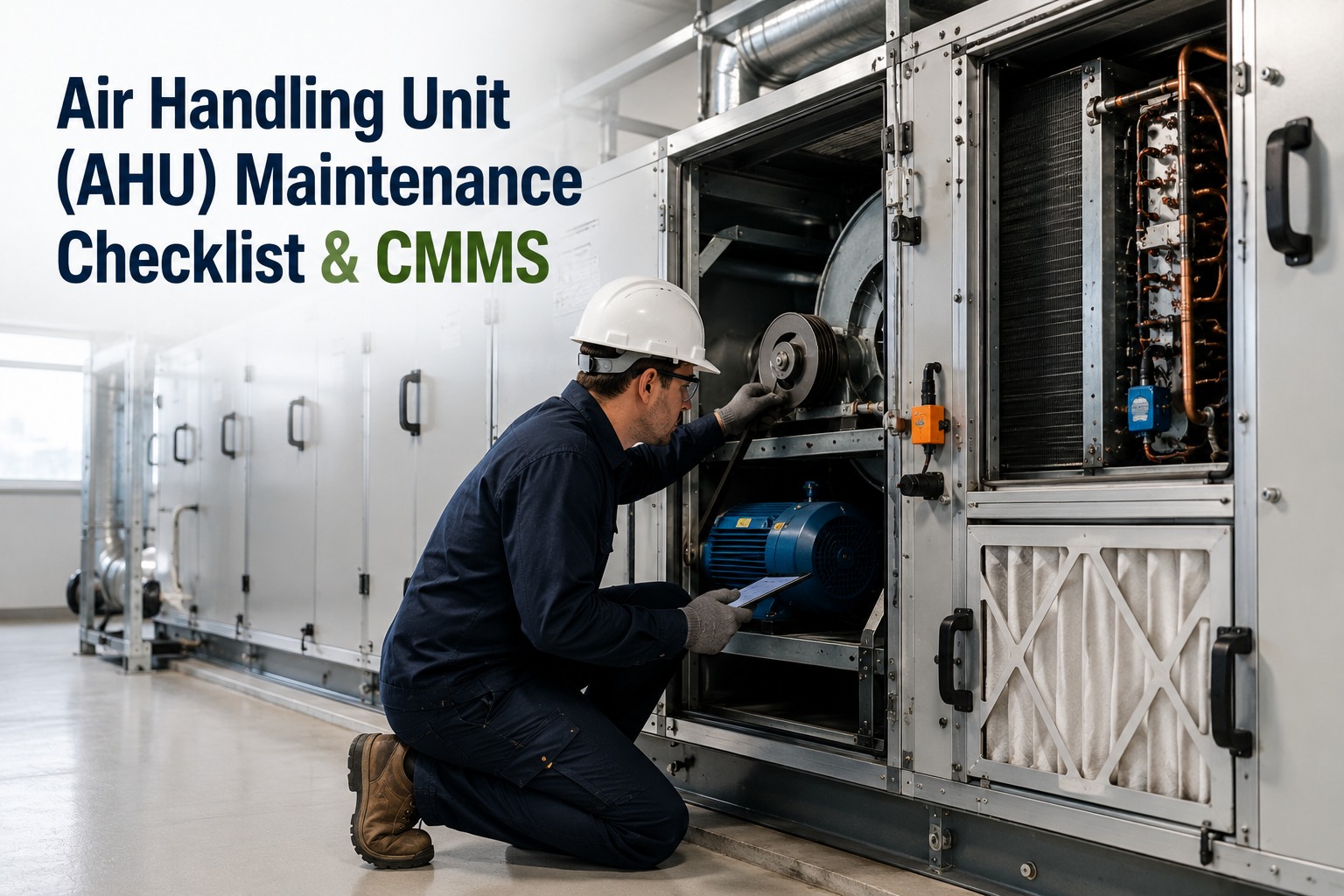
An air handling unit runs 8,760 hours a year moving 10,000+ CFM through coils, filters, dampers, and belts — yet most facilities only open the cabinet when a complaint lands. A structured AHU maintenance checklist paired with a CMMS drops unplanned downtime by 30–50% and extends fan-bearing life from a typical 4 years to 7+. This guide breaks preventive tasks by frequency, then maps them to work-order automation in Start Free Trial, so technicians execute, log, and trend every inspection without spreadsheets.
Every missed filter change costs $0.42 per CFM in wasted fan energy.
A 10,000-CFM unit running on a clogged 2-inch pleat wastes roughly $4,200/yr in extra motor load and shortens belt life by 40%. This checklist plus CMMS-driven scheduling recovers that loss in under one quarter.
- Filter differential & MERV ratings
- Fan belt tension & sheave alignment
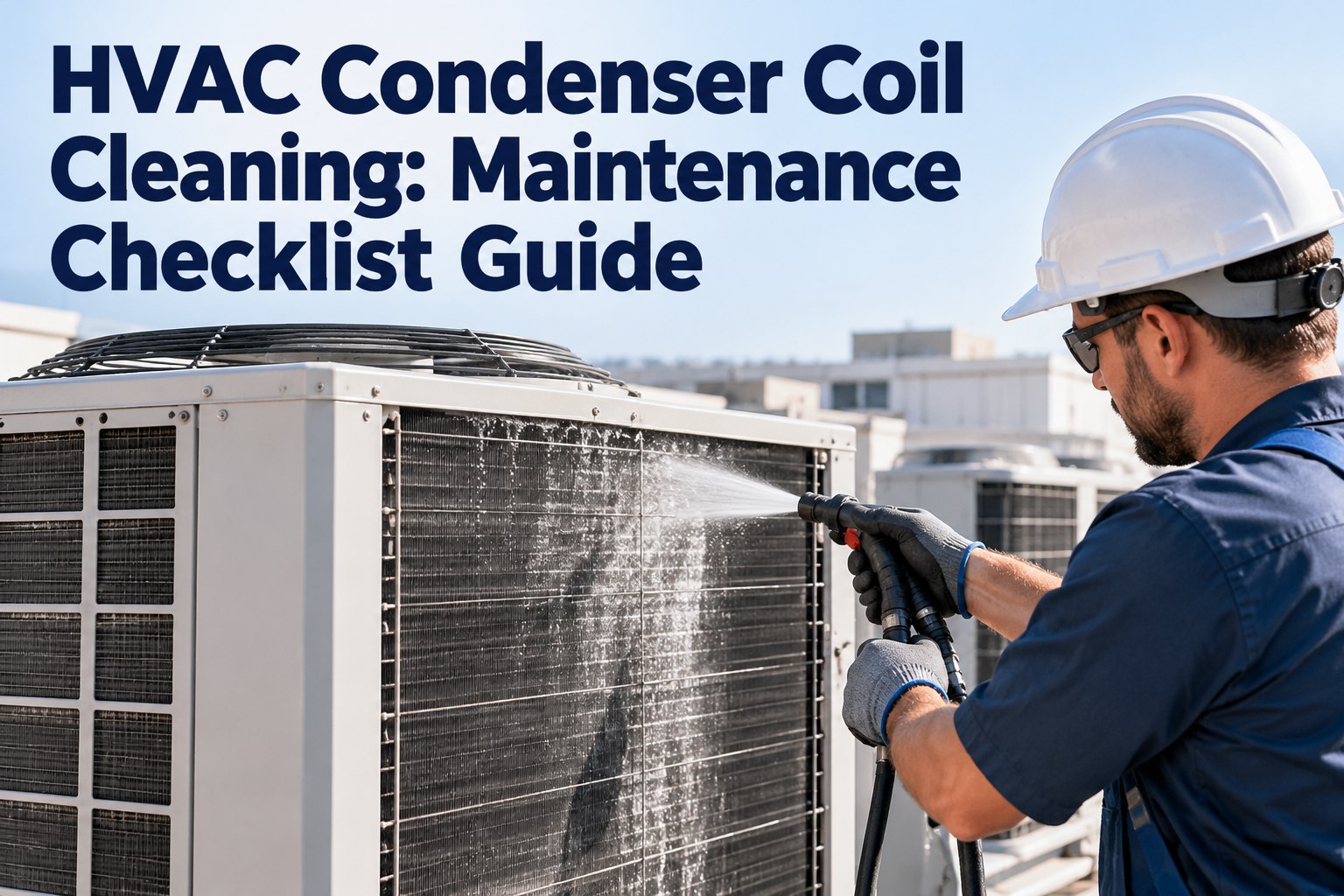
- Coil cleaning & condensate drainage
- Damper actuator & sensor calibration
Weekly walkthrough: catch the 15-minute failures before they cascade
Roughly 62% of AHU breakdowns trace to four items a technician can verify in under a minute each: filter pressure drop, belt tension, condensate trap seal, and unusual vibration. Do these every Monday morning before the building fills.
Filter differential pressure
Read the magnehelic gauge. Replace filters at 0.8 in. w.g. for 2-inch pleats or 1.0 in. w.g. for 12-inch mini-pleats — not when they "look dirty." A 0.2 in. w.g. overshoot adds ~6% to fan motor kWh.
Target: < 0.8 in. w.g.Fan belt tension & deflection
Deflect the belt midpoint 1/64 in. per inch of span. A belt at 25% under-tension slips, sheds rubber, and drops fan RPM by 8–12% — directly cutting airflow to occupied zones.
Target: 1/64 in. per span inchCondensate trap & drain pan
Confirm the trap is primed and the pan drains freely. A dry trap lets sewer air backdraft through the coil; a clogged pan overflows onto ceilings within 48 hours during peak cooling.
Target: free flow, no standing waterVibration & noise scan
Stand at the access door and listen. A new whine, thump, or hum usually points to a bearing race failing — the window between abnormal sound and seized shaft is typically 2–6 weeks.
Target: baseline < 0.15 in/s RMSMonthly PM: the six tasks that keep coils clean and airflows balanced
A single 0.04-inch biofilm on a cooling coil cuts heat-transfer efficiency by 21% and raises leaving-air temperature 2–4°F. Monthly cleaning and calibration hold rated capacity and protect downstream ductwork from microbial growth.
| Task | Acceptance Criteria | Time | CMMS Trigger |
|---|---|---|---|
| Coil face cleaning | Visual inspection — no debris, biofilm, or fin damage; fin comb passes | 45 min | Recurring monthly WO |
| Damper stroke test | Full travel 0–100%, modulating signal tracks within ±2% of BMS command | 20 min | Recurring monthly WO |
| Mixed-air sensor calibration | Compare to NIST-traceable probe; drift < 1°F | 15 min | Recurring monthly WO |
| Belt sheave alignment | Straightedge across both sheaves — gap < 1/32 in. at any point | 25 min | Recurring monthly WO |
| Motor amperage vs. nameplate | All three phases within ±5% of FLA; imbalance < 2% | 10 min | Recurring monthly WO |
| UV-C lamp output (if equipped) | Meter reading > 80% of lamp-rated µW/cm²; replace at 9,000 hrs | 15 min | Hour-meter WO |
Quarterly deep PM: bearings, sensors, and the efficiency math that justifies labor
Every 90 days a deeper 3-hour service window catches slow-moving degradation — bearing wear, sensor drift, heat-exchanger fouling — that weekly and monthly checks miss. Below is the efficiency recovery math for a 10,000-CFM unit serving a 24/7 office.
Annual overhaul timeline: 12 months, 8 milestone tasks, one shutdown window
The annual AHU shutdown is where you either buy another decade of service or accelerate failure. Stack the heavy work — bearing replacement, coil descaling, motor meggering — into a single 8-hour window while the building is unoccupied.
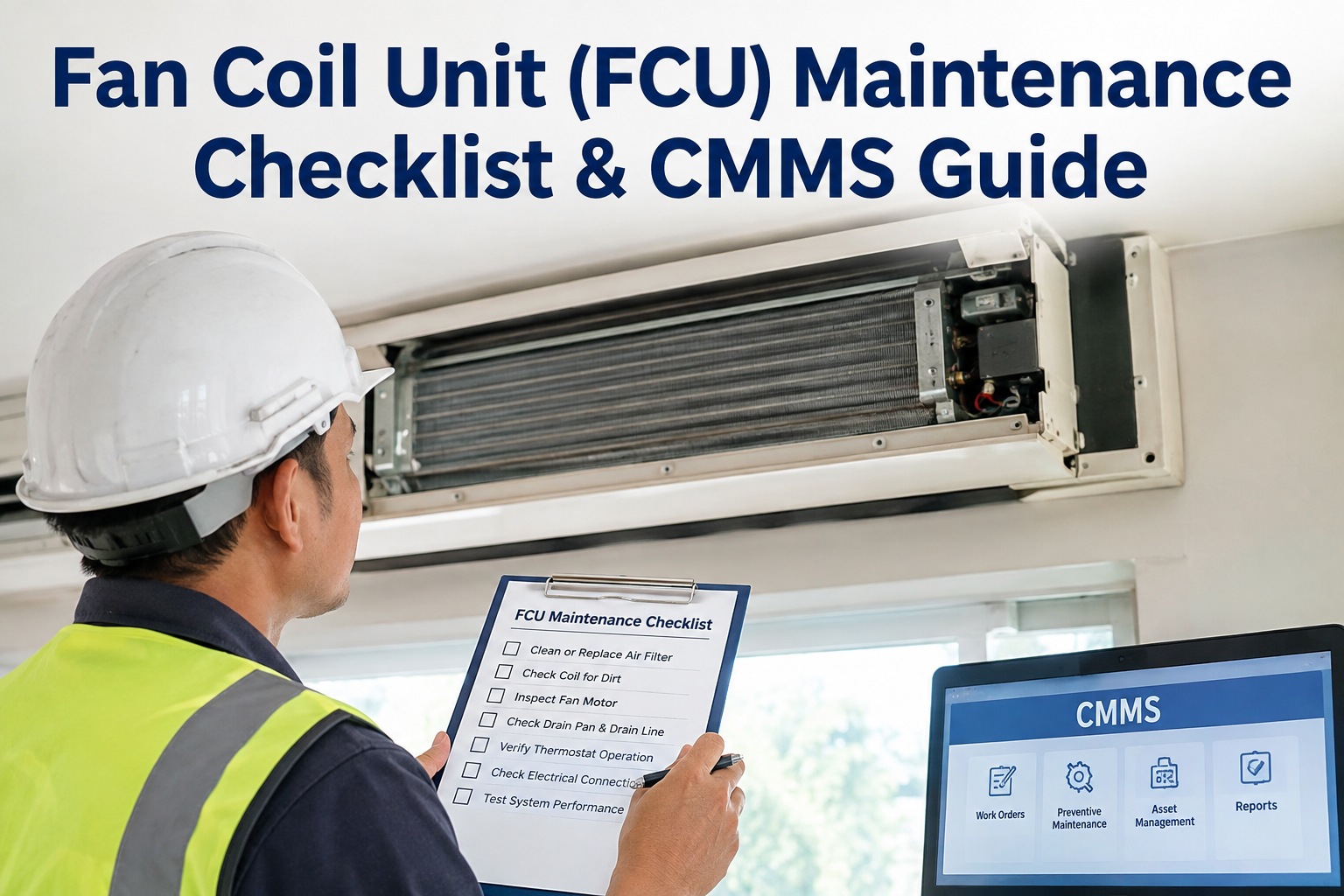
From clipboard to CMMS: how digitized checklists cut missed PMs by 73%
A 180-asset facility running AHU PM on paper checklists typically completes 68% of scheduled tasks on time. The same plant on a CMMS hits 94% — because every task auto-generates a work order, routes to the right tech, and escalates if not closed.
- Laminated checklist taped to door — often ignored
- Filter logs in a binder nobody opens
- Belt replaced at failure, not at interval
- No trend data — every problem is a surprise
- Average PM completion: 68%
- Auto-generated WO with photo capture on mobile
- Differential-pressure readings trend on dashboard
- Belt replaced at 18-month interval, pre-failure
- MTBF and cost-per-ton visible to FM in real time
- Average PM completion: 94%
Turn this checklist into auto-routed work orders in 10 minutes.
Import your AHU inventory, set the PM intervals from this guide, and watch every weekly, monthly, and quarterly task assign itself to the right technician.
AHU maintenance checklist: 5 questions facilities teams ask most
Set the CMMS trigger to differential pressure, not a fixed calendar. For 2-inch MERV-13 pleats on a typical office, that lands between 8 and 12 weeks. In a medical or industrial environment with high particulate, expect 4–6 weeks. Program the WO to auto-generate at 0.8 in. w.g. so you never overshoot into wasted fan energy.
A clean cooling-coil air-side pressure drop is usually 0.15–0.30 in. w.g. depending on fin spacing. If your reading is 1.5× the clean baseline — say 0.45 in. w.g. against a 0.30 baseline — the coil needs chemical cleaning. Log the clean baseline in your CMMS after every descale so techs have a reference point.
Yes — the reduction comes from two mechanisms. First, time-based and condition-based PMs execute at 94%+ compliance instead of 60–70% on paper, catching bearings and belts before failure. Second, every anomaly logged on a mobile device feeds a trend curve, so the maintenance manager sees degradation weeks before a breakdown. You can see this in your own data when you Start Free Trial and import 12 months of historical WOs.
Layer four tiers: weekly visual inspections (15 min), monthly mechanical checks (2 hrs), quarterly deep PM (3 hrs), and annual shutdown overhaul (8 hrs). Each tier is a separate recurring WO template in the CMMS with its own checklist, parts kit, and assigned skill level. This structure matches ASHRAE Guideline 32 and keeps labor predictable.
A single facility with 20–50 AHUs can be fully live in one afternoon. You import the asset list as a CSV, apply the PM templates from this guide, assign technicians, and the first weekly WOs generate immediately. For multi-site rollouts, book a demo and we will scope a 2-week pilot on one building before scaling.
Start your AHU maintenance program this week.
Build your preventive maintenance calendar from the checklists above, assign technicians, and let the CMMS handle the scheduling, escalation, and trending.
Free 14-day trial · No credit card