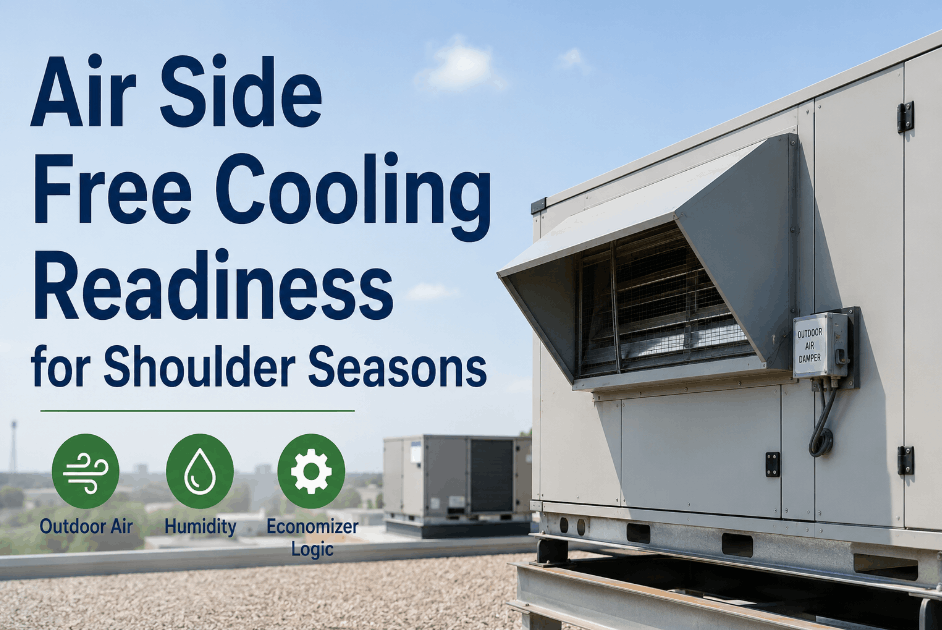
Shoulder seasons — the weeks between peak heating and peak cooling demand — offer building operations teams the best opportunity to run HVAC systems on free cooling, using outdoor air to satisfy zone loads without mechanical refrigeration. But this opportunity only delivers energy savings when the equipment, controls, and sequences supporting economizer operation are verified in advance. Facilities that Sign Up Free on Oxmaint can schedule pre-season free cooling readiness inspections, track economizer maintenance histories, and ensure damper and humidity control systems are verified before the weather window opens. For building operations teams that want to capture free cooling savings reliably rather than discovering blocked economizers after the opportunity has passed, Book a Demo to see how Oxmaint structures seasonal HVAC readiness programs.
Oxmaint helps facility teams schedule economizer inspections, damper verifications, and humidity control reviews — so air-side free cooling delivers savings from the first eligible day.
6 Air-Side Free Cooling Readiness Checks That Determine Whether Your Economizer Delivers Savings This Shoulder Season
Air-side economizer efficiency depends entirely on whether the mechanical and control components enabling free cooling are functional and correctly configured before the outdoor air window appears. Facilities that Sign Up Free on Oxmaint can assign each readiness check a pre-season PM work order — ensuring technicians verify every system component before the shoulder season begins.
Economizer dampers that are stuck, corroded, or leaking at closed position cannot deliver full modulation range — reducing the outdoor airflow available for free cooling and limiting energy savings during eligible conditions.
BAS economizer sequences must be verified against current outdoor air enthalpy and temperature thresholds — outdated or incorrectly configured lockout setpoints prevent economizer activation even when conditions are favourable.
Economizer logic depends on accurate outdoor condition sensing. Drifted temperature or humidity sensors cause incorrect lockout decisions — blocking free cooling when it should be available or enabling it when humidity conditions are unsuitable.
Increased outdoor air intake during free cooling must be balanced by relief air discharge. Stuck relief dampers cause positive building pressurisation during economizer operation — reducing effectiveness and creating door-opening resistance.
High filter pressure drop limits the outdoor airflow available for free cooling and increases fan energy consumption. Pre-season filter replacement ensures maximum air-side economizer effectiveness during shoulder season operation.
In humid climates, enthalpy-based economizer logic prevents high-moisture outdoor air from entering buildings during shoulder seasons. Confirming the correct lockout strategy is active for the local climate is essential before the window opens.
Air-Side Free Cooling Readiness: Pre-Season Maintenance Tasks, Assets, and Timing Reference
Each free cooling readiness task targets a specific component in the economizer system. Use this reference to evaluate whether your pre-season inspection program covers all the assets that determine shoulder-season performance. Teams operating without a structured readiness program are encouraged to Book a Demo to see Oxmaint's seasonal PM scheduling in action.
| System Component | Readiness Check | Failure Impact on Free Cooling | Inspection Timing | Priority |
|---|---|---|---|---|
| OA Damper Actuator | Full stroke test — open to close | Loss of modulation — fixed position operation | 4–6 weeks pre-shoulder season | Critical |
| OA Temperature Sensor | Calibration against reference thermometer | Incorrect lockout — blocked or uncontrolled economizer | Pre-season annual | Critical |
| Humidity / Enthalpy Sensor | Calibration and signal verification | Moisture infiltration — IAQ and comfort failures | Pre-season annual | Critical |
| Relief / Exhaust Damper | Operation and seal check | Building pressurisation — occupant discomfort | Semi-annual | Important |
| Air Filters | Pressure drop measurement and replacement | Reduced OA flow — lower free cooling effectiveness | Pre-season replacement | Important |
| BAS Economizer Sequence | Logic review and lockout setpoint verification | Economizer blocked or active at wrong conditions | Annual commissioning review | Important |
| Return Air Damper | Modulation and position feedback check | Mixed air temperature instability during economizer | Annual | Routine |
How Oxmaint Helps Facility Teams Build Shoulder-Season Free Cooling Readiness Into Their Annual PM Calendar
Free cooling savings require preparation — and preparation requires a maintenance system that triggers readiness inspections before the shoulder season arrives, not after the first complaint. Oxmaint gives building operations teams the PM scheduling, checklist delivery, and work order tracking infrastructure to run structured air-side free cooling readiness programs across every AHU in the asset register. Facilities can Sign Up Free and activate pre-season economizer inspection work orders with checklist-guided verification steps from their first session.
- Pre-shoulder-season PM work orders auto-triggered 4–6 weeks before target dates
- AHU assets linked to economizer inspection checklists covering all readiness items
- Technician mobile app delivers checklist with pass/fail fields and corrective action links
- Failed readiness checks automatically generate reactive work orders for immediate follow-up
- Sensor calibration records and damper test results stored in the AHU asset history
- Completion dashboard shows which units are verified and which remain outstanding
ROI of Structured Air-Side Free Cooling Readiness Programs for Commercial Buildings
Facility teams configure AHU assets and pre-season PM schedules in Oxmaint — typically completing economizer readiness program setup in one to two sessions without specialist support.
Verified economizer operation during shoulder seasons reduces compressor runtime by capturing outdoor air cooling that would otherwise require refrigeration — with savings proportional to the length of the eligible window.
Damper actuator and sensor failures identified during pre-season inspection are repaired before the economizer window opens — avoiding the lost savings and reactive repair costs of mid-season economizer failures.
Sensor calibration and enthalpy lockout verification prevent moisture infiltration during free cooling operation — avoiding the indoor air quality events that unchecked economizer control can generate during humid shoulder weather.
Documented economizer inspection records in Oxmaint satisfy ASHRAE 90.1 and local energy code requirements for economizer maintenance documentation — reducing audit preparation time for energy compliance reviews.
Portfolio-wide readiness tracking ensures all buildings capture free cooling savings during shoulder seasons — not just the sites where a proactive technician happened to remember the pre-season check.
Oxmaint gives facility teams the PM scheduling, economizer checklist tools, and portfolio readiness dashboard to capture shoulder-season free cooling savings reliably, every year.
Air-Side Free Cooling Readiness for Shoulder Seasons — Questions Facility Teams Ask
Outdoor air damper stroke verification and sensor calibration are the two highest-priority checks — a stuck damper or drifted sensor will block economizer activation regardless of how favourable outdoor conditions are.
Four to six weeks before the expected shoulder season window allows time to complete inspections, address failures, and commission any corrective repairs before free cooling operation is needed.
Shoulder-season outdoor air can carry high moisture loads. Without verified enthalpy lockout logic, economizer operation introduces humidity that raises indoor moisture levels — creating comfort complaints and potential mould risk.
Yes. Oxmaint manages AHU assets, PM schedules, and inspection checklists across all buildings in a portfolio — giving operations teams a single platform to track pre-season readiness completion by site.
A CMMS standardises inspection checklists, automates work order timing, and records results per asset — ensuring every technician performs the same readiness checks every season, regardless of personnel changes.
Oxmaint gives building teams pre-season PM scheduling, economizer inspection checklists, and portfolio readiness dashboards — so shoulder-season free cooling savings are captured every year without manual coordination.