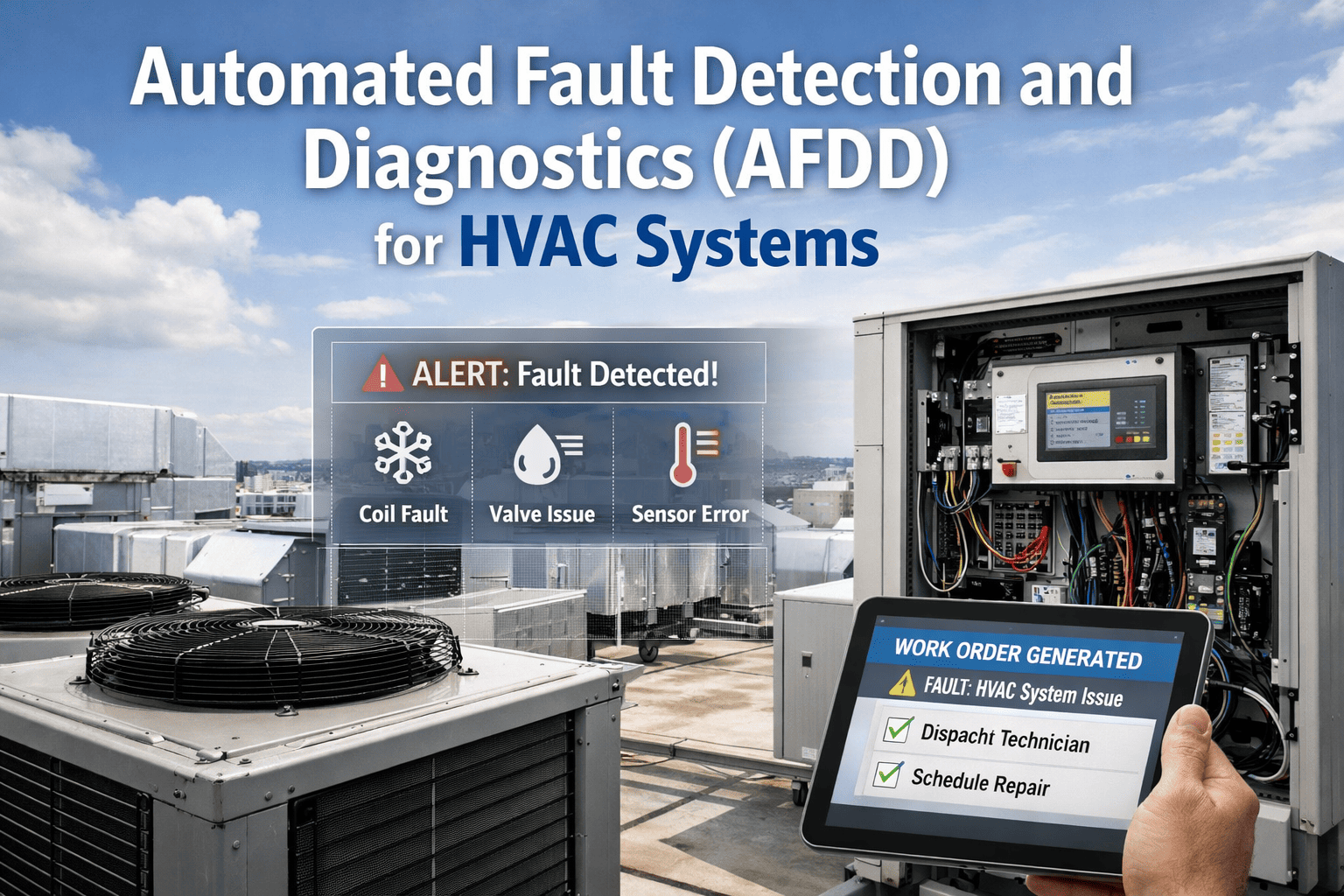
HVAC systems are the largest single energy consumer in commercial buildings — accounting for over 30% of total energy use in U.S. commercial buildings — and most of them are running with at least one undetected fault right now. Coil fouling, drifting sensors, leaking valves, and broken control sequences quietly inflate energy bills and accelerate equipment wear for weeks before any technician notices. Automated Fault Detection and Diagnostics (AFDD) changes that. Instead of waiting for a breakdown or a complaint, AFDD continuously analyses your HVAC operating data, classifies faults by severity, and generates work orders automatically — so your maintenance team acts on real data, not guesswork. Start using OxMaint's AFDD-integrated CMMS free today.
Automated Fault Detection and Diagnostics Explained
AFDD is a software layer that sits between your building automation system (BAS) or sensor network and your maintenance team. It continuously reads operational data — temperatures, pressures, flow rates, valve positions, control outputs — and applies algorithms to detect when equipment is behaving outside its expected envelope. When a fault is confirmed, the system classifies it, estimates its impact on energy and reliability, and pushes an actionable alert or work order to your CMMS.
Data Ingestion
Sensor streams, BAS points, and metering data flow continuously into the AFDD engine via OPC-UA, BACnet, Modbus, or REST API — no manual data exports.
Fault Detection
Rule-based logic and machine learning models compare live readings against expected performance baselines. Deviations that persist beyond configured thresholds are flagged as candidate faults.
Fault Diagnosis & Classification
The system distinguishes between fault types — coil fouling vs. valve leakage vs. sensor drift — and assigns a severity level, estimated energy impact, and likely root cause. False positives are suppressed before any alert is raised.
CMMS Work Order Generation
Confirmed faults automatically generate prioritised work orders in OxMaint with fault type, affected equipment, historical context, and recommended corrective action — reducing response time from hours to minutes.
Common HVAC Faults AFDD Detects Automatically
Most HVAC failures are preceded by weeks of degraded operation that manual inspections miss. The table below covers the fault types that AFDD systems detect earliest — and the cost of leaving each one unaddressed.
| Fault Type | Equipment | AFDD Detection Signal | Energy Impact | If Undetected |
|---|---|---|---|---|
| Coil Fouling | AHU, FCU, Chiller | Rising supply-return delta-T at same load; increased fan amp draw | 15–25% efficiency loss | Compressor overload, premature failure |
| Valve Leakage / Stuck Valve | Cooling & Heating Coils | Discharge temp not tracking setpoint; valve position vs. thermal response mismatch | 10–20% heating/cooling energy waste | Zone comfort failures, actuator burnout |
| Sensor Drift | All HVAC equipment | Cross-sensor consistency checks; readings diverging from physical plausibility ranges | Drives incorrect control decisions | Cascading control faults, occupant complaints |
| Refrigerant Charge Fault | Chillers, DX Units, RTUs | Suction pressure deviation; superheat and subcooling out of range at given conditions | Up to 30% COP degradation | Compressor burnout, refrigerant leak compliance risk |
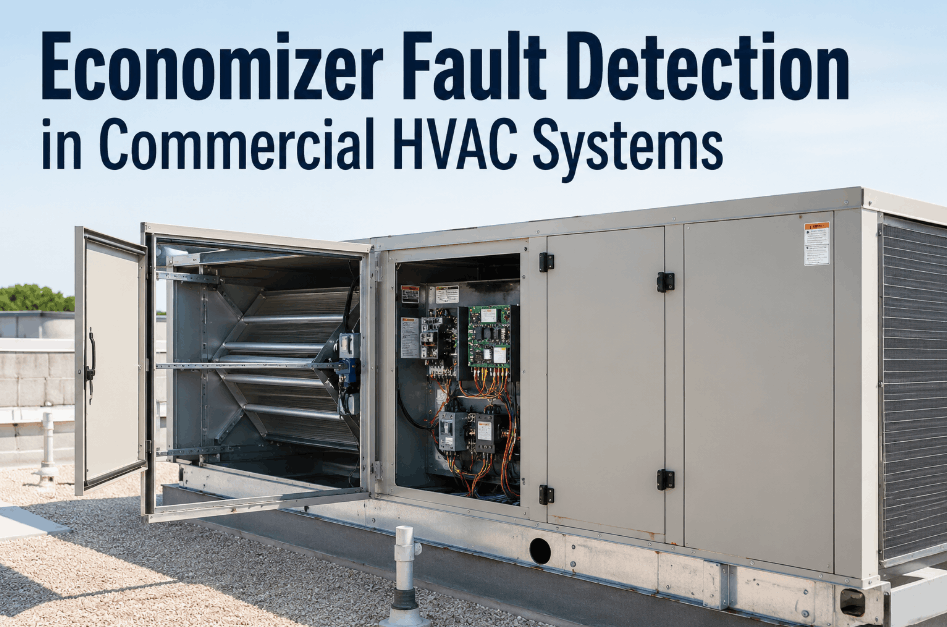
| Economiser Lockout Failure | RTUs, AHUs | Outdoor air damper position vs. enthalpy conditions — damper open when it should be closed | 8–15% cooling energy waste | Unchecked energy waste through full operating season |
| Control Sequence Error | BAS / DDC Controllers | Simultaneous heating and cooling detection; setpoint vs. output logic inconsistency | Simultaneous H+C waste is common | Years of undetected waste — often never found manually |
| Filter Fouling | AHU, FCU | Increasing static pressure across filter section at constant airflow | 5–12% fan energy increase | Coil contamination downstream, IAQ degradation |
Why Manual Inspections Cannot Replace AFDD
The Real Cost of Undetected HVAC Faults
Every fault left running adds cost every hour. The chart below shows the estimated annual energy waste for a 50,000 sq ft commercial building running four common HVAC faults simultaneously — a scenario that is more common than most facility managers realise.
How OxMaint Bridges AFDD and Maintenance Execution
Fault detection without a maintenance workflow is just an alarm system. OxMaint closes the loop — turning AFDD signals into work orders, parts requests, and resolution records that give facility managers a full audit trail from fault onset to repair verified.
Auto Work Order Creation
When AFDD flags a confirmed fault, OxMaint instantly creates a prioritised work order with fault type, affected asset, energy impact estimate, and recommended action — no manual logging required.
Fault Severity Prioritisation
Work orders are ranked by energy impact and equipment risk — so your team fixes the $22,000/year simultaneous heating-cooling fault before the $2,000 filter replacement. Every shift, high-impact items surface first.
Asset Fault History
Every fault detected and resolved is logged against the specific asset. Recurring faults trigger escalation alerts — identifying equipment that needs capital replacement rather than repeated repairs.
BAS & Sensor Integration
OxMaint connects via BACnet, Modbus, OPC-UA, and REST API. Your existing BAS data flows in without hardware replacement — setup to first fault detected in under 48 hours for most buildings.
What Building Operators and Engineers Say
How to Deploy AFDD in 4 Steps
Asset & Point Mapping
Identify all monitored HVAC assets and map BAS data points to fault detection rules. Define equipment baselines from 2–4 weeks of clean operating data.
Connect Data Sources
Integrate BAS, BMS, and standalone sensor networks into OxMaint via standard protocols. Cloud-based ingestion means no on-site server installation.
Configure Fault Rules & Thresholds
Set alert thresholds by fault type, severity, and energy impact floor — filtering low-priority nuisance alerts so your team only sees actionable faults.
Go Live & Measure Savings
AFDD begins monitoring immediately. OxMaint tracks energy savings per resolved fault, giving you a documented ROI report at 30, 60, and 90 days.
Frequently Asked Questions
Your HVAC Faults Are Running Right Now. AFDD Finds Them.
OxMaint connects to your BAS, detects faults automatically, and generates prioritised work orders — so your team fixes the right thing first, every shift.