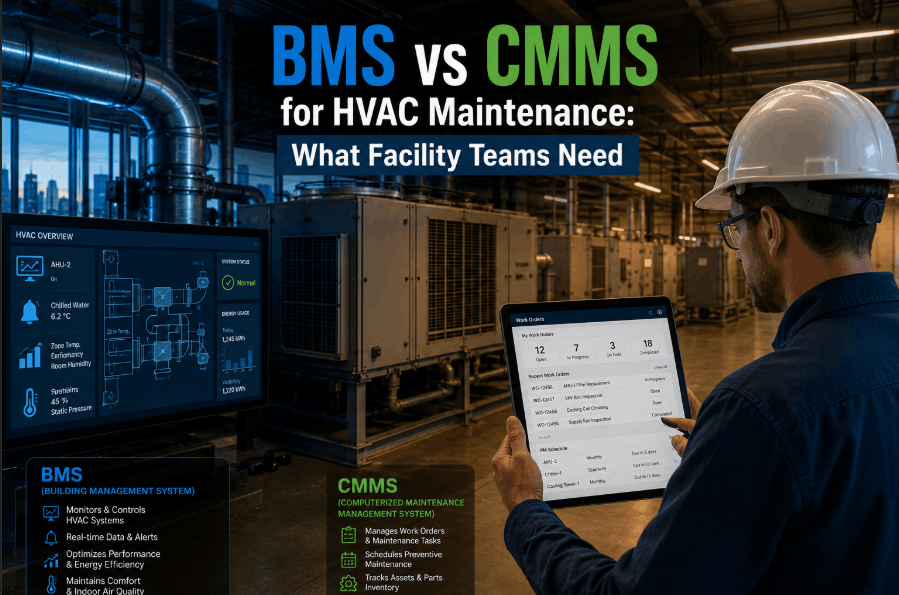
BMS vs CMMS for HVAC maintenance is a question facility teams encounter the moment their building automation system starts generating fault alerts faster than technicians can respond to them. A Building Management System detects — it monitors HVAC equipment, identifies fault conditions, and issues alerts. A CMMS like OxMaint acts — it converts those alerts into structured work orders, assigns them to qualified technicians, tracks completion, and builds the maintenance history that drives smarter decisions over time. Sign Up Free to see how OxMaint's CMMS platform closes the accountability gap that BMS systems leave open — giving facility maintenance teams the work order management, technician scheduling, and HVAC maintenance history tools that BMS platforms are not designed to provide. Book a Demo to explore how OxMaint bridges BMS fault detection and CMMS maintenance execution for facility teams managing complex HVAC portfolios across single or multiple sites.
Your BMS Detects HVAC Faults. OxMaint Ensures They Get Fixed — With Full Accountability.
OxMaint gives facility maintenance teams the work order management, technician scheduling, and HVAC maintenance history tools that BMS platforms were never designed to provide.
What BMS and CMMS Each Actually Do for HVAC Maintenance
Most facility teams that struggle with HVAC maintenance accountability are not missing detection capability — their BMS is already generating fault data. What they are missing is the action and accountability layer that a CMMS provides. Sign Up Free to add OxMaint's work order and maintenance management layer on top of your existing BMS infrastructure — without replacing the building automation investment already in place.
BMS vs CMMS: What Each Platform Covers for HVAC Maintenance Teams
| Maintenance Function | BMS Capability | CMMS (OxMaint) Capability |
|---|---|---|
| HVAC Fault Detection | Real-time sensor monitoring and fault alert generation | Receives fault signals to trigger work order creation |
| Work Order Creation | Not supported — alerts go to email or dashboard only | Automated work order generation from fault triggers or manual creation |
| Technician Assignment | Not supported | Full technician scheduling with capacity visibility and skill matching |
| PM Scheduling | Not supported | Auto-scheduled PM work orders on calendar or run-hour triggers |
| Maintenance History | Fault log only — no repair record or technician notes | Complete work order history with condition notes, parts used, and labor time |
| Parts and Inventory Linking | Not supported | Parts requirements linked to work orders before assignment |
| Compliance Documentation | Not supported | Work order sign-off records for regulatory audit trails |
| Multi-Site Visibility | Site-specific only in most deployments | Portfolio-wide work order and asset management from single dashboard |
Why BMS Alone Is Not Enough for HVAC Maintenance Accountability
Alerts Without Assignment Are Not Action
BMS fault alerts that land in an email inbox or on a dashboard without automatic work order creation and technician assignment are frequently missed, delayed, or lost. CMMS work order automation closes this response gap by converting every fault signal into an assigned, tracked maintenance task.
No Preventive Maintenance Scheduling
BMS systems do not generate preventive maintenance schedules. Calendar-based HVAC PM tasks — filter replacements, coil cleaning, belt tension checks, refrigerant inspections — require a CMMS to create, assign, track, and record completion with technician accountability.
Fault Log Is Not a Maintenance History
BMS fault logs record when alerts occurred — not what was done in response, who did it, what parts were used, or what condition the asset was left in. CMMS work order records capture the full repair history that enables mean time between failure analysis and informed asset replacement decisions.
No Technician Capacity or Workload Visibility
BMS systems have no visibility into technician schedules, available capacity, or open work order backlog. Maintenance managers using only BMS data cannot make informed staffing decisions — leading to overtime, delayed responses, and unresolved fault conditions that extend equipment degradation cycles.
No Compliance Documentation Support
Regulatory compliance for HVAC maintenance — refrigerant handling records, ventilation inspection logs, filter replacement documentation — requires signed work order records that BMS systems cannot produce. OxMaint generates the digital compliance documentation that audit trails require.
No Cross-Team or Contractor Coordination
HVAC maintenance frequently involves both internal technicians and external service contractors. BMS systems have no mechanism to assign work to contractors, share work order context, or track completion across different service providers — all of which OxMaint manages within a single platform.
How OxMaint Works Alongside Your BMS for Complete HVAC Maintenance Coverage
Connect BMS Fault Alerts to OxMaint Work Order Triggers
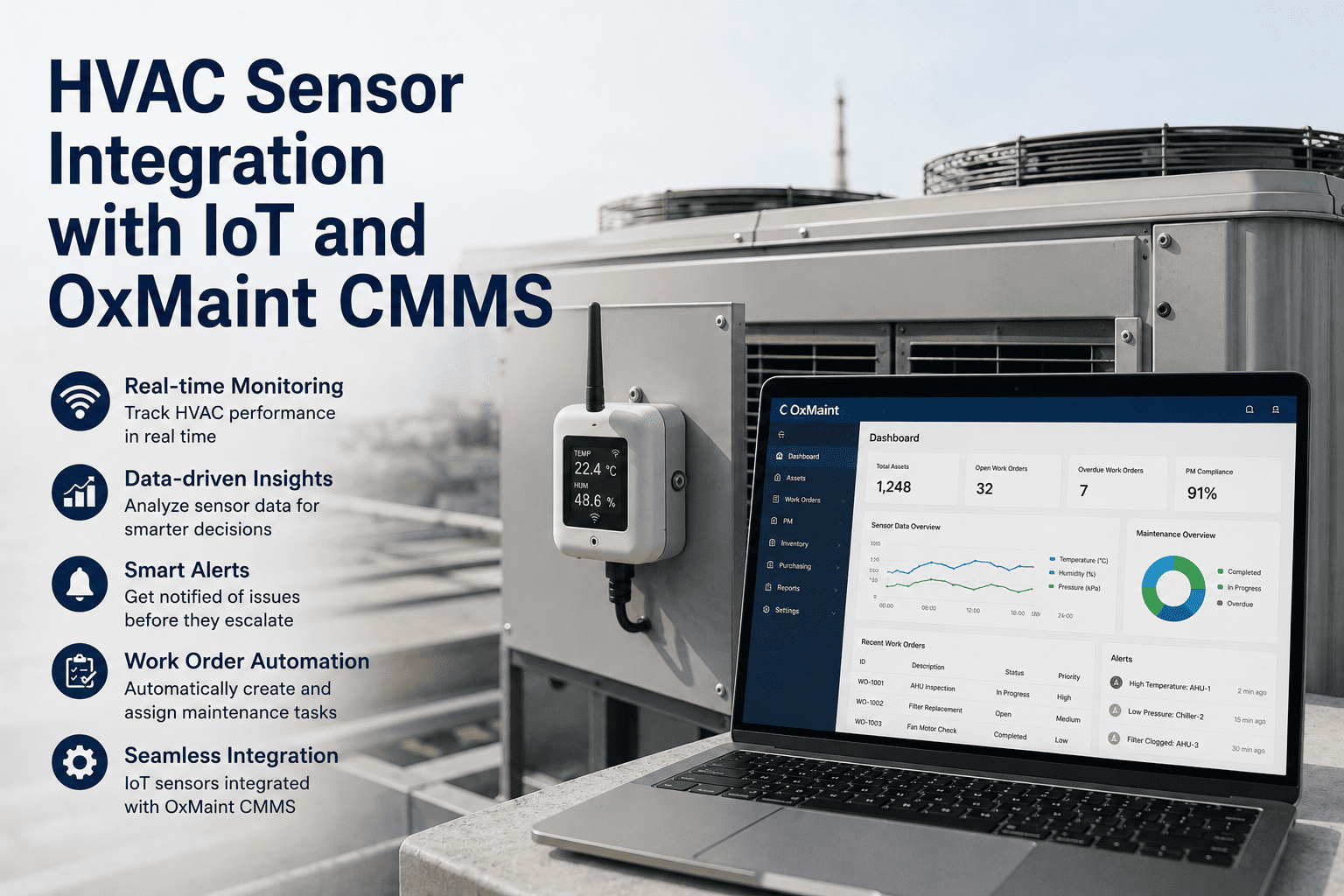
OxMaint can receive BMS fault signals through API integration or manual fault logging — automatically generating structured HVAC work orders with asset context, fault description, and priority classification already populated. Technicians receive actionable tasks, not raw alarm notifications.
Layer Preventive Maintenance Schedules Over BMS-Driven Reactive Work
OxMaint auto-schedules HVAC PM work orders on calendar or run-hour triggers — independently of BMS fault detection. This ensures filter replacements, coil cleaning, lubrication, and seasonal readiness tasks are executed on schedule regardless of whether the BMS has generated a fault condition.
Build Complete HVAC Asset Maintenance History in OxMaint
Every HVAC work order closed in OxMaint — whether triggered by BMS fault or PM schedule — adds to the asset's permanent maintenance record. Over time, this history enables MTBF analysis, warranty tracking, and data-driven decisions about which assets should move from preventive to predictive maintenance programs.
Manage Technician Workload Across BMS-Generated and Scheduled HVAC Tasks
OxMaint's scheduling dashboard gives maintenance supervisors visibility into both BMS-triggered reactive work orders and planned PM tasks in a single queue — enabling capacity-matched technician assignment that prevents reactive BMS faults from displacing critical scheduled PM work. Book a Demo to see OxMaint's BMS-to-CMMS workflow configured for your facility's HVAC maintenance operations.
What Facility Teams Gain When BMS Feeds Into OxMaint CMMS
Your BMS Already Sees the Problem. OxMaint Makes Sure It Gets Solved.
OxMaint gives facility maintenance teams the work order management, PM scheduling, and HVAC asset history tools that close the accountability gap BMS systems leave open — without replacing the building automation investment already in place.
BMS vs CMMS for HVAC Maintenance — Common Questions
Ready to Close the Gap Between What Your BMS Detects and What Your Team Actually Fixes?
OxMaint gives your facility maintenance team the digital work order management, PM scheduling, and HVAC asset history tools to make BMS fault detection actionable — with full technician accountability and compliance documentation built in.