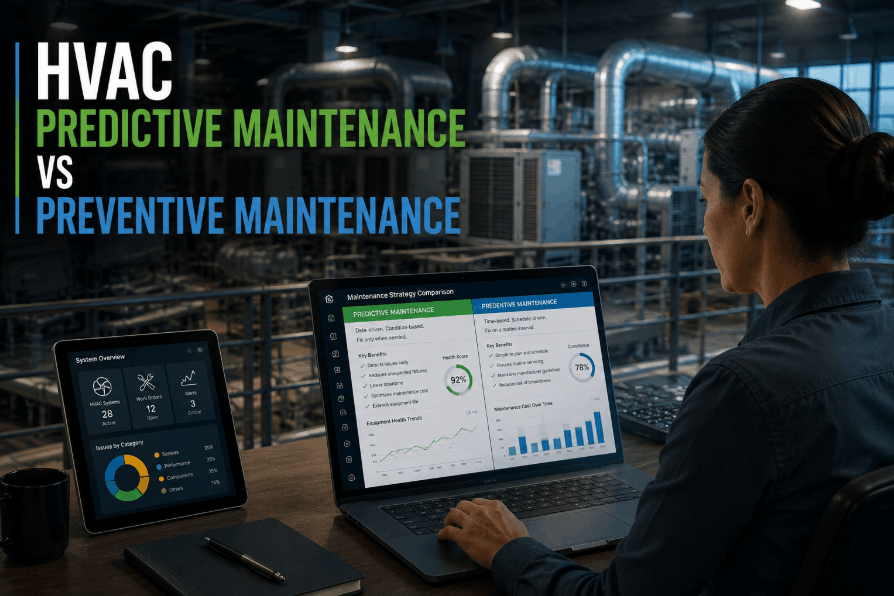
HVAC predictive maintenance vs preventive maintenance is one of the most consequential strategy decisions facility and maintenance managers make — shaping labor costs, equipment lifespan, unplanned downtime risk, and energy efficiency across chillers, AHUs, pumps, compressors, and smart building systems for years. Most facilities default to calendar-based preventive maintenance because it is familiar and schedulable — but predictive maintenance, enabled by sensor data and AI-driven analytics, is changing the cost equation for HVAC-intensive facilities at scale. Sign Up Free to see how OxMaint's CMMS platform supports both preventive and predictive HVAC maintenance strategies — with work order automation, PM scheduling, and analytics tools that let facility teams operate whichever approach fits their asset base and budget. Book a Demo to explore how OxMaint's maintenance management capabilities help facility teams reduce HVAC downtime and labor costs regardless of which maintenance strategy they are currently running.
Run HVAC Preventive or Predictive Maintenance — OxMaint Supports Both
OxMaint gives facility maintenance teams the PM scheduling, work order automation, and HVAC analytics to execute either strategy with discipline — and track results at the asset level.
Defining the Two HVAC Maintenance Strategies
Before comparing outcomes, facility teams need a clear operational definition of each approach — because the difference is not just about data or technology, it is about when the maintenance decision is triggered. Sign Up Free to configure your HVAC asset maintenance strategies inside OxMaint with the right PM schedules, condition thresholds, and work order rules for each approach.
HVAC Predictive vs Preventive: How They Compare Across Key Dimensions
| Comparison Dimension | Preventive Maintenance | Predictive Maintenance |
|---|---|---|
| Trigger Mechanism | Fixed calendar or run-hour interval | Condition threshold or anomaly detection |
| Applicability — Chillers | Annual tube cleaning, refrigerant checks on schedule | Vibration and performance curve monitoring for early fault detection |
| Applicability — AHUs | Monthly filter replacement, belt tension on interval | Airflow differential and coil fouling sensors trigger cleaning work orders |
| Applicability — Pumps | Lubrication and seal inspection on fixed schedule | Vibration signature analysis detects bearing wear before failure |
| Applicability — Compressors | Oil analysis and filter replacement by hours | Thermal imaging and pressure trend analysis detect early degradation |
| Labor Cost Profile | Predictable but may include unnecessary tasks | Lower over time as unnecessary PMs are eliminated |
| Infrastructure Required | CMMS with PM scheduling — low infrastructure threshold | Sensors, IoT connectivity, and analytics platform required |
| Emergency Repair Rate | Moderate — some failures occur between PM intervals | Low — condition monitoring catches developing faults early |
| Best Fit | Facilities with limited sensor infrastructure or lower-criticality HVAC | High-criticality HVAC assets where downtime cost justifies sensor investment |
Which HVAC Assets Belong in Predictive vs Preventive Programs
Chillers — Predictive Priority
Chillers represent the highest replacement cost and operational criticality in most HVAC portfolios. Vibration analysis, refrigerant performance curves, and energy consumption trending are reliable predictive inputs that justify sensor investment for this asset class.
Air Handling Units — Hybrid Approach
AHUs benefit from calendar-based filter and belt PM combined with airflow differential monitoring for coil fouling detection. The hybrid model captures the reliability of PM scheduling while reducing unnecessary coil cleaning interventions through condition data.
Pumps — Predictive for Critical Loops
Chilled water and condenser water pumps in critical loops benefit from vibration-based bearing wear detection. Preventive lubrication intervals remain appropriate for low-criticality circulation pumps where downtime cost does not justify continuous monitoring.
Cooling Towers — Preventive with Water Quality Monitoring
Cooling towers are well-served by calendar-based PM for mechanical components combined with automated water quality monitoring. This hybrid approach addresses both the mechanical reliability needs and the Legionella risk management obligations simultaneously.
Split and Packaged Units — Preventive Standard
Low-cost, high-population HVAC assets like split systems and packaged rooftop units are typically best managed on fixed PM schedules. The replacement cost and criticality rarely justify continuous sensor investment for individual unit monitoring.
Smart Building HVAC Systems — Predictive Native
BMS-connected HVAC in smart buildings already generates condition data streams. Integrating BMS fault alerts with OxMaint work order automation converts raw sensor signals into actionable predictive maintenance tasks without additional sensor infrastructure.
How OxMaint Supports Both HVAC Maintenance Strategies
Auto-Scheduled Preventive Maintenance Work Orders
OxMaint auto-generates HVAC PM work orders on calendar or run-hour triggers — ensuring filter replacements, lubrication tasks, and seasonal readiness checks are never missed. PM completion rates are tracked digitally with technician sign-off and condition notes captured at each interval.
Condition-Triggered Work Order Automation
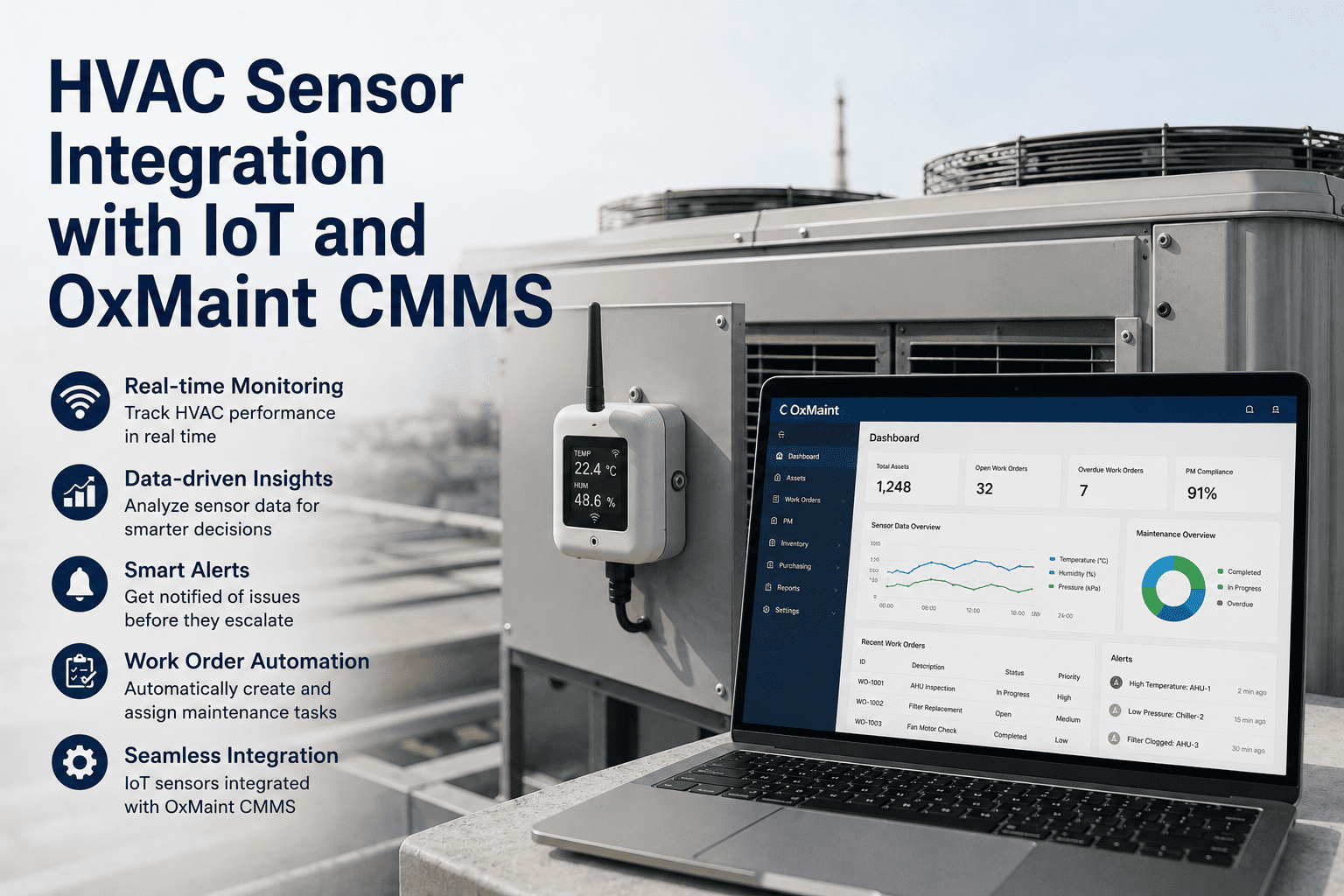
When BMS fault alerts or sensor threshold breaches occur, OxMaint can receive those signals and automatically generate prioritized HVAC work orders — converting condition data into maintenance action without manual dispatcher intervention. Technicians receive work orders with asset context and fault description already populated.
HVAC Asset Performance and Maintenance History Tracking
OxMaint maintains complete work order history for every HVAC asset — enabling maintenance managers to identify repeat failures, calculate mean time between failures, and make data-driven decisions about whether specific assets should move from preventive to predictive programs. Book a Demo to see OxMaint's HVAC asset analytics configured for PM versus PdM strategy evaluation.
Mixed-Strategy Management Across HVAC Asset Classes
OxMaint allows facility teams to configure different maintenance strategies asset by asset within a single platform — chillers on condition-triggered work orders, split systems on fixed PM calendars, and cooling towers on hybrid schedules — without managing separate systems for each strategy type.
What Each HVAC Maintenance Approach Delivers
Whether You Run Preventive or Predictive HVAC Maintenance — OxMaint Runs It Better
OxMaint gives facility maintenance teams the digital PM scheduling, condition-triggered work order automation, and HVAC asset analytics to execute either strategy with full visibility and accountability.
HVAC Predictive Maintenance vs Preventive Maintenance — Common Questions
Ready to Build a Smarter HVAC Maintenance Strategy with OxMaint?
OxMaint gives your facility and maintenance teams the digital PM scheduling, predictive work order automation, and HVAC asset analytics to run the right maintenance strategy for every asset — and prove the results.