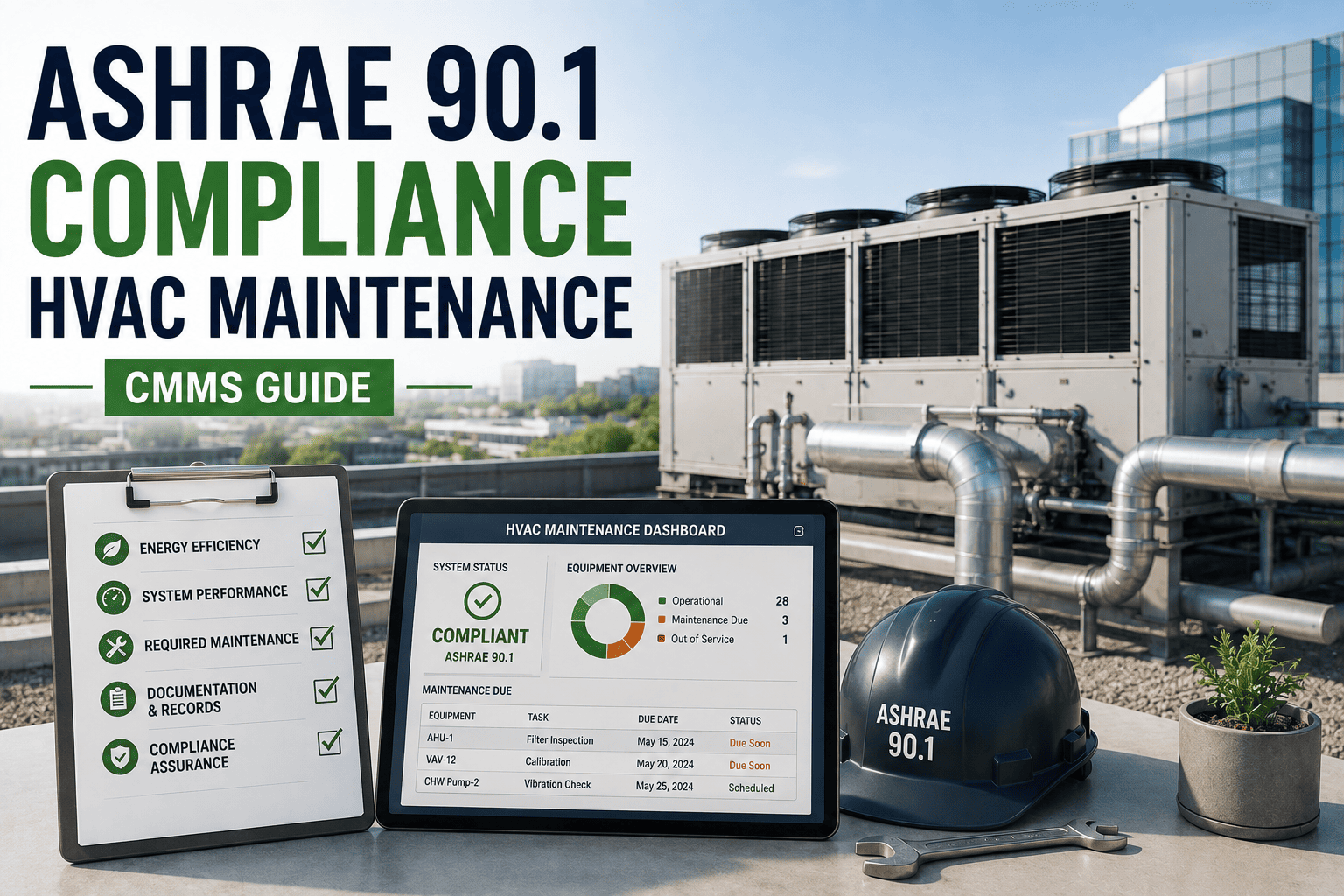
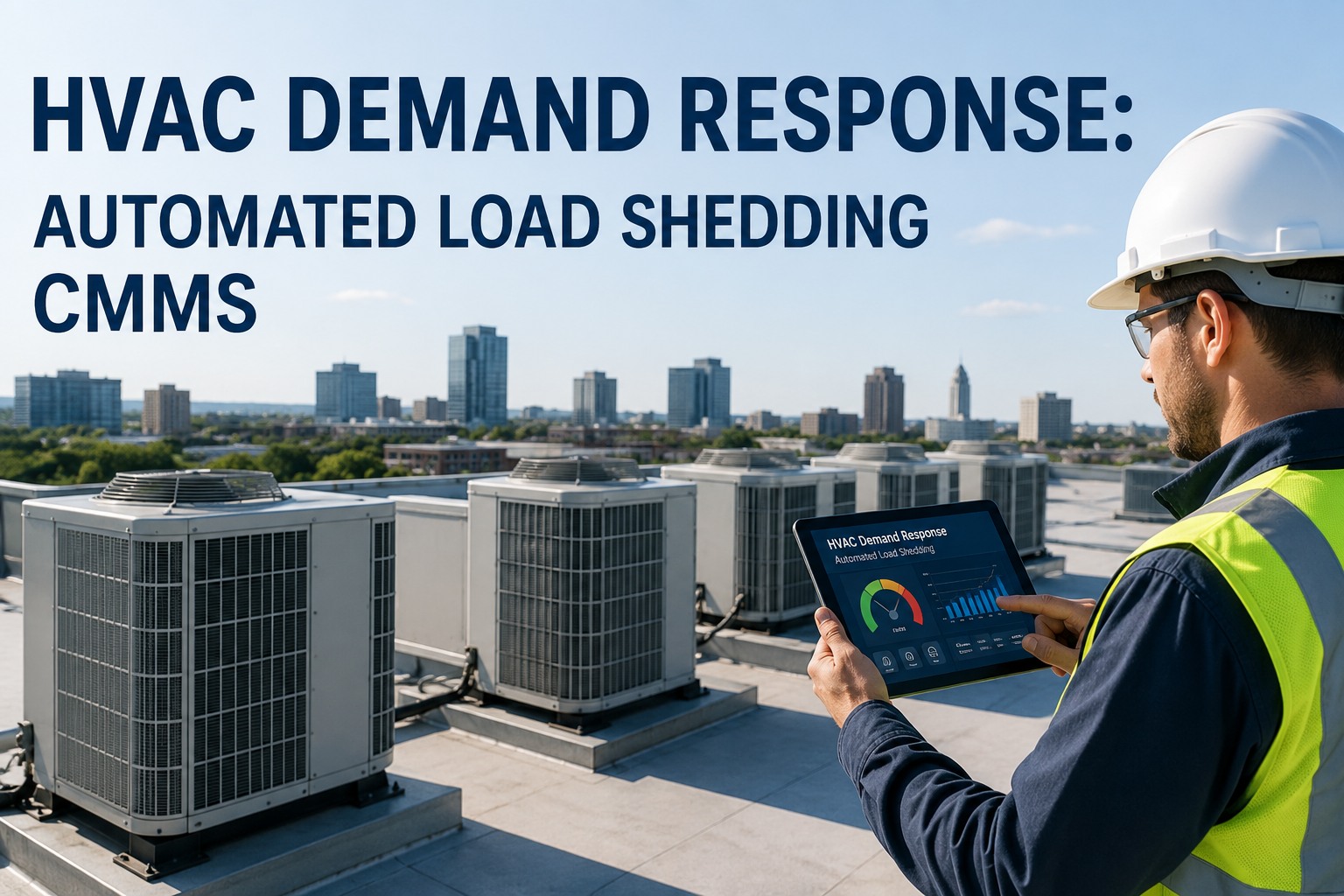
Building energy code compliance for HVAC systems now hinges on three connected mandates: fault detection and diagnostics (FDD), optimal start/stop programming, and demand response capability — all backed by auditable documentation. The 2026 code cycle tightens these requirements significantly, pushing maintenance and reliability teams to move from manual logs and spreadsheets to a CMMS that can automatically capture, timestamp, and report compliance evidence. If your team is still tracking HVAC energy compliance in binders or disconnected spreadsheets, Start Free Trial of OxMaint to see how an AI-powered CMMS turns every work order into a defensible audit record.
HVAC Energy Code Compliance Guide
Is your HVAC system ready for 2026 energy code enforcement?
New FDD, optimal start, and demand response mandates aren't optional checkboxes — they're continuous, documentation-heavy obligations. A CMMS purpose-built for building energy code compliance turns every sensor reading, work order, and repair into audit-ready evidence.
The Compliance Landscape
What the 2026 HVAC building energy code requires
The latest energy code cycle (ASHRAE 90.1-2022 / IECC 2024 provisions, adopted broadly by 2026) shifts HVAC compliance from prescriptive design rules to operational, data-driven performance. For maintenance teams, that means compliance is no longer a one-time commissioning event — it is a continuous obligation measured by your FDD system, optimal start programming, and demand response readiness.
FDD Implementation
Air-handling units (AHUs) ≥ 4,500 CFM and VAV systems ≥ 75,000 BTU/h must run automated fault detection and diagnostics. The code requires specific faults — sensor failure, simultaneous heating/cooling, OA damper stuck — to be flagged and logged within minutes, not days.
Optimal Start Program
HVAC systems must use an optimal start algorithm that calculates the latest possible start-up time based on outdoor air temperature, indoor setpoint, and building thermal mass — reducing runtime by 8–15% without sacrificing occupant comfort.
Demand Response Readiness
Buildings >150,000 sq ft must demonstrate automated demand response capability — shedding at least 10% of peak HVAC load on utility signal — and maintain logs proving the system responds within 15 minutes of a DR event trigger.
FDD Requirements Decoded
How FDD energy code compliance actually works in practice
Fault detection and diagnostics is the most enforcement-heavy piece of the new HVAC energy code. An FDD system continuously monitors HVAC sensor data and control sequences, automatically flagging deviations that indicate energy waste or equipment failure. But detecting faults is only half the mandate — the code also requires you to document the resolution.
Automated fault detection on critical HVAC sequences
Your building automation system (BAS) or FDD software monitors AHU leaving-air temperature, OA damper position, valve status, and supply fan speed against expected profiles. When a deviation exceeds the defined tolerance band for a sustained period, a fault is declared — typically for air temperature sensor failure, coil valve leaking, or economizer high-limit error.
Fault alerts routed to maintenance within minutes
The code doesn't specify an exact notification window, but auditors expect evidence that faults are communicated to the maintenance team promptly — same shift at minimum. This is where most teams fail: the BAS flags a fault, but nobody sees it until the next quarterly review. OxMaint closes that gap by auto-generating a work order the moment a fault is declared.
Repair, verify, and close — with a complete audit trail
Once the fault is resolved, the technician must verify the fix (confirm the sequence is back within tolerance), close the work order, and retain the record. An inspector will ask: "When was this fault detected? Who responded? When was it verified fixed?" If your answer is "it's in the BAS logs somewhere," you're already non-compliant.
A 320,000 sq ft corporate campus running 24 AHUs without an integrated FDD-to-CMMS workflow spent $3,200 per AHU annually on unnecessary energy waste from undetected simultaneous heating and cooling. After integrating FDD alerts directly into OxMaint work orders, the team cut average fault-resolution time from 11 days to under 36 hours — recovering roughly $61K/year in avoided energy cost, with zero manual log-keeping.
ROI & Savings Breakdown
The cost of non-compliance — and the payback of fixing it
Energy code violations aren't just a regulatory risk. They are a direct, measurable drain on operating budgets. The formula below estimates the annual energy penalty from unresolved HVAC faults — the same waste that FDD compliance is designed to eliminate.
| Compliance Gap | Annual Cost / Risk | Fix with CMMS-Integrated FDD |
|---|---|---|
| Undetected simultaneous heating & cooling | $8K–$15K per AHU | Auto work order on fault flag; resolve in <36 hrs |
| No optimal start programming | 8–15% excess HVAC runtime | Schedule + verify optimal start sequence per season |
| Failed demand response event | $5K–$25K utility penalty per event | DR readiness checklist + automated test logs |
| Missing FDD documentation at audit | Fines + mandatory retro-commissioning | Every work order auto-stamped with timestamp + technician |
| Stuck OA damper / economizer fault | 20–30% excess cooling energy | FDD alert → work order → verified repair in one trail |
How OxMaint Helps
CMMS energy code compliance — built into every work order
OxMaint turns the documentation burden of HVAC energy code compliance into an automatic byproduct of your existing maintenance workflow. Every fault alert, preventive task, and repair is captured, timestamped, and reportable — so an audit takes minutes instead of weeks.
FDD-to-Work-Order Automation
When your BAS or FDD system flags a fault, OxMaint automatically generates a prioritized work order — assigned to the right technician with the fault code, sensor data, and recommended corrective action attached. Cuts average fault-resolution time by 60–80%.
Optimal Start & PM Scheduling
Schedule seasonal preventive maintenance tasks that verify optimal start programming, calibrate sensors, and confirm economizer sequences. Never miss a pre-season readiness check — OxMaint auto-triggers tasks based on runtime, calendar, or degree-day data.
Demand Response Readiness Logs
Generate and store automated DR test records — load shed percentage, response time, recovery sequence — so you can prove compliance readiness to any utility or inspector without digging through BAS trend logs.
One-Click Audit Documentation
Export a complete energy code documentation packet — every FDD event, resolution timestamp, technician signature, PM completion record, and DR test log — in a single filtered report. Turn a 3-day audit prep scramble into a 10-minute export.
See OxMaint on your assets — book a 30-min demo
Walk through a live FDD-to-work-order workflow, an energy code audit report export, and a demand response readiness dashboard — configured for your building's HVAC systems.
Frequently Asked Questions
Building energy code HVAC compliance: what teams ask most
What HVAC systems require FDD under the 2026 energy code?
FDD is required for air-handling units with supply airflow ≥ 4,500 CFM and VAV systems with cooling capacity ≥ 75,000 BTU/h. The system must monitor specific fault conditions — including sensor failure, simultaneous heating and cooling, OA damper or economizer malfunction, and coil valve leakage — and alert the maintenance team within the same operational shift.
How does a CMMS help with energy code compliance documentation?
A CMMS like OxMaint automatically timestamps every fault detection event, routes it as a work order, captures the technician's corrective action, and stores the verified-resolution record — creating a complete, defensible audit trail. Instead of assembling documentation manually before an inspection, you export a filtered compliance report in minutes. Book a Demo to see the audit-export workflow live.
What is an optimal start program and why does the energy code require it?
An optimal start program uses outdoor air temperature, indoor setpoint, and building thermal mass to calculate the latest possible HVAC start-up time — minimizing runtime before occupancy. The energy code requires it because it reduces HVAC energy consumption by 8–15% compared to a fixed schedule, with no impact on occupant comfort.
How often must demand response capability be tested for compliance?
Most adopted code cycles require demand response readiness to be tested at least annually, with some jurisdictions requiring semi-annual testing. You must document the test date, load-shed percentage achieved (minimum 10% of peak HVAC load), response time (under 15 minutes), and system recovery — all of which OxMaint captures as a structured PM task with a permanent record.
Can OxMaint integrate with our existing BAS or FDD software?
Yes. OxMaint integrates with major building automation and FDD platforms via API, so fault alerts flow directly into work orders without manual data entry. This closes the most common compliance gap — faults detected by the BAS but never acted upon — and ensures every event is documented from detection through verified resolution. Start Free Trial to connect your first system.
Make energy code compliance a byproduct of great maintenance
Stop scrambling before audits. OxMaint turns FDD alerts, optimal start checks, and demand response tests into automatically documented work orders — so compliance is built into your daily workflow, not bolted on at inspection time.
Free 14-day trial · No credit card